TSMC Revenue, CoWoS and What's Next for Taiwan's AI Chips
August 2026 in one line: TSMC sold NT$514.8bn, Taiwan shipped a record US$82.4bn, and packaging is still the step that sets the pace. Our Q3 math and the dates that matter.
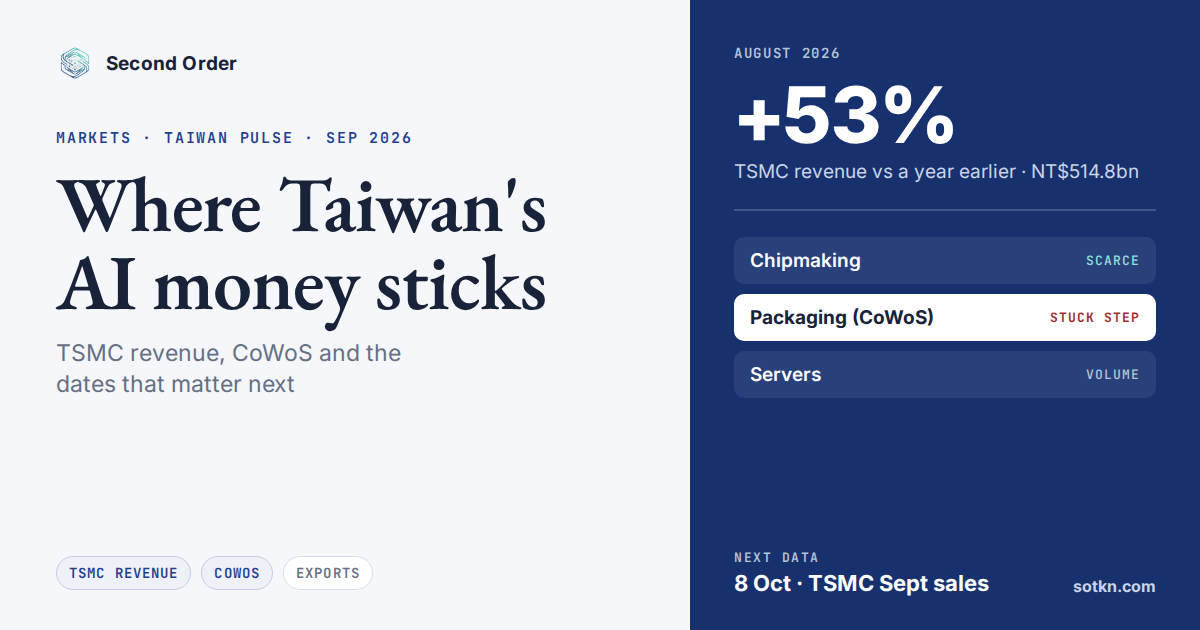
TSMC's August sales rose 53% and Taiwan's exports set a record. Here is who gets paid, which step is still stuck, and the dates to watch before year-end.
TAIWAN PULSE · Data as at 16 Sep 2026 · Next update: after TSMC Q3 results
Affects: Semiconductors · Hyperscalers · Neoclouds — Markets: Taiwan · US · Korea
Education only, not advice to buy or sell any security. Figures are from company and government releases dated as shown.
The numbers that matter this month
TSMC monthly revenue (Aug 2026)
NT$514.8bn
+53.3% YoY · +10.1% MoM
RecordTSMC revenue, Jan–Aug 2026
NT$3,386.9bn
+39.3% YoY
Ahead of planTSMC gross margin (Q2 2026)
67.7%
Guided 65–67% for Q3
HoldingTaiwan exports (Aug 2026)
US$82.4bn
+41.0% YoY
RecordCoWoS demand vs supply (2026)
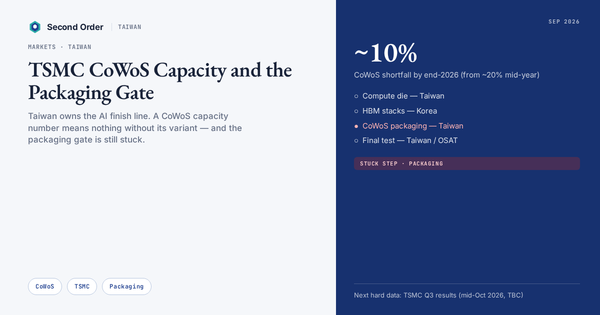
~20% short → ~10% short
Narrowing
Still stuckUS chip tariff framework
Being written
Announced 2 Sep 2026
OpenStatus chips are Second Order's read. Full sources are at the end of this article.
Why does Taiwan matter so much for AI chips?
Because two of the steps that decide how many AI chips reach a data centre happen mostly in Taiwan.
Every AI build starts with the same shopping list: accelerators (GPUs or custom AI chips), memory, and servers to hold them. The big buyers are the hyperscalers (Microsoft, Google, Amazon, Meta) and the neoclouds, newer GPU clouds such as CoreWeave. A large share of what they spend ends up in Taiwan.
Chipmaking (wafers)
Who: TSMC
Paid: Price per wafer; newest processes cost most
Packaging (CoWoS)
Who: TSMC; ASE (incl. SPIL) as overflow
Paid: Price per package slot; booked years ahead
Servers and racks
Who: Foxconn (Hon Hai), Quanta, Wistron
Paid: Volume; thin margins
What the labels mean: Newest lines are booked = factories making the latest chips are already full. Still the bottleneck = this step limits how many AI chips can ship. Hard to get enough = supply is scarce relative to demand. Shipping at record volume = exports are at an all-time high. Labels are Second Order's read from the sources at the end.
If you only remember one thing: chipmaking and packaging are scarce; server building is big. Scarce steps keep more of each dollar. Big steps need volume to make money.
New to packaging? Start with CoWoS, explained. For why it is the finish line for AI chips, read TSMC, CoWoS capacity and the packaging gate.
What did TSMC revenue do in August 2026?
It set a record, and the pace sped up again.
TSMC reported August 2026 revenue of NT$514.8 billion (about US$16bn). That is 10.1% more than July and 53.3% more than August 2025. From January to August, sales reached NT$3,386.9 billion, up 39.3%.
June 2026
NT$442.7bn
+6.2% vs prior month · +67.9% vs a year earlier
July 2026
NT$467.6bn
+5.6% vs prior month · +44.7% vs a year earlier
August 2026
NT$514.8bn
+10.1% vs prior month · +53.3% vs a year earlier
Source: TSMC monthly revenue reports, 10 Jul, 10 Aug and 10 Sep 2026.
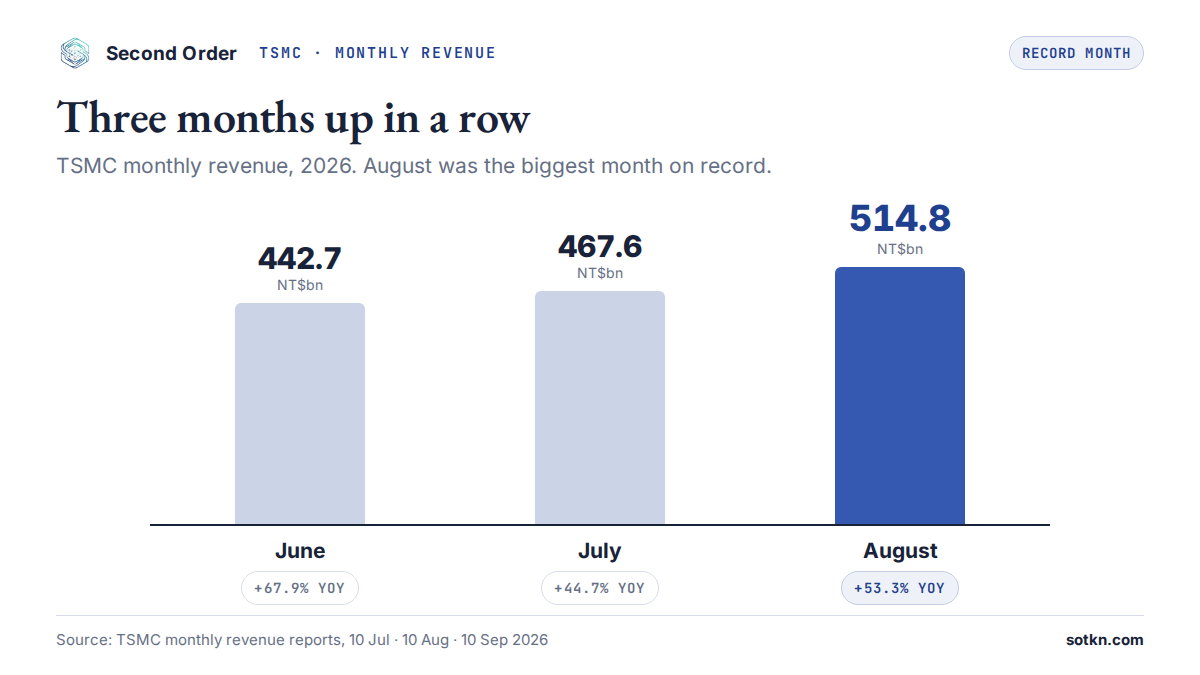
Three months in a row of higher sales matters more than any one month. Monthly numbers can jump when a big batch of wafers ships. A steady climb says demand is broad, not lumpy.
The profit side is stronger still. In Q2 2026, TSMC's gross margin was 67.7%: about two-thirds of each dollar of sales was left after the direct cost of making the chips. Net income rose 77.4% from a year earlier while revenue rose 36%. When profit grows twice as fast as sales, the seller has pricing power.
On its Q2 call, TSMC said it expects full-year 2026 revenue growth of slightly above 40% in US dollar terms, and raised its 2026 capital spending plan to US$60–64 billion.
Our Q3 math: what does September need to show?
Not much. On our arithmetic, July and August have already done most of the work.
TSMC guided Q3 2026 revenue of US$44.6–45.8 billion, assuming NT$32 to the US dollar. At that rate, the range is NT$1,427–1,466 billion.
Figures in NT$bn
Q3 guidance, low end (US$44.6bn × 32)
1,427.2
Q3 guidance, high end (US$45.8bn × 32)
1,465.6
July + August, already reported
982.4
September needed to hit the low end
444.8
September needed to hit the high end
483.2
September if flat with August
514.8
Second Order calculation from TSMC guidance (16 Jul 2026) and monthly reports. The exchange rate moves, so treat this as a guide, not a forecast.
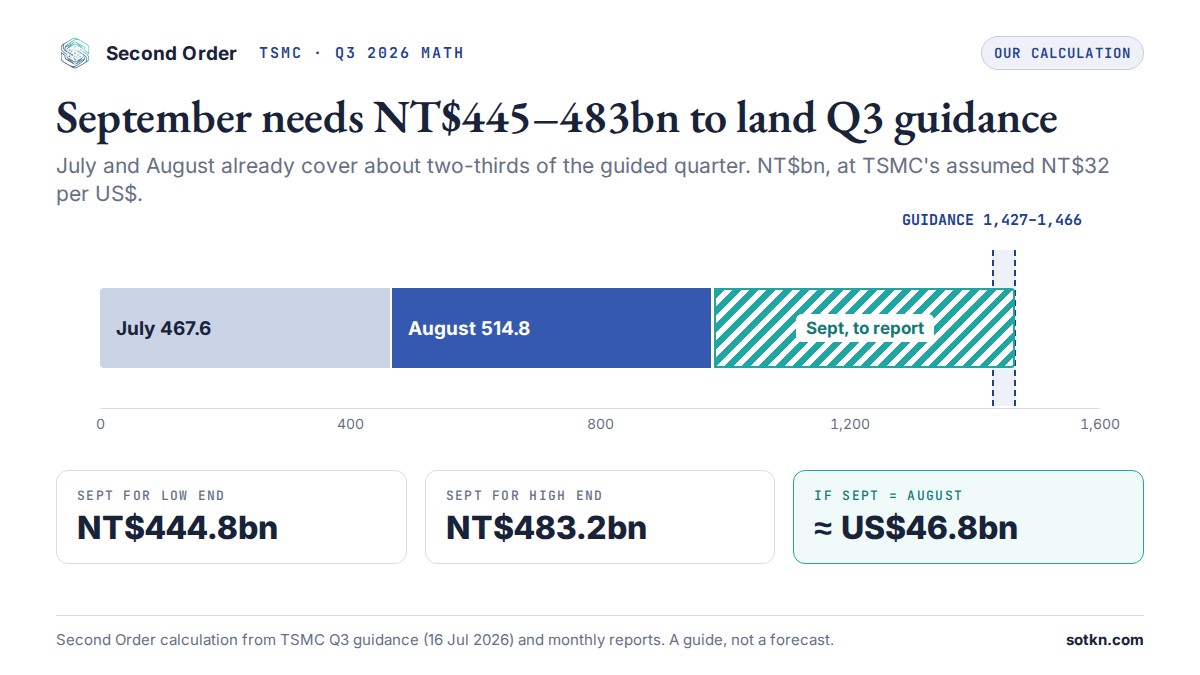
What this tells you: September could fall about 6% from August and TSMC would still hit the top of its range. If September simply matches August, Q3 would come to about NT$1,497 billion, or about US$46.8 billion at NT$32. That is roughly 2% above the top of guidance.
What it does not tell you: whether the market already expects a beat. That is a price question, and we do not do price calls.
What is TSMC selling most?
Its newest and most expensive chips.
In Q2 2026, chips made at 7 nanometres or smaller brought in 77% of TSMC's wafer revenue. High-performance computing, which is mostly AI and data-centre chips, made up 66% of total revenue, and HPC sales rose 20% from the quarter before.
Share of Q2 2026 wafer revenue
2nm (newest)
3%
3nm
30%
5nm
33%
7nm
11%
Older processes
23%
Source: TSMC Q2 2026 results, 16 Jul 2026.
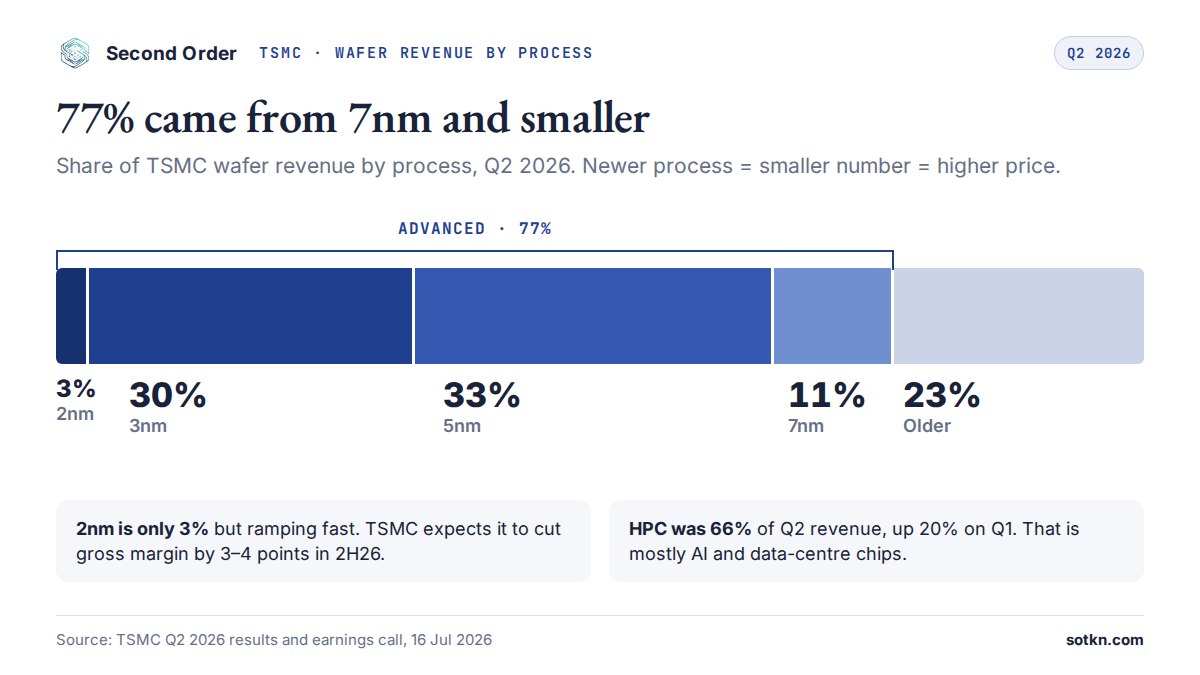
Watch the 2nm line. It was only 3% in Q2, but it is ramping fast. New processes cost a lot to start. TSMC said the 2nm ramp will cut gross margin by 3–4 percentage points in the second half of 2026, and the ramp of overseas fabs could take off a similar amount later on. That is why Q3 margin guidance (65–67%) sits below Q2's 67.7% even as sales climb.
How big were Taiwan's exports in August 2026?
The biggest ever, and almost all of the growth came from AI hardware.
Taiwan's exports hit US$82.4 billion in August 2026, up 41% from a year earlier. Two lines did most of the work:
Electronic components (mostly chips)
US$32.2bn
+58.0% vs a year earlier
Computer and communications products (mostly servers)
US$33.1bn
+41.8% vs a year earlier
Everything else
US$17.1bn
—
Total
US$82.4bn
+41.0% vs a year earlier
Source: Ministry of Finance via Focus Taiwan, 9 Sep 2026. "Everything else" is our subtraction.
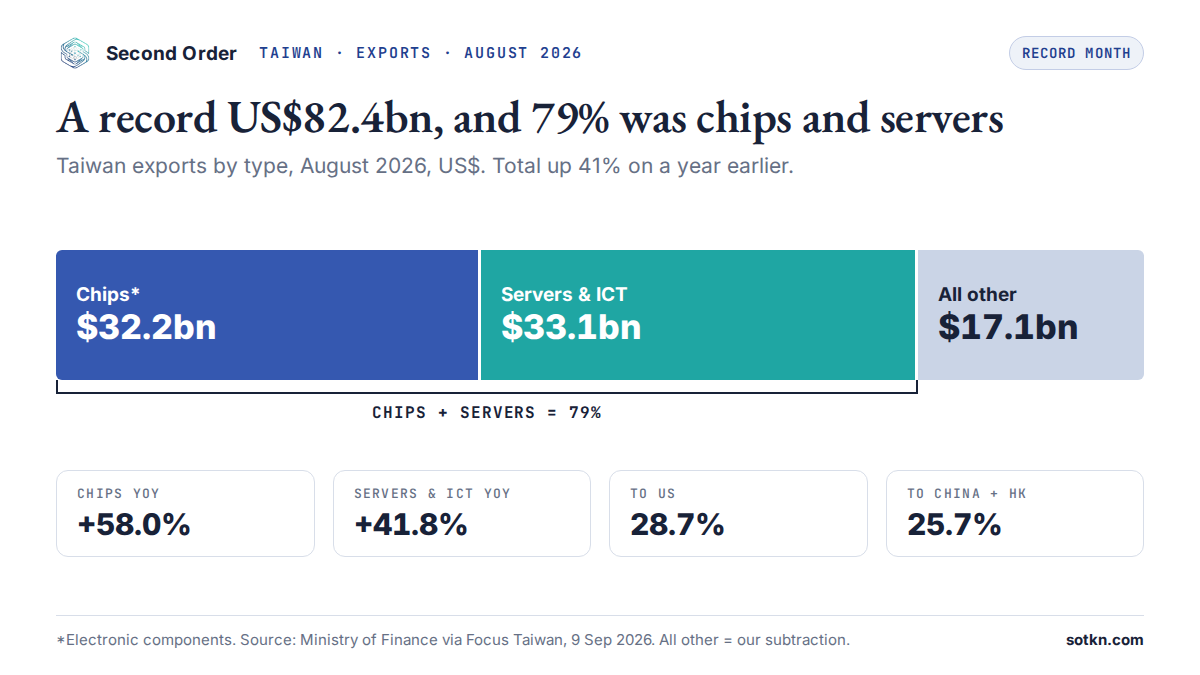
Chips and servers made up 79% of all exports. The US took 28.7% of the total, and China plus Hong Kong took 25.7%. From January to August, exports reached US$574.3 billion, up 44%. The ministry expects September exports of US$77.0–80.3 billion, up 42–48%.
Where does the money stick in Taiwan?
At the steps with the fewest good suppliers.
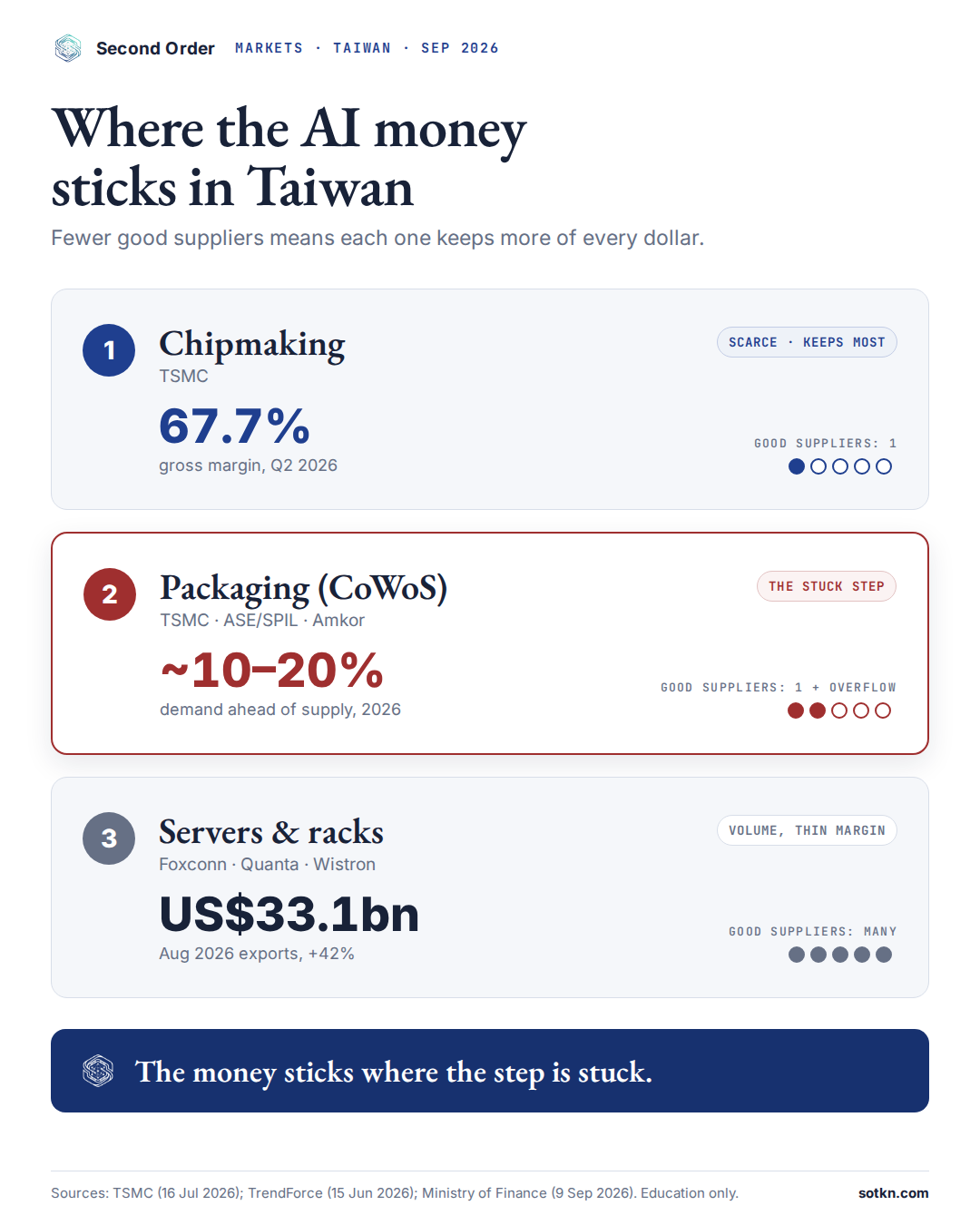
1. Leading-edge chipmaking. TSMC is the main maker of the most advanced AI chips at scale today. When one supplier does most of a step, that supplier keeps more of each dollar. A 67.7% gross margin is the evidence.
2. Packaging. CoWoS joins each AI chip to its high-speed memory. No join, no shippable chip. This is the stuck step, so buyers book it years ahead. DigiTimes reported in December 2025 that Nvidia had booked more than half of TSMC's CoWoS supply for 2026–27. When TSMC cannot do it all, outside packagers such as ASE (with its SPIL unit) and Amkor take the overflow.
3. Servers. Foxconn, Quanta and Wistron ship huge volumes, which is why computer-product exports hit a record. But many firms can build a rack, so each dollar of sales keeps less profit. Their money is in volume, not scarcity.
The pattern is simple: the money sticks where the step is stuck.
Is CoWoS still the stuck step?
Yes, though the shortage is shrinking.
TrendForce reported in June 2026 that demand for CoWoS was running about 20% ahead of supply, narrowing to about 10% by the end of 2026. Local press reports, summarised by TrendForce on 14 Sep 2026, gave the clearest capacity map so far:
Capacity (wafers per month) · End-2026
CoWoS packaging
~130,000
Next target: ~260,000 by end-2028
2nm chipmaking
~90,000
Next target: ~110,000 by mid-2027
3nm chipmaking
180,000+
Next target: ~210,000 by mid-2027
Source: TrendForce, 14 Sep 2026, citing Economic Daily News and Commercial Times. Reported targets, not TSMC guidance.
Two cautions before you read too much into "CoWoS doubles":
- Variant matters. CoWoS is a family (S, R and L). Added capacity only helps if it is the type the in-demand chips use. Our packaging gate piece explains why.
- Built is not the same as working. New lines take months to reach good yields. Watch lead times for smaller buyers. That is the most honest sign the step is getting unstuck.
If packaging catches up, the stuck step moves. The next candidates are memory (HBM, explained) and power for data centres.
TSMC earnings date and what comes next
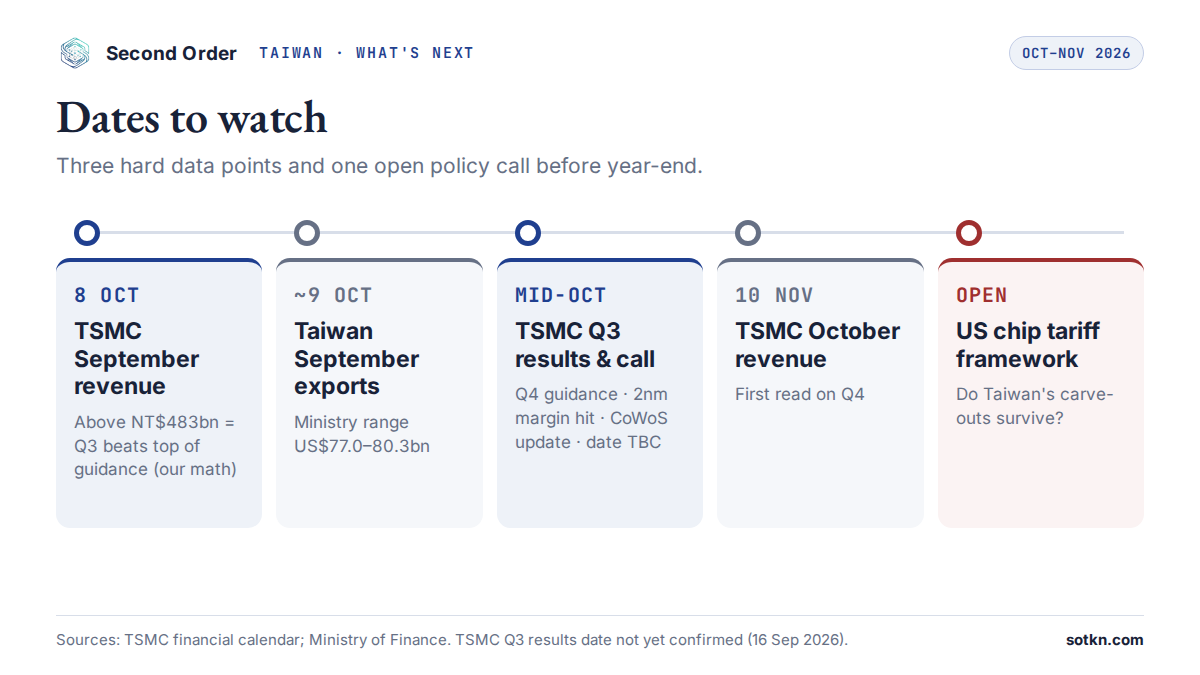
The next eight weeks bring three hard data points and one policy decision.
8 Oct 2026
TSMC September revenue
Above NT$483bn = Q3 above the top of guidance (on our math)
~9 Oct 2026
Taiwan September exports
Ministry range: US$77.0–80.3bn
Mid-Oct 2026 (TBC)
TSMC Q3 2026 results and call
Q4 guidance; 2nm margin hit; any CoWoS capacity update
10 Nov 2026
TSMC October revenue
First read on Q4
Open
US chip tariff framework
Whether Taiwan's carve-outs survive
Sources: TSMC financial calendar; Ministry of Finance. TSMC has not yet confirmed its Q3 results date; it held Q2 results on 16 Jul 2026.
How do US tariffs affect Taiwan's chipmakers?
For now, firms that build in the US get a way around them. The details are still moving.
Under the US–Taiwan deal agreed in January 2026:
- Taiwanese firms pledged at least US$250 billion of direct US investment, plus US$250 billion in credit guarantees.
- The general US tariff on Taiwanese goods is capped at 15%.
- Chipmakers building US plants can import chips duty-free: up to 2.5 times their planned US capacity while building, then 1.5 times once the plant is running.
On 2 Sep 2026, the US Commerce Secretary said a wider chip tariff framework is being written, with exemptions tied to US manufacturing. Taiwan has said it wants its existing concessions kept.
The so-what: the final wording decides how much of the chip money stays in Taiwan and how much follows TSMC to Arizona. It also explains part of the capex rise: building in the US is partly the price of tariff-free access.
What would change this view?
The "money sticks in Taiwan" read weakens if:
- [ ] Hyperscaler or neocloud spending plans are cut (Taiwan's monthly sales would show it first)
- [ ] CoWoS lead times shorten for buyers outside the top tier
- [ ] A second packaging supplier qualifies on a leading AI chip, not just announces capability
- [ ] TSMC's gross margin falls below its guided range for reasons other than the 2nm and overseas ramps
- [ ] The US tariff framework removes the carve-outs for firms building in the US
- [ ] Memory, not packaging, becomes the louder bottleneck
It stays intact while monthly sales keep climbing, margins hold in the mid-60s, and packaging is still booked years ahead.
Practical takeaways
- TSMC's sales are growing faster this year (40%+) than the company first expected
- On our arithmetic, Q3 guidance is within easy reach unless September drops sharply
- Scarce steps (chipmaking, packaging) keep the most profit; server building wins on volume
- CoWoS is still short, but the gap is narrowing. Watch lead times, not headlines
- 8 October is the next hard data point; the tariff framework is the biggest open question
FAQ
Why is Taiwan so important for AI chips?
TSMC makes most of the world's leading AI chips and does much of the advanced packaging that turns them into shippable products. Taiwanese firms also build a large share of AI servers.
What was TSMC's revenue in August 2026?
NT$514.8 billion, a record. That was up 53.3% from August 2025 and 10.1% from July 2026.
When is TSMC's next earnings date?
TSMC reports September revenue on 8 October 2026. It usually holds Q3 results in mid-October; the exact 2026 date was not yet confirmed as at 16 September 2026.
What is TSMC CoWoS?
CoWoS is TSMC's advanced packaging family. It places an AI chip and its high-speed memory side by side on one base so data moves fast between them. It is currently the stuck step for AI chip supply.
Is the CoWoS shortage over?
Not yet. TrendForce estimated demand was about 20% ahead of supply in mid-2026, narrowing to about 10% by year-end, with capacity reported to double by the end of 2028.
How do US tariffs affect TSMC?
Under the January 2026 US–Taiwan deal, chipmakers building US plants can import a multiple of their US capacity duty-free. A wider US chip tariff framework was still being written in September 2026.
Keep reading on the map
- Explained: CoWoS, explained · HBM, explained
- Markets: Taiwan's packaging gate · Korea: the memory door · US: where the buyers are
- The Stack: Semiconductors · Hyperscalers
How we made this
We use company filings, government statistics and named trade press. Every number carries a date. Capacity targets from press reports are labelled as reported, not guided. The Q3 math is our own arithmetic and is shown in full. Status chips are our read and change when the data does. Spot an error? Reply to any Wire email and we will correct it and note the change here.
Sources
- TSMC, August 2026 revenue report (10 Sep 2026): pr.tsmc.com/english/news/3340
- TSMC, July 2026 revenue report (10 Aug 2026): pr.tsmc.com/english/news/3329
- TSMC, June 2026 revenue report (10 Jul 2026): pr.tsmc.com/english/news/3323
- TSMC, Q2 2026 results and Q3 guidance (16 Jul 2026): pr.tsmc.com/english/news/3326 · guidance FX assumption: SEC EDGAR
- TSMC Q2 2026 earnings call highlights (full-year growth, capex, HPC share, margin dilution): Yahoo Finance
- TSMC financial calendar: investor.tsmc.com
- Focus Taiwan, August 2026 exports (9 Sep 2026): focustaiwan.tw
- TrendForce, CoWoS gap narrowing (15 Jun 2026): TrendForce, 15 Jun 2026
- TrendForce, 2nm/3nm/CoWoS targets (14 Sep 2026): TrendForce, 14 Sep 2026
- DigiTimes, Nvidia CoWoS bookings (10 Dec 2025): DigiTimes
- US Department of Commerce, US–Taiwan agreement fact sheet (Jan 2026): commerce.gov
- Vision Times, US chip tariff framework (4 Sep 2026): Vision Times
Second Order publishes education, not investment advice. Nothing here is a recommendation to buy or sell any security.