Dell Books $132B AI Backlog After $22B Server Quarter
Dell shipped $22 billion in AI servers in a single quarter and exited October with $132.3 billion in vetted backlog. The second-order effect runs from Nvidia Blackwell GPUs to HBM memory, CoWoS packaging, and optical interconnects.
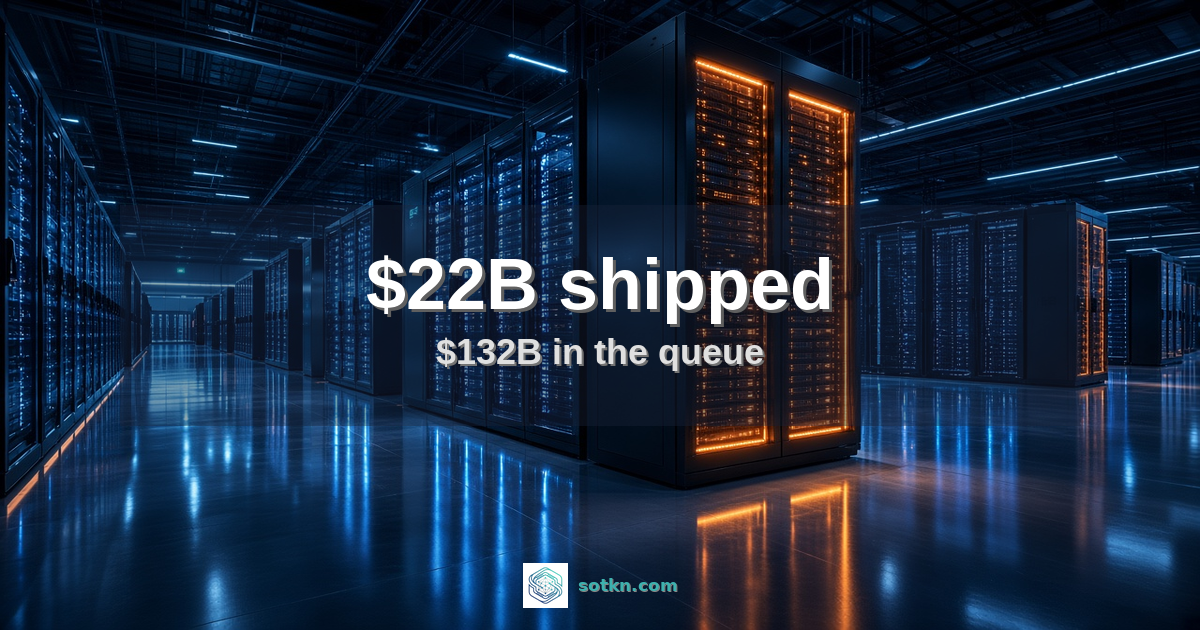
Dell Technologies reported a record $54.9 billion in quarterly revenue on 24 November 2026, booking $60.2 billion in AI server orders during the period and exiting October with a $132.3 billion AI backlog that locks in demand well past 2027 — drawing down the upstream supply chain from Nvidia Blackwell GPUs to HBM memory and CoWoS packaging at a pace that leaves little slack.
What happened?
- 24 Nov 2026 (Dell Technologies press release): Dell reported fiscal third-quarter 2027 results for the period ended 30 October 2026. Total revenue was $54.9 billion, up 103% year on year; diluted EPS was $8.82, up 287%.
- 24 Nov 2026 (Dell Technologies press release): Infrastructure Solutions Group (ISG) revenue reached $42.0 billion (+198% year on year). AI-optimised servers generated $22.0 billion, up 291% from a year earlier; storage added $4.9 billion (+24%). ISG operating income was $7.1 billion, with a 17% margin.
- 24 Nov 2026 (Dell Q3 FY2027 earnings call): Dell booked $60.2 billion in AI server orders in the quarter — the second consecutive period with orders above $60 billion — and exited with a record $132.3 billion AI backlog. Jeff Clarke, vice chairman and COO, said the customer pipeline "remains multiples of our backlog" after converting $180 billion in AI orders over the prior four quarters, and that every order is vetted for access to capital, land, and power before entering the backlog.
- 24 Nov 2026 (Dell Technologies press release): Dell raised its full-year FY2027 revenue guidance to $202.0 billion (+78% year on year). Our arithmetic: with nine-month revenue of $145.75 billion, Q4 FY2027 implied revenue is approximately $56.25 billion ($202.0B − $145.75B).
Why does it matter?
Dell's AI backlog is not a soft forecast. The company runs a two-stage vetting process — first on purchase order acceptance, and again before production begins — covering each customer's financial capacity, end-user contracts, and site access to land and power. A $132.3 billion vetted backlog represents roughly six quarters of Dell's current AI server run-rate ($22B × 6 = $132B; our arithmetic) already committed.
The second-order effect runs upstream. As Dell converts this backlog, it draws on:
- Nvidia Blackwell GPUs (B200/B300): Dell assembles AI clusters around Nvidia GPUs; $22 billion in AI servers per quarter sets the floor for Nvidia's production line.
- HBM memory from SK Hynix, Micron, and Samsung: Blackwell clusters contain multiple HBM3e stacks per GPU; shipment volumes at Dell's rate translate to hundreds of thousands of HBM units per quarter.
- CoWoS packaging at TSMC (and Amkor, ASE): HBM-on-GPU interposers require CoWoS capacity; Dell's backlog conversion pace sets the demand floor for CoWoS through 2027.
- Power delivery silicon (Analog Devices, Texas Instruments, Monolithic Power): every AI server rack needs voltage regulators and power management ICs at unprecedented density — a point underscored by Analog Devices reporting record quarterly revenue of $4.37 billion the same day, led by data-centre growth.
- 800G optical interconnects (AOI, Coherent, Lumentum): racks inside AI clusters are connected by 800G transceivers; AOI's $2.2 billion, four-year hyperscaler agreement announced the same day confirms that link is under sustained demand.
Dell's ISG business has now delivered eleven consecutive quarters of double-digit or better year-on-year revenue growth, per management's earnings call statement.
What does it change?
Near term: Dell's power-vetting screen means only sites with confirmed land and power commitments can enter the backlog. The $132.3 billion in the queue has already passed this filter. Sites without firm grid connections are queued out — not demand-destroyed, but delayed until their infrastructure is in place.
Nvidia's Blackwell supply chain now faces a sustained, committed draw-down rather than volatile spot demand. That visibility benefits the full AI hardware stack, reducing the incentive for builders to over-order and then cancel.
Dell's client solutions group (PCs, $12.9 billion, +3% year on year) reported a 6% decline in operating income as corporate customers deferred PC refresh budgets toward server and storage orders. That deferred PC cycle is building a future replacement wave behind the current AI spend.
Longer term: Dell's $202 billion full-year guidance, if met, would make the company roughly twice its FY2026 scale in one fiscal year. At ISG's current 76% share of total revenue (our arithmetic: $42B/$54.9B), the annual ISG run-rate implied is approximately $154 billion — approaching four times ISG's $41.2 billion in all of FY2026.
If Dell ships another $22 billion-plus AI server quarter in Q4, the annual AI-optimised server run-rate will exceed $80 billion. Sustaining that level requires Nvidia and TSMC to hold Blackwell/CoWoS output at or above current rates through 2027.
The vetting screen also acts as a signal filter. Orders that fail the land-or-power gate represent genuine demand that has not yet secured infrastructure; when those sites clear, they represent a future capex phase rather than demand that simply evaporated.
| Metric | Value | Source name | Date |
|---|---|---|---|
| Q3 FY2027 total revenue | $54.9B (+103% YoY) | Dell Technologies press release | 24 Nov 2026 |
| AI-optimised server revenue | $22.0B (+291% YoY) | Dell Technologies press release | 24 Nov 2026 |
| ISG revenue | $42.0B (+198% YoY) | Dell Technologies press release | 24 Nov 2026 |
| ISG operating income | $7.1B, 17% margin | Dell Technologies press release | 24 Nov 2026 |
| AI backlog (30 Oct 2026) | $132.3B | Dell Q3 FY2027 earnings call | 24 Nov 2026 |
| AI orders booked in Q3 | $60.2B | Dell Q3 FY2027 earnings call | 24 Nov 2026 |
| Dell AI Factory customers | 7,500+ | Dell Technologies press release | 24 Nov 2026 |
| Full-year FY2027 revenue guide | $202.0B (+78% YoY) | Dell Technologies press release | 24 Nov 2026 |
| Q4 FY2027 implied revenue | ~$56.25B | Our arithmetic: $202.0B − $145.75B | 24 Nov 2026 |
| CSG revenue | $12.9B (+3% YoY) | Dell Technologies press release | 24 Nov 2026 |
What should we watch next?
- 4 Dec 2026 (expected): Nvidia's Q3 FY2027 10-Q files with the SEC. That is the first document to show Blackwell's gross margin contribution and any CoWoS or HBM supplier lead-time commentary. It is the clearest upstream read on whether Nvidia can sustain the supply rate that fills Dell's AI server revenue. The Second Order Catalyst on 20 November flagged eight specific lines to check.
- 9 Dec 2026 (confirmed): PJM 2029/2030 Base Residual Auction bidding opens. Dell's power-vetting screen means sites in PJM territory face the same grid-connection scrutiny; a shortfall auction raises the bar for new backlog entries from that region.
- 30 Nov 2026 (confirmed): AWS re:Invent opens in Las Vegas. Dell's vetted backlog is concentrated in hyperscalers and enterprises; any new AWS Trainium or infrastructure deployment announcement there would signal incremental demand that could flow back into Dell orders.
- ~Feb 2027 (expected): Dell Q4 FY2027 results. The question is whether Dell ships the implied ~$56.25B to meet full-year guidance and whether the AI backlog holds above $100 billion. A backlog decline would signal demand moderation; a further rise would indicate supply constraints rather than demand limits.
Disconfirmation: if Nvidia reports a Blackwell production constraint — from CoWoS yield, HBM allocation, or export control — Dell's backlog conversion rate would slow, and the implied Q4 AI server revenue would not reach the guidance-consistent level. Watch Nvidia's 10-Q gross-margin-by-segment line and any TSMC CoWoS capacity commentary in January.
Also on the tape
- 24 Nov 2026: Analog Devices reported record Q4 fiscal 2026 revenue of $4.37 billion, with data-centre and industrial segments leading year-on-year growth; full-year FY2026 revenue was $15.2 billion, up 38% (Analog Devices newsroom).
- 23 Nov 2026: Semtech reported fiscal Q3 data-centre revenue of $145 million, up 158% year on year, and guided Q4 total revenue to approximately $480 million; it expects data-centre revenue to grow roughly 40% further in Q4 (Semtech investor relations).
- 24 Nov 2026: AOI signed a four-year minimum-purchase agreement with an unnamed Tier-1 hyperscaler for 800G transceivers and laser diodes totalling $2.2 billion in commitments through December 2030 (AOI investor relations).
- 24 Nov 2026: Dell's client solutions group posted $12.9 billion in revenue (+3% year on year), as commercial PC revenue rose 6% and consumer PC revenue fell 15%, with customers deferring PC refresh to fund server and storage orders (Dell Technologies press release).
FAQ
What is Dell's AI backlog?
Dell's AI backlog is the value of AI server orders it has accepted and vetted for quality and viability but not yet shipped. As of 30 October 2026, it stood at $132.3 billion after Dell booked $60.2 billion in new AI orders during the quarter.
How does Dell vet AI server orders?
Dell runs a two-stage check: first when it accepts the purchase order, and again before production begins. Each review covers the buyer's financial capacity, their end-customer contracts, land and power site commitments, and trade and export compliance. Orders that fail either check are removed from the backlog.
Does a large AI backlog mean AI demand will continue?
A large vetted backlog means committed orders have passed rigorous screening — giving Dell what management calls "high conviction" they will convert to revenue. However, conversion still depends on Dell sourcing components (GPUs, memory, networking) and customers maintaining their site power and land timelines. The backlog is a strong demand signal, not a guarantee.
What does Dell's $22B quarter mean for the AI supply chain?
At $22 billion in AI server revenue in one quarter, Dell draws on Nvidia Blackwell GPUs, HBM memory, CoWoS packaging, power delivery chips, and optical interconnects at a scale that keeps those supply chains at or near capacity. Any upstream constraint — HBM yield, CoWoS throughput, or Nvidia packaging — would directly cap Dell's backlog conversion rate.
Dell's $132.3 billion AI backlog represents roughly six quarters of its current AI server run-rate — a committed demand signal that keeps the upstream supply chain from GPU allocation to optical interconnects running near capacity well into 2027.
References
- Dell Technologies, "Dell Technologies Delivers Third Quarter Fiscal 2027 Financial Results," 24 Nov 2026, investors.delltechnologies.com
- Dell Technologies, "Q3 FY2027 Financial Tables (PDF)," 24 Nov 2026, investors.delltechnologies.com
- Motley Fool, "Dell (DELL) Q3 2027 Earnings Call Transcript," 24 Nov 2026, fool.com
- Analog Devices, "Analog Devices Reports Record Fourth Quarter and Fiscal 2026 Financial Results," 24 Nov 2026, analog.com
- VCPost / Semtech, "Semtech Posts Record Revenue Up 58% on AI Data Center Demand," 24 Nov 2026, vcpost.com
- AOI, "AOI Announces Multi-Year Long-Term Agreement with Tier-1 Hyperscale Datacenter Customer," 24 Nov 2026, investors.ao-inc.com