Hyperscaler, Explained: Who Sets AI Capex for the Whole Stack
A hyperscaler is a very large cloud company whose capital spending sets demand for the whole AI stack. How that spend flows, and where it lands first.
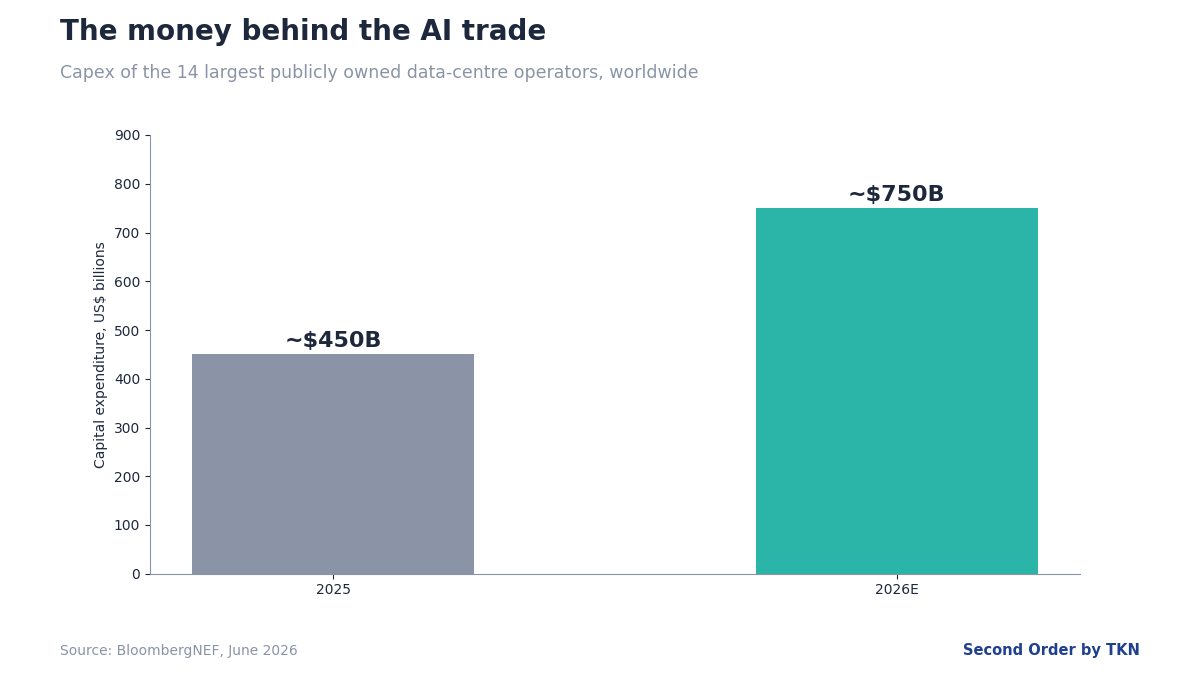
A hyperscaler is a very large cloud operator whose capital spending shapes AI hardware demand for everyone else. When hyperscalers raise capex, orders flow into chips, packaging, memory, servers, networking, cooling, and powered halls. When they pause, queues ease later.
In short: hyperscaler capex is the demand dial for the AI stack. It sets orders that arrive as price and lead-time pressure at scarce steps, with lags measured in quarters. Capex is a demand signal, not a guarantee of supplier profit.
What is a hyperscaler?
A hyperscaler operates cloud infrastructure at a scale large enough to fill factories. They sell many services — storage, databases, general compute, and AI capacity — and they build the data centres that run them.
Capex means capital expenditure: money spent on long-lived assets. For a hyperscaler that means shells, electrical plant, cooling, servers, accelerators, networking fabric, and sometimes land and interconnect.
Their plans are large enough to move supplier calendars, which is why this layer sits near the top of demand rather than in the middle of the stack.
How does the spend flow down?
A simplified chain, each step on its own clock:
- Board guidance sets a spend envelope for the year
- Cluster roadmaps decide accelerator counts and networking speed
- Server and GPU orders hit ODMs, accelerator sellers, and memory makers
- Packaging and memory must match the die — see CoWoS and HBM
- Networking and optics scale with the fabric — see optics in the AI cluster
- Power, cooling, and landlords must clear watts and leases — see speed-to-power and data-centre REITs
Capex news today can show up as a packaging queue later, and as a transformer wait after that.
How does capex turn into price pressure?
This is the part worth slowing down for, because it is where lag lives.
When guidance rises, orders rise. Those orders hit finish lines that are already short, and suppliers respond in one of two ways: they raise prices where scarcity is real, or they ration with lead time.
A longer wait is still a form of scarcity rent. Readers who watch only list price miss the queue. Equally, list price can rise while discounts stay quiet in private deals — realised price matters more than a brochure.
Where rent shows up, by lag
| Lag | Where scarcity rent tends to sit |
|---|---|
| Near-term | Advanced packaging, memory stacks, scarce accelerator parts |
| Mid-term | Optical modules, coolant distribution units, large electrical gear |
| Longer | Powered lease rates where campuses clear slowly |
Servers can be busy without being the scarcest rent pocket. Price today often reflects orders placed months ago, and lead time today can reflect tools ordered years ago.
Why do mechanics matter more than the headline?
Headlines say "AI spend is up". The useful questions are narrower:
- Is the spend for training clusters, inference, or general cloud refresh?
- Is the scarce step the accelerator, the package, the watt, or the lease?
- Did guidance actually rise, or did only commentary get louder?
A higher envelope without timed power still leaves racks dark. A lower envelope can loosen tool demand even while one accelerator seller stays busy working through backlog.
Capex versus utilisation
Spending money is not the same as filling machines. A hyperscaler can buy accelerators and still run them below plan if software demand, networking, or power lags.
Capex starts the order chain. Utilisation decides how fast the next order lands. Software and applications sit above this flow, and app monetisation can lag infrastructure spend considerably — capex can stay hot while app profits are still proving out.
Orders versus installations
Three steps that diverge for months and are constantly conflated:
- Guidance is a budget
- Purchase orders are commitments
- Installations are machines that light up
A buyer can raise guidance and still delay installs if interconnect is late. A supplier can book orders and still wait on packaging. Anyone mixing "capex up" with "revenue this quarter" has skipped the lag. Ask which step moved.
How do you read a capex update?
- What is the stated range versus last year?
- What share is framed as AI versus ordinary cloud?
- Are campuses self-build, leased, or mixed?
- Which bottleneck do executives name — chips, power, cooling, or labour?
- Which suppliers cited allocation, lead time, or pricing in the same window?
What would change this view?
The tight price-pressure read weakens if capex guidance cools and stays cool, inventories of key parts rise, lead times normalise across packaging, memory, optics, and power gear, powered lease starts catch backlog without rate spikes, and rented accelerator prices soften while fleets grow.
It strengthens if guidance stays high while multiple finish lines report longer waits together.
Practical takeaways
- Hyperscaler capex is a demand dial that sets stack prices and queues with lag
- Lead-time rationing is scarcity too, even when price is flat
- Budget, order, and install are three different facts
- Capex can run hot while app monetisation proves out slowly
FAQ
What is a hyperscaler?
A very large cloud operator running infrastructure at a scale that can fill supplier factories, selling storage, compute, databases, and AI capacity.
What does hyperscaler capex mean?
Capital expenditure on long-lived assets: data-centre shells, electrical plant, cooling, servers, accelerators, and networking.
Why do suppliers watch capex guidance?
Because a change in planned spend can tighten or loosen queues across the stack months later. It is the earliest public demand signal available.
Does higher capex mean higher supplier profits?
Not automatically. Spend has to reach a scarce step before it becomes pricing power, and lags mean the benefit can land in a later period.
How is a hyperscaler different from a neocloud?
A hyperscaler earns across many services with accelerators as one line. A neocloud concentrates on renting accelerators, which raises both focus and risk.