
SK Hynix and the HBM Allocation Cycle
Korea holds the largest share of AI-class HBM output. How the allocation cycle turns into cash, and the four disclosures that tell you whether it is still tight.
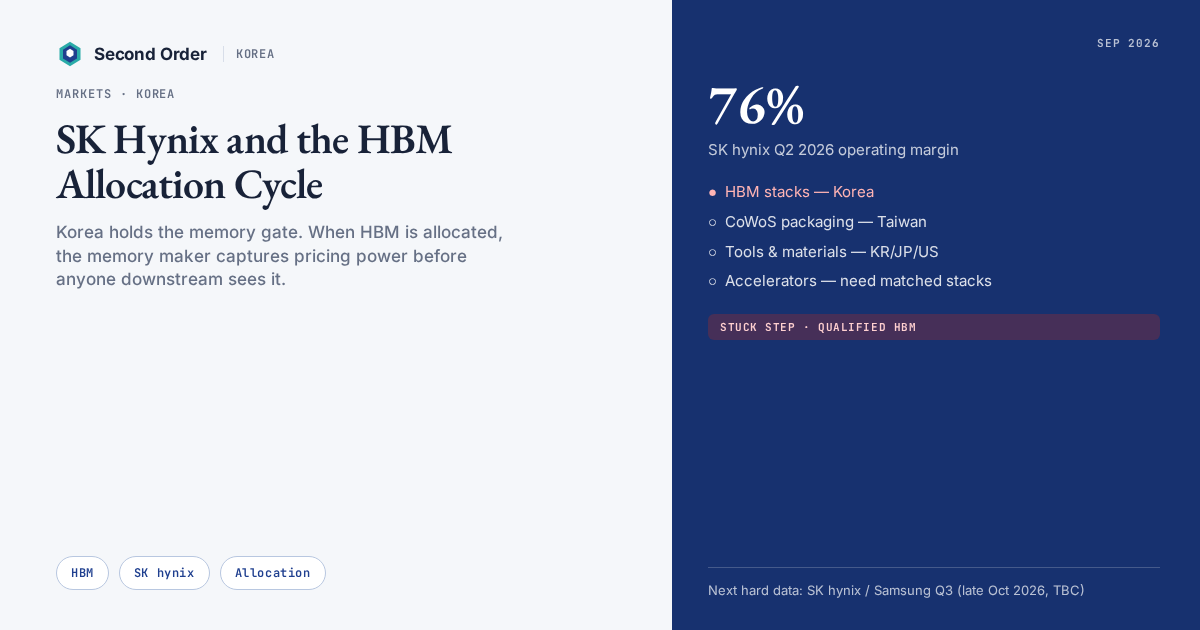
Korea is where the AI trade's memory gate physically sits. SK Hynix, Samsung and the tool suppliers around them hold the largest share of AI-class HBM output, which means the allocation cycle described in HBM explained turns into revenue on Korean income statements first.
KOREA MARKETS · Data as at 19 Sep 2026 · Next update: after SK hynix / Samsung Q3 results
Affects: Semiconductors · Memory · Korea / Taiwan packaging gate
Education only. Nothing here is a recommendation to buy or sell any security.
Numbers that matter
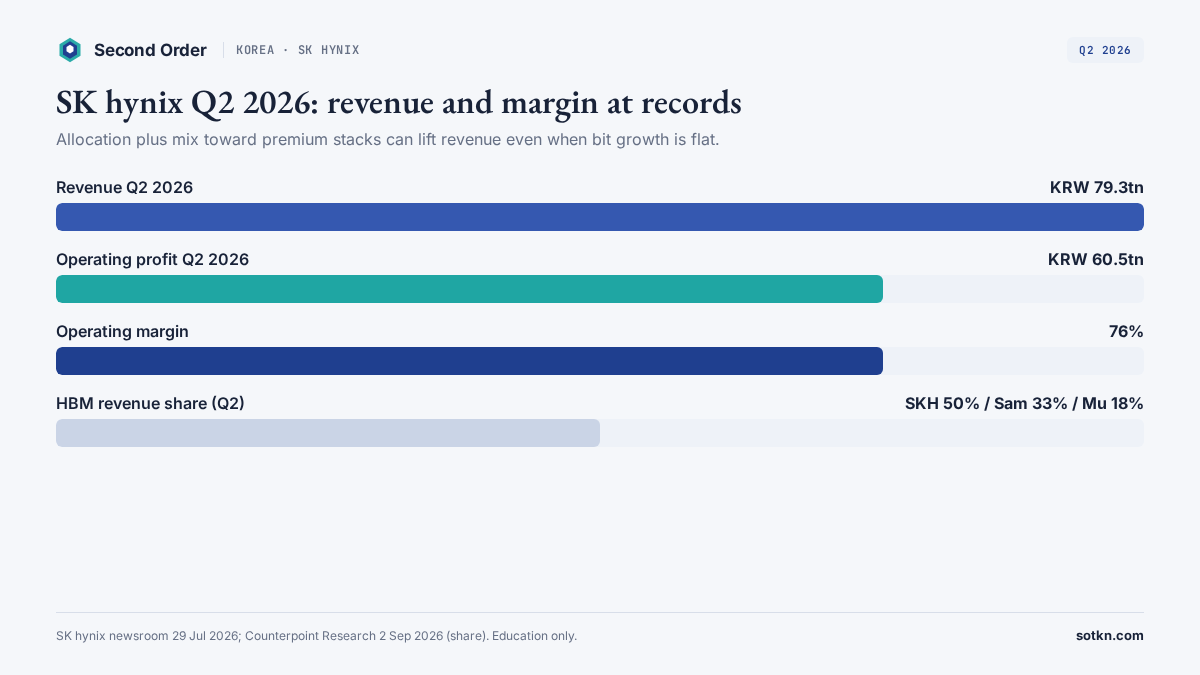
SK hynix revenue (Q2 2026)
KRW 79.3tn
+257% YoY (company)
RecordSK hynix operating margin (Q2 2026)
76%
OP KRW 60.5tn
RecordHBM revenue share (Q2 2026)
SKH 50%
Samsung 33% · Micron 18%
Leader still aheadHBM supply mode (Sep 2026)
Allocated
Long agreements, not open sale
Still stuckKorea chip exports (Aug 2026)
US$46.65bn
Memory ~US$40.94bn (~87.8%)
Hot printSources: SK hynix (29 Jul 2026), Counterpoint Research (2 Sep 2026), MOTIE via Seoul Economic Daily (1 Sep 2026). Status chips are Second Order's read.
Why does Korea matter to the AI trade?
Because the scarce step is physically there. Advanced packaging concentrates in Taiwan; high-bandwidth memory concentrates in Korea. Those are the two gates that decide whether a finished accelerator exists, and they sit in two different countries.
That geographic split is the reason this site treats Korea and Taiwan as separate lanes rather than one Asia semis bucket. They bind at different times, they respond to different news, and a reader who merges them will misattribute a delay to the wrong gate.
High-bandwidth memory
Who: Korea (SK hynix, Samsung; Micron third)
Paid: Qualification, stack yield, allocation — contracted rates + mix
Advanced packaging
Who: Taiwan (TSMC; ASE overflow)
Paid: Interposer capacity, variant mix, attach slots
Process tools and materials
Who: Japan, Korea, US, Netherlands
Paid: Lead times on bonding and test tools that expand both gates
New to the memory gate? Start with HBM, explained. Country Pulse: Korea HBM September 2026. Packaging neighbour: TSMC CoWoS capacity.
How does SK Hynix actually get paid in an allocation cycle?
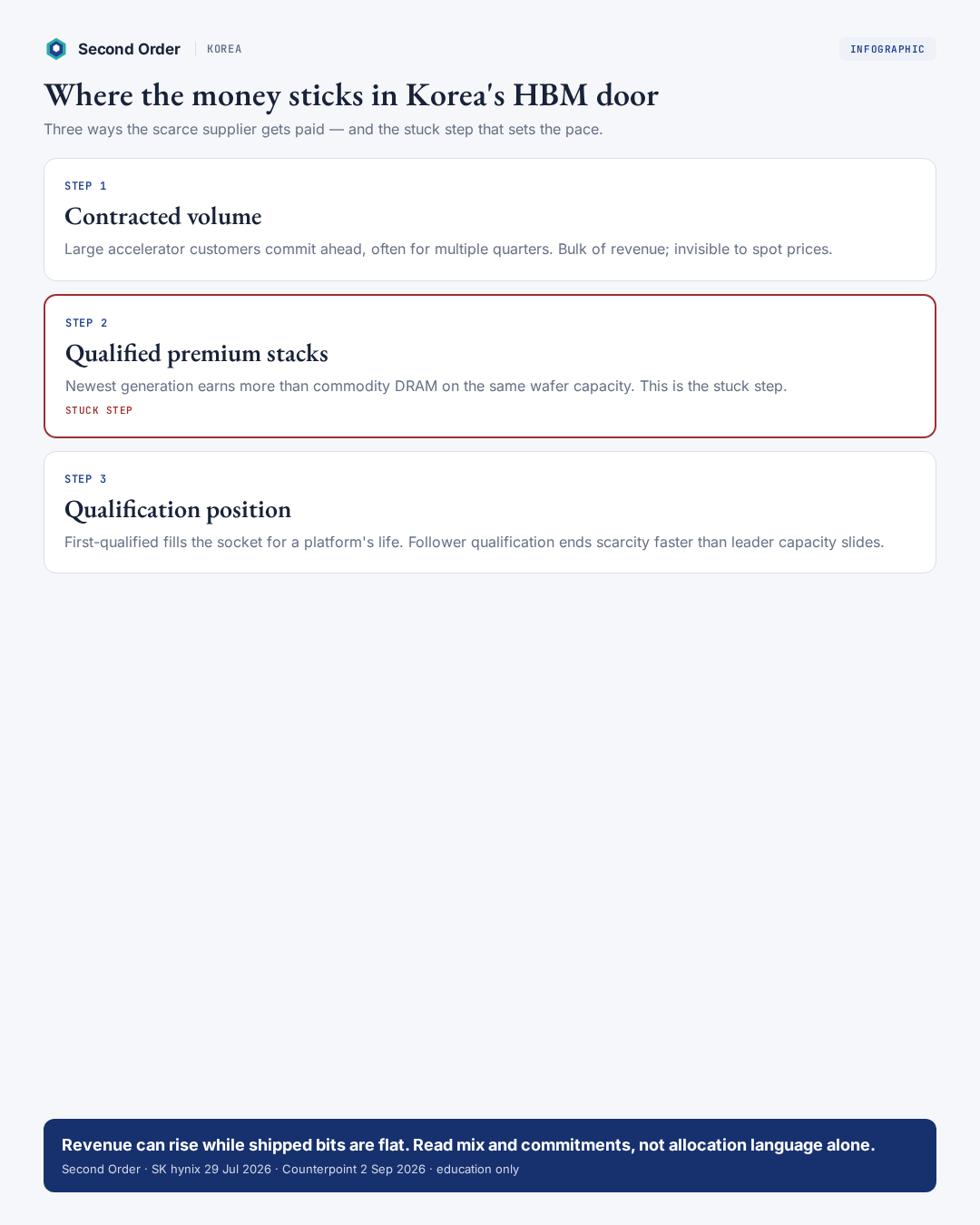
Not through list prices. In an allocation cycle, the scarce supplier earns three ways at once, and only one of them is visible in a headline price.
Contracted volume at negotiated rates. Large accelerator customers commit ahead, often for multiple quarters. This is the bulk of the revenue and it is invisible to spot-price commentary.
Mix shift toward the premium stack. The same wafer capacity directed at the newest qualified generation earns materially more than at commodity DRAM. A quarter where advanced-stack mix rises can lift revenue with flat bit shipments.
Qualification position. Being first-qualified on a platform is worth more than being cheapest. It determines who fills the socket for that platform's life, which is why qualification news moves the read more than capacity slides do.
The practical consequence: revenue can rise while shipped bits are flat. If you read bit growth alone you will miss the cycle; if you read allocation language alone you will imagine one that is not there.
Which disclosures separate a real tightening from talk?
This is the part worth slowing down for, because supplier commentary is systematically louder on scarcity than on volume.
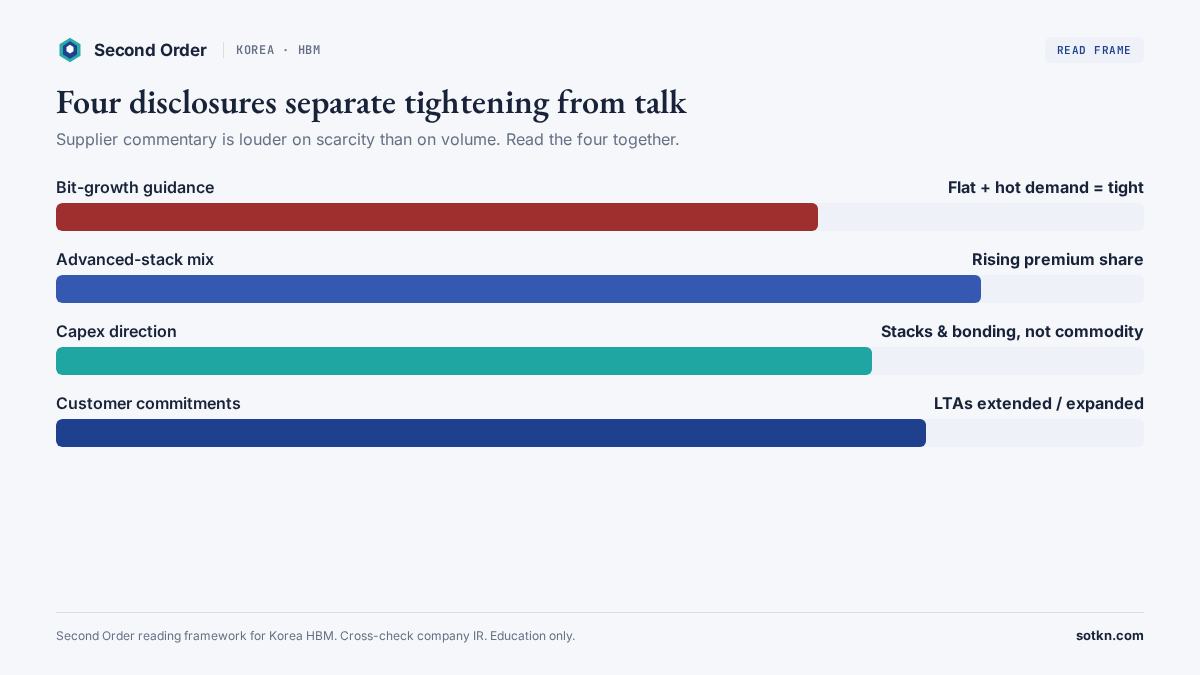
Bit-growth guidance
Advanced-stack mix
Capex direction
Customer commitment
When the first three point the same way and the fourth confirms it, the cycle is real. When only the language is hot, it is a briefing, not a tightening. The allocation-versus-bit-growth section of the HBM page sets out the general mechanism; this is its Korea-specific reading list.
Where does Samsung fit?
As the second scaled supplier, and as the reason the single-socket advantage is never permanent. Samsung runs both memory and a foundry, which makes its position structurally different from a pure memory maker: it can pursue the base die for HBM4 as well as the stack itself.
That matters for the next generation specifically. HBM4 makes the base die semi-custom, which advantages a supplier who can make both parts. Whether that advantage converts depends entirely on qualification timing, which is a fact not a forecast — it either happens on a platform or it does not.
The reading rule for a two-supplier scarce market: watch the follower's qualification news more closely than the leader's capacity news. The leader's scarcity is already priced into the narrative. The follower qualifying is what ends it.
What about the tools that build the stacks?
Stacks do not expand because someone announces capacity. They expand when bonding and test tools are installed, qualified and yielding. That places a second Korean and Japanese supplier set upstream of the memory makers themselves — covered in memory process tools.
The useful sequence, because it is where most misreading happens:
- Tool orders are placed — the earliest signal, and the least certain
- Tools are installed — visible in capex and supplier backlogs
- Yield ramps — rarely disclosed, usually inferred
- Qualified stacks ship — the only step that is actually supply
- Packaging joins them to compute dies — in Taiwan, a separate clock
A headline about step 1 is frequently read as though it were step 4. They can be a year apart.
How do international readers get exposure?
Korean memory makers are listed domestically, and access from outside varies by broker, share class and tax treatment. Some exposure also arrives indirectly through equipment and materials suppliers listed elsewhere. If you use Interactive Brokers, this soft referral opens an account path: Interactive Brokers referral. That is exposure language, not a recommendation. Second Order does not publish buy lists. Check the share class, the withholding treatment and the liquidity for your own account before assuming an exposure is available to you.
What would change this view?
The tight read on Korean memory weakens if:
- Bit-growth guidance rises while allocation language cools — the clearest single tell
- A second and third supplier qualify on the same platform at similar timing
- Advanced-stack mix stops rising while capex keeps climbing, which would suggest capacity landing into softer demand
- Packaging in Taiwan becomes the louder gate again, moving pricing power one step downstream
- Accelerator demand cools enough that committed agreements are renegotiated rather than extended
It strengthens if HBM4 qualification narrows to one supplier while platform commitments are already signed.
Practical takeaways
- Korea is the memory gate; Taiwan is the packaging gate. They bind at different times
- Revenue can rise on mix while shipped bits stay flat — read both
- Qualification position matters more than announced capacity
- Watch the follower's qualification, not the leader's capacity slides
- Tool orders and shipped stacks can be a year apart
FAQ
Why is Korea important for AI memory?
The largest share of AI-class high-bandwidth memory production sits with Korean makers, so the HBM allocation cycle shows up in Korean revenue before it appears anywhere downstream.
Who are the main Korean AI infrastructure companies?
SK Hynix and Samsung on memory stacks, plus a set of equipment and materials suppliers that build and test those stacks. Second Order covers the mechanism rather than publishing a buy list.
Does an HBM allocation cycle mean revenue is rising?
Usually, but not automatically, and not through list prices. It shows up as contracted volume, mix shift toward the premium stack, and qualification position — which is why revenue can rise while shipped bits are flat.
What was SK hynix's Q2 2026 result?
Revenue of KRW 79.3 trillion, operating profit of KRW 60.5 trillion, and a 76% operating margin (SK hynix newsroom, 29 Jul 2026).
What would end the Korean memory tightness?
Bit-growth guidance rising while allocation language cools, or additional suppliers qualifying on the same platform at similar timing.
Is Samsung or SK Hynix better positioned on HBM4?
That depends on qualification timing on specific platforms, which is observable rather than predictable. Samsung's combination of memory and foundry is structurally relevant because HBM4 makes the base die semi-custom.
Keep reading on the map
- Explained: HBM, explained · CoWoS, explained · Memory process tools
- Markets: Korea · Korea Pulse · Taiwan
- Stack doors: Semiconductors · Hyperscalers
How we made this
Upgraded from the Sep 2026 Korea allocation Markets piece to the locked Pulse presentation (in-short, signal/chain stacks, FAQPage schema, image pack). Q2 and share figures aligned with Korea Pulse sources. Thesis unchanged.
Sources
- SK hynix newsroom Q2 2026 results, 29 Jul 2026
- Counterpoint Research HBM revenue share, 2 Sep 2026
- MOTIE chip-export figures via Seoul Economic Daily, 1 Sep 2026
- Second Order HBM explained · Korea Pulse
Disclaimer: Education only. Not investment advice. Figures are as reported by named sources on the dates shown. Second Order may update this door when Q3 results land.
