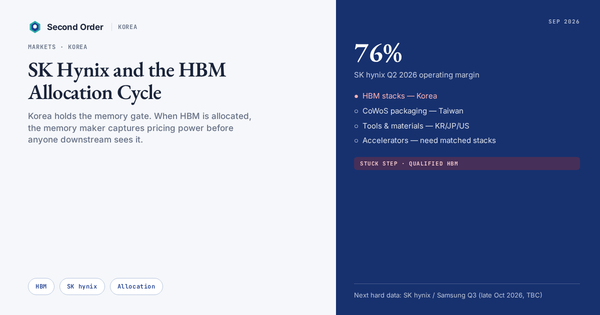
Korea HBM: Who Gets Paid When AI Memory Is Still Stuck
September 2026 in one line: SK hynix's operating margin hit 76%, Korea's chip exports set another record, and HBM is still allocated to a short customer list. Who gets paid, and what dates change the read.

Korea is the memory door next to Taiwan's packaging gate. SK hynix and Samsung set records in Q2 2026, chip exports hit another high in August, and HBM is still allocated, not freely sold. Here is who gets paid, which step is still stuck, and the dates to watch.
KOREA PULSE · Data as at 18 Sep 2026 · Next update: after SK hynix / Samsung Q3 results
Affects: Semiconductors · Hyperscalers · Neoclouds — Markets: Korea · Taiwan · US
Education only, not advice to buy or sell any security. Figures are from company and government releases dated as shown.
The numbers that matter this month
SK hynix revenue (Q2 2026)
KRW 79.3tn
+51% QoQ · +257% YoY
Record quarterSK hynix operating margin (Q2 2026)
76%
Operating profit KRW 60.5tn
Pricing powerSamsung DS revenue (Q2 2026)
KRW 127.5tn
OP KRW 89.2tn · +56% QoQ sales
Memory-ledKorea chip exports (Aug 2026)
US$46.65bn
+209% YoY · ~47.5% of total exports
Shipping at record volumeHBM market share by revenue (Q2 2026)
SK 50% · Samsung 33%
Micron 18% (Counterpoint)
Korea still dominatesHBM supply mode (Sep 2026)
Allocated under LTAs
SK ~10 customers · Samsung up to ~70% capacity to LTAs
Still the bottleneckSources: SK hynix (29 Jul 2026), Samsung Electronics (30 Jul 2026), MOTIE via Seoul Economic Daily (1 Sep 2026), Counterpoint Research (2 Sep 2026). Status chips are Second Order's read.
Why does Korea matter so much for AI chips?
Because the scarce memory that sits next to an AI GPU is made mostly in Korea.
Every AI build needs the same three pieces: the accelerator, the high-speed memory stacked beside it, and the package that joins them. Taiwan does most of the leading-edge chipmaking and CoWoS packaging. Korea does most of the HBM. The big buyers are the hyperscalers and the neoclouds. A large share of what they spend on memory ends up with SK hynix and Samsung.
HBM stacks
Who: SK hynix, Samsung (Micron third)
Paid: Contracted volume at negotiated rates; mix toward newest stacks
Server DRAM and eSSD
Who: Same Korean makers
Paid: Rising contract prices as AI capacity takes wafer share
Advanced packaging (CoWoS)
Who: Mostly Taiwan, not Korea
Paid: See the Taiwan Pulse
Finished accelerators
Who: GPU and ASIC designers
Paid: Cannot ship full-spec parts without matched HBM
What the labels mean: Still the bottleneck = this step limits how many AI chips can ship. Hard to get enough = supply is scarce relative to demand. Labels are Second Order's read from the sources at the end.
If you only remember one thing: HBM and CoWoS are neighbours. A packaging slot without stacks leaves racks unfinished. Stacks without packaging sit in crates. Korea gets paid when stacks ship under contract. Taiwan gets paid when packages ship. Read both clocks.
New to the memory gate? Start with HBM, explained. For the country mechanism, read SK hynix and the HBM allocation cycle.
What does HBM supply look like this month?
Still tight, with the newest generation starting to ship and most near-term output spoken for.
SK hynix said on 29 Jul 2026 that HBM4 mass shipments began in the second quarter and that it will ramp production in the second half. HBM4E samples shipped in the first half, with volume production aimed at 2027. The company said it has long-term agreements with around 10 key customers.
Samsung said on its Q2 call (30 Jul 2026) that HBM4 sales in the third quarter are expected to more than triple from the second quarter, and that HBM4 should account for more than 60% of its HBM sales in the second half. It also said industry supply is falling short of customer demand and that a meaningful supply increase looks hard through 2028. Press reports of the call said Samsung plans to allocate up to about 70% of future capacity to long-term agreements.
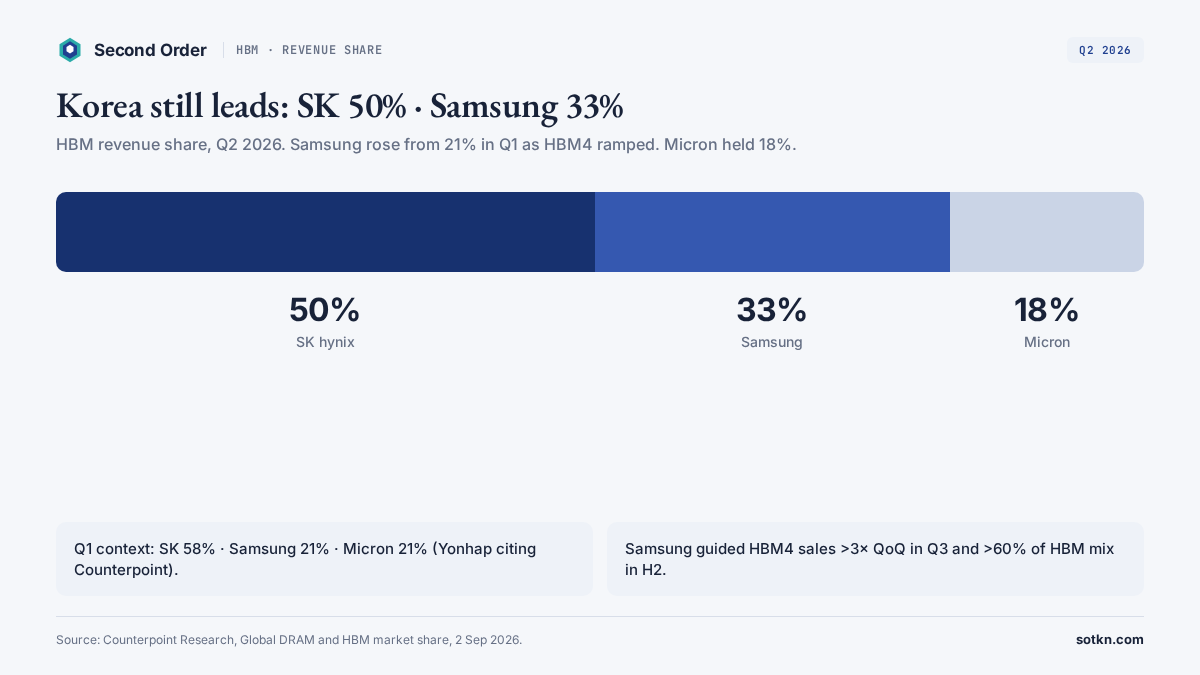
Counterpoint Research's Q2 2026 HBM revenue shares (published 2 Sep 2026): SK hynix 50%, Samsung 33%, Micron 18%. That is still a Korea-led market. Samsung's share rose from 21% in Q1, reflecting its HBM4 ramp.
What this tells you: the stuck step is not "all DRAM." It is qualified HBM stacks for leading AI platforms, sold under multi-year contracts. Open supply for mid-tier buyers remains thin.
What it does not tell you: the exact bit shortfall this quarter. Suppliers do not publish a public HBM supply-demand ratio each month. Watch allocation language, mix toward HBM4, and whether bit-growth guidance rises while that language cools.
How did Samsung and SK hynix get paid in Q2 2026?
On volume of high-value memory, rising prices, and contracted AI demand — not on spot sales of leftover stacks.
SK hynix — Q2 2026
Revenue KRW 79.32tn
Operating profit KRW 60.54tn · Margin 76% · Net income KRW 93.92tn
Samsung Electronics — Q2 2026
Company revenue KRW 171.5tn
Company OP KRW 89.5tn · DS revenue KRW 127.5tn · DS OP KRW 89.2tn
SK hynix cash (end-Q2 2026)
Cash KRW 88tn
+KRW 33.6tn from end-Q1 · Net cash KRW 69.4tn
Sources: SK hynix newsroom (29 Jul 2026); Samsung Global Newsroom (30 Jul 2026). Preliminary K-IFRS figures as published.
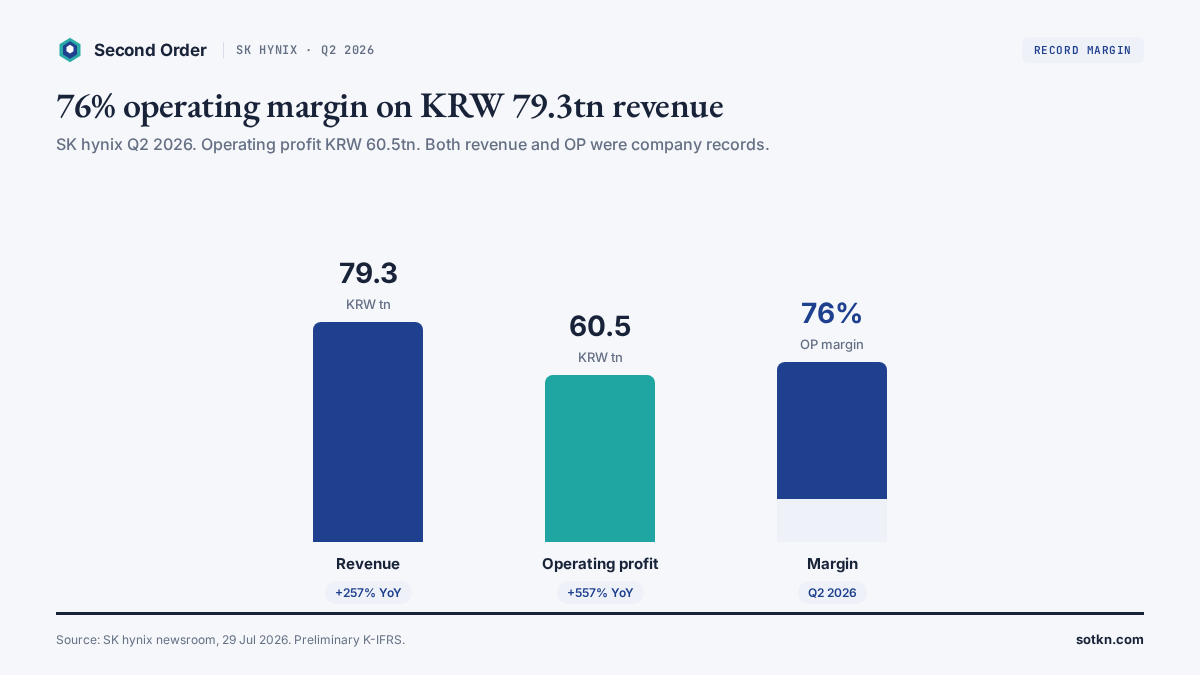
SK hynix said first-half 2026 revenue crossed KRW 100 trillion for the first time. On our arithmetic from the published quarters: Q1 revenue KRW 52.58tn + Q2 KRW 79.32tn = KRW 131.9tn for H1. That is the scale of the cash print at the memory door.
Samsung's Memory Business set another record for quarterly revenue and operating profit, led by server products. The company said it scaled HBM4 sales and shipped the industry's first HBM4E samples to major customers. Press coverage of the call put Memory Business revenue near KRW 120.8 trillion for the quarter; treat that line as reported from the call, not as a separate audited segment in the newsroom release.
Both firms are paid three ways when HBM is scarce: contracted volume, mix toward the newest stack, and qualification position on new platforms. List price alone understates the cash path. See the evergreen allocation cycle for the reading rule.
Is the story pricing, or capacity?
Both. Prices rose because capacity for advanced DRAM is finite and is being steered to HBM and server products first.
SK hynix said DRAM ASP rose about 30% quarter-on-quarter in Q2, and NAND ASP about 50%, with bit shipments up only high-single-digit for DRAM and mid-teens for NAND. That gap — prices up far more than bits — is the signature of a tight market.
Samsung's Q2 call framed the shortage as structural: new fabs take more than three and a half years from construction to wafers, so a meaningful supply add through 2028 is hard. Unmet demand this year carries into next year. That is why long-term agreements matter. They lock who gets stacks before open supply exists.
HBM4 is the capacity story inside the price story. SK hynix began mass shipments in Q2 and plans a second-half ramp. Samsung guided HBM4 revenue to more than triple in Q3 and to exceed 60% of its HBM mix in H2. Newer stacks need more process steps and bonding tools. Announced nameplate capacity is not the same as qualified stacks in a GPU package.
The so-what: watch whether bit-growth guidance rises while allocation language cools. If prices stay high but qualified shipments stay flat, the stuck step is still yield and allocation. If shipments rise and mid-tier access improves, the door is loosening.
How big were Korea's chip exports in August 2026?
Another monthly record, and memory did most of the work.
The Ministry of Trade, Industry and Energy said August semiconductor exports reached US$46.65 billion, up 209% from a year earlier, and about 47.5% of Korea's total exports of US$98.25 billion (Seoul Economic Daily, 1 Sep 2026). Memory exports were US$40.94 billion, up 290.2% (Digital Today, citing MOTIE, mid-Sep 2026).
Memory exports (Aug 2026)
HBM and server DRAM led the mix
US$40.94bn
+290.2% vs a year earlier
All semiconductors (Aug 2026)
Third straight month above US$40bn
US$46.65bn
+209% vs a year earlier
Our math: memory share of chip exports
US$40.94bn ÷ US$46.65bn
~87.8%
Second Order calculation from MOTIE figures
Early September (1–10 Sep)
Preliminary customs; not a full month
US$16.48bn
Chip exports +270.1% YoY · 47.1% of period exports
Sources: MOTIE via Seoul Economic Daily (1 Sep 2026); Digital Today (MOTIE memory line); Korea Customs Service prelim via JKN / BTW (11 Sep 2026). Early-September figures are 10-day totals only.
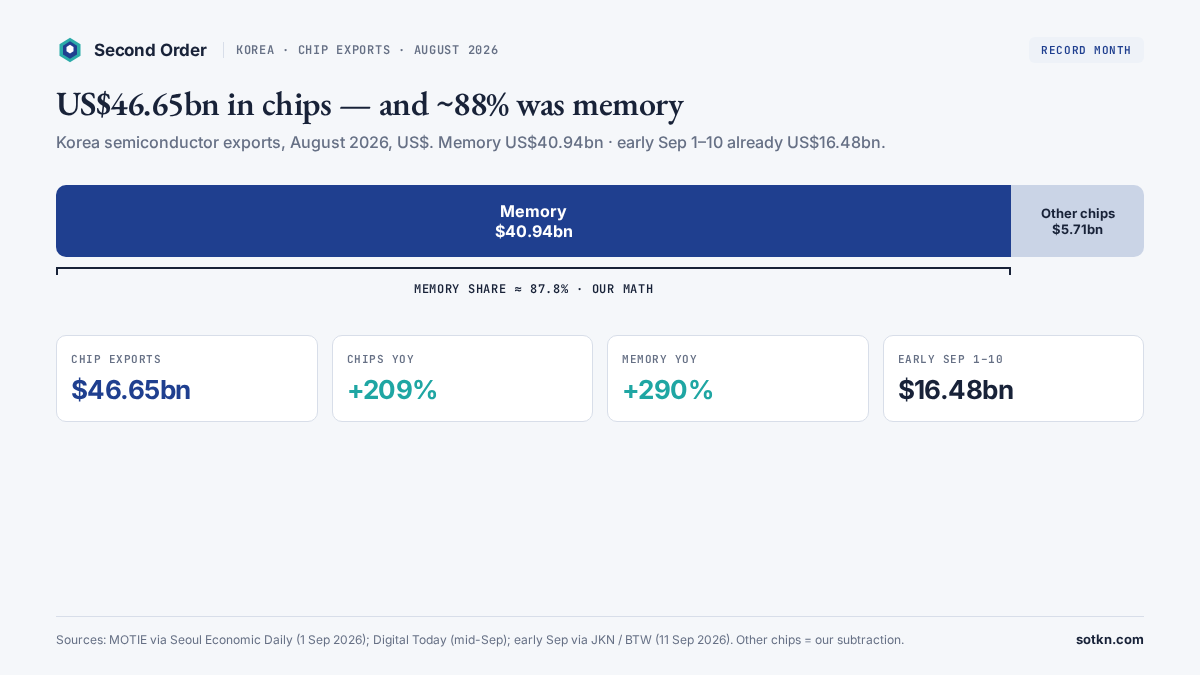
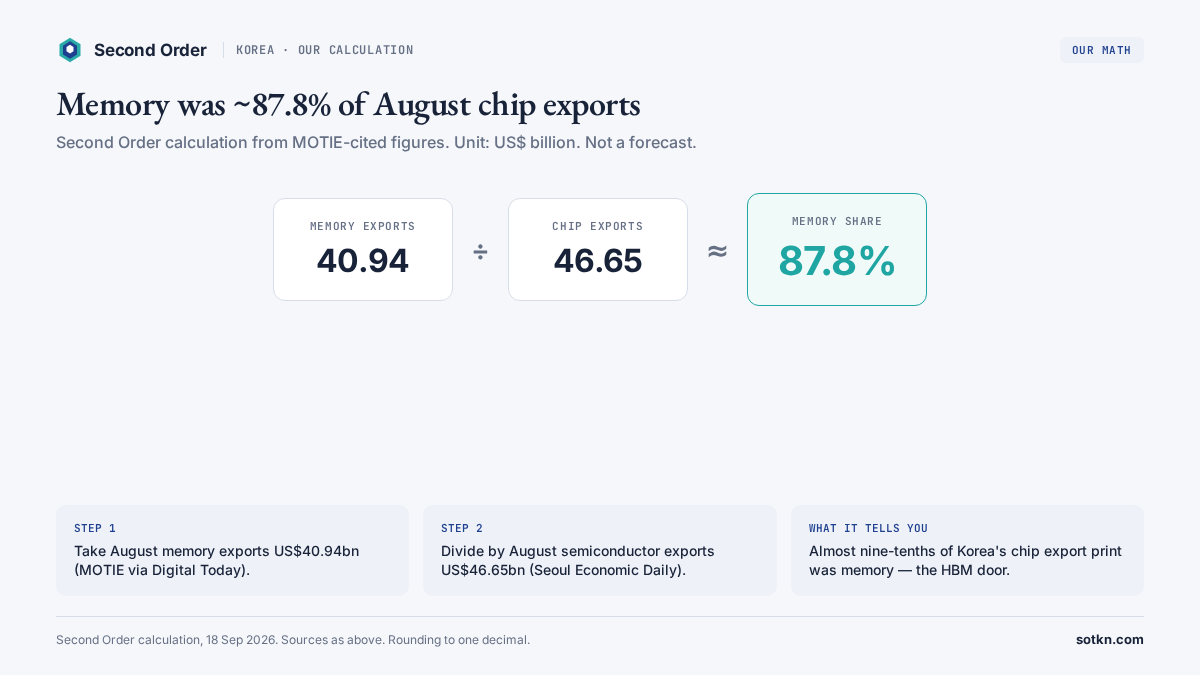
What this tells you: Korea's export boom is a memory story. Nearly nine-tenths of August chip exports were memory. System semiconductors grew much more slowly. The cash is sticking at the memory door, not spreading evenly across the chip chain.
What it does not tell you: that every DRAM product is scarce. HBM and server DRAM are the products that bind. Older phone and PC memory can look freer while AI stacks stay allocated.
Where does the money stick in Korea?
At the steps with the fewest qualified suppliers.
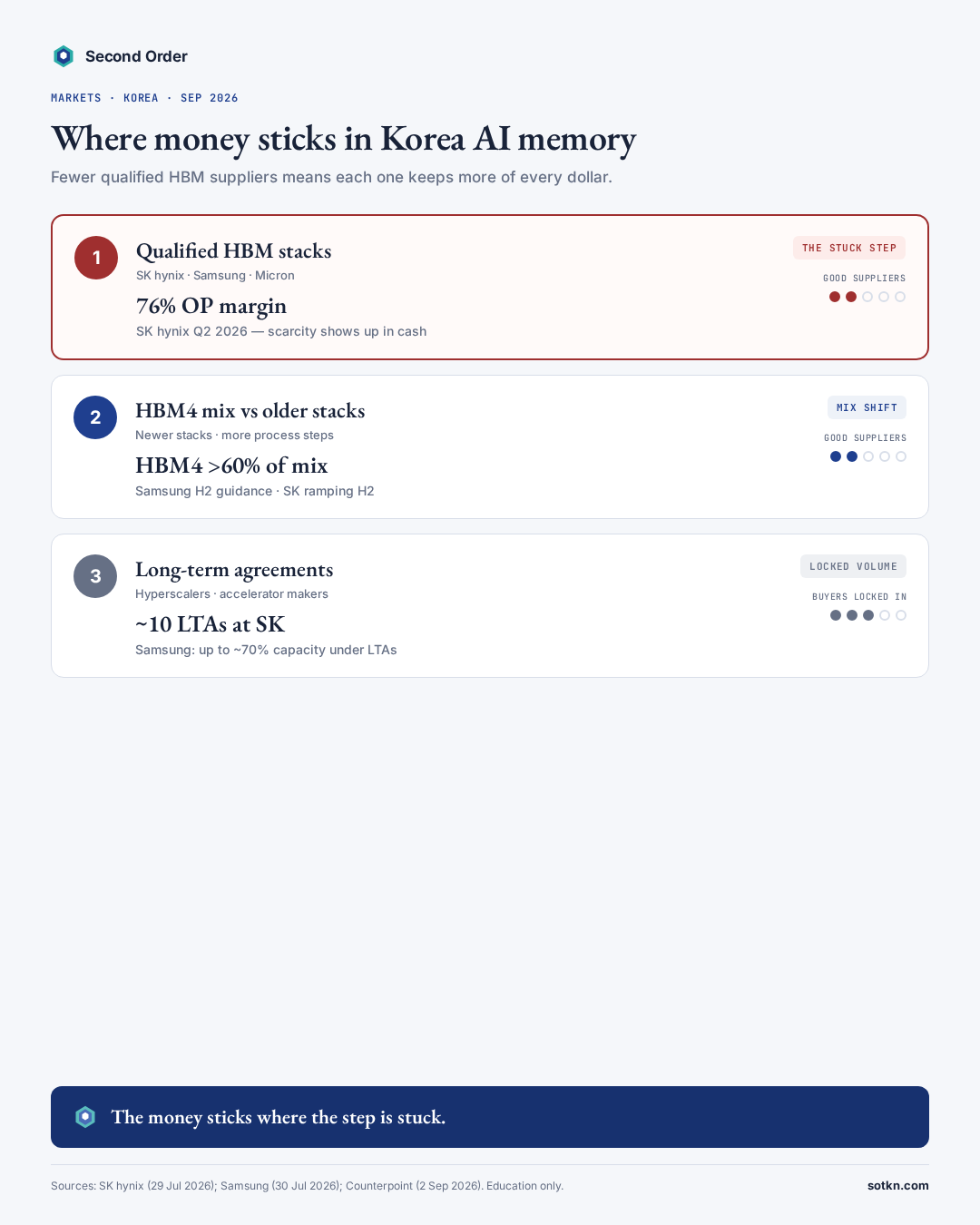
1. Qualified HBM stacks. SK hynix and Samsung (with Micron third) are the only scaled suppliers of AI-class HBM. When a platform qualifies one or two suppliers, those firms keep more of each dollar. A 76% operating margin at SK hynix is the evidence for Q2.
2. Mix toward the newest generation. HBM4 and server products earn more than commodity DRAM on the same wafer capacity. Revenue can rise while bit shipments grow only modestly. That is why "sold out" language and bit-growth tables must be read together.
3. Long-term agreements. Contracts with a short list of hyperscalers and accelerator makers lock volume and pricing before open supply exists. SK hynix cited around 10 LTAs. Samsung said it is expanding LTAs and may put up to about 70% of capacity under them. Mid-tier buyers wait.
The pattern matches Taiwan: the money sticks where the step is stuck. In Taiwan that step is packaging. In Korea it is HBM.
Is HBM still the stuck step?
Yes for AI-class stacks. The shortage is shifting from "no HBM3E" toward "HBM4 ramp still catching demand," but the door is not open.
Three cautions before you treat any capacity headline as relief:
- Generation matters. Capacity for last year's stack does not fill this year's platform. HBM3E and HBM4 are different clocks.
- Qualified is not announced. Sample shipments and mass shipments are different. SK hynix began HBM4 mass shipments in Q2; the broader ramp is second-half work.
- Packaging can re-bind. Even if Korean stacks arrive, CoWoS can still delay the finished module. Read Korea and Taiwan together.
If HBM loosens while packaging stays tight, the stuck step moves back to Taiwan. If both loosen, the next candidates are power and site delivery for data centres.
What comes next?
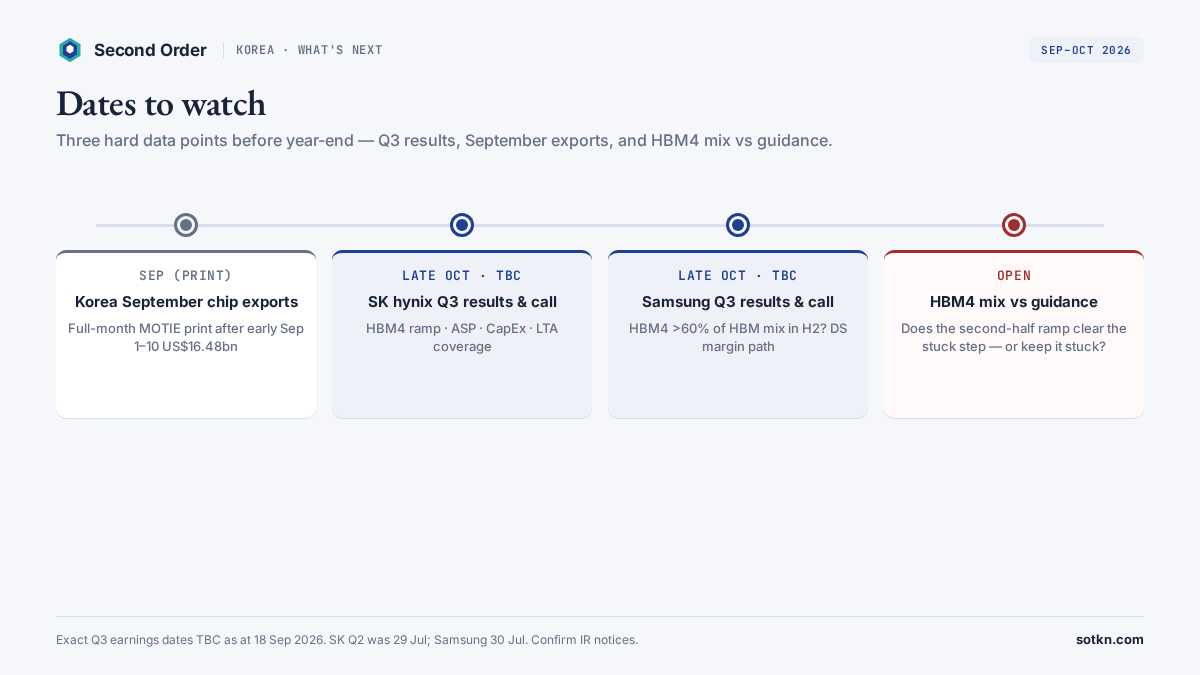
The next six weeks bring company results and a full-month export print.
~1 Oct 2026
Korea September trade / chip exports
Does the early-month surge hold for the full month?
Early Oct 2026 (TBC)
Samsung Q3 2026 preliminary results
Memory and DS contribution; any HBM4 mix update
Late Oct 2026 (TBC)
SK hynix and Samsung Q3 results / calls
HBM4 shipment ramp; LTA commentary; bit-growth vs allocation language
Through H2 2026
HBM4 volume ramp
Samsung guided HBM4 >60% of HBM sales in H2; SK hynix guided a significant HBM4 shipment rise
Exact Q3 earnings dates were not all confirmed as at 18 Sep 2026. SK hynix held Q2 results on 29 Jul 2026; Samsung on 30 Jul 2026. Calendar dates marked TBC until company notices.
What would change this view?
The "HBM is still stuck in Korea" read weakens if:
- Bit-growth guidance rises while allocation language cools
- Mid-tier buyers report shorter HBM lead times, not just top-tier LTAs
- Three suppliers qualify on the same leading platform at similar timing
- HBM4 mix rises but operating margins fall for reasons other than a planned yield ramp
- Packaging, not memory, becomes the louder gate again on GPU ship dates
- Hyperscaler or neocloud memory commitments are cut or deferred in public commentary
It stays intact while LTAs cover most near-term output, HBM4 is still ramping into unmet demand, and Korea's export print remains memory-heavy.
Practical takeaways
- Korea is the memory door; Taiwan is the packaging door. Read them as a pair
- SK hynix's 76% Q2 margin and Samsung's DS print show who gets paid when stacks are scarce
- Nearly 88% of August chip exports were memory on our MOTIE-based math
- HBM is still allocated under long agreements — that is the stuck step, not all DRAM
- Late October Q3 calls are the next hard read on HBM4 shipments vs allocation talk
FAQ
Why is Korea so important for AI chips?
Korea hosts the largest share of AI-class HBM production. SK hynix and Samsung supply most of the high-speed memory stacked beside leading AI GPUs.
What was SK hynix's Q2 2026 result?
Revenue of KRW 79.32 trillion, operating profit of KRW 60.54 trillion, and a 76% operating margin, all records for the company (29 Jul 2026).
What were Korea's semiconductor exports in August 2026?
About US$46.65 billion, up 209% from a year earlier, or roughly 47.5% of total exports (MOTIE via Seoul Economic Daily, 1 Sep 2026).
Is the HBM shortage over?
Not for AI-class stacks. Both SK hynix and Samsung describe demand ahead of supply, with long-term agreements covering much of near-term output. HBM4 is ramping in the second half of 2026.
Who leads the HBM market?
Counterpoint's Q2 2026 revenue shares put SK hynix at 50%, Samsung at 33%, and Micron at 18% (published 2 Sep 2026).
When is the next Korea Pulse update?
After SK hynix and Samsung Q3 2026 results, expected in late October 2026, plus the full September export print.
Keep reading on the map
- Explained: HBM, explained · CoWoS, explained
- Markets: Korea hub · SK hynix HBM allocation · Taiwan Pulse (Sep 2026) · Semiconductors
- The Stack: Hyperscalers · Neoclouds
How we made this
We use company filings, government statistics and named trade press. Every number carries a date. Capacity and LTA figures from earnings calls are labelled as company statements or press reports of those calls. The memory-share-of-exports figure is our own arithmetic from MOTIE totals and is shown in full. Status chips are our read and change when the data does. Spot an error? Reply to any Wire email and we will correct it and note the change here.
Sources
- SK hynix, 2Q26 financial results (29 Jul 2026): https://news.skhynix.com/en/q2-2026-business-results/
- SK hynix Q2 results via PR Newswire (28–29 Jul 2026): https://www.prnewswire.com/news-releases/sk-hynix-announces-2q26-financial-results-302837085.html
- Yonhap, SK hynix Q2 record profit (29 Jul 2026): https://en.yna.co.kr/view/AEN20260729001053320
- Samsung Global Newsroom, Q2 2026 results (30 Jul 2026): https://news.samsung.com/global/samsung-electronics-announces-second-quarter-2026-results
- Samsung Newsroom Malaysia mirror, Q2 2026 DS figures: https://news.samsung.com/my/samsung-electronics-announces-second-quarter-2026-results
- Seoul Economic Daily, Samsung HBM4 / shortage / LTA call coverage (30 Jul 2026): https://en.sedaily.com/finance/2026/07/30/samsung-sees-deepening-memory-shortage-q3-hbm4-sales-to
- Asia Business Daily, Samsung shortage through 2028 / HBM4 mix (30 Jul 2026): https://www.asiae.co.kr/en/article/2026073012180322044
- EDAILY, Samsung DS and Memory call figures (30 Jul 2026): https://en.edaily.co.kr/news/eda202607305772/
- Seoul Economic Daily, Korea August chip exports (1 Sep 2026): https://en.sedaily.com/finance/2026/09/01/korea-chip-exports-hit-record-466-billion-on-ai-memory-boom
- Digital Today, MOTIE memory export line US$40.94bn (mid-Sep 2026): https://www.digitaltoday.co.kr/en/view/103323/semiconductor-export-boom-consumer-sentiment-linked-industries-why
- JKN / Korea Customs Service, early September 1–10 exports (11 Sep 2026): https://news.jkn.co.kr/post/982973
- BTW Media, early September chip exports (Sep 2026): https://btw.media/en/south-korea-chip-exports-jump-270-in-early-september
- Counterpoint Research, Global DRAM and HBM market share quarterly (2 Sep 2026): https://counterpointresearch.com/en/insights/global-dram-and-hbm-market-share
- TrendForce HBM Industry Analysis 3Q26 abstract (5 Aug 2026): https://www.trendforce.com/research/download/RP260805KC3
- Second Order, HBM explained (12 Sep 2026): https://www.sotkn.com/explained/hbm-explained/
- Second Order, SK hynix HBM allocation (14 Sep 2026): https://www.sotkn.com/markets/korea/sk-hynix-hbm-allocation/
- Second Order, Taiwan Pulse Sep 2026: https://www.sotkn.com/markets/taiwan/taiwan-tsmc-revenue-september-2026/
External links: add `rel="nofollow noopener"`. Internal sotkn.com links stay dofollow.
Second Order publishes education, not investment advice. Nothing here is a recommendation to buy or sell any security.