
CoreWeave and How Neocloud Contracts Become Cash
A contracted backlog is not revenue. How neocloud contracts convert to cash, what the financing structure does to the risk, and what would break the model.
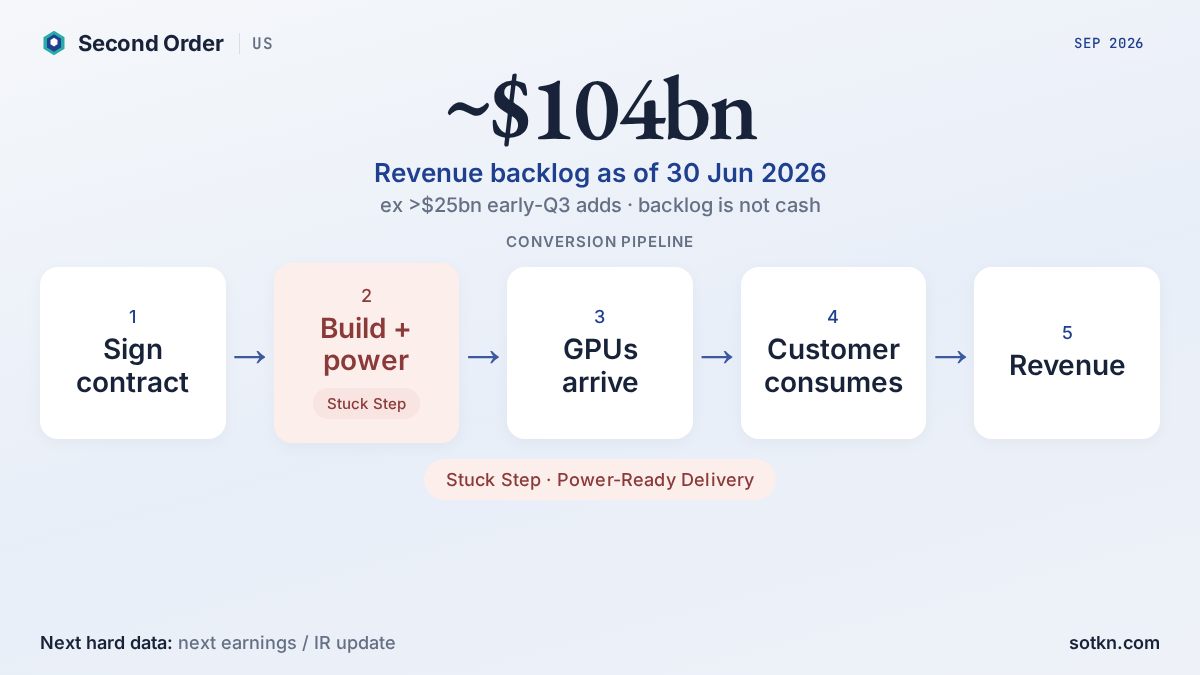
The US holds the broadest entity set in the AI trade — neoclouds, equipment makers, data-centre landlords and the hyperscalers whose capex sets prices for everyone else. The neocloud layer is the one where the mechanism is least understood, because a very large number gets reported as though it were revenue when it is not.
US MARKETS · Data as at 19 Sep 2026 · Next update: after next CoreWeave earnings / IR print
Affects: Neoclouds · Hyperscalers · US
Education only. Nothing here is a recommendation to buy or sell any security.
Numbers that matter
CoreWeave revenue (Q2 2026)
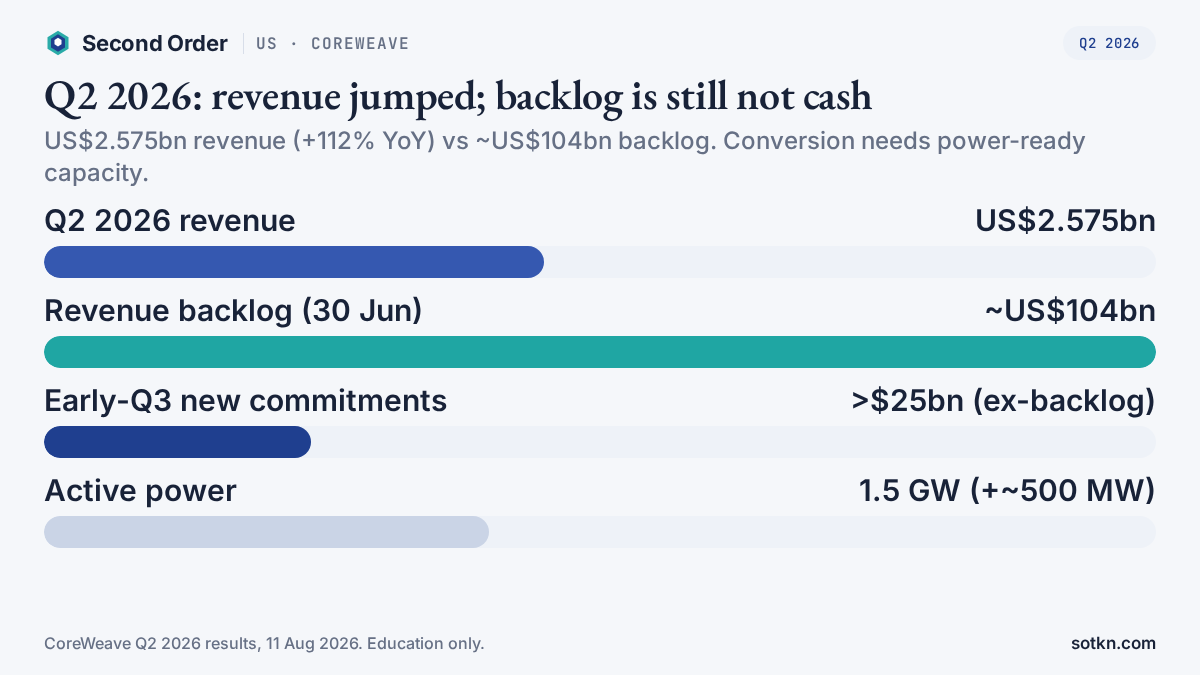
US$2.575bn
+112% YoY
Record quarterRevenue backlog (30 Jun 2026)
~US$104bn
Excludes >US$25bn early-Q3 adds
Not yet cashActive power
1.5 GW
Expanded by nearly 500 MW in the quarter
Conversion fuelContracted power
~3.7 GW
Company disclosure, Q2 2026
Watch energised shareInterest expense, net (Q2)
US$640m
Debt service does not wait
Structure riskSource: CoreWeave Reports Strong Second Quarter 2026 Results, 11 Aug 2026. Revenue backlog includes RPO plus other amounts the company estimates will be recognised under committed contracts, subject to delivery. Status chips are Second Order's read.
What is a contracted backlog, and why is it not revenue?
A backlog is the total value of signed customer commitments not yet delivered. For a neocloud it typically means a customer has agreed to pay for GPU capacity over several years, starting when that capacity exists.
Three conditions sit between the signature and the cash:
- The hall has to be built and powered. Capacity that exists on a slide earns nothing.
- The GPUs have to arrive. Which puts the backlog behind the HBM and packaging gates.
- The customer has to remain able to pay. Concentrated counterparties make this a real variable, not a formality.
A headline backlog number compresses all three into one figure. Reading it as revenue is the single most common error on this layer.
What gets reported
Why does the financing structure decide the risk?
Because neoclouds buy the hardware before they earn from it, and the gap has to be funded by someone.
A scaled neocloud finances GPU fleets with debt secured against the hardware and, increasingly, against the contracts themselves. That structure works cleanly while contracts perform. It is unforgiving if utilisation disappoints, because the interest does not wait for the customer. CoreWeave's Q2 2026 interest expense, net, was US$640 million — a reminder that the clock on the liability side is independent of conversion.
The comparison that matters is not neocloud versus neocloud. It is neocloud versus hyperscaler, and the difference is where the money comes from:
Hyperscaler expansion
Who: Cash from unrelated businesses
Paid: Demand dip absorbed across many lines; lender holds nothing specific
Scaled neocloud expansion
Who: Debt, leases, equity, customer prepayments
Paid: Demand dip lands on debt service; lender may hold GPUs and contracts
Speed to deploy
Who: Neocloud's core product
Paid: Faster than hyperscaler internal process — customers pay for that
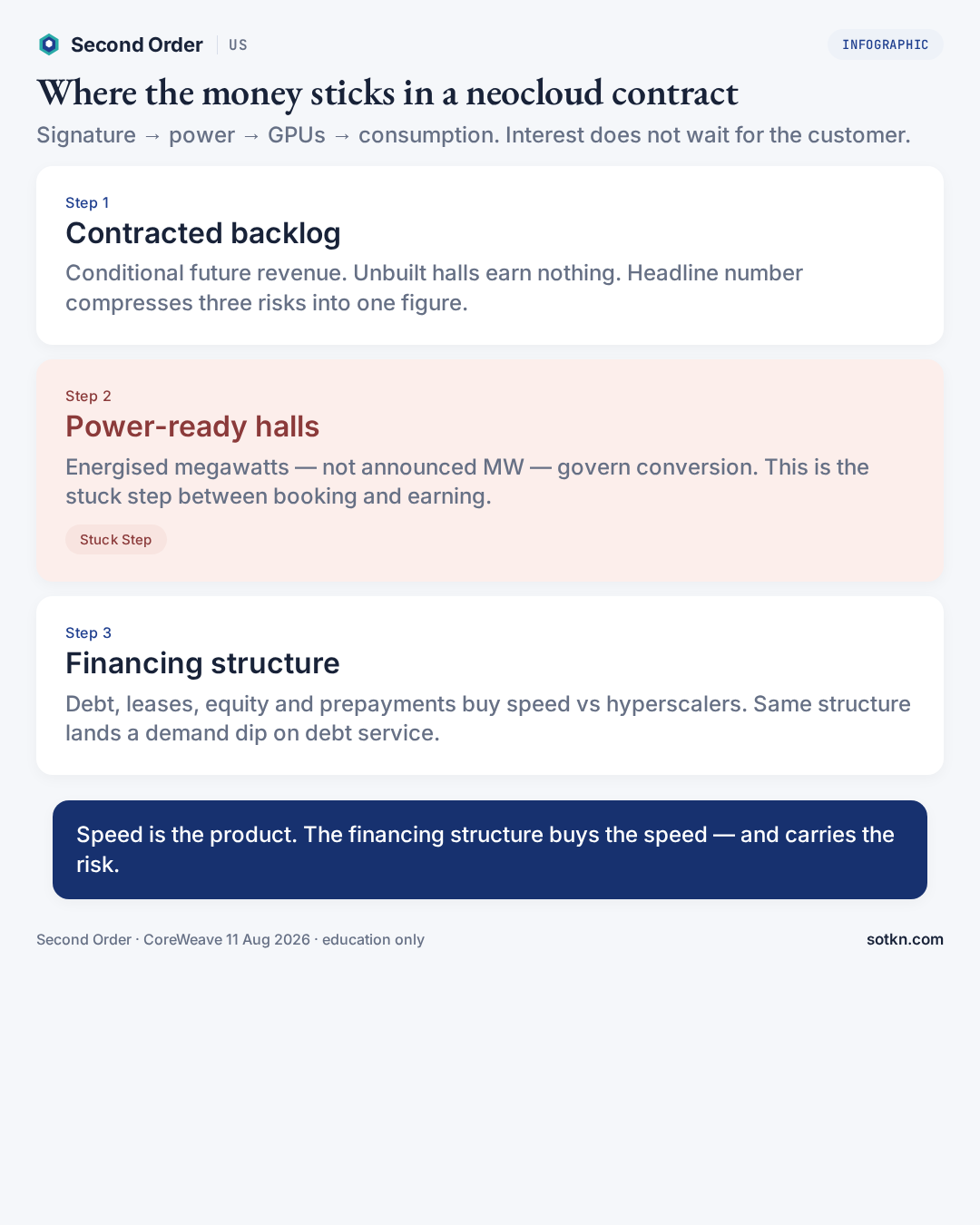
Speed is the product. A neocloud exists because it can stand up a cluster faster than a hyperscaler's internal process allows, and customers pay for that. The financing structure is what buys the speed, and it is also the risk.
What do you actually watch to tell a booking from an earning?
Five disclosures, in rough order of usefulness:
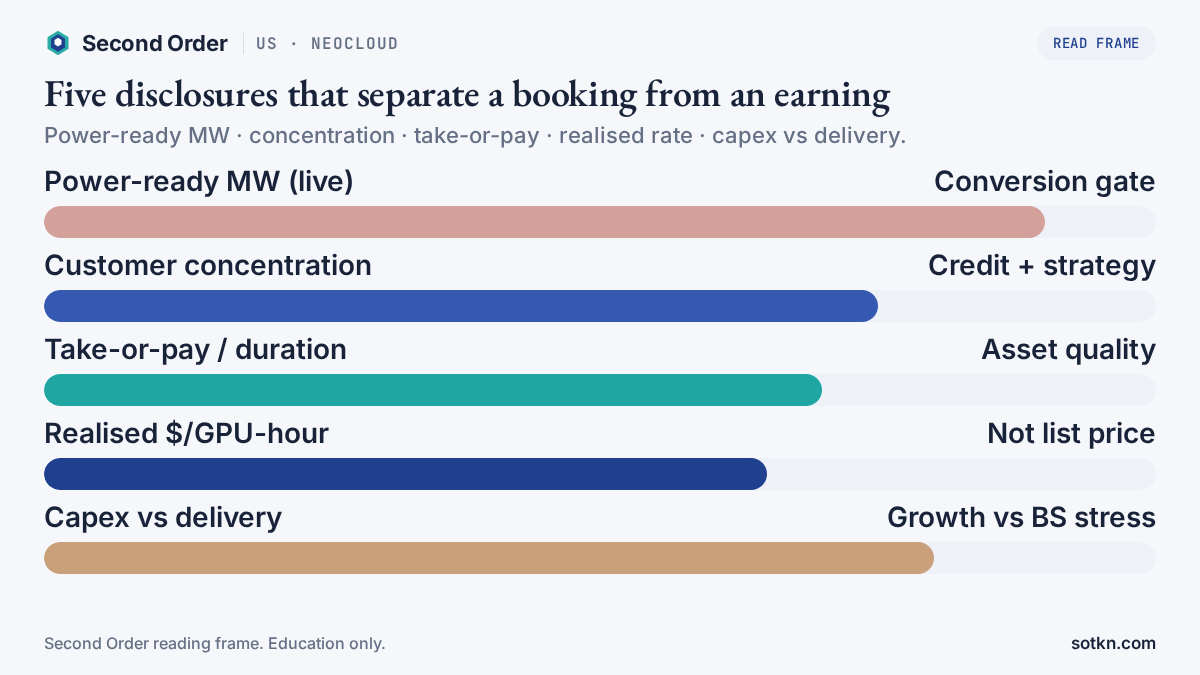
Power-ready capacity, in megawatts. Not contracted megawatts, not announced megawatts — energised and running. This is the physical constraint on converting backlog, and it connects to the grid queue that governs every hall. CoreWeave said active power reached 1.5 GW after expanding by nearly 500 MW in Q2 2026, with total contracted power about 3.7 GW.
Customer concentration. If a small number of counterparties dominate the backlog, the backlog inherits their credit and their strategy. A customer deciding to build its own capacity changes the picture without any operational failure by the neocloud.
Contract duration and take-or-pay terms. A commitment that bills whether or not the customer consumes is a different asset from one that bills on usage. CoreWeave said contracted commitments generated 98% of Q2 revenue — useful context, not a substitute for reading the terms.
Realised rate per GPU-hour. Not list price. As covered in neocloud explained, the discount ladder is where the margin actually sits.
Capex against delivery. Heavy capex with backlog converting on schedule is a growth business. Heavy capex with conversion slipping is a balance-sheet problem forming. Q2 purchases of property and equipment were several billion dollars — the point is the pairing with power-ready delivery, not the absolute size alone.
How does this connect to the rest of the stack?
The neocloud sits at the point where physical scarcity turns into a service. It is downstream of memory and packaging, downstream of the grid, and upstream of the software that eventually has to pay for all of it.
That position explains an otherwise confusing pattern: scarcity upstream is simultaneously good and bad for a neocloud. Good, because whoever already owns live GPUs faces less competition and firmer pricing. Bad, because the next tranche of fleet is harder and more expensive to buy. A quarter can show strong utilisation and constrained growth at the same time without anything being contradictory.
Related doors: TSMC CoWoS capacity · SK Hynix HBM allocation · data-centre landlords.
How do international readers get exposure?
The US neocloud and data-centre complex is accessible through ordinary listed equity for most international brokers, which is not true of every lane on this site. Exposure also arrives indirectly — through the equipment suppliers that fill the halls, the landlords that own them, and the utilities that power them. If you use Interactive Brokers, this soft referral opens an account path: Interactive Brokers referral. That is exposure language, not a recommendation. Second Order does not publish buy lists.
What would change this view?
The constructive read on contracted neocloud capacity weakens if:
- Power-ready megawatts consistently lag contracted megawatts, showing conversion is slipping
- Customer concentration rises while contract duration shortens
- Realised rate per GPU-hour falls while fleet size grows — the signature of capacity landing into softer demand
- Hyperscalers expand AI instance supply aggressively enough to remove the speed advantage
- A major counterparty shifts to building its own capacity
- Refinancing terms tighten materially, which would show up before any operational weakness does
It strengthens if power-ready capacity converts on schedule, realised rates hold as the fleet grows, and contract terms lengthen.
Practical takeaways
- A backlog is conditional future revenue, not revenue
- Power-ready megawatts is the number that governs conversion
- The financing structure buys the speed and carries the risk
- Upstream scarcity firms pricing and slows growth simultaneously
- Realised rate beats list price every time
FAQ
What is a neocloud backlog?
The total value of signed customer commitments not yet delivered. It becomes revenue only as capacity is built, powered, and consumed.
What was CoreWeave's Q2 2026 revenue and backlog?
Revenue was US$2.575 billion, up 112% from a year earlier. Revenue backlog was about US$104 billion as of 30 Jun 2026, not including more than US$25 billion of net new commitments added in early Q3 (CoreWeave, 11 Aug 2026).
Why do neoclouds carry so much debt?
They buy GPU fleets before earning from them. Debt secured against the hardware, and sometimes against the contracts, funds the gap between purchase and revenue.
What is the main risk in a neocloud contract?
Customer concentration combined with delivery risk. If a small number of counterparties dominate the backlog and capacity conversion slips, the debt service does not slip with it.
How is CoreWeave different from a hyperscaler?
Its revenue is concentrated on accelerator time rather than spread across many cloud services, and its expansion is funded externally rather than from unrelated business cash flow.
Does upstream GPU scarcity help or hurt a neocloud?
Both. It firms pricing on the fleet already running and makes the next tranche harder and costlier to buy.
Keep reading on the map
- Explained: Neocloud, explained · Speed to power · AI landlords
- Markets: US · Taiwan · Korea
- Stack doors: Neoclouds · Hyperscalers
How we made this
Upgraded from the Sep 2026 neocloud-contracts Markets piece to the locked Pulse presentation (in-short, signal/chain stacks, FAQPage schema, image pack). Q2 2026 figures from CoreWeave's 11 Aug 2026 release. Thesis unchanged.
Sources
- CoreWeave, Inc. — Reports Strong Second Quarter 2026 Results, 11 Aug 2026 (investors.coreweave.com)
- Company backlog footnote: RPO plus estimated future revenue under committed contracts, subject to delivery
- Second Order neocloud explained · speed to power
Disclaimer: Education only. Not investment advice. Figures are as reported by CoreWeave on the dates shown; backlog is not revenue. Second Order may update this door when the next earnings print lands.