Samsung Electro-Mechanics books ₩879bn AI server capacitor deal
Samsung Electro-Mechanics signed a ₩879 billion one-year supply deal for AI server capacitors, its eighth long-term parts contract this year, which shows the tiny parts around every AI chip are now booked a year ahead like memory and packaging.
Samsung Electro-Mechanics has signed a ₩879 billion, one-year deal to supply multilayer ceramic capacitors (MLCCs) for AI servers from December 2026, its eighth long-term parts contract this year, which shows that the tiny parts around every AI chip are now booked a year ahead, the way memory and advanced packaging already are.
What happened?
- The contract: On 30 October 2026 Samsung Electro-Mechanics disclosed a single sales and supply contract for MLCCs worth ₩879.3 billion, signed on 29 October with a customer it named only as a "global large company". The filing set the value at US$658 million, converted at ₩1,336.30 per dollar, equal to 7.8% of the company's 2025 consolidated revenue of ₩11.31 trillion.
- The term: Supply runs from 21 December 2026 to 21 December 2027. There is no down payment or advance, the customer and main terms stay confidential until after 21 December 2027, and the company warned that the amount and period may change.
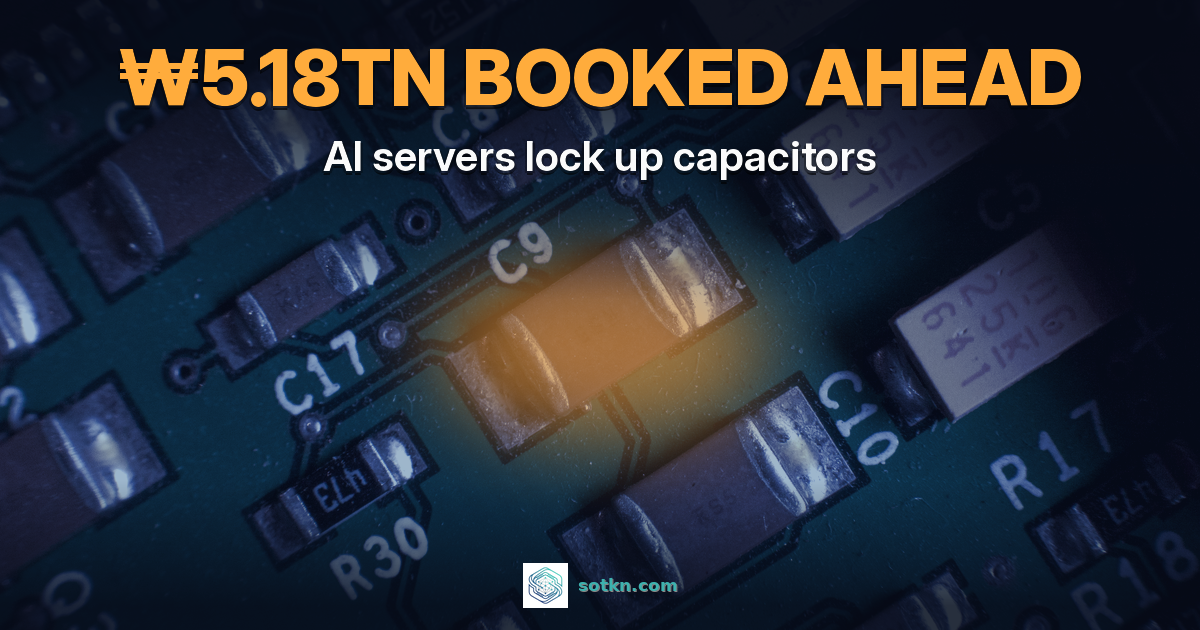
- The running total: The company said the parts are AI server MLCCs, that this is the second-largest MLCC supply contract it has disclosed this year, and that it is the eighth long-term supply agreement for core components since May. Disclosed contracts now total about ₩5.18 trillion across MLCCs, silicon capacitors, power inductors and FCBGA package substrates.
- The pipeline: Samsung Electro-Mechanics said it has signed or is negotiating long-term agreements with about 50 customers, and expects more than half of its 2027 MLCC revenue to come from them.
Why does it matter?
The direct signal: AI chips need far more capacitors, and buyers are locking supply. An MLCC is a small ceramic part that stores charge and smooths the power and current reaching a chip. The company says the MLCC capacity needed per GPU or custom accelerator doubles every year, and its September release said an AI server carries more than ten times as many MLCCs as a general server. It claims more than 40% of the AI server MLCC market.
The second-order signal: a commodity part now trades on the memory model. MLCCs used to be sold quarter to quarter, with makers building plants first and finding buyers later. Seoul Economic Daily, citing industry officials, reported that long-term agreements and advance payments are what let the company expand without carrying the old risk of empty lines. When a buyer signs for a full year of a part this small, the bind is not the part itself. It is the factory time to make high-capacity, high-voltage versions that only a few suppliers can produce.
The pace has quickened. Our arithmetic: the company's September release put its disclosed long-term contracts since May at ₩3.32 trillion, including a record ₩1.07 trillion MLCC deal for calendar 2027. Two months later the total is ₩5.18 trillion, so about ₩1.86 trillion was added in September and October, of which this deal is ₩879 billion.
Note on the count. Seoul Economic Daily described six MLCC contracts totalling ₩5.18 trillion. The company's own figure, reported by Yonhap, is eight core-component contracts across four product types. We use the company's figure.
What does it change?
Near term (to end-2027)
- 2027 capacitor supply for at least two big buyers is spoken for. The September deal covers January to December 2027 and this one runs from late December 2026 to late December 2027. Our arithmetic: together they are about ₩1.95 trillion, roughly 26% of a year of component sales if the third quarter's ₩1.88 trillion component revenue held flat for four quarters.
- The size of one deal against one quarter. Our arithmetic: ₩879 billion is about 47% of the component unit's third-quarter sales. The unit, which makes MLCCs, grew 36% from a year earlier and 14% from the second quarter, and accounted for half of group sales.
- Earnings already show it. Third-quarter sales were a record ₩3.76 trillion, up 30%, and operating profit was a record ₩691.0 billion, up 165%, led by MLCCs and FCBGA substrates for AI data centers. The company guided to continued strong AI data center demand in the fourth quarter.
Longer term (2027 and beyond)
- New capacity is coming, but slowly. Seoul Economic Daily reported that a third MLCC plant in Calamba, the Philippines, could start as early as early 2027, with added lines in Busan, lifting capacity by about 20% a year, and that capital spending is projected to double to ₩6 trillion next year. The company has not confirmed the capex figure in its results release.
- Optical modules become a second source of demand. The same report quoted the earnings call as expecting MLCC revenue for optical modules, which link GPUs at high speed, to more than triple next year. That ties the capacitor step to the optics build we track in our Catalyst on Nvidia's substrate and interposer prepayments.
- The board level is where AI servers queue. Boards, substrates and now passives all show the same pattern: orders run ahead of capacity, and customers sign or prepay to hold their place. Our Catalyst on TTM's data center boards showed the same at the circuit board.
| Metric | Value | Source name | Date |
|---|---|---|---|
| New MLCC supply contract | ₩879.3 billion (US$658 million), 7.8% of 2025 revenue | Samsung Electro-Mechanics disclosure, via Lead Economy | 30 Oct 2026 |
| Supply period | 21 Dec 2026 to 21 Dec 2027; no advance | Samsung Electro-Mechanics disclosure, via Daymark | 30 Oct 2026 |
| Long-term contracts disclosed in 2026 | about ₩5.18 trillion across 8 contracts | Samsung Electro-Mechanics, via Yonhap | 30 Oct 2026 |
| Long-term contracts at 1 September | ₩3.32 trillion, incl. ₩1.07 trillion MLCC deal for 2027 | Samsung Electro-Mechanics | 1 Sep 2026 |
| Q3 sales and operating profit | ₩3,763.3 billion (+30%); ₩691.0 billion (+165%) | Samsung Electro-Mechanics | 28 Oct 2026 |
| Q3 component unit sales | ₩1,883.0 billion (+36%) | Samsung Electro-Mechanics | 28 Oct 2026 |
| AI server MLCC market | US$1.4 billion (2025) to US$5.8 billion (2030), Goldman Sachs estimate | Samsung Electro-Mechanics | 1 Sep 2026 |
What should we watch next?
- Supply under the new contract starts on 21 December 2026. It is on our Catalyst calendar. The filing says the amount and period can change, so any amended disclosure before then would be the first sign of a revision.
- Another large deal before year-end. Seoul Economic Daily reported that a further order of around ₩1 trillion could come before the end of 2026. A ninth disclosure would confirm the pace; none would suggest buyers have covered 2027.
- The Calamba plant start. A start in early 2027 would add capacity while these contracts deliver. A delay would keep AI capacitor supply tight through 2027.
- What would weaken the catalyst: a cut or cancellation of a disclosed contract, a slowdown in AI accelerator builds that lowers MLCC needs per server, or rivals adding high-capacity lines fast enough to end the need to book a year ahead.
Also on the tape
- 29 Oct: Zhongji Innolight reported third-quarter revenue of RMB27.77 billion, up 171.83%, as sales of 800G and 1.6T optical modules for AI computing kept rising (Zhongji Innolight).
- 27 Oct: The US Department of Energy made a conditional loan commitment of up to $5 billion for Constellation nuclear uprates that would add nearly 1.1 GW across the PJM and MISO grids (US Department of Energy).
- 27 Oct: STTGDC secured a ¥93 billion green loan to fit out and run its two-building Inzai City campus near Tokyo, with 70.8 MW of combined IT capacity (STTGDC).
FAQ
What is an MLCC and why do AI servers need so many?
A multilayer ceramic capacitor is a tiny part that stores charge and smooths the power reaching a chip. AI accelerators draw large, fast-changing currents, so each new generation needs more capacitance placed close to the chip.
Who is the customer?
The filing names only a "global large company". Samsung Electro-Mechanics will disclose the customer and terms after 21 December 2027 at the customer's request.
Is the ₩879 billion guaranteed revenue?
No. It is a contract value, not booked sales, and the filing says the amount and period may change. There is no down payment or advance.
Why does a capacitor deal matter for AI data centers?
Every server tray needs these parts before it can ship. When suppliers commit a year of output in advance, a missing capacitor can hold up a rack as surely as a missing chip, which is why buyers now lock them in.
Takeaway: Samsung Electro-Mechanics' ₩879 billion deal lifts its 2026 parts contracts to about ₩5.18 trillion, so the capacitor around every AI chip is now a step that buyers book a year ahead.
References
- Lead Economy, Samsung Electro-Mechanics signs ₩879.3 billion MLCC supply contract (DART disclosure), 30 Oct 2026.
- Daymark, Samsung Electro-Mechanics discloses ₩879.3 billion MLCC supply contract, 30 Oct 2026.
- Yonhap News Agency, Samsung Electro-Mechanics wins ₩879.3 billion AI MLCC order, long-term contracts reach ₩5.2 trillion, 30 Oct 2026.
- Samsung Electro-Mechanics, Q3 2026 business results, 28 Oct 2026.
- Samsung Electro-Mechanics, ₩1.0722 trillion AI server MLCC supply contract with a global company, 1 Sep 2026.
- Seoul Economic Daily, Samsung Electro-Mechanics tops 5 trillion won in MLCC orders, 1 Nov 2026.
- Zhongji Innolight, Third quarterly report 2026 (HKEX filing), 29 Oct 2026.
- US Department of Energy, Energy Department announces $5 billion loan to boost nuclear power, 27 Oct 2026.
- STTGDC, STTGDC secures JPY93 billion green loan to support expansion of Tokyo data centre campus, 27 Oct 2026.