
China HBM Access: The Stuck Step in the Domestic AI Stack
September 2026 in one line: MIIT wants 9,800 EFLOPS by 2030, Ascend cards just got much more expensive, and advanced HBM access is still the stuck step in China’s domestic AI stack.
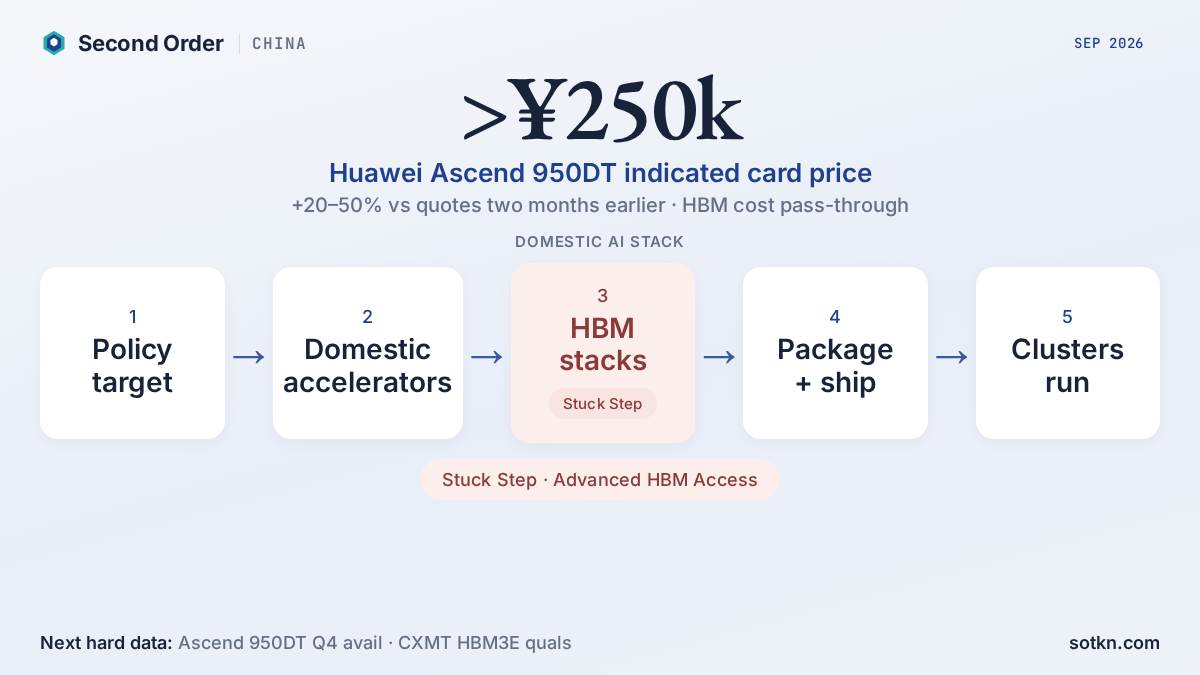
China set a 9,800-EFLOPS intelligent-compute target for 2030. The money question is not whether domestic accelerators exist — it is whether advanced HBM can reach them at legal price and volume. September’s price prints say that step is still stuck.
CHINA PULSE · Data as at 19 Sep 2026 · Next update: after Ascend 950DT availability / CXMT HBM3E volume news
Affects: Semiconductors · Hyperscalers · Neoclouds — Markets: China · Korea · Taiwan
Education only, not advice to buy or sell any security. Figures are from company, ministry and trade-press releases dated as shown.
The numbers that matter this month
MIIT intelligent compute (end-Jun 2026)
2,185 EFLOPS
+177% YoY · plan base for 2030 target
Starting pointMIIT 2030 intelligent-compute target
9,800 EFLOPS
Published 7 Sep 2026 · ~4.5× June base
Policy printAscend 950DT indicated price (Sep 2026)
>¥250,000
+20–50% vs quotes ~2 months earlier
HBM pass-throughAscend 910C board (Sep vs early 2026)
>¥110k from ~¥90k
Same board class, higher indicated cost
Cost upInfo-infra investment (2026–2030 plan)
¥3.8 trillion
Cumulative · includes more than AI halls
Capex envelopeCXMT HBM3E status (early Sep 2026)
Small-batch / risk
Samples to Cambricon & T-Head · volume ~2027
Not volume yetSources: MIIT 15th Five-Year ICT plan (published 7 Sep 2026); Reuters exclusive 10 Sep 2026; The Information via Korea Herald / TechTimes ~1–2 Sep 2026 on CXMT. Status chips are Second Order’s read.
Why does China’s AI stack matter if you cannot buy Nvidia’s best chips there?
Because Beijing is building a closed, parallel stack under access rules — and the scarce step inside that stack still sets who gets paid.
US export controls limit what advanced accelerators and, since December 2024, what advanced HBM China can buy legally. The response is domestic accelerators (Huawei Ascend, Cambricon and peers), domestic memory (CXMT), domestic packaging, and a national compute target. Our earlier Wire mapped the 9,800-EFLOPS plan as power, equipment and memory — not a simple GPU trade. This Pulse names the stuck step with September’s price evidence.
1. Policy + cluster demand
Who: MIIT / NDRC / state cloud buyers
Paid: Budget and mandate for 10k- and 100k-card clusters on domestic chips
2. Domestic accelerators
Who: Huawei Ascend, Cambricon, MetaX, Iluvatar
Paid: Price per card / board; design wins at ByteDance and peers
3. Advanced HBM stacks
Who: Legal: constrained. Grey market. CXMT (small-batch)
Paid: Price per stack; several× global where diverted
4. Package + cluster
Who: Domestic OSATs / cloud builders / power & grid
Paid: Volume and utilisation; thinner margins than scarce memory
Chain labels are Second Order’s read from MIIT (7 Sep 2026), Reuters (10 Sep 2026) and BIS Dec 2024 HBM controls. For the global HBM map see Korea HBM Pulse and for packaging Taiwan TSMC / CoWoS Pulse.
What did Ascend and Cambricon prices do in September 2026?
They rose sharply, and the reported reason is HBM cost — not a sudden leap in chip design.
On 10 Sep 2026 Reuters reported, from people familiar with pricing talks, that Huawei had lifted the indicated price of its Ascend 950DT accelerator card to more than 250,000 yuan — about 20% to 50% above quotes given roughly two months earlier. The 950DT is Huawei’s most advanced AI card publicly aimed at Q4 2026 availability. Cambricon raised indicated pricing on its planned 690 chip by about 20–30%. MetaX and Iluvatar made similar moves.
Older boards moved too. Ascend 910C boards rose to more than 110,000 yuan from about 90,000 yuan early in 2026. Ascend 950PR cards rose to more than 80,000 yuan from about 60,000 yuan at the start of the year. Memory is a large share of an AI accelerator’s bill of materials, so grey-market HBM that costs several times the open-market price feeds straight into finished-card quotes.
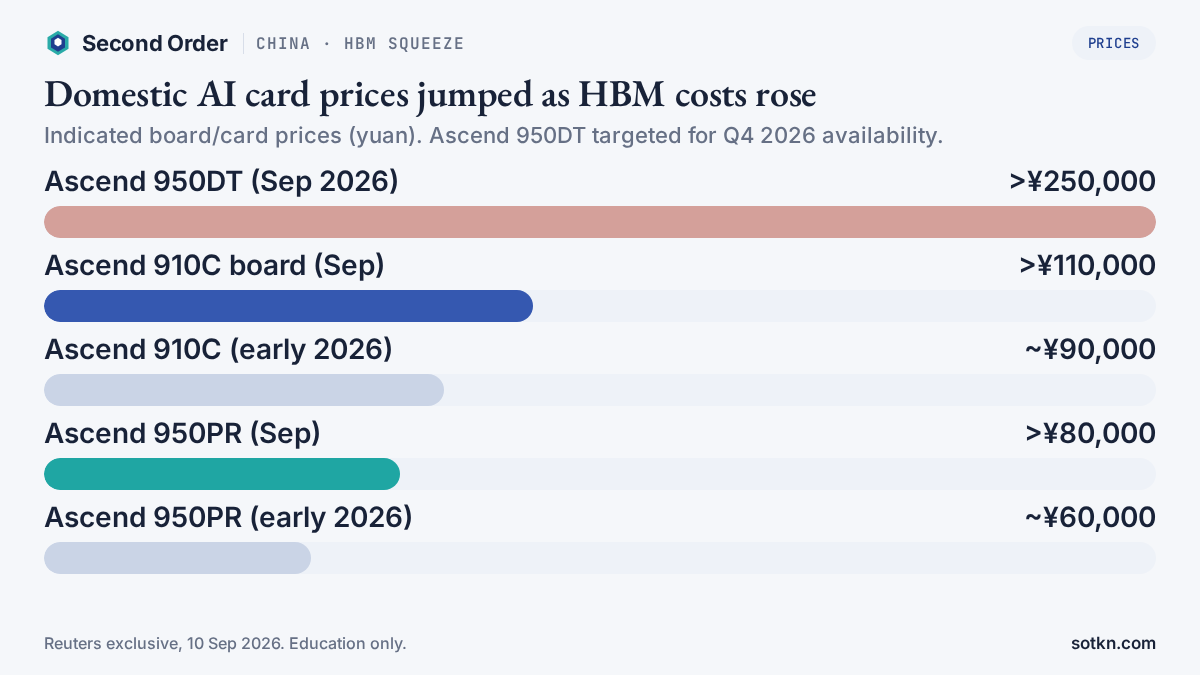
Indicated prices (Reuters, 10 Sep 2026)
Source: Reuters, “China’s AI chipmakers raise prices as high-bandwidth memory shortage bites”, 10 Sep 2026. Indicated prices from people familiar with talks; companies did not comment.
So-what: when the board maker raises price and names memory as the squeeze, the stuck step is upstream of the logo on the card. Buyers still need Ascend-class silicon for domestic clusters; they pay more per card until legal HBM volume appears.
What compute target sits behind this demand?
A written national lift: 9,800 EFLOPS of intelligent compute by 2030, from 2,185 at end-June 2026.
MIIT published the 15th Five-Year Plan for the information and communications industry on 7 Sep 2026 (notice dated 12 Aug 2026). Intelligent computing power is a headline indicator for the first time. The same plan calls for cumulative information-infrastructure investment of 3.8 trillion yuan over 2026–2030 and for orderly deployment of 10,000-card and 100,000-plus-card clusters adapted to domestic chips. Trade press citing the plan put end-July capacity near 2,450 EFLOPS.
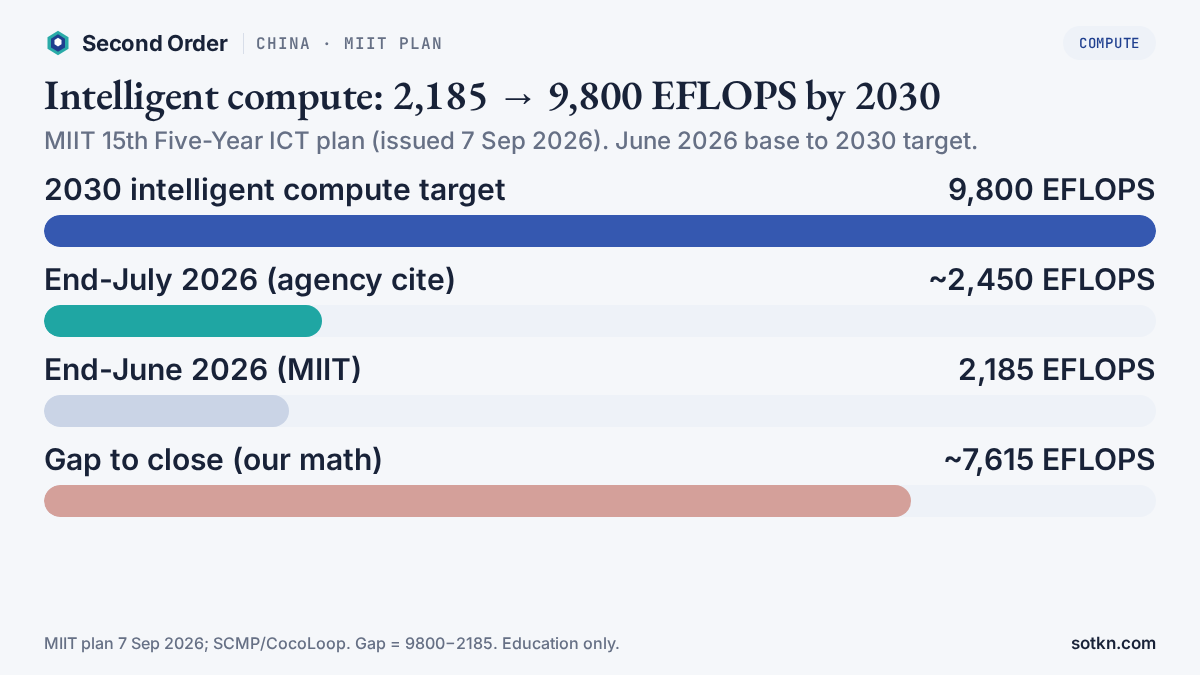
This Pulse does not treat the plan as a purchase order for any listed chip name. It treats the target as demand pressure on every scarce input — especially advanced memory that each accelerator still needs beside the die.
Our math: what does the Ascend 910C price jump cost at cluster scale?
Enough to matter on a 10,000-card hall — before you count the scarcer 950DT class.
Second Order calculation — 10,000 Ascend 910C boards
Our calculation from Reuters indicated prices (10 Sep 2026). Exchange rate illustrative. This is not a forecast of what any buyer will actually pay, and it excludes servers, networking, power and installation.
What this tells you: HBM scarcity shows up as higher domestic card prices now, not only as missing cards later. What it does not tell you: whether any particular listed name is cheap or dear.
Plan arithmetic on the compute side: 9,800 ÷ 2,185 ≈ 4.48× the June 2026 base by 2030. If HBM attach per EFLOP stays in a similar band, the memory requirement scales with the target — unless efficiency or lower-precision tricks cut stacks per unit of useful work. That is an assumption, not a published MIIT ratio.
Where does the money stick in China’s domestic AI stack?
At the step with the fewest workable suppliers under today’s access rules: advanced HBM.
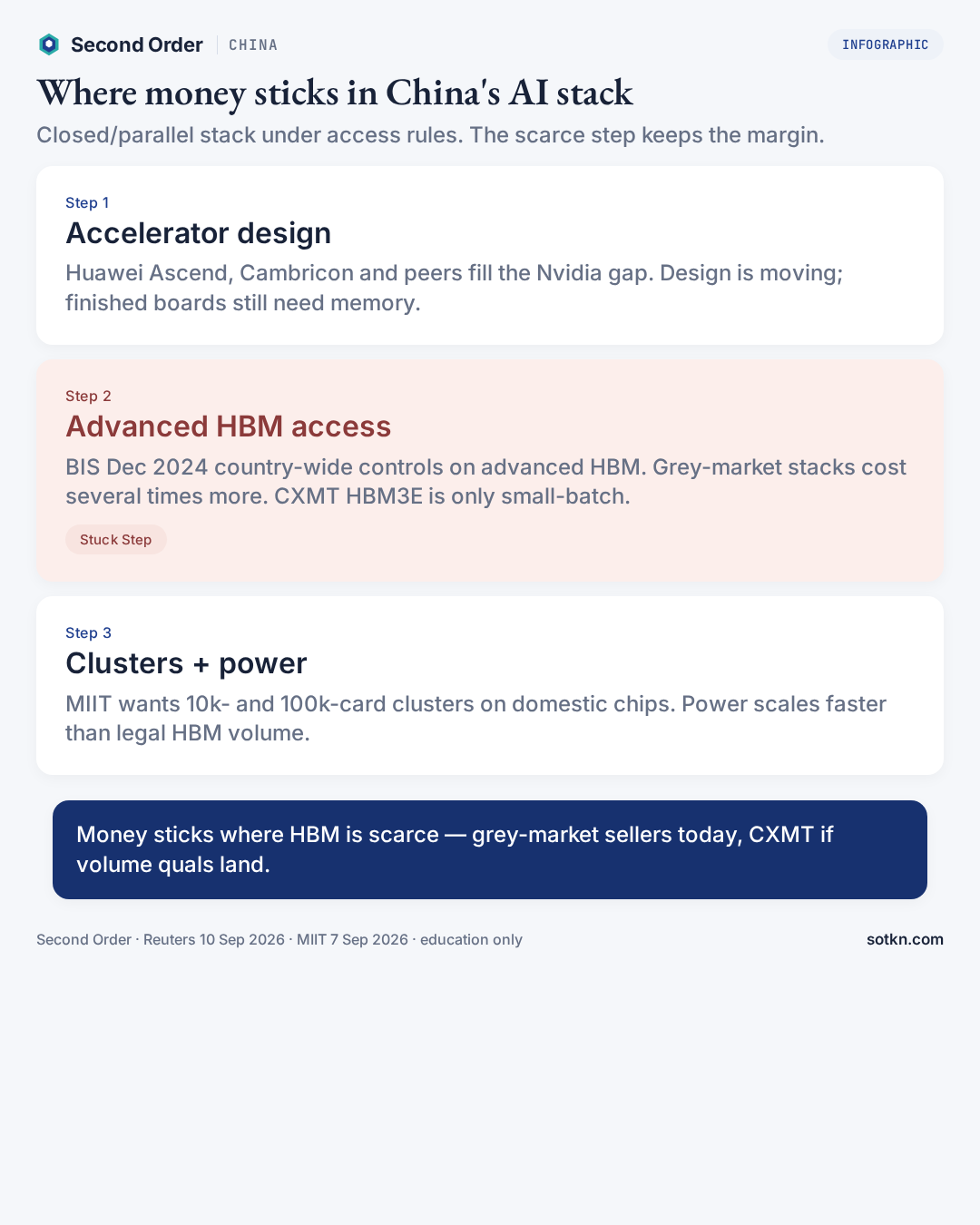
1. Grey-market and diverted HBM. Reuters’ sources say Chinese chipmakers lean on grey-market channels since Washington’s December 2024 country-wide advanced-HBM controls, and that such stacks often cost several times what buyers outside China pay. That spread sticks with whoever can deliver a qualified stack.
2. Domestic accelerator vendors with allocation. Huawei remains ByteDance’s largest domestic supplier in the Reuters account, followed by Cambricon and Iluvatar. When memory is scarce, vendors who still ship raise price and reshuffle who gets cards — Iluvatar reportedly doubled GPU shipments to ByteDance to 100,000 units this year.
3. CXMT — if volume quals land. CXMT listed on Shanghai’s STAR Market in July 2026 (688825.SS). Small-batch HBM3E is a milestone; Counterpoint still called its HBM capability unproven at scale. Volume that passes customer quals would move margin from grey-market sellers toward the domestic memory name. That has not happened yet.
One-line rule: in a closed stack, money sticks where the legal import is blocked and the domestic substitute is not yet at volume.
Is advanced HBM access still stuck?
Yes. Small-batch domestic HBM3E is progress; it is not an open supply valve.
HBM path into China AI cards (Sep 2026)
Sources: BIS Federal Register rule 2024-28270 (Dec 2024); CSIS analysis of HBM thresholds; Reuters 10 Sep 2026; The Information reports via Korea Herald / TechTimes early Sep 2026.
Two cautions: (1) “HBM3E samples shipped” is not the same as qualified volume in training clusters. (2) Huawei’s HiBL/HiZQ branding does not disclose whether the die is CXMT, stockpile, or another path — so treat proprietary names as product labels, not proof the stuck step is cleared.
If domestic HBM volume clears, the stuck step can move — toward advanced packaging tools, leading-edge logic capacity, or power for the largest clusters. Until then, read China AI hardware through memory access first. Global context: HBM explained.
What dates and prints come next?
Four watches matter more than daily share noise.
Dates and signals to watch
How do export rules frame this stuck step?
They are why grey-market prices and domestic pilots matter at the same time.
- December 2024 BIS rules added country-wide controls on certain advanced HBM (ECCN 3A090.c), tied to memory bandwidth density, with related foreign-direct-product coverage — so Korean and US stacks can fall in scope when the thresholds are met.
- Earlier rules already limited many advanced AI accelerators and tools. The HBM layer closed a path that chip controls alone left open: buying world-class memory to sit beside a domestic die.
- MIIT’s compute target does not waive those rules. It raises the cost of missing domestic HBM volume.
So-what: policy sets the ceiling on legal imports; September’s card prices show the ceiling is binding.
Who is exposed if you follow the money?
This is a map of exposure, not a recommendation to buy or sell.
- Domestic listed (Shanghai STAR): Cambricon (688256.SS) as an accelerator proxy; CXMT (688825.SS) as the domestic HBM name after its July 2026 IPO. Both are China A-share access questions for many foreign accounts.
- Global HBM majors: SK hynix and Samsung (see Korea Pulse) and Micron — constrained on advanced grades to China, still central to the worldwide HBM cycle.
- Equipment: ASML, Applied Materials, Lam, KLA face a separate long-run China share-loss story as domestic tools improve — that is the Wire’s equipment angle, not this month’s price print.
International brokers with Stock Connect / STAR access vary by account. One example path many readers already use is Interactive Brokers. Education only — we do not advise opening or funding any account.
What would change this view?
The “HBM is the stuck step” read weakens if:
- CXMT (or another domestic maker) posts verified volume HBM3E shipments into named training clusters, not only samples
- Indicated Ascend / Cambricon card prices fall while unit shipments rise — a sign memory cost eased
- BIS or allied licensing reopens meaningful legal advanced-HBM channels into China
- A non-HBM bottleneck (packaging tools, logic capacity, or power) becomes the louder constraint in primary data
- MIIT / NDA prints show intelligent compute rising without a matching rise in domestic accelerator ASP
- Huawei discloses a memory bill-of-materials path that is clearly domestic and at scale
It stays intact while card ASPs stay elevated on memory cost, CXMT remains small-batch, and legal advanced HBM stays under presumption of denial.
Practical takeaways
- Name the stuck step: advanced HBM access inside China’s parallel AI stack
- MIIT’s 9,800-EFLOPS target (7 Sep 2026) raises demand pressure; it does not clear memory rules
- Reuters’ 10 Sep 2026 Ascend/Cambricon price hikes are the fresh evidence that memory cost is binding
- CXMT HBM3E small-batch is a milestone, not volume — 2027 remains the commercial ambition in secondary reports
- Money sticks with whoever can deliver a qualified stack today; that can shift if domestic volume quals land
FAQ
What is the stuck step in China’s domestic AI stack?
Advanced high-bandwidth memory (HBM) access. Export rules block many legal advanced stacks; domestic CXMT HBM3E is only in small-batch production as of early September 2026.
What compute target did China set?
MIIT’s 15th Five-Year ICT plan (published 7 Sep 2026) targets 9,800 EFLOPS of intelligent compute by 2030, from 2,185 EFLOPS at end-June 2026 — about a 4.5× lift.
Why did Huawei Ascend card prices rise in September 2026?
Reuters reported on 10 Sep 2026 that HBM shortage and grey-market costs pushed indicated Ascend 950DT prices above 250,000 yuan (+20–50% vs quotes about two months earlier).
Has CXMT solved China’s HBM problem?
Not at volume. Early September 2026 reports say CXMT began small-batch HBM3E and sent samples to Cambricon and Alibaba’s T-Head; commercial volume is still aimed at 2027.
Is this a buy list of China AI chip stocks?
No. This Pulse maps who gets paid and where money sticks under access rules. It is education, not a recommendation to buy or sell any security.
How does this relate to Korea and Taiwan?
Korea still supplies most global HBM; Taiwan does most advanced packaging. China’s parallel stack is trying to build both domestically while legal imports of advanced HBM stay constrained.
Keep reading on the map
- HBM explained · CoWoS explained
- Korea HBM Pulse (Sep 2026) · Taiwan TSMC / CoWoS Pulse
- China Markets · Wire: China compute target — the trade isn’t the chips
- Semiconductors · Analysis
How we made this
Primary sources first (MIIT plan text and notice; BIS Federal Register HBM rule; Reuters exclusive on 10 Sep 2026). Secondary trade press used only for CXMT small-batch timing and for July EFLOPS cites, labelled as such. One original calculation (10,000 × Ascend 910C board cost delta) is shown with assumptions. Status chips are Second Order’s read, not a ministry grade.
Sources
- MIIT, 信息通信行业发展“十五五”规划 notice, published 7 Sep 2026 (工信部规〔2026〕188号)
- Reuters, China AI chipmakers raise prices as HBM shortage bites, 10 Sep 2026
- BIS / Federal Register, advanced computing & HBM controls (2024-28270), Dec 2024
- The Information via Korea Herald / TechTimes / Yahoo — CXMT HBM3E small-batch, ~1–2 Sep 2026
- SCMP / CocoLoop — MIIT 9,800 EFLOPS coverage and July run-rate cites, Sep 2026
- Reuters — CXMT STAR Market IPO / debut, July 2026
- Second Order Wire: China compute target (11 Sep 2026)
Education only. Not investment advice. Do your own research. Second Order may correct figures if primary sources revise them — next planned refresh after Ascend 950DT availability news or a CXMT HBM volume print.