
AEP to build $4B, 702 MW of fuel-cell data center power for Google
On 14 October AEP said it will invest about $4 billion in 702 MW of Bloom fuel cells near Cheyenne, selling the power to Google for 20 years. AEP bought the cells in January, before the buyer was named. Full power is due by end-2028.
WIRE · HYPERSCALERS · US · Data as at 14 Oct 2026
Google now looks like the customer AEP left unnamed in January. On 14 October 2026 American Electric Power said it plans to invest about $4 billion in a 702 MW fuel cell plant near Cheyenne, Wyoming, and sell its power to Google under a 20-year power purchase agreement. The cells come from Bloom Energy. Back on 4 January, AEP had agreed, unconditionally, to buy fuel cells for a Cheyenne plant for about $2.65 billion, with the buyer described only as a "high investment grade" customer. So the equipment maker was signed up more than nine months before the buyer's name came out. On the Hyperscalers layer, this is Google's second power supplier for the same planned campus in two weeks.
What happened
14 October 2026
AEP plans about $4 billion for a 702 MW fuel cell plant near Cheyenne, with Google buying the power for 20 years
The plant company, Cheyenne Fuel Cell, is about 92% AEP and nearly 8% funds advised by Basalt Infrastructure Partners
The clock
Construction starts in 2026 and the plant is due to be fully running by the end of 2028
Bloom's cells make power from natural gas without burning it. Carbon capture is planned, not built
The January filing
On 4 January AEP signed an unconditional purchase of fuel cells for a Cheyenne plant, for about $2.65 billion
It came with a 20-year deal to sell all the output to an unnamed customer. If that deal's conditions failed, AEP would be paid back for all its capital and costs
The other supplier
Black Hills' Google agreements, in force from 30 September: $1.8 billion for 564 MW of new gas plants, service from late 2027
Black Hills says the campus will be served by 2.7 GW of resources in all, ramping to peak load in 2030, on terms that run to 2048
Why cash cares
Start with who gets paid first. Bloom does. AEP bought its cells in January without conditions, before the customer's name or the full project cost were public. AEP's release did not tie the two announcements together in so many words, but they describe the same thing: a fuel cell plant near Cheyenne with 20 years of output sold to one large buyer. If the $2.65 billion of cells sits inside the $4 billion, which AEP has not broken down, about two-thirds of the project's money goes to the cell maker. That leaves about $1.35 billion for everything else on the site.
AEP is paid next, on a slower clock. Under a power purchase agreement, the seller is normally paid for the power it delivers, so most of AEP's 20 years of revenue starts as the plant comes online, with full operation due by the end of 2028. If the 20 years start then, the contract runs to about 2048, the same year Black Hills' Google contracts end. AEP also took less risk than the size suggests: its January filing said it would be paid back for all capital and costs if the sale's conditions were not met.
Google pays for all of it. Black Hills said its agreements are set up so that Google bears every cost of serving the data center through 2048, and Google has already advanced $399 million for long-lead equipment there. Now Google is also the 20-year buyer of a second plant, from a utility whose 11 states do not include Wyoming. AEP said the deal shows it meeting energy needs "beyond our traditional service territory".
Here is our own arithmetic, not a company figure. $4 billion for 702 MW is about $5.7 million per MW. Black Hills' $1.8 billion for 564 MW of gas plants is about $3.2 million per MW. So, per MW, the fuel cells cost about 1.8 times the gas plants feeding the same campus. Together the two named builds come to 1,266 MW, about 47% of the 2.7 GW Black Hills says the campus will use. The cells were bought 283 days before Google's name appeared, and the end of 2028 is about 26.5 months away.
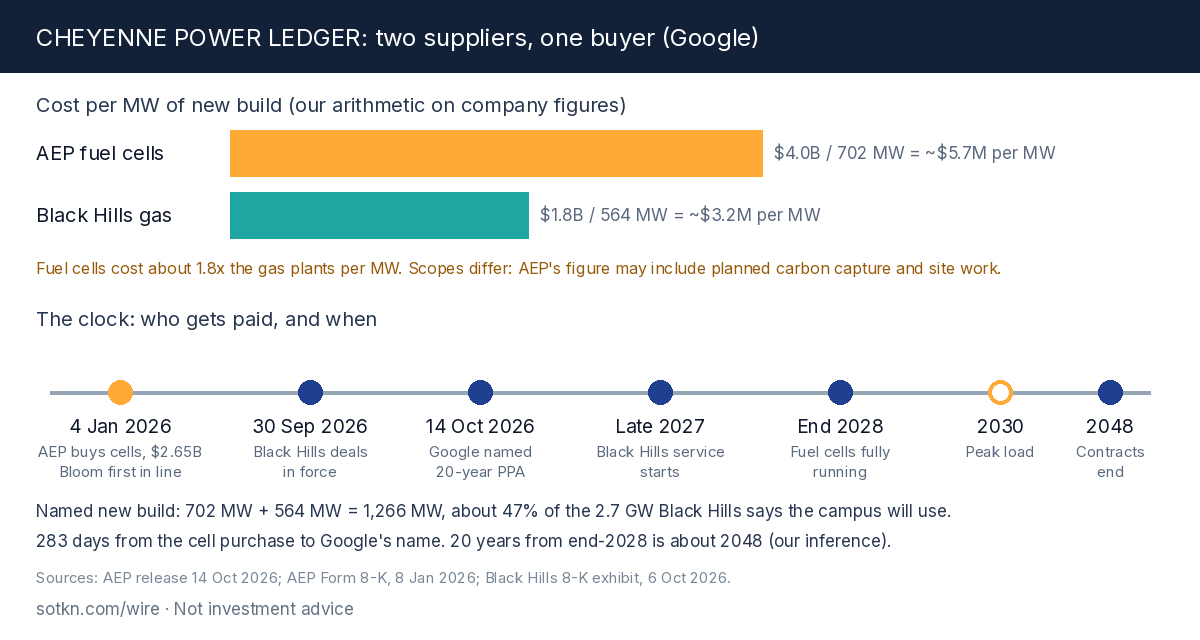
Figure: Cheyenne power ledger. Two suppliers, two price points, one buyer. The per-MW costs, the 1.8x, the 47% and the day counts are our arithmetic on AEP and Black Hills releases and filings.
The step that is still open
Getting power to the hall on Google's timetable. Black Hills plans to start serving the campus in late 2027 and ramp to peak load in 2030. The fuel cells are not fully running until the end of 2028. Until then the campus leans on Black Hills' gas plants, which it builds from 2027 to 2029, and on power bought from the market.
The rest of the 2.7 GW is the other open question. Black Hills says it will manage about 2.1 GW of other Wyoming suppliers' output through a private microgrid. Neither company said whether AEP's cells are part of that. If they are, about 1.4 GW of it is still unnamed. The wires are not all approved either: Black Hills filed for a South Cheyenne transmission expansion in September and plans a wider Wyoming transmission filing in the fourth quarter of 2026.
We have seen this pattern twice this month. On 6 October, Black Hills agreed to build $1.8B of gas power for Google in Wyoming. On 13 October, Oracle kept Bloom's fuel cells as the main power for Project Jupiter and offered El Paso Electric $10 million a year for backup. The hyperscaler pays to build its own power, and the equipment maker is the first to get paid.
The second-order read
Who gets paid. Bloom, first, on a cell order signed in January. Black Hills from 2027, when it starts earning a return on its build. AEP and the Basalt funds over 20 years, once power flows.
Who pays. Google, for both plants, on contracts that run to about 2048.
Who waits. AEP's revenue waits for the plant, due by the end of 2028. Google's hall waits for enough power to reach peak load in 2030.
Stuck step. Power to the hall. Two suppliers are named and paid for, and they cover less than half of the 2.7 GW the campus is planned around.
Three cautions
AEP did not break down the $4 billion or say whether the $2.65 billion cell order sits inside it. Our two-thirds share assumes it does.
The per-MW comparison mixes two technologies and two scopes. AEP's figure may include the planned carbon capture and site work, and both are nameplate MW, not power delivered.
Nobody published a price for the power, the size of Google's hall, or whether the fuel cells count toward Black Hills' 2.1 GW. The 2048 end date for AEP's contract is our inference from a 20-year term starting at full operation.
What to watch
- Construction start: AEP says building begins in 2026, which leaves 78 days of the year from 14 October.
- Bloom's next quarterly report: whether it shows the Cheyenne order and a delivery schedule.
- Black Hills' Wyoming transmission filing: due in the fourth quarter of 2026.
- First service to the campus: Black Hills' late-2027 date is the first test of the ramp.
Read: Hyperscalers, what Google does and AI Data Centers
Get the Wire. A free brief every day, here and in your inbox. Subscribe free →
Not investment advice. Do your own research. The two-thirds share, $1.35 billion, $5.7 million and $3.2 million per MW, 1.8x, 1,266 MW, 47%, 1.4 GW, 283-day, 26.5-month and 78-day figures are our arithmetic.
References
- American Electric Power, "AEP Advances Innovative Energy Solution for Google with 702MW of Bloom Fuel Cells", news release, 14 Oct 2026. About $4 billion, 702 MW near Cheyenne, 20-year PPA with Google, Cheyenne Fuel Cell about 92% AEP and nearly 8% Basalt-advised funds, construction in 2026, fully operational by end-2028, Bloom technology, carbon capture planned.
- American Electric Power, Form 8-K, SEC, filed 8 Jan 2026 (event 4 Jan 2026). Unconditional purchase of solid oxide fuel cells for about $2.65 billion, 20-year offtake for 100% of output of a plant expected near Cheyenne, cost recovery if conditions fail.
- Black Hills Corp., "Black Hills Corp. Executes Definitive Agreements to Serve Google's Planned Data Center in Cheyenne, Wyoming", Exhibit 99.1 to Form 8-K, 6 Oct 2026. $1.8 billion for 564 MW of gas, up to 590 MW grid service, about 2.1 GW third-party resources, 2.7 GW total, service late 2027, peak load 2030, terms to 2048, $399 million Google advances, transmission filings.
- Reuters, "AEP to invest $4 bln in fuel cell project to power Google", via Gurutrade, 14 Oct 2026. Links the January Bloom option exercise of about $2.65 billion to the project.


