Black Hills to build $1.8B of gas power for Google in Wyoming
Black Hills (6 Oct): $1.8B of new gas for Google's planned Cheyenne data center, power from late 2027. Google has already advanced $399M. The cloud pays before it plugs in.
WIRE · HYPERSCALERS · US · Data as at 6 Oct 2026
Google has signed a utility to power a planned data center outside Cheyenne, Wyoming. The utility, Black Hills Corp, will spend $1.8 billion on new gas plants for it. First power is due in late 2027. But Google's money moves first. It has already put up $399 million for equipment, and Black Hills starts earning on the build in 2027, before a single watt reaches the hall. On the hyperscalers layer, this is what buying power looks like now: the cloud pays before it plugs in.
What happened
On 6 October 2026, Black Hills said it had signed final agreements to serve a planned Google data center in Cheyenne (Black Hills release, 6 Oct 2026; also its 8-K filing the same day). The deals took effect on 30 September and run to 2048. Reuters reported the deal the same afternoon (Reuters via KELO, 6 Oct 2026).
The plan has two parts. Black Hills will supply up to 590 MW over its grid. Most of that, 564 MW, comes from new gas plants it will build at its Cheyenne Prairie station. It will also manage about 2.1 GW from other Wyoming suppliers through a private microgrid. In total that is 2.7 GW of resources, counting spare capacity kept in reserve.
The money is set out too. Black Hills spends $1.8 billion from 2027 to 2029. It earns a return on that money once building starts in 2027. It also earns a fee for running the microgrid, from late 2027, rising as the hall's load grows. The company expects the project to add about $150 million to its net income in 2030. Google bears all the costs of serving the hall, through 2048. The contracts also let Black Hills recover the full cost of the new plants over the term, with protection if the project ends early.
Google has already paid in. It has advanced $399 million so Black Hills can order long-lead equipment, the parts that take longest to build. The money is refundable, and Black Hills expects to pay it back by 30 June 2027.
Event
Black Hills signs deals to power Google's planned data center in Cheyenne, Wyoming
Black Hills Corp release and 8-K, 6 Oct 2026; deals effective 30 Sep, run to 2048
Power plan
2.7 GW of resources, including reserve margins
Same — up to 590 MW from Black Hills, about 2.1 GW from other Wyoming suppliers
New build
$1.8 billion for 564 MW of new gas plants, 2027–2029
Same
Paid already
$399 million of Google advances for long-lead equipment
Same — refundable; Black Hills expects to pay it back by 30 Jun 2027
Black Hills earns
From the start of building in 2027, before any power flows
Same — return on the build from 2027; microgrid fees from late 2027
First power
Late 2027; full load in 2030
Same — the June update said early 2028
Still open
The gas plant's siting permit and two transmission filings
Same — siting permit filed July 2026; one transmission filing in September, one due Q4 2026
Not disclosed
The power price, the hall's size, and what Google spends on the hall
None of the filings give them
So the order runs the other way from a normal power bill. Google pays first. The utility earns while it builds. The hall, and Google's own payback, come last.
Why cash cares
Most power deals pay on delivery. You get a megawatt-hour, you pay for it. Yesterday's Wire on Google's Constellation nuclear deal was that kind: the new power is billed as each upgrade comes online, from 2028. This deal is different. Google pays before the power exists.
That is the point of cash capex: cash leaves long before an AI hour is sold. Here it leaves even before the power plant is built.
The filings lay out three cash steps, and only the first is done.
- Equipment money out. Done. Google has advanced $399 million. In June, Black Hills said the figure was "over $200 million". That money funds payments to suppliers of long-lead power equipment.
- Build and earn. Not started. Black Hills spends $1.8 billion from 2027 to 2029, and earns a return from the day building starts. But the gas plant still needs its siting permit, filed in July 2026. The air permit came through in August.
- Power on. Not done. First power is due in late 2027. Full load comes in 2030. The microgrid fee starts in late 2027 and rises on a set schedule as the load ramps up.
The stuck step is the permit, then the build. The contracts are signed. The plant's siting permit is not granted yet. A signed deal tells you Google wants power in Wyoming. It does not tell you when the hall runs. Ready is not paid.
Here are the numbers, as our own arithmetic. The 564 MW of new Black Hills gas is about 21% of the 2.7 GW mix. The 2.1 GW from other suppliers is about 78%. The $1.8 billion works out to about $3.2 million per MW of new gas capacity. Google's $399 million advance equals about 22% of that build cost, and it has roughly doubled since June.
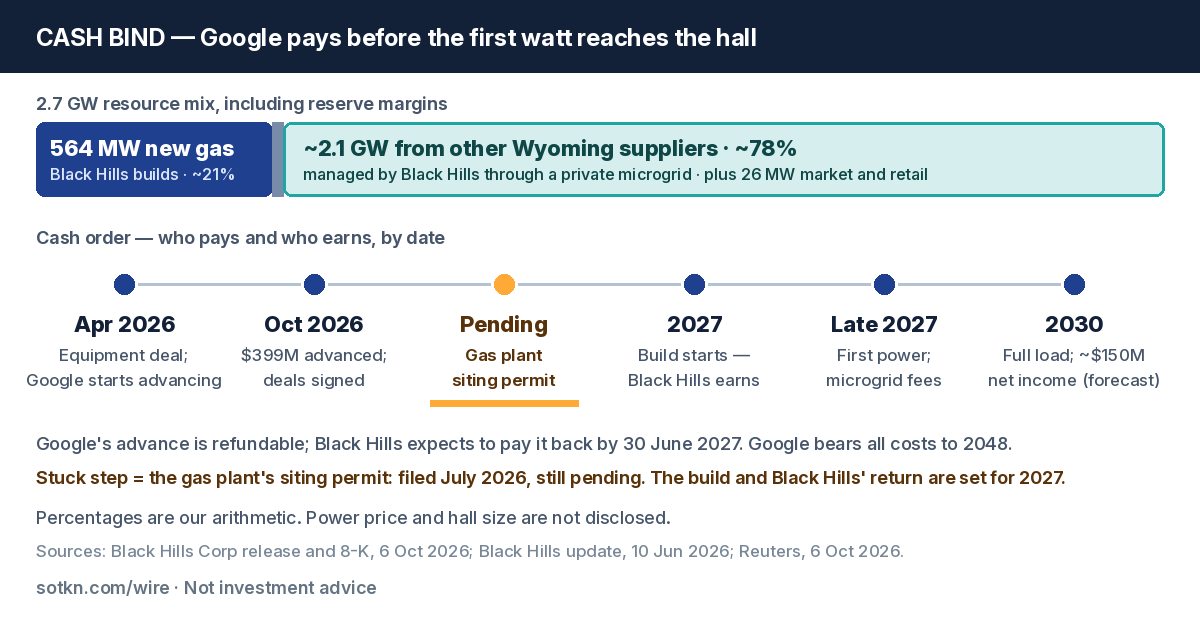
Figure — The cash bind. Google's money moves first. Black Hills earns from the 2027 build. Power and Google's own payback come last. Amber marks the stuck step: the gas plant's siting permit, still pending ahead of the 2027 build.
The second-order read
| Who | Seat | What this means |
|---|---|---|
| Power buyer; owner of the planned hall | Pays first: $399M advanced, and all costs of serving the hall to 2048; earns nothing here until the hall runs | |
| Black Hills Corp | Utility; builds and owns 564 MW of gas | Earns from the 2027 build start; microgrid fees from late 2027; about $150M net income in 2030, its forecast |
| Power equipment suppliers | Long-lead equipment | Paid milestone payments now, out of Google's advance; not named |
| Other Wyoming suppliers | About 2.1 GW of contracted supply | Not named; paid as power flows, from late 2027 |
| Wyoming regulators | Permits and certificates | Siting permit pending; transmission filings in September and Q4 2026 |
| Other Black Hills customers | Ratepayers | Protected from cost shifts under the deal, Black Hills says |
Who gets paid. First are the equipment makers, now, from Google's advance. Next is Black Hills, from the start of building in 2027. That is the unusual part: a utility earning on a plant before it makes any power. Then the other Wyoming suppliers, once power flows in late 2027.
Who waits. Google waits longest. It has cash out today and carries the cost of serving the hall for two decades. Its payback, selling cloud and AI time from the hall, starts only when the hall runs. Black Hills also waits on one thing. Its return starts when building starts, and the plant's siting permit is still pending.
By clock. Equipment deal: April 2026. Advance at $399 million: by 6 October 2026. Siting permit: filed July 2026, pending. Second transmission filing: Q4 2026. Building: 2027 to 2029. Advance paid back: by 30 June 2027. First power: late 2027. Full load: 2030. Contract end: 2048.
The date has moved forward, not back. In June, Black Hills said service was on track for early 2028. Now it says late 2027. That June update also said Crusoe was no longer the project's development partner (see What Does Crusoe Do?). Google is now the named customer, and it is paying up front so the long-lead equipment can be ordered.
This matters past Wyoming. When power is short, the buyer with cash can jump the queue by paying for the plant itself. That moves cash out of the cloud's pocket years earlier than a normal power bill. For a hyperscaler, it is one more cost that lands before the revenue does.
Two cautions
The 21%, 78%, $3.2 million per MW and 22% are our own arithmetic from the release. The $150 million of 2030 net income and the $2.4 billion of free cash flow through 2048 are Black Hills forecasts, not results. Do not treat them as Google's cost; the price Google pays for power is not disclosed.
The 2.7 GW is a resource mix that includes spare capacity kept in reserve. It is not the size of the hall. Black Hills called it a 1.8 GW project in June; the October release does not give the hall's size. And "late 2027" assumes the siting permit and transmission filings clear on time.
What would change the view
- A siting permit decision for the Cheyenne Prairie expansion, or a delay.
- Repayment of the $399 million by 30 June 2027, which would show Black Hills has its own financing in place.
- Google naming the hall's size or its own spend on the site.
- A slip in first power past late 2027.
What to watch
- The Wyoming transmission filing due in Q4 2026 — the last of the filings Black Hills listed.
- Alphabet's next results — any comment on paying for power ahead of its halls.
- Other utilities copying the model — customer-funded equipment, with returns paid during the build.
- Black Hills' financing plan for the $1.8 billion — it says it will use cash flow, debt and other options.
Read: Hyperscalers, What Is Cash Capex?, Neocloud vs Hyperscaler, What Does Crusoe Do?, and If Hyperscalers Subscribe to Operating Nuclear, Where Does Cash Stick?
Get the Wire. A free brief every day, here and in your inbox. Subscribe free →
Sources: Black Hills Corp release, 6 Oct 2026 — definitive agreements effective 30 Sep 2026, terms through 2048; 2.7 GW resource mix including reserve margins; up to 590 MW grid-connected service, 564 MW new gas at Cheyenne Prairie, 26 MW market and retail; about 2.1 GW third-party resources via private microgrid; $1.8B in 2027–2029; return from construction start in 2027; microgrid fees from late 2027; about $150M net income in 2030; about $2.4B unlevered free cash flow through 2048; $399M refundable Google advances, reimbursement by 30 Jun 2027; permit and transmission filings; Black Hills 8-K, 6 Oct 2026 — same release furnished as Exhibit 99.1; Reuters via KELO, 6 Oct 2026 — $1.8B, 564 MW, 2.7 GW, late 2027 start, 2030 peak, Google covers full cost; Black Hills Corp update, 10 Jun 2026 — 1.8 GW project; Crusoe no longer development partner; service tracking for early 2028; April 2026 equipment agreement; over $200M of refundable contributions. Percentages and per-MW figures are our arithmetic. Not investment advice.