Google signs 890 MW Constellation nuclear uprate deal
Google and Constellation (6 Oct): 20-year PPA for 890 MW from uprates at 11 reactors, first by 2028, all by end-2032. Constellation spends $4.3B+ first; new MW bill only as uprates finish.
WIRE · HYPERSCALERS · US · Data as at 6 Oct 2026
Google has signed a 20-year power deal with Constellation Energy for 890 MW of new nuclear output. The deal was announced on 6 October 2026. The new power does not exist yet. It comes from upgrades, called uprates, at 11 Constellation reactors in Illinois, Pennsylvania and New Jersey. The first uprate is due by 2028. Google says the full 890 MW lands before the end of 2032. On the hyperscalers layer, a signed megawatt is not a delivered megawatt. The cash that moves first goes to the plant work, not to the power.
What happened
Constellation and Google put out a joint release on 6 October. Google is the anchor buyer. Its 20-year power purchase agreement (PPA) gives Constellation the long-term revenue it needs to upgrade turbines, steam generators and control systems at six nuclear sites on the PJM grid, the power market that runs across 13 states in the US Mid-Atlantic and Midwest.
Constellation says the work is more than $4.3 billion of new investment. The two firms also signed a separate 15-year deal covering 2,700 MW of Constellation's existing PJM fleet. Google agreed to cut non-critical load when the grid is under stress. And Constellation will use Google Cloud's Gemini Enterprise under a five-year technology deal.
Neither firm gave a price. Before the release, Bloomberg reported on 5 October (via Reuters) that the deal was worth $1 billion or more over several years. Constellation shares traded about 5% higher before the US open on 6 October (Investing.com).
The facts as reported:
New capacity bought
890 MW from uprates at 11 units, six sites (IL, PA, NJ)
Constellation and Google, 6 Oct 2026
Delivery clock
First uprate by 2028; all 890 MW before end-2032
Constellation release; Google blog, 6 Oct 2026
Who spends on the plants
Constellation, more than $4.3 billion
Constellation release, 6 Oct 2026
Existing fleet deal
2,700 MW of operating PJM capacity, 15 years
Constellation release, 6 Oct 2026
Price
Not disclosed; reported at $1 billion or more before signing
Bloomberg via Reuters, 5 Oct 2026
Google's nuclear total
Over 1.5 GW enabled from uprates and restarts
Google blog, 6 Oct 2026
Not in any release: a price per megawatt-hour, the names of the six plants, or a date for each of the 11 uprates.
Why cash cares
A power deal pays when power is delivered and billed. For the 890 MW, that is years away. Each uprate is a physical job at a running reactor: bigger turbine parts, new steam generators, new controls. Every uprate also needs a formal safety review and approval from the regulator, the Nuclear Regulatory Commission, before the plant can run at the higher output. Work this size is usually done during planned refuelling outages, when the reactor is already offline.
So here is the stuck step. Regulator approval plus outage-window installs, unit by unit, at 11 reactors. The first one is due by 2028. The last one is due by the end of 2032. That is up to six years from signing to the last megawatt. It is our count from the two dates the companies gave, not a company schedule.
Here is the cost side, in our own arithmetic. Constellation's $4.3 billion over 890 MW works out to about $4.8 million per new megawatt. That is Constellation's spend on the plants, not what Google pays for power. For a rough comparison, Cybernews (6 October) reported Amazon's 30 September Constellation deal at 690 MW and more than $3 billion of investment at Calvert Cliffs, which is about $4.3 million per megawatt on the same maths.
The near-term part is the 2,700 MW existing-fleet deal. That power already runs. It is about three times the size of the new 890 MW, again on our maths. The release did not say when that 15-year deal starts billing, so we do not assume a date.
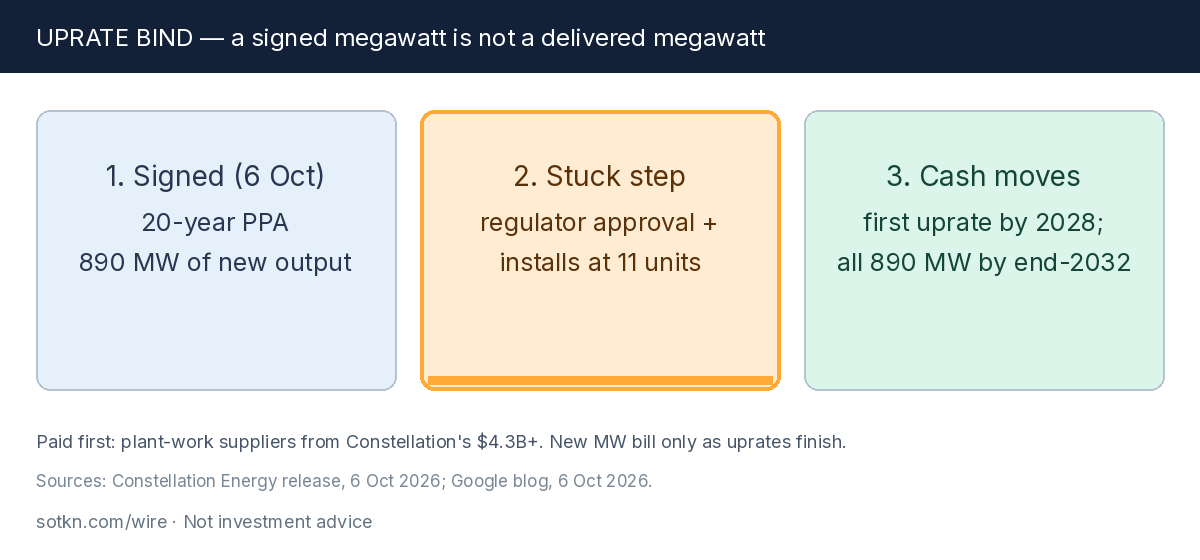
Figure — Uprate bind. Signed 20-year PPA (6 Oct) → regulator approval and outage installs at 11 units (stuck step) → first uprate MW billed by 2028, all 890 MW by end-2032.
Context: the hyperscaler nuclear queue
Context, not today's deal. This is the third big hyperscaler nuclear move in a week. Amazon signed with Constellation on 30 September (Cybernews, 6 October). On 5 October we covered Oracle's offer to buy Point Beach nuclear power. Google's own list now includes Georgia Power uprates at four units, the restart of Duane Arnold in Iowa (over 600 MW), and advanced reactors with Kairos Power and TVA. Google says its existing-plant deals should cover nearly 25% of the US Department of Energy goal of 5 GW of uprates and restarts by 2030. We set out the payer question in If Hyperscalers Subscribe to Operating Nuclear, Where Does Cash Stick?
The difference today: Oracle's offer was for power from a plant that already runs. Google's 890 MW is new output that has to be built first.
The second-order read
Who gets paid first. The firms that do the plant work. Constellation's $4.3 billion goes out as orders for turbine parts, steam generators, controls and about 7,200 construction jobs. That spend comes before any new megawatt is sold.
Who gets paid next. Constellation, on the 2,700 MW existing-fleet deal, once it starts billing. Then on the 890 MW, one uprate at a time, from 2028.
Who waits. Google's growth in PJM. The new 890 MW is firm power Google can count on only as each uprate finishes. Until then, Google's growth in the region leans on today's grid, with a promise to cut non-critical load when the grid is stressed.
Stuck step. Regulator approval and outage-window installs at 11 reactors. The PPA starts no meter. Only finished uprates do.
Two cautions
The price is not public. The "$1 billion or more" figure came from Bloomberg's sources before the deal was announced. Neither company has confirmed it. Do not read it as the contract value.
Our $4.8 million per megawatt is Constellation's spend divided by capacity. It is not Google's cost of power. The two numbers measure different things.
What would change the view
- Plant names and uprate dates for each of the 11 units.
- NRC filings for the licence changes, and how fast they clear.
- A start date and price for the 2,700 MW existing-fleet deal.
- Any delay or cost overrun on the first 2028 uprate.
- PJM's final rules on "Bring Your Own Power" for large new loads.
What to watch
- Constellation's next earnings call: any split of the $4.3 billion by year.
- First NRC uprate application tied to this deal.
- Google's next PJM data-centre filing: how much of its load leans on this power.
- Other hyperscalers: whether Microsoft or Meta sign uprate deals of the same shape.
Read: Hyperscalers, Neocloud vs Hyperscaler, and What Does Amazon Do?.
Get the Wire. A free brief every day, here and in your inbox. Subscribe free →
Sources: Constellation Energy release, 6 Oct 2026 — 20-year PPA, 890 MW at 11 units, six sites in IL/PA/NJ, more than $4.3B investment, first uprate by 2028, 2,700 MW 15-year existing-fleet deal, demand flexibility, Gemini Enterprise alliance; Google blog / Amanda Peterson Corio, 6 Oct 2026 — 890 MW before end-2032, over 1.5 GW enabled, DOE 5 GW goal, Georgia Power, Duane Arnold, Kairos/TVA; Reuters, citing Bloomberg, 5 Oct 2026 — deal of $1 billion or more reported before signing; Investing.com, 6 Oct 2026 — Constellation shares about 5% higher pre-market; Cybernews, 6 Oct 2026 — Amazon–Constellation 30 Sep deal, 690 MW, more than $3B, Calvert Cliffs; StockTitan, 6 Oct 2026 — release text and note that every uprate needs safety analysis and regulator approval. Per-megawatt, ratio and six-year sizing is our arithmetic. Not investment advice. Do your own research.