Oracle offers to buy Point Beach nuclear power
Oracle (2 Oct): subscribe to 125–250 MW of Point Beach output and absorb ~$300M of fuel costs. Needs Wisconsin PSC approval; filing expected by end-2026.

WIRE · HYPERSCALERS · US · Data as at 4 Oct 2026
Oracle has offered to take a slice of Wisconsin's Point Beach nuclear output for its Port Washington AI campus. The plan is to subscribe to 125 to 250 megawatts and absorb about $300 million in fuel costs that other We Energies customers would otherwise pay. On the hyperscalers layer, that is an offer, not a power bill. The deal still needs the state regulator, and the filing has not gone in yet.
What happened
On 2 October 2026, We Energies and Oracle announced the agreement. (The Milwaukee Journal Sentinel dates Oracle's own release to 30 September.) Oracle will "voluntarily subscribe" to part of the expensive power that We Energies is required to buy from Point Beach, the state's only working nuclear plant. The power goes to Project Lighthouse, the $15 billion campus Oracle is building with OpenAI and Vantage Data Centers.
The facts as reported:
Size of the ask
125–250 MW, described as 10–20% of output
Journal Sentinel via Daily Reporter, 2 Oct 2026; LCG EnergyOnline, 2 Oct 2026
Cost Oracle takes on
About $300M in fuel costs, 2027–2033 (company projection)
We Energies news release, 2 Oct 2026; Oracle via Journal Sentinel
Approval status
Not filed yet; Oracle expects to submit by end-2026
Public Service Commission of Wisconsin must approve — Julia Robin, Oracle, via Journal Sentinel
Contract price path
$45.94/MWh (2016) → $75.51 (2026) → est. $122.45 (2033)
Point Beach purchase contract, SEC filing cited by WPR; via The Duck Curve, 2 Oct 2026
Campus timing
1.3 GW campus; full launch in 2028
Journal Sentinel via Daily Reporter, 2 Oct 2026
Not in either release: the price Oracle pays, the term, or the exact megawatts. The filing has to supply those.
Why cash cares
A hyperscaler gets paid when a customer runs on a live hall and the bill clears. A hall goes live only when power shows up. So power that is "available now" matters. Oracle's Julia Robin said it plainly: "Yes, it may be expensive, but we're not shying away from that... It's available now."
Here is the part people miss. Point Beach's owner, NextEra, is paid either way. We Energies already has to buy most of the plant's output under a contract signed in 2006, and that price climbs 6 to 8 percent a year from 2026 to 2033. Oracle's offer does not add new cash for the plant. It changes who writes the cheque for part of it. Today, households and businesses on We Energies bills carry the rising cost. If the deal is approved, Oracle carries a slice of it.
To size it, here is our own arithmetic, not a disclosed figure. At the 2026 contract price of $75.51 per megawatt-hour, running all year, 125 MW is about $83 million of power a year and 250 MW is about $165 million. Oracle's real price and volume are not public. The $300 million is the company's estimate of what other customers stop paying over 2027–2033, not Oracle's total bill.
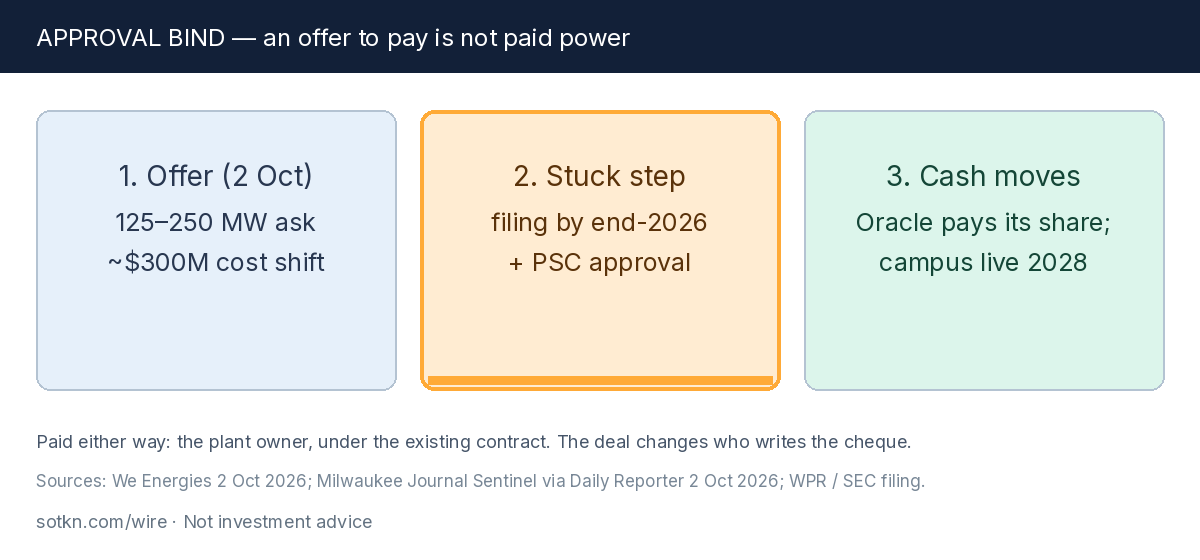
Figure — Approval bind. Offer announced (2 Oct) → filing and state approval (stuck step) → Oracle pays its share as the campus comes online in 2028.
Context: the bill and the queue
Context, not today's deal. We Energies blamed the Point Beach contract for about 20 percent of its proposed $176 million electric rate rise for 2027, and called it the main driver of a $59 million fuel cost increase next year (Journal Sentinel). The Journal Sentinel's read is that Oracle's offer is unlikely to change the 2027 rate request, because the campus does not fully launch until 2028. Separately, We Energies signed a new 20-year deal in August to keep buying about 86 percent of the plant's output into the 2050s; that also needs approval (WEC Form 8-K, via The Duck Curve). Some of the new power plants meant to serve Port Washington are still being built or waiting for approval (Robin, via Journal Sentinel).
The second-order read
Who gets paid. NextEra, the plant owner, keeps getting paid under the existing contract. Nothing about that changes. We Energies' other customers are the ones who gain, about $300 million by the company's estimate, but only once regulators approve.
Who pays. Oracle, for a slice of power that is already expensive and getting more so. It is paying a premium to have power ready before its campus is.
Who waits. Ratepayers facing the 2027 increase. The offer does not reach that bill. And anyone reading this as new nuclear supply: it is the same plant and the same output, with a different payer.
Stuck step. The filing, then the vote. Oracle expects to file by the end of 2026. Until the Public Service Commission of Wisconsin approves it, no cost has moved and no customer has saved anything.
Two cautions
The sources do not agree on what the "10 to 20 percent" is a share of. One report says the plant's output. Another says the campus's power use. Treat 125 to 250 MW as the range, and wait for the filing.
The $300 million is a projection from the companies. Consumer advocate Tom Content of the Citizens Utility Board called the offer "a step in the right direction," but said that until the details are filed, "it's very hard to know if customers are seeing a big win or baby steps." Do not book it as savings yet.
What would change the view
- The filing lands with a price, term and megawatt number that differ from the headline.
- The commission approves, rejects, or adds conditions.
- New power for Port Washington comes online faster, so Oracle needs less of Point Beach.
- The campus slips past 2028, which pushes out when Oracle actually draws the power.
What to watch
- The filing date. Oracle says by the end of 2026.
- The We Energies rate order for 2027 and 2028, expected before the end of 2026.
- The Point Beach extension into the 2050s, also before the commission.
- Project Lighthouse progress toward its 2028 launch.
Read: Hyperscalers, What Is a Hyperscaler?, and Who Finances GPU Clusters.
Get the Wire. A free brief every day, here and in your inbox. Subscribe free →
Sources: We Energies, 2 Oct 2026 — Oracle subscription; ~$300M fuel cost savings; full details to PSC in coming months; Milwaukee Journal Sentinel via Daily Reporter, 2 Oct 2026 — 125–250 MW; $15B Lighthouse; 1.3 GW; 2027–2033 savings window; filing by end-2026; $176M rate rise, 20% share; $59M fuel increase; 2028 full launch; Robin and Content quotes; BizTimes, 2 Oct 2026 — Thiagarajan quote; PSC approval required; LCG EnergyOnline, 2 Oct 2026 — 10–20% of Point Beach generation; current contract to 2033; The Duck Curve, 2 Oct 2026 — $45.94 / $75.51 / $122.45 per MWh path (SEC filing cited by WPR); August 2026 extension 8-K; APPA, 4 Oct 2026 — subject to PSC approval. Annual power cost sizing is our arithmetic. Not investment advice. Do your own research.