Samsung sets Q4 2027 start for Vietnam chip test fab
Samsung filings (5 Oct): two Vietnam memory test fabs, about $3.9B, first line live Q4 2027. About 37% is cash now; 63% waits on future profit.
WIRE · SEMICONDUCTORS · GLOBAL · Data as at 5 Oct 2026
Samsung is building a memory test plant in northern Vietnam, and its filings now give the dates. The first line starts testing chips in the fourth quarter of 2027. The plan is worth about $3.9 billion. But only about 37% of that is cash Samsung puts in now. The other 63% is meant to come from profits the plant has not made yet. On the semiconductors layer, a plan this size is a promise to test chips. It is not paid chips yet.
What happened
On 5 October 2026, the Seoul Economic Daily reported on documents Samsung sent to the government of Thai Nguyen province (Seoul Economic Daily, 5 Oct 2026; also a second report the same day). Samsung set up a new unit, Samsung Vietnam Semiconductor, in March. It is building two test fabs in the Yen Binh Industrial Park, next to its phone factory.
A test fab is the last stop before a memory chip ships. The chip is already made and packaged. Here it gets checked: does it read and write data at the right speed, and does it still work when hot and under high voltage? Chips that fail are thrown out. Only chips that pass go to customers. Samsung does this today at two sites in Korea. The Vietnam plant will take packaged DRAM and NAND chips from Korea and test them there.
The money comes in two kinds. The total plan is 105.79 trillion dong, which the paper puts at about 5.48 trillion won, or $3.9 billion. Samsung affiliates put in 34.6% and the investor 2.5%. The rest, 66.64 trillion dong, will come from reinvested profits once the Vietnam business makes money. No bank loans.
The dates are set too. The first floor line (V1) gets its equipment in July 2027 and starts work in the fourth quarter of 2027. The two reports differ on the second floor line (V2): one says it starts in October 2028, the other says the first quarter of 2028. A second plant is due to start building in 2028.
Event
Samsung plans two memory test fabs in Thai Nguyen, Vietnam
Seoul Economic Daily, 5 Oct 2026, citing Samsung filings to the provincial government
Total plan
105.79 trillion dong, about $3.9 billion, over two phases
Same — the August permit filing listed $4.08 billion
Cash up front
About 37% — Samsung affiliates 34.6%, investor 2.5%
Same; our sum
Waits on profit
About 63% — paid only from profits the plant has not made yet
Same; 66.64 trillion dong of 105.79 trillion, our arithmetic
First line live
Tools arrive July 2027; testing starts Q4 2027
Same
Tools on the list
1,612 new test tools, including 712 burn-in chambers and 332 testers
Businesskorea, 31 Aug 2026, citing the environmental permit
Not disclosed
Which chips, how many per month, and for which customers
None of the reports give output or buyers
So the order is simple. The plant is being built. The tools land in mid-2027. Samsung gets paid only when tested chips leave the plant. And most of the headline money only shows up if the plant earns it first.
Why cash cares
Most chip plant stories stop at the headline number. This one shows two kinds of money and one stuck step.
A memory chip is not sold when it comes off the wafer. It is not sold when it is packaged either. It still has to pass test. That is the last gate before a customer pays. Memory Process Tools Explained covers the front of the line. This plant is the very end of it.
Samsung's filings lay out three steps, and only the first is under way.
- Plant built. Under way. The unit was set up in March 2026 and the site is being built.
- Tools in, line live. Not done. Test tools arrive in July 2027, and the first line starts in the fourth quarter of 2027. Until then, no chip is tested here.
- Profits fund phase two. Not done. About 63% of the plan is paid from the plant's own profits. If the plant earns less, or later, that money comes later or smaller.
The stuck step is the switch-on of that first line. A plan tells you Samsung wants more test capacity outside Korea. It does not tell you when a single tested chip leaves Vietnam. Ready is not paid.
Here is the split, as our own arithmetic. Affiliates (34.6%) plus the investor (2.5%) is about 37% up front. The 66.64 trillion dong from profits is about 63% of 105.79 trillion. The August permit, reported by Businesskorea, gives the same split in dollars: $1.51 billion up front and $2.57 billion from future profits, out of $4.08 billion. The dollar totals differ only because of exchange rates.
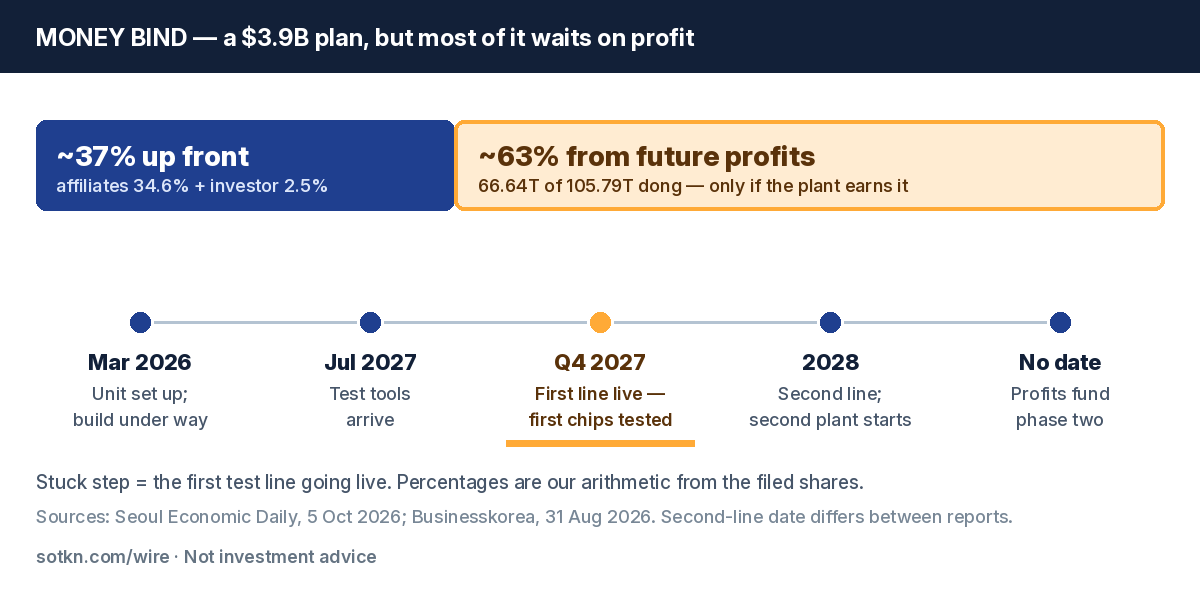
Figure — The money bind. About 37% of the plan is cash Samsung puts in now. About 63% comes only from future profits. Amber marks the stuck step: the first test line going live in Q4 2027.
Compare this with the Wire on Micron locking up 75% of its 2027 memory output. Micron has buyers lined up for chips it has not made. Samsung is adding the step that turns made chips into shippable ones. Both point at the same thing: in memory, the order book is ahead of the factory.
The second-order read
| Who | Seat | What this means |
|---|---|---|
| Samsung Electronics | Owner and chip seller | Adds a test site outside Korea; gets paid only when tested chips ship, from Q4 2027 at the earliest |
| Samsung affiliates | Up-front funders | Put in 34.6% of the plan now |
| Test tool makers | Equipment sellers | 1,612 new tools listed as Korean-made; paid as tools land, from July 2027 |
| Builders of the site | Construction | Paid during the build, from the up-front money |
| Memory buyers | Customers | No new tested supply from Vietnam before late 2027 |
| Thai Nguyen province | Host | Received the filings; gets the plant and the jobs |
Who gets paid. First are the builders, now. Next are the test tool makers, when the tools arrive in mid-2027. The permit lists 712 burn-in chambers, 332 testers, 332 handlers and 136 sorters among the 1,612 tools. Samsung itself gets paid last, when tested chips ship.
Who waits. Samsung waits on the first line. Until it runs, the plant tests nothing and earns nothing. Phase two waits longer, because 63% of the money comes from profits that depend on phase one working. Memory buyers who hoped for more supply soon also wait. One professor quoted by the paper expects high-bandwidth memory (HBM), the AI chip memory, to stay at the Korean sites, with plain memory moving to Vietnam. That is his view, not a Samsung statement. If he is right, this plant does not ease the HBM squeeze.
By clock. Plant set up: March 2026. Tools in: July 2027. First line live: Q4 2027. Second line: Q1 or October 2028, depending on which report you read. Second plant: starts building in 2028. Phase-two money: whenever the plant turns a profit. No date is given for that, so that is the line to watch.
This matters past Samsung. Samsung Electro-Mechanics decided last month to build a 2.51 trillion won plant for AI chip package substrates in the same park (see IC Substrates and ABF Explained). The back end of the memory chain is spreading out of Korea. That spreads risk. It also adds new start-up dates that can slip.
Two cautions
The 37% and 63% are our own arithmetic from the filed shares. The filings set a plan, not a spending record. Samsung has not said how many chips the plant will test each month, or which customers they are for. Do not turn the $3.9 billion into a yearly revenue figure.
The two Seoul Economic Daily reports, published the same day, give different start dates for the second line: Q1 2028 and October 2028. Treat the second-line date as unsettled until Samsung or the province confirms it. The tool list comes from a permit filed earlier and reported on 31 August; the final count can change.
What would change the view
- A confirmed go-live for the first line, or a slip past Q4 2027.
- Output numbers: how many chips a month the plant will test.
- A Samsung statement on which memory goes to Vietnam, including whether any HBM does.
- Profit-linked money moving early, which would mean the plant is earning faster than planned.
What to watch
- Tool deliveries in July 2027 — the first hard sign the line is on time.
- Samsung's third-quarter results — any comment on back-end capacity and memory supply.
- Other test and packaging moves — whether more memory makers shift the last step outside their home country.
- The second-line date — which of the two reported dates holds.
Read: Semiconductors, Memory Process Tools Explained, Foundry and Advanced Packaging Explained, IC Substrates and ABF Explained, What Is HBM?, and Who Makes HBM.
Get the Wire. A free brief every day, here and in your inbox. Subscribe free →
Sources: Seoul Economic Daily, 5 Oct 2026 — Samsung filings to Thai Nguyen province; 105.7944 trillion dong (about 5.48 trillion won, $3.9B) over two phases; affiliates 34.6%, investor 2.5%, 66.6401 trillion dong from reinvested profits; no bank loans; V1 tools July 2027, operation Q4 2027; V2 tools May 2028, operation October 2028; test-fab role; Inha University professor's view on HBM; Seoul Economic Daily, 5 Oct 2026 (second report) — V1 Q4 2027; V2 Q1 2028; second plant from 2028; about 2 trillion won for the first plant; Businesskorea, 31 Aug 2026 — environmental permit: $4.08B registered; $100M own capital, $1.41B from affiliates, $2.57B future profit reinvestment; 1,612 new Korean-made tools; Reuters, 27 May 2026 — first-phase plan of about $1.5B. Percentages are our arithmetic. Not investment advice.