Who Makes HBM
Who makes HBM is the map of roles along the stack — memory makers, package attach, and tools. Allocation locks are not settled cash. Roles only. No tip sheet.

Who makes HBM is the roles map for high-bandwidth memory: which firms build the DRAM stacks, which partners attach those stacks beside an accelerator on advanced packaging, and which tools and materials gate how fast supply can rise.
EXPLAINEDPlayersLast reviewed: 04 Oct 2026Next review: after next Micron / Samsung / SK hynix HBM capacity or allocation print (ask, SCA lock, or volume note)
In short. Who makes HBM is a roles map on the semiconductors layer: DRAM stack makers build the cubes; packaging/foundry partners attach them beside accelerators; tools and materials gate how fast stacks can rise. Fresh clocks (early Oct 2026) show allocation locks and opening asks — not settled cash. Roles only. No tip sheet.
For investors on the semiconductors layer, the useful question is which role gets paid when AI CapEx binds scarce stacks and packaging — not which ticker “wins.” Early October 2026 clocks show allocation locks and opening asks — ready book, not settled cash until stacks ship and invoices clear. See what HBM is; for the attach gate, see what CoWoS is.
Education only. Not investment advice. Do your own research.
Who makes HBM?
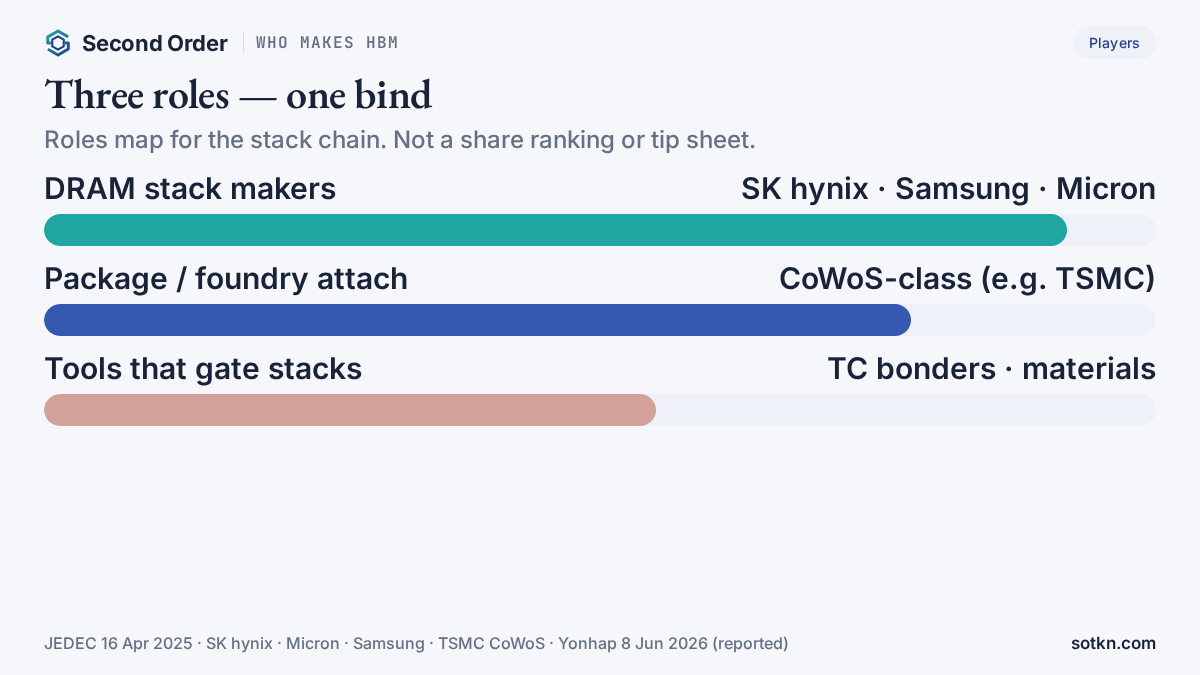
Who makes HBM splits into three roles. DRAM stack makers fabricate and stack the memory cube. Foundry and advanced-packaging partners attach that cube beside the accelerator. Tool and materials suppliers gate how fast cubes can ship. JEDEC’s HBM4 standard (JESD270-4, 16 April 2025) sets the interface envelope — up to about 2 TB/s on a 2048-bit bus — but does not name who clears which role.
| Role | Job | Dated example (labelled) |
|---|---|---|
| DRAM stack makers | Build HBM cubes (dies + stack + base die) | SK hynix 12-Hi HBM3E volume (26 Sep 2024); Micron >75% FY2027 output committed / vast majority calendar-2027 HBM bits sold higher YoY (outlook 30 Sep–1 Oct 2026); Samsung mid-$4/Gb HBM4 opening ask (2 Oct 2026, reported — not ASP) |
| Foundry / packaging attach | Place stacks beside logic on advanced package | TSMC CoWoS integrates SoC + HBM (product page). SK hynix HBM5–CoWoS Partner of the Year (28 Sep 2026) — early validation, not volume |
| Tools / materials that gate stacks | Stacking equipment and process materials | TC bonders stack DRAM into HBM; Yonhap 8 Jun 2026 reported SK hynix → Hanmi ₩44.2bn TC-bonder order for HBM4 |
Who builds the DRAM stacks?
Stack makers are the memory suppliers that ship HBM cubes — principally SK hynix, Samsung, and Micron. SK hynix began 12-layer HBM3E volume production on 26 September 2024; Samsung announced HBM4 commercial shipments on 12 February 2026 (both company-reported). Those dates show the role, not a ranking. Contrast board-level memory in HBM vs GDDR or HBM vs DDR5 — same DRAM family tree, different attach and who clears first when AI orders hit.
The cash clock shifted in early October 2026. Micron’s fiscal Q4 release (30 Sep 2026) and Korea Herald (1 Oct 2026) carried the outlook: more than 75% of fiscal 2027 output already committed, talks shifting toward 2028, and most calendar 2027 HBM bits sold at higher YoY prices — company outlook, not collected cash. Committed volume still has to ramp, ship, and clear invoice. See the Micron >75% 2027 output Wire.
Separately, Maeil Business (2 Oct 2026) reported Samsung opened 2027 HBM4 talks at mid-to-high about $4/Gb — more than three times a ~$1.50/Gb HBM3E reference. That is an opening ask, not a settled ASP. Cash clears when qualified volume locks and the customer pays. See the Samsung mid-$4/Gb HBM4 Wire.
Who attaches HBM to the accelerator?
HBM only becomes useful when it sits beside the GPU or ASIC on an advanced package. TSMC’s CoWoS family places SoCs and HBM stacks on a shared package; CoWoS-L has been in volume since 2024 (TSMC CoWoS page). That is attach — not DRAM fabrication. GPU designers who specify stacks still wait on cubes and package slots — see who makes AI chips.
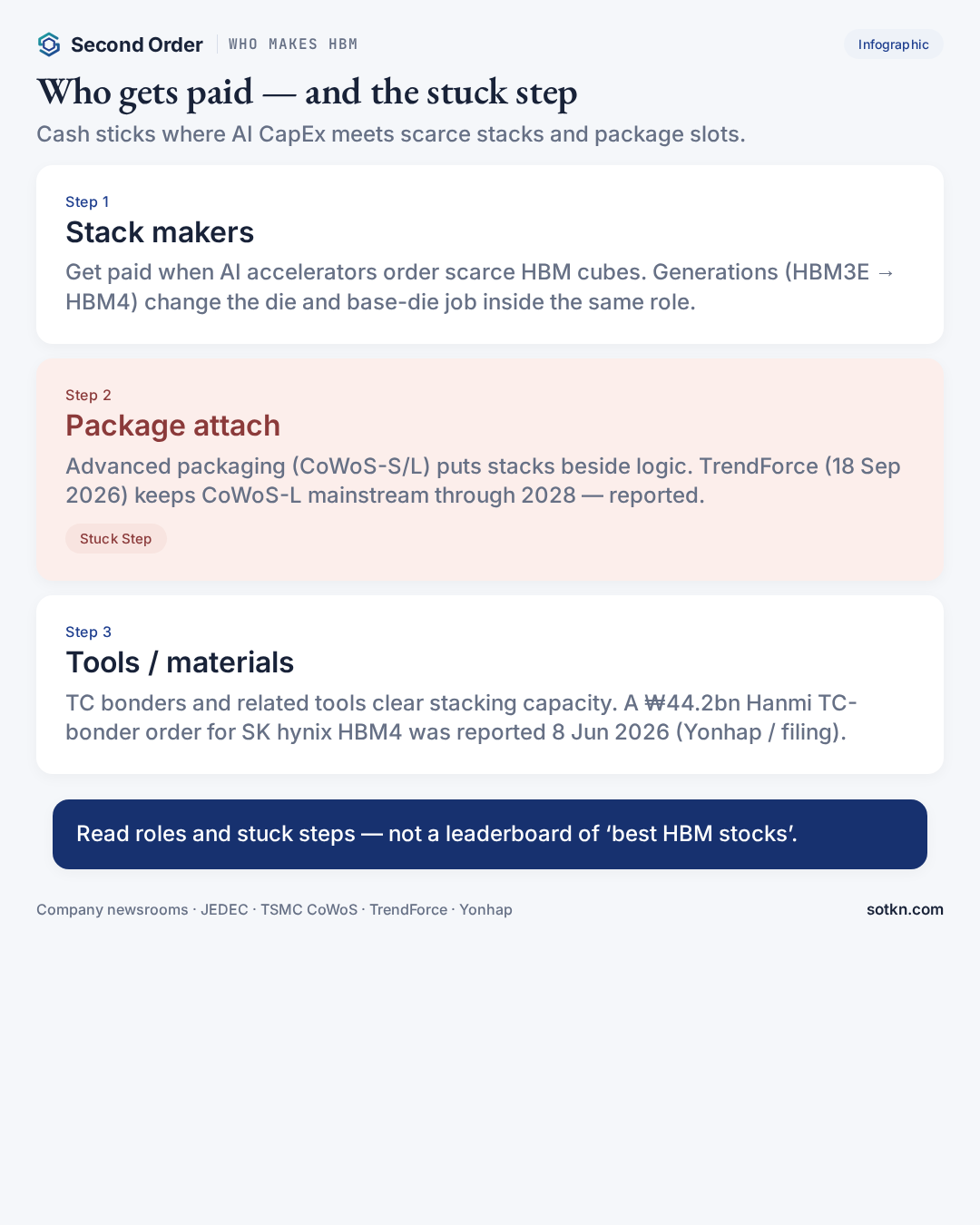
SK hynix’s 28 September 2026 newsroom note says it won Partner of the Year for validating HBM5 with TSMC CoWoS — early validation, not volume. When package slots are short, cash sticks at attach; stack makers can wait even when cubes exist. See CoWoS explained.
Who supplies the tools that gate stacks?
Building taller HBM cubes needs stacking equipment. Thermal-compression (TC) bonders stack DRAM dies — a step memory makers buy when they expand HBM capacity. Yonhap (8 Jun 2026) reported SK hynix ordered Hanmi TC bonders in a ₩44.2 billion filing for HBM4 — reported, not guided. See memory process tools for HBM.
Who gets paid — and where is the stuck step?
Who gets paid tracks which role clears first when AI CapEx orders arrive. Stack makers clear when scarce cubes ship under settled contracts; packaging clears when CoWoS-class slots bind; toolmakers clear when stacking capacity expands. The stuck step is usually stacks plus attach — and allocation locks or asks can rise while installs and invoices still wait.
| Clock | What the print means | When cash clears |
|---|---|---|
| Micron >75% FY2027 output committed | Ready book / SCA + allocation language (outlook 30 Sep–1 Oct 2026) | Fab ramp → shipment → invoice |
| Samsung mid-$4/Gb HBM4 ask | Opening negotiation print (Maeil Business 2 Oct 2026) | Annual contract settles on qualified volume; customer pays |
| SK hynix HBM5–CoWoS award | Early attach validation (newsroom 28 Sep 2026) | Not volume; cash still waits on qualified stacks + package slots |
Korea markets door where memory allocation bites: Korea HBM — who gets paid when AI memory stays scarce. Yield / wafer-shift door: Samsung HBM4 yield. Analysis on where the bind moves next: If packaging catches up, where does the stuck step move?.
Common misconceptions
- People assume “who makes HBM” means one company. Actually three roles share the chain: stack makers, package attach, and tools/materials. Missing any one role leaves the accelerator waiting.
- People assume TSMC makes the HBM cube. Actually CoWoS attaches memory makers’ stacks beside logic. The foundry/packaging partner does not fabricate the DRAM stack.
- People treat an allocation lock or opening ask as collected cash. Actually committed volume and mid-$4/Gb asks are ready book. Cash clears on ship and invoice — and on settled contract ASP, not the first number in the room.
- People treat a Partner of the Year award as volume. Actually SK hynix’s HBM5–CoWoS recognition is early validation with the packaging partner — not a shipment print.
FAQ
Who makes HBM?
HBM stacks are built by DRAM memory makers — principally SK hynix, Samsung, and Micron — then attached beside an accelerator on advanced packaging such as TSMC CoWoS. Tools such as thermal-compression bonders gate how fast stacks can be built. This is a roles map, not a stock tip sheet.
Who manufactures HBM memory chips?
The DRAM dies and finished stacks come from memory suppliers. SK hynix began 12-layer HBM3E volume production on 26 September 2024; Samsung announced HBM4 commercial shipments on 12 February 2026 (company-reported). Allocation prints are not settled cash.
Does TSMC make HBM?
No. TSMC’s CoWoS-class packaging integrates logic dies with HBM stacks supplied by memory makers. The packaging partner attaches the stack; it does not fabricate the DRAM cube (TSMC CoWoS product page).
Is Micron’s >75% 2027 lock the same as cash collected?
No. Micron’s fiscal Q4 2026 outlook (30 Sep–1 Oct 2026) said more than 75% of fiscal 2027 output was already committed and most calendar 2027 HBM bits were sold at higher YoY prices — company outlook. Committed volume still has to ramp, ship, and clear invoice.
Is Samsung’s mid-$4/Gb HBM4 print a closed ASP?
No. Maeil Business (2 Oct 2026) reported Samsung opened 2027 HBM4 talks at mid-to-high about $4/Gb versus about $1.50/Gb for HBM3E — a reported opening ask, not a settled contract ASP.
Does SK hynix’s HBM5–CoWoS award mean volume?
No. SK hynix’s 28 September 2026 newsroom note recognizes early HBM5 validation with TSMC CoWoS — attach readiness, not a volume shipment claim.
Who gets paid when HBM is scarce?
Cash sticks at stack makers when scarce cubes ship under settled contracts, and at packaging when CoWoS-class slots bind. Toolmakers clear when stacking capacity expands. Asks and allocation locks are ready book — not paid until ship and invoice.
Is this a list of the best HBM stocks?
No. Second Order Players pages map roles and stuck steps. They do not rank tickers or give buy/sell calls.
Related terms
- HBM — what high-bandwidth memory is.
- CoWoS — the packaging attach that sits next to HBM.
- Memory process tools — equipment that gates how fast HBM capacity can rise.
- HBM vs GDDR — stack-on-package versus board-level graphics DRAM.
- Who makes AI chips — designers who specify stacks next to the attach gate.
Markets and stack doors
Layer: semiconductors. Markets: Korea HBM memory · Samsung HBM4 yield.
Further reading
Anger prints: Micron >75% 2027 output Wire · Samsung mid-$4/Gb HBM4 Wire · where the stuck step moves if packaging catches up.
Get the Wire — short notes when memory or packaging clocks move.
How we check this
Figures come from company filings and government releases, each dated in the list below. Capacity and timing from press reports are labelled as reported, not guided. Opening asks and allocation locks are not treated as collected cash. Where we work something out ourselves, the arithmetic is shown in full.
Last reviewed: 04 Oct 2026 · Next review: after next Micron / Samsung / SK hynix HBM capacity or allocation print (ask, SCA lock, or volume note)
Spot an error? Tell us and we will correct it and note the change here.
Sources
- Micron IR — record fiscal Q4 and full-year 2026 results (30 Sep 2026)
- Korea Herald — Micron >75% of fiscal 2027 output committed; 2027–2028 tighter (1 Oct 2026)
- Maeil Business / MK — Samsung mid-to-high ~$4/Gb opening ask for 2027 HBM4 (2 Oct 2026, reported ask ≠ ASP)
- SK hynix Newsroom — TSMC OIP; HBM5–CoWoS Partner of the Year (28 Sep 2026; early validation)
- BusinessWire / JEDEC — HBM4 (JESD270-4); up to ~2 TB/s on 2048-bit interface (16 Apr 2025)
- SK hynix Newsroom — volume production of 12-layer HBM3E 36 GB (26 Sep 2024)
- TSMC — CoWoS integrates SoCs and HBM stacks; CoWoS-L volume since 2024 (accessed 4 Oct 2026)
- Yonhap — SK hynix orders Hanmi TC bonders ₩44.2bn for HBM4 (8 Jun 2026, reported from filing)