If Packaging Catches Up in 2027, Where Does the Stuck Step Move?
Advanced packaging has been the step the whole AI build chain waits for since 2024. Reported capacity plans put that gap closing through 2027. This piece works out what binds next — and it is not the step most people assume.
ANALYSIS · MEMBERS CONTINUE · 3 min free / 12 min full · Data as at 21 Sep 2026
Advanced packaging has been the step the whole AI build chain waits for since 2024. Reported capacity plans put that gap closing through 2027. This piece works out what binds next — and it is not the step most people assume.
In short
- The question: when packaging stops being scarce, where does the money stick?
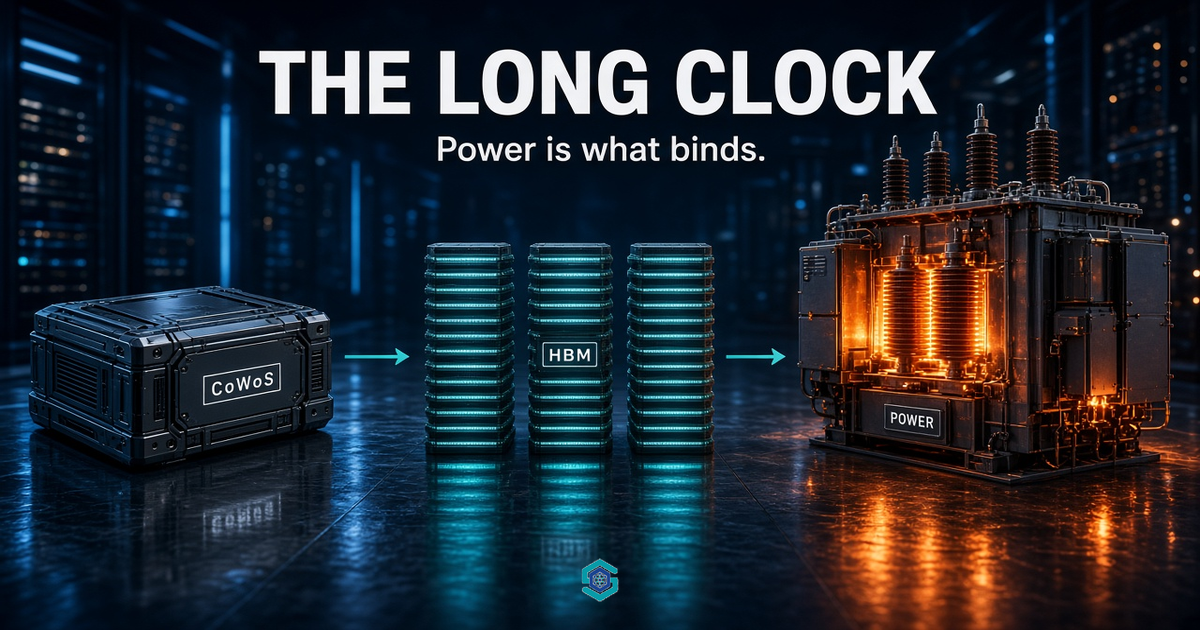
- The answer: it moves through memory, to power. Memory binds briefly; power binds for years
- Why: pricing power lasts as long as the shortage does, and the three candidate steps have three very different clocks — roughly 4 quarters, 3 quarters, and 5 years
Behind the wall: three scenarios with the arithmetic · the dated sequence · six practical takeaways · Members’ FAQ - What would break it: a hyperscaler cutting 2027 capex before packaging capacity lands. That is the one that undoes everything
- Nothing here is a recommendation. This is a map of where cash collects, with the working shown
What's in this piece: the numbers that matter · why packaging is the visible clock · the two candidates · members from here · why the clock beats the size · three scenarios, arithmetic shown · the sequence and its dated checks · our read · what would change the view · practical takeaways · FAQ · sources
The numbers that matter
| What | Figure | Date | What it tells us |
|---|---|---|---|
| TSMC CoWoS capacity, 2026 | 120,000–140,000 wafers/month, +50,000–60,000 at partners | Reported, 15 Jun 2026 | Packaging is adding capacity fast |
| Packaging gap | ~20% → ~10% by end-2026 | Reported, 15 Jun 2026 | The visible clock — quarters |
| TSMC August revenue | NT$514.81bn, +53.3% YoY | 10 Sep 2026 | Demand is not slowing to meet it |
| NVIDIA data-centre revenue | $89.0bn, +117% YoY | Quarter to 26 Jul 2026 | Same |
| 2026 hyperscaler capex | ~$660–690bn guided | 12 Feb 2026 | Same |
| HBM supply | Sold out through 2026, all three suppliers | Reported, 3 Aug 2026 | Memory is short |
| HBM4 ramp | SK hynix in volume Q2 2026; Samsung guiding 3× Q3 vs Q2 | Reported, 3 Aug 2026 | But moving in quarters |
| US grid queue | 1,312 GW generation + 749 GW storage waiting | End-2025, published May 2026 | Power is short |
| Median wait, request to operation | Over 5 years | Projects completed 2025 | And moving in years |
| CoreWeave power | 1.5 GW active, 3.7 GW contracted | 30 Jun 2026 | 2.5× the live footprint waiting for a hall |
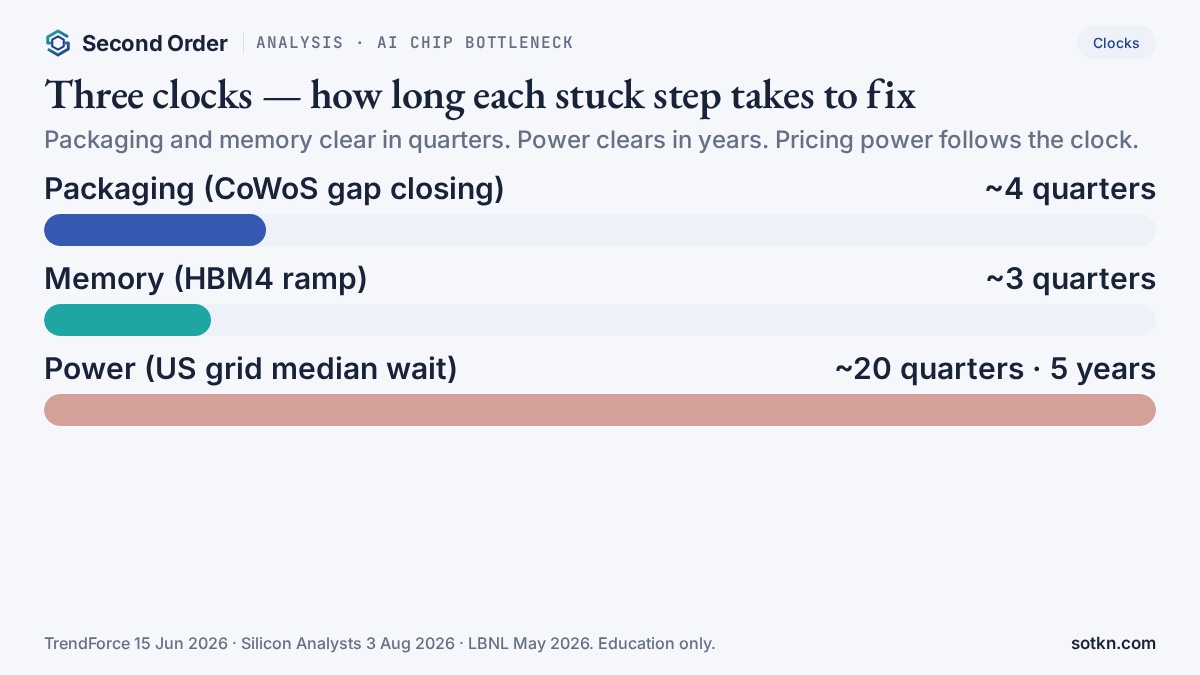
Chart 1 — The three clocks. Sources: TrendForce 15 Jun 2026; Silicon Analysts 3 Aug 2026; LBNL Queued Up May 2026.
Why is packaging the visible clock?
The Semiconductors layer has five steps. Right now two are short: advanced packaging and high-bandwidth memory. A finished accelerator needs both at once, and the slower of the two sets the date.
Packaging is the one with a timetable. TSMC's CoWoS capacity is reported at 120,000–140,000 wafers a month through 2026, with outsourced partners adding a further 50,000–60,000, taking the industry towards roughly 200,000 a month. The gap between what buyers want and what exists is reported to be narrowing from about 20% to about 10% by the end of 2026, with further improvement in 2027 (TrendForce, 15 Jun 2026 — reported, not company guidance).
Demand is not slowing to meet it. TSMC's August revenue was NT$514.81bn, up 53.3% on a year earlier, with January–August up 39.3% (TSMC, 10 Sep 2026). NVIDIA's data-centre revenue for the quarter ended 26 July was $89.0bn, up 117% (NVIDIA, 26 Aug 2026). The five largest buyers guided to roughly $660–690bn of capital spending in 2026 (Futurum Group, 12 Feb 2026, from company guidance).
So the question is not whether packaging capacity arrives. It is what the money does when it does. Everything downstream of a scarce step waits; the margin collects at the scarce step and thins out everywhere else. The most useful thing to know about the build chain is not which step is stuck now — that is on the Stack — but which step is stuck next, because that is where pricing power moves before the results show it.
Which two steps could bind next?
Two candidates: memory and power. Memory is the bigger shortage today — all three suppliers are reported sold out through 2026. Power is the longer one — the median US grid connection takes over five years. They differ in the one respect that matters most, and it is not the size of the shortage. It is how long each takes to fix, because pricing power lasts exactly as long as the shortage does.
Our read, in one line: the constraint moves — but it does not move to memory. It moves through memory, to power. The clocks, the three scenarios and the arithmetic are below.
The free preview ends here.
—— Still to read · ~8 of 12 minutes ——
MEMBERS CONTINUE HERE
- Three scenarios with the arithmetic
- The dated sequence
- Six practical takeaways
- Members’ FAQ