If Short AI Contracts Clear Near $40m/MW, Where Does Cash Stick?
When short AI contracts clear near $40 million per megawatt and contracted power hits about 4.2 GW, what stuck step does the neocloud map already assume — utilization and short-contract price, power and hall delivery, or customer concentration?
ANALYSIS · MEMBERS CONTINUE · 3 min free / 12 min full · Data as at 25 Sep 2026
When short AI contracts clear near $40 million per megawatt and contracted power hits about 4.2 GW, the money question is not whether neoclouds are busy — it is what stuck step the map already assumes: utilization and short-contract price, power and hall delivery, or customer concentration.
In short
- The question: if short AI contracts clear near $40m/MW while contracted power hits ~4.2 GW, where does cash stick on the neocloud map?
- The answer: Scenario B — a dual near-term bind. Short-contract / on-demand price stays elevated and power+hall delivery stays scarce; customer concentration is the long risk clock, not the whole story
- Why: CoreWeave’s Q3 short 3–6 month deals at ≈$40m/MW annualized, +0.5 GW contracted power in six weeks, and Nebius PAYG selected GPUs +17–21% from 1 Oct 2026 all print the same signature — fleets that can attach near-term capacity get paid
Behind the wall: three scenarios with the arithmetic · $40m/MW × GW ceiling vs commitment clocks · six practical takeaways · Members' FAQ - What would break it: short $/MW compressing before halls clear — or offtake concentration breaking fleets without Meta/Microsoft-class demand
- Nothing here is a recommendation. This is a map of what today’s prints already assume, with the working shown
What's in this piece: the numbers that matter · why short contracts sit at the neocloud stuck step · what the map assumes in one line · members from here · who gets paid · three scenarios, arithmetic shown · our read · what would change the view · practical takeaways · FAQ · sources
The numbers that matter
| What | Figure | Date | What it tells us |
|---|---|---|---|
| CoreWeave Q3 short contracts | ≈3–6 months; ≈$40m/MW annualized | Company press / BusinessWire, 17 Sep 2026 | Near-term price bind |
| Contracted power | ~4.2 GW (11 Aug) from ~3.7 GW (30 Jun) | Same; Q2 call reiterate | +0.5 GW in ~6 weeks |
| Early-Q3 net new commitments | >$25bn (not in 30 Jun backlog) | Same | Backlog clock ≠ short $/MW alone |
| Nebius PAYG selected NVIDIA GPUs | +17–21% from 1 Oct 2026 | Reuters, 17 Sep 2026 | Layer-wide on-demand price power |
| Nebius–Meta AI infra | Up to ~$27bn (5-year; Vera Rubin dedicated + optional) | Nebius newsroom, 16 Mar 2026 | Concentration / offtake clock |
| Nebius–Microsoft | Multi-billion multi-year AI infra | Nebius newsroom, 8 Sep 2025 | Same clock, second anchor |
| Oracle AI capacity delivered | +850 MW; GPU util 97.9%; RPO $664bn | Oracle Q1 FY27, 10 Sep 2026 | Hyperscaler contrast — long clock still full |
| Our ceiling illustration | $40m × 4,200 MW ≈ $168bn/yr if all GW cleared at short price | Second Order arithmetic | Ceiling — not what clears |
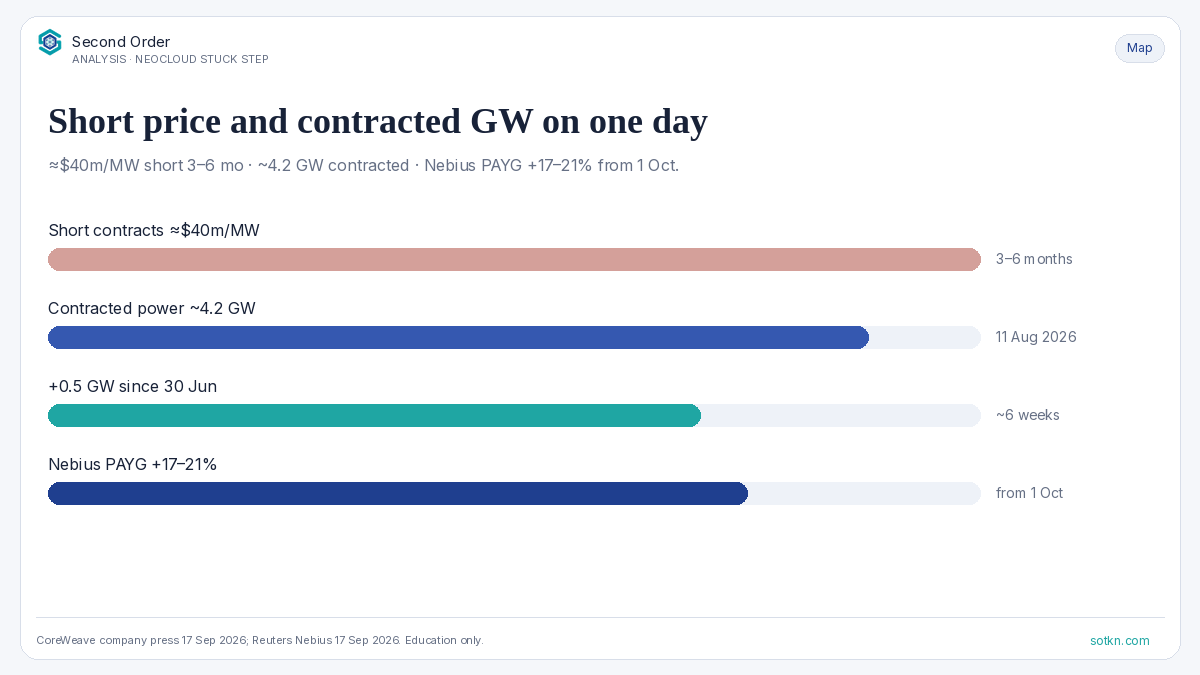
Chart 1 — Short-contract price and contracted GW on the same day. Sources: CoreWeave company press 17 Sep 2026; Reuters Nebius 17 Sep 2026. Education only.
Why do short contracts sit at the neocloud stuck step?
The neoclouds layer sits between scarce accelerators and builders who need clusters now. Specialist fleets finance GPUs, place them in power-ready halls, and sell capacity by the hour or by contract — different from a hyperscaler platform (see Neocloud explained, What does CoreWeave do?, GPU-as-a-service explained, Neocloud vs hyperscaler).
Who gets paid in this layer is whoever keeps the fleet busy at a price above the cost of chips, power, networking, and capital. Who waits is the buyer stuck on a waitlist — or the operator with dark racks and expensive debt. The Stack page already names the stuck step as utilization, power delivery, and customer concentration, not chip scarcity alone. Today’s prints let us test which of those three the map is actually leaning on.
Today’s Wire already printed the signal: CoreWeave said that since 30 June 2026 it has continued to contract new compute at higher prices — Q3 short-dated deals of roughly three to six months at approximately $40 million per megawatt (annualized revenue ÷ power for the related clusters), with contracted power up to about 4.2 GW as of 11 August from about 3.7 GW at 30 June, and more than $25 billion of early-Q3 net new commitments not in the June backlog (Wire; CoreWeave company press, 17 Sep 2026). Same day, Nebius said pay-as-you-go rates for selected NVIDIA GPUs rise 17–21% from 1 October 2026 — the second hike in about three months (Nebius Wire; Reuters, 17 Sep 2026).
Two clocks sit on the same day. The price clock is short and on-demand — 3–6 month deals near $40m/MW, and a PAYG hike that lands on 1 October. The delivery clock is contracted power — half a gigawatt added in about six weeks, with more than $25 billion of early-Q3 commitments still waiting to become backlog once capacity clears. Collapse those clocks into one story and you miss the bind. US Markets desks already track the long power queue on speed-to-power; hyperscaler contrast sits on Oracle’s 850 MW add with the fleet still 97.9% full (Oracle Q1 FY27, 10 Sep 2026). Neoclouds are the specialist mid-stack expression of the same scarcity weather.
That is not a results recap. It is a map question. Where the stuck step moves tracked packaging → memory → power clocks at the layer level. CoWoS-L capacity vs validation asked who gets paid inside packaging. Yesterday’s ASE company piece asked what one OSAT price assumes. Today asks what the neocloud map already assumes when the short-price print and the GW print arrive together.
What does the map already assume?
Three candidate binds compete for the label “stuck step”:
- Utilization / short-contract price — fleets that stay busy at rising near-term rates get paid; dark racks wait.
- Power and hall delivery — contracted GW rises, but cash sticks with whoever can light the megawatts customers already booked.
- Customer concentration — Meta- and Microsoft-scale offtake (Nebius up to ~$27bn Meta agreement, 16 Mar 2026; Microsoft multi-year, 8 Sep 2025) decides who fills halls even when price is strong.
A tip sheet would pick a winner and a ticker. Analysis works the other way: ask which bind today’s dated prints already require for the Stack’s “Tightening” read to keep holding — then show the arithmetic members can check.
Our read, in one line: the map already assumes Scenario B — a dual near-term bind of elevated short-contract / on-demand price and scarce power+hall delivery — with concentration as the long risk clock, not the whole thesis. The three scenarios and the arithmetic are below.
The free preview ends here.
—— Still to read · ~8 of 12 minutes ——
MEMBERS CONTINUE HERE
- Three scenarios with the arithmetic
- $40m/MW × GW ceiling vs commitment clocks
- Six practical takeaways
- Members' FAQ