CoreWeave’s short AI contracts clear near $40m per MW — contracted power hits 4.2 GW
CoreWeave’s Q3 short-dated AI contracts clear near $40m per MW as contracted power rises to 4.2 GW — who gets paid while near-term capacity attaches.
WIRE · NEOCLOUDS · Data as at 17 Sep 2026 · Updated 25 Sep 2026
CoreWeave is still signing short AI contracts near $40 million per megawatt while contracted power climbs to about 4.2 GW. For investors the stuck step on the neoclouds layer is not whether demand exists — it is who can attach power and clusters on near-term deals before the multi-year backlog clears.
What happened
On 17 September 2026 CoreWeave said that since 30 June 2026 it has continued to contract new compute at higher prices (CoreWeave company press via Business Wire, 17 Sep 2026).
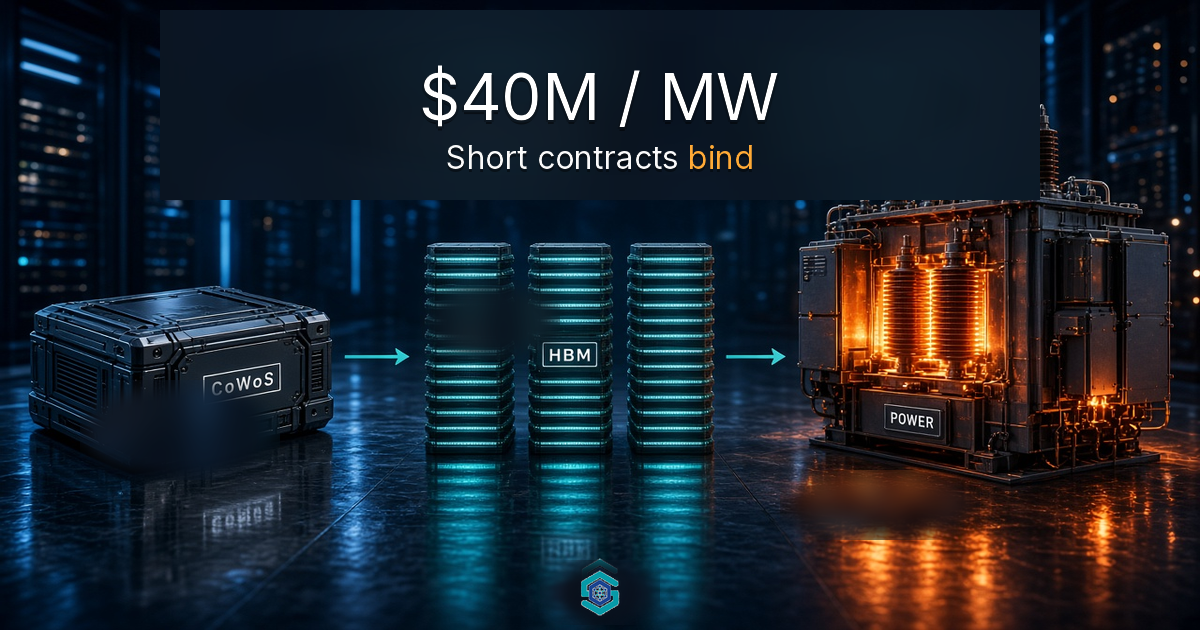
In the third quarter it signed short-dated customer contracts of roughly three to six months, with pricing of approximately $40 million per megawatt — defined as annualized revenue divided by the power required for the related clusters. Early in the quarter it added more than $25 billion of net new customer commitments that were not in the 30 June backlog. Total contracted power rose to about 4.2 GW as of 11 August 2026, from about 3.7 GW at 30 June 2026.
| Figure | Date | |
|---|---|---|
| Short-dated contract tenor | ~3–6 months | Q3 2026 |
| Short-contract pricing | ~$40m per MW (annualized rev ÷ power) | Same |
| Early-Q3 net new commitments | >$25bn (outside 30 Jun backlog) | Early Q3 |
| Contracted power | ~4.2 GW (from ~3.7 GW) | 11 Aug vs 30 Jun 2026 |
What “$40m per MW” means. A neocloud’s binding constraint is often power, not chip count alone. Take the annual revenue a short contract brings in and divide by the megawatts needed to run the clusters behind it. That is a price-per-delivered-megawatt print on near-term deals — not a valuation multiple, and not a claim about what the whole backlog clears at. Most contracted gigawatts sit in longer offtake at different prices; the short print tells you what buyers pay when they need capacity now.
The half-gigawatt step from 3.7 GW to 4.2 GW in about six weeks is the delivery clock beside the price clock. Early-Q3 commitments above $25 billion sit wider still — multi-year offtake as well as short deals — so they must not be collapsed into the $40m/MW figure alone.
Why cash cares
On the neoclouds layer, specialist GPU fleets sit between scarce accelerators and builders who need clusters on a short clock. Who gets paid when short 3–6 month deals clear near $40m/MW is the fleet that can attach power and clusters customers will take now — not only who holds a multi-year backlog on paper. Who waits is the buyer on a waitlist, or the operator with dark racks and expensive capital. See What Does CoreWeave Do? for how the model sits on the map.
Contracted power up about 0.5 GW in six weeks means the short clock is still power delivery and attach on near-term contracts. Designs waiting for halls wait. Backlog that has not yet lit does not become cash until megawatts turn on.
Since 17 September: the same-day on-demand print
The same morning, Nebius told customers it will raise pay-as-you-go prices for selected NVIDIA GPUs from 1 October 2026 — the company’s second hike in about three months, with selected instances up about 17–21% (Reuters, 17 Sep 2026; our Nebius Wire).
Two product shapes, one scarcity signature. CoreWeave’s print is a 3–6 month contract near $40m/MW. Nebius’s print is an on-demand rate card rising into October. Both say near-term capacity is still getting paid more, even as fleets keep adding contracted power. Capacity is arriving; the price of an hour and of a short megawatt is not falling.
Hyperscaler contrast, not confusion: Oracle’s Q1 FY27 print showed 850 MW of additional AI capacity delivered with GPU utilization still at 97.9% (Oracle press / call, 10 Sep 2026; our Oracle Wire). That is the long clock — multi-year backlog and fleet fullness after a large add. Neocloud short contracts are the short clock on the same scarcity weather: who can attach capacity buyers will take now.
The second-order read
| Who | Where they sit | What this means |
|---|---|---|
| Specialist fleets with lit power | Near-term attach | Clear short 3–6 month deals near $40m/MW while util stays high |
| Power and hall deliverers | Contracted GW path | +0.5 GW contracted only becomes cash when megawatts light |
| Buyers without a long contract | Short / on-demand | Pay the scarcity print until halls and longer offtake clear |
| Hyperscaler AI platforms | Long backlog | Absorb overflow; different contract shape, same scarcity signature |
Who gets paid. Fleets that attach power and clusters on near-term deals. Every lit megawatt that can clear a short contract reprices upward relative to multi-year offtake booked months earlier. Who waits. Buyers who need capacity this quarter without a reservation, and operators whose contracted GW has not yet lit.
By clock. The price clock is short and on-demand — 3–6 month deals near $40m/MW, and a PAYG hike that lands on 1 October. The delivery clock is contracted power — half a gigawatt added in about six weeks, with more than $25 billion of early-Q3 commitments still waiting to become reported backlog once capacity clears. Collapse those clocks into one story and you miss the bind.
Our read: the stuck step is a dual near-term bind — elevated short-contract / on-demand price and scarce power+hall delivery. Customer concentration remains the long risk clock, not the whole thesis.
For the map arithmetic — ceiling vs what actually clears, and three scenarios for where cash sticks — see today’s Analysis: If Short AI Contracts Clear Near $40m/MW, Where Does Cash Stick?.
Two cautions
These are company and reported prints, not forecasts of realised margin. The ~$40m/MW figure is CoreWeave’s stated annualized revenue ÷ power for related short clusters — not what the whole 4.2 GW backlog clears at. Most contracted power sits in multi-year offtake at different prices; treating $40m × every contracted megawatt as revenue would invent a ceiling the company did not print.
It is also one primary name on the short-contract print, with a same-day Nebius on-demand print as layer context. Watch whether other fleets echo the short $/MW level, and how much of the ~4.2 GW is live at the next earnings print.
What would change the view
- Short-dated pricing sliding well below ~$40m/MW while contracted gigawatts keep rising — scarcity easing on the price clock before halls clear.
- The >$25bn early-Q3 commitments failing to show up in reported backlog once capacity is scheduled to clear.
- On-demand GPU rates cut back within a quarter while installed capacity keeps rising (the Stack’s falsifier on sustained price declines as capacity arrives).
- A large neocloud printing dark-rack util while short $/MW stays elevated — attach broken even if the rate card looks strong.
What to watch
- CoreWeave next earnings: whether short-dated pricing stays near $40m/MW as more contracted megawatts come online, and how much of the ~4.2 GW is live.
- Reported backlog after early-Q3: whether the >$25bn net new commitments convert once capacity clears.
- 1 October: Nebius PAYG column — whether the +17–21% hike holds on the rate card.
- Other neoclouds / hyperscalers: whether another large fleet moves short-contract or on-demand GPU prices before Q3 prints.
Read: Neoclouds — The Specialist GPU Layer and What Does CoreWeave Do? for how the model sits on the map — and If Short AI Contracts Clear Near $40m/MW, Where Does Cash Stick? for the scenario arithmetic.
Get the Wire. A free brief every day, here and in your inbox. Subscribe free →
Sources: CoreWeave company press via Business Wire, 17 Sep 2026 — company release (also mirrored at company IR / Investing News Network); Reuters, 17 Sep 2026 — reported (Nebius PAYG); Oracle Q1 FY27 press / call, 10 Sep 2026 — company. Not investment advice.