ITC opens a DDR5 DIMM import case on Micron — Samsung’s license is the cash print
The Federal Register today published USITC 337-TA-1523 against Micron, HPE, Lenovo and Super Micro over DDR5 DIMMs. Who gets paid on the US import gate, with Samsung’s August license as the cash print.
WIRE · SEMICONDUCTORS · US · Data as at 25 Sep 2026
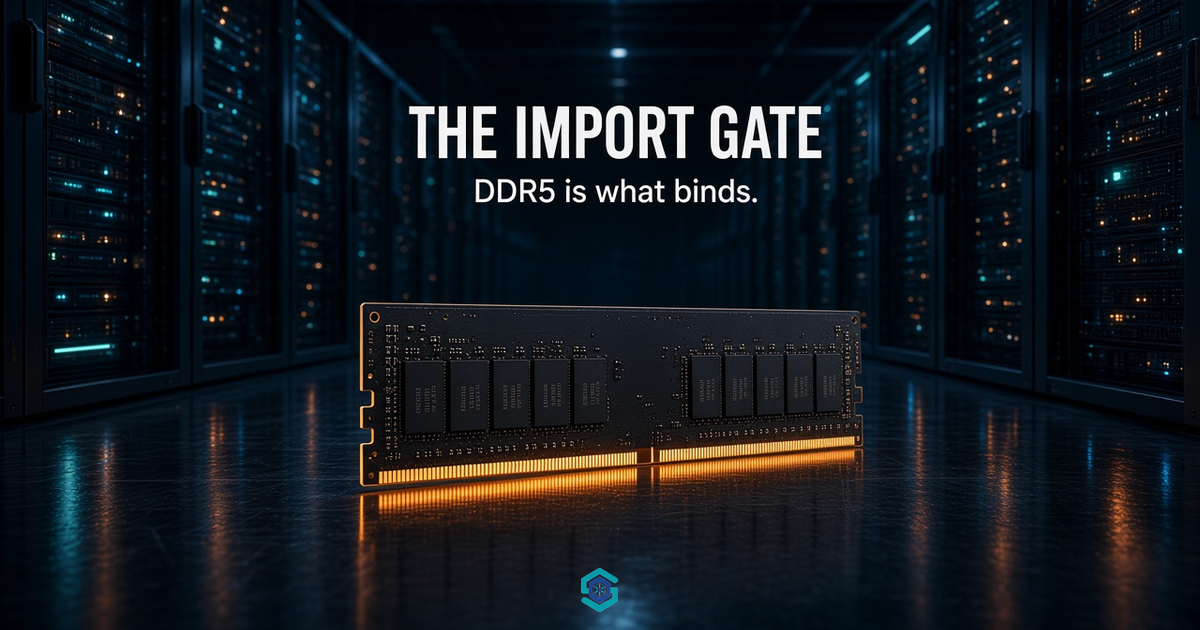
The Federal Register today published the USITC’s notice instituting investigation 337-TA-1523: Netlist versus Micron, HPE, Lenovo and Super Micro over DDR5 DIMMs and the servers that contain them. For investors the stuck step on the semiconductors layer this morning is not HBM attach — it is a US import gate on board-level server memory, with Samsung’s August license already printing what a five-year seat can cost.
What happened
On 25 September 2026 the Federal Register published the USITC notice instituting Certain Dynamic Random Access Memory (DRAM) Devices, Products Containing the Same, and Components Thereof (III) (Federal Register, 25 Sep 2026, 91 FR 60980). The Commission ordered institution on 22 September; the Secretary issued the notice on 23 September (USITC, 23 Sep 2026). Netlist of Irvine, California filed the complaint on 11 August, supplemented 25 August, seeking a limited exclusion order and cease-and-desist orders. Institution is not a finding of infringement or a ban.
The accused products are “certain DRAM devices (specifically, DDR5 generation DIMM), and products containing the same (such as servers, computing systems, and storage systems), and components thereof.” Board-level DDR5 modules and the boxes they sit in — not HBM stacks inside an accelerator package.
| Figure | Date | |
|---|---|---|
| Investigation | 337-TA-1523 (III) | FR 25 Sep 2026 |
| Commission order | Institution under 19 U.S.C. § 1337 | 22 Sep 2026 |
| Asserted patents | ’731, ’523, ’366, ’407 | Same notice |
| Respondents | Micron; Micron Semiconductor Products; HPE; Lenovo Group; Lenovo (US); Super Micro | Same |
On 24 September Netlist said the ITC will decide “whether Micron memory products should be banned from importation” under four patents that “read on DDR5 RDIMMs and/or MRDIMMs.” CEO C.K. Hong called the Samsung agreement “an important industry benchmark for the value of our IP.” (Netlist via PR Newswire, 24 Sep 2026 — company.)
That Samsung print is an 8-K dated 5 August 2026 (event 4 August, effective 31 July) — prior context, not today’s cash. Five-year license: upfront US$239 million (~ US$200 million net of Korean withholding) plus quarterly fees of up to US$32.9 million (~ US$27.5 million net) for twenty quarters through 2Q 2031, formula-based, with refund rights. An ITC Cooperation Agreement has Samsung produce information for Netlist’s future ITC actions against third parties (Netlist Form 8-K, 5 Aug 2026 — company filing).
Our arithmetic (ceilings, not collections). Gross if every quarter hits “up to”: $239m + (20 × $32.9m) = $897 million. Net: $200m + (20 × $27.5m) = $750 million. Maxima on a formula — not Micron’s bill.
Why cash cares
On the semiconductors layer, AI servers still need two memory clocks: HBM beside the GPU, and DDR5 DIMMs on the board. The Stack’s stuck step has been CoWoS-class packaging plus HBM attach. 337-TA-1523 does not move that package gate. It opens who can import DDR5 DIMMs — and servers that contain them — into the United States, and who has already paid for a license.
Who gets paid if the case bites is the patent owner, or the memory maker already licensed. Who waits is the unlicensed importer. Micron is the DRAM respondent; HPE, Lenovo and Super Micro are named because accused goods include products containing the DIMMs. A 337 exclusion order stops imports. See HBM, explained: board DRAM and package HBM are not the same invoice.
What a Section 337 limited exclusion order actually does
Section 337 is an unfair-import statute at the USITC, not a damages trial in district court. If the Commission finds a violation, the typical patent remedy is a limited exclusion order against the named respondents’ infringing articles, plus cease-and-desist orders that can reach stock already in the United States. Remedial orders are effective when issued and become final 60 days later unless the US Trade Representative disapproves them (USITC, 23 Sep 2026).
Institution is the start, not the output. A presiding ALJ holds a hearing and makes an initial determination; the Commission may review it. A target date is set within 45 days of institution. Respondents answer within 20 days of service. The ALJ must also take public-interest evidence under 19 U.S.C. § 1337(d), (f) and (g).
Two clocks. A legal clock: service, answer, hearing, Commission review, then a 60-day USTR window. A cash clock: licenses that settle the import risk before that finishes. Samsung’s August 8-K already printed the cash clock. Today’s Federal Register page starts the legal clock against Micron and three server OEMs. Nothing in the notice bans a DIMM tomorrow.
The second-order read
| Who | Where they sit | What this means |
|---|---|---|
| Netlist | Complainant | Collects if Micron or an OEM licenses, or if an exclusion order later bites |
| Samsung | Licensed (Aug 2026 8-K) | Five-year seat paid; ITC cooperation helps against third parties |
| Micron | DRAM respondent | Faces the DDR5 DIMM import case; not found to infringe today |
| HPE, Lenovo, Super Micro | Server respondents | Named because accused goods include servers containing the DIMMs |
| HBM / CoWoS suppliers | Package attach | Not in the accused-product sentence |
| US AI server buyers | Downstream | An eventual LEO hits import paths, not package slots |
Who gets paid. Samsung already wrote the five-year license cheque. Netlist gets paid again if another DRAM name or OEM buys a seat. Who pays. Micron and the named OEMs, if they license or if an order later blocks unlicensed DDR5 DIMMs and servers at the border. Upstream / downstream. DDR5 module makers shipping into the United States; US server assemblers that still need host DRAM.
By clock. The package clock is still CoWoS-L and HBM. The board-import clock is 337-TA-1523. Our read: the stuck step today is who holds a US license to import DDR5 DIMMs, not who holds a CoWoS slot. Samsung’s ITC cooperation clause was aimed at third parties. Micron is the name on this morning’s notice.
Two cautions
Institution is not a finding. Do not treat 337-TA-1523 as an import ban, a Micron shutdown, or a change in HBM allocation. The accused products are DDR5 generation DIMM and systems containing them. Prior Netlist ITC captions have reached HBM; this notice does not. Mixing (III) with earlier HBM captions invents an accelerator-package case the Commission did not open today.
The Samsung dollars are August, “up to,” formula-based, and subject to refund rights. Our $897 million / $750 million figures are ceiling arithmetic — a benchmark Hong pointed at on 24 September, not Micron’s bill.
What would change the view
- A Micron or OEM license that prints cash on the same order as Samsung’s 8-K.
- An initial determination of no violation, or a Commission decision not to review a respondent win.
- A violation finding plus a limited exclusion order that survives the 60-day USTR window.
- Public-interest findings that withhold or delay a remedy even after a violation.
What to watch
- Within 45 days of institution (from 22 Sep 2026): the Commission’s target date for 337-TA-1523.
- 20 days after service: whether Micron, HPE, Lenovo and Super Micro answer.
- 30 September 2026: Micron’s fiscal fourth-quarter call, 2:30 p.m. Mountain (Micron IR, 26 Aug 2026 — company).
- ALJ designation and EDIS schedule: hearing date is the legal clock’s next hard print.
- Any 8-K that puts a dollar figure on a DDR5 DIMM license.
Read: Semiconductors — Chips, Packaging and the Stuck Step and HBM, explained for how board DRAM sits next to the package-memory gate.
Get the Wire. A free brief every day, here and in your inbox. Subscribe free →
Sources: Federal Register, 25 Sep 2026 (91 FR 60980) — USITC notice of investigation 337-TA-1523; USITC, 23 Sep 2026 — Commission press room; Netlist via PR Newswire, 24 Sep 2026 — company; Netlist Form 8-K, 5 Aug 2026 — company filing (Samsung license, ITC cooperation); Micron IR, 26 Aug 2026 — company (30 Sep call). Not investment advice.