Nebius is raising GPU prices by up to 21% from 1 October — and that is the spread getting wider, not demand cooling
Nebius raises on-demand GPU prices up to 21% from 1 October. The spread is widening; capacity is arriving and prices are still going up.

WIRE · NEOCLOUDS · US · Data as at 17 Sep 2026 · Price list checked 23 Sep 2026
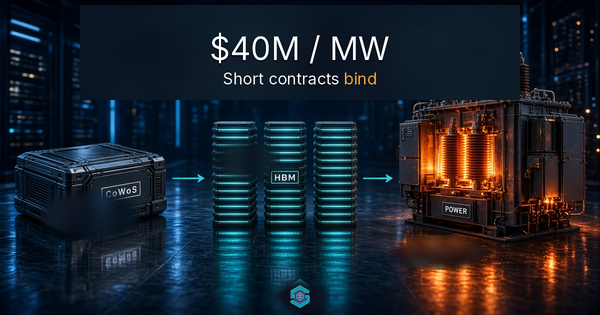
Nebius is charging more for the same GPU hour from 1 October, and it is not the only one. The same day, CoreWeave said it is signing short contracts at about $40 million per megawatt, up to twice what long deals fetched a quarter earlier. Capacity is arriving, and the price of an hour is still going up. That is the spread getting wider, not demand cooling.
What happened
On 17 September 2026 Nebius told customers it will raise pay-as-you-go prices for selected NVIDIA GPUs from 1 October. It is the company's second price rise in about three months (Reuters, 17 Sep 2026). Nebius's own price list now shows both columns side by side:
| GPU instance | On-demand now | From 1 Oct 2026 | Change |
|---|---|---|---|
| NVIDIA HGX H100 | $3.85 | $4.50 | +17% |
| NVIDIA HGX H200 | $4.50 | $5.40 | +20% |
| NVIDIA HGX B200 | $7.15 | $8.50 | +19% |
| NVIDIA HGX B300 | $7.85 | $9.50 | +21% |
| NVIDIA RTX PRO 6000 | $1.80 | $1.80 | unchanged |
Per GPU-hour. Nebius price list, checked 23 Sep 2026.
Some CPU-only instances rise by 25% and some memory offerings by about 41%, Nebius said. Customers who reserve large clusters for several months still get commitment discounts, which the price list puts at up to 35% off on-demand rates.
The same morning, CoreWeave said it has kept contracting new capacity at higher prices since 30 June. In the third quarter it signed short-dated deals of about three to six months at approximately $40 million per megawatt of annualised revenue, and its contracted power rose to about 4.2 GW as of 11 August from about 3.7 GW at mid-year (CoreWeave via Business Wire, 17 Sep 2026).
Why cash cares
A neocloud earns the gap between what it pays for accelerators, power and borrowing, and what it charges per hour. Every number in that sentence except the last one has been rising. This is a clear print showing the last one rising too, which means the spread is widening rather than being squeezed.
Nebius's own filings show the same move in contracts, not just on the rate card. In its Q2 2026 shareholder letter, Nebius said its four largest new deals averaged more than $1 billion each at $20–25 million of annual revenue per megawatt, with older-generation GPUs priced more than 30% higher than in Q1. About 70% of deals included customer prepayments covering 50–60% of the related capex, and the expected payback on that capex fell to 1 year and 10 months, from two to three years before. It also flagged a price opportunity of $40–50 million per megawatt for short-term capacity (Nebius Q2 2026 letter, SEC filing).
Put the two companies side by side and the price curve is plain:
| Deal type | Annual revenue per MW | Source |
|---|---|---|
| Nebius multi-year AI cloud deals (Q2) | $20–25m | Nebius Q2 letter |
| Nebius short-term capacity (early Q3) | $40–50m opportunity | Nebius Q2 letter |
| CoreWeave 3–6 month contracts (Q3) | ~$40m | CoreWeave, 17 Sep |
Our read: buyers who need capacity now are paying up to twice what long-term buyers locked in a few months ago. The on-demand hike is the retail end of the same curve.
What "revenue per megawatt" means. A neocloud's real limit is power, not chips, so the industry has started pricing deals by the electricity a cluster needs. Take the annual revenue a contract brings in and divide it by the megawatts required to run the GPUs behind it. At $20 million per megawatt, a 100 MW site earns about $2 billion a year; at $40 million, the same site earns about $4 billion. The chips and the building barely change. The price per hour does.
Why prepayments matter as much as price
Price is half the story. The other half is who funds the build. Nebius said about 70% of its Q2 deals came with customer prepayments covering 50–60% of the related capex, that it expects more than $9 billion of customer prepayments in 2026, and that it raised a $775 million secured facility in July on the back of one of these agreements. Its AI cloud business ran at a 50% adjusted EBITDA margin in the quarter, on revenue of about $575 million, up 514% on a year earlier (Nebius Q2 2026 letter).
That changes the risk in the model. When customers pay up front for capacity that goes live later, the neocloud borrows less to build it, and the payback shortens: Nebius's fell to under two years. Prepayments are a scarcity signal in their own right. Buyers only fund a supplier's capex when they are worried about not getting the capacity at all.
The second-order read
Who gets paid. Operators with GPUs already powered and not yet committed. Every ready hour reprices upward, which favours fleets with power connected today over fleets with power contracted for 2027.
Who pays. Buyers without a contract: startups and labs renting by the hour. For one eight-GPU B300 node running around the clock, the new rate adds about $317 a day ($9.50 − $7.85 = $1.65, × 8 GPUs × 24 hours; our arithmetic).
Hyperscalers. They absorb the overflow. If specialist on-demand rates keep rising, some buyers move back to hyperscaler capacity or commit for longer to fix a price. Either way, the bargaining power sits with whoever has powered racks. See neocloud vs hyperscaler.
Upstream. Prices rising this late in a GPU generation, with H100 and H200 going up rather than down, say demand is still outrunning delivery. That supports NVIDIA's allocation and the packaging chain behind it (CoWoS-L stays the path through 2028).
Downstream. A dearer GPU hour is a margin question for AI app builders who rent rather than own.
It also answers a question the map has been carrying. On the neoclouds page, one of the things that would change the view is "sustained on-demand price declines as capacity arrives." Capacity is arriving, and prices are going up. For now, demand is outrunning it.
Two cautions
This is on-demand pricing, not the long contracts that make up most of a large neocloud's backlog. It says more about spot scarcity than about locked-in margins; the $20–25 million per megawatt deals are what most of 2027 revenue rests on. And the rate card is not the realised price: commitment discounts of up to 35% still apply, and preemptible capacity on the same list starts at $0.79–$0.99 per GPU-hour.
It is also two suppliers. Watch whether the others follow.
What would change the view
- On-demand rates cut back within a quarter while installed capacity keeps rising.
- Short-dated pricing (the ~$40 million per megawatt deals) sliding back toward long-term levels.
- Prepayments falling well below the ~70% of deals Nebius reported for Q2, a sign buyers no longer fear running short.
What to watch
- 1 October: the new rates take effect. Check whether the price list column holds.
- Before Q3 results: whether another large neocloud or a hyperscaler moves on-demand GPU prices.
- Nebius Q3 results: whether revenue per megawatt rises, and whether contracted power tracks the 5 GW year-end target it raised in August.
- CoreWeave Q3 results: how much of the ~4.2 GW contracted is live.
Read: CoreWeave and how neocloud contracts become cash, What does CoreWeave do?, and What is a neocloud? for the three things a neocloud's margin depends on.
Get the Wire. A free brief every day, here and in your inbox. Subscribe free →
Sources: Reuters, 17 Sep 2026 — reported; Nebius price list — checked 23 Sep 2026; Nebius Q2 2026 shareholder letter — company filing, 12 Aug 2026; CoreWeave via Business Wire — company release, 17 Sep 2026. Not investment advice.