Neocloud vs Hyperscaler
A neocloud bills accelerator time; a hyperscaler sells a broad cloud with GPUs as one line. Compare funding, pricing, lock-in, and what a demand dip hits.
Neocloud vs hyperscaler is the contrast between a specialist cloud that bills GPU accelerator time and a broad cloud that sells many services with GPUs as one line.
For investors the money link is simple: who gets paid when GPU hours bind on a specialist fleet, versus who gets paid when CapEx — or a chip leaseback — clears with lag. Same GPUs. Different cash clocks. This page is the contrast — not a scorecard of names.
EXPLAINEDLast reviewed: 04 Oct 2026Next review: after next CoreWeave earnings, Amazon SPV close print, or hyperscaler AI-capex update
In short: A neocloud bills GPU hours and lives on utilisation and realised price. A hyperscaler funds AI from a broad book — CapEx, and sometimes chip leasebacks — and sets stack demand with lag. Same accelerators can appear in both stories. Who gets paid, where money sticks, and what a demand dip hits are different cash clocks.
Education only. Not investment advice. Do your own research.
What is the difference between a neocloud and a hyperscaler?
A neocloud concentrates on accelerators and bills time by the hour or under reserved contracts. A hyperscaler sells storage, databases, general compute, and AI as one menu. That difference drives revenue concentration, balance-sheet shape, and dip sensitivity.
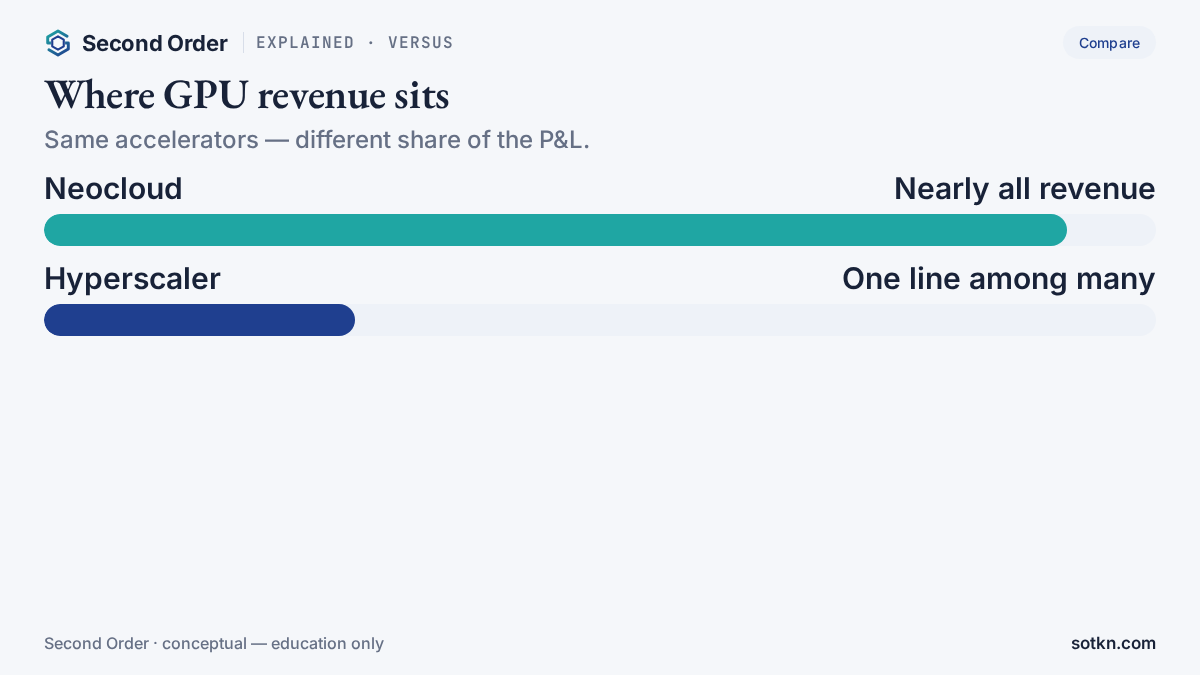
| Axis | Hyperscaler | Neocloud |
|---|---|---|
| Service range | Storage, databases, general compute, GPUs | Accelerators, plus the minimum around them |
| Revenue concentration | GPUs are a slice | GPUs are effectively all of it |
| What funds expansion | Cash from unrelated or broader lines; sometimes chip leasebacks | Debt, leases, equity, customer prepayments |
| Cash clock | CapEx / financing close with lag | Utilisation × realised price on billed hours |
| Pricing behaviour | Anchors the market; discounts strategically | Prices against the anchor; competes on access and speed |
| Customer lock-in | Data gravity and service breadth | Supply certainty and price |
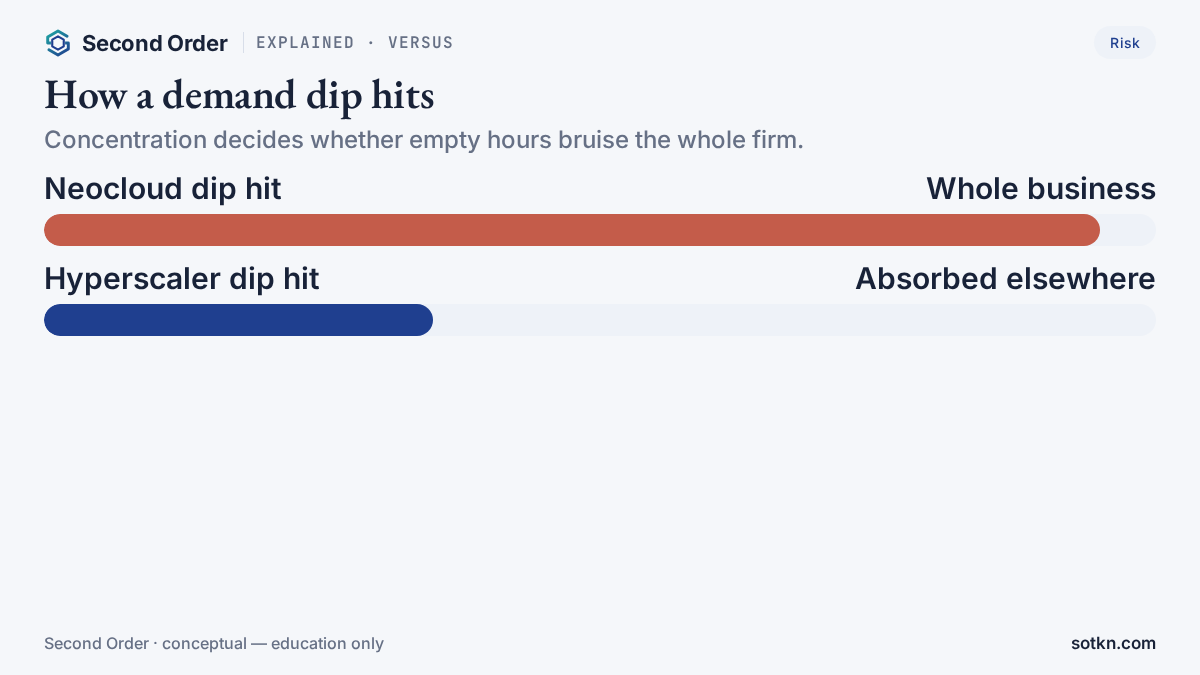
| Demand-dip sensitivity | Absorbed by other lines | Hits the whole business |
| Deploy speed | Slower, process-bound | Faster when GPUs are scarce |
| Customer type | Enterprises and platforms needing a full stack | AI teams that need capacity now |
See the neoclouds stack and the hyperscalers stack for how each layer sits next to chips, power, and halls.
When does each win?
A neocloud often wins when scarce GPUs must land fast and the buyer needs committed blocks without a full platform move.
A hyperscaler often wins when data gravity and the multi-service stack outweigh raw GPU access speed. CapEx also sets supplier calendars: Amazon guided about US$220 billion of company-wide cash CapEx for 2026 on its Q2 call (30 Jul 2026; raised from ~US$200B on higher memory costs); Alphabet’s 2026 guide is US$195–205 billion (CNBC, 22 Jul 2026); Meta’s FY2026 outlook is US$130–145 billion (Meta IR, 29 Jul 2026). Those are guided envelopes, not supplier profit forecasts.
Financing can split from ownership even when racks are already live. The Financial Times reported on 2 October 2026 (Financial Post reprint) that Amazon is in talks to move about US$8 billion of Nvidia Grace Blackwell chips into an SPV and lease the same silicon back. Talks are ongoing — installed chips are not closed financing until investors fund the vehicle and the lease services it. See the Amazon $8B Nvidia chip leaseback Wire and who finances GPU clusters.
Customers often use both. Overflow hits neoclouds when hyperscaler queues are long; pricing pressure hits when hyperscalers expand AI instances.
Who gets paid — and where money sticks?
On the neocloud path, cash sticks when billed hours cover hardware carry, power, cooling, and financing. CoreWeave reported Q2 2026 revenue of US$2.575 billion and company-defined backlog of about US$104 billion as of 30 June 2026 (earnings, 11 Aug 2026) — subject to delivery, not guaranteed profit. Commitments were 98% of revenue; Customer A 36%, B 26%, C 10% (Form 10-Q). Concentration cuts both ways. Markets door: CoreWeave neocloud contracts.
For the biggest example of the neocloud model, see how CoreWeave makes money.
Idle cards still carry capital even when the rate card looks strong. Nebius said on 1 October 2026 it acquired Inferize to cut the “idle GPU tax” from cold starts on Token Factory (Nebius newsroom). Its on-demand GPU-hour list also rose about 17–21% from 1 October (H100 US$3.85→US$4.50 on the public card). A list hike is not collected cash — utilisation × realised price is. See the Inferize idle-GPU Wire, the on-demand hours Wire, and what price assumes when GPUs sit idle.
On the hyperscaler path, CapEx orders pay accelerators, packaging, memory, optics, and halls with lag. AWS net sales rose 37% year over year in Q2 2026 (Amazon IR, 30 Jul 2026) — reported growth inside a broad book. A leaseback talk changes financing form; it does not by itself change whether the GPU earns as a cloud slice or as a specialist hour.
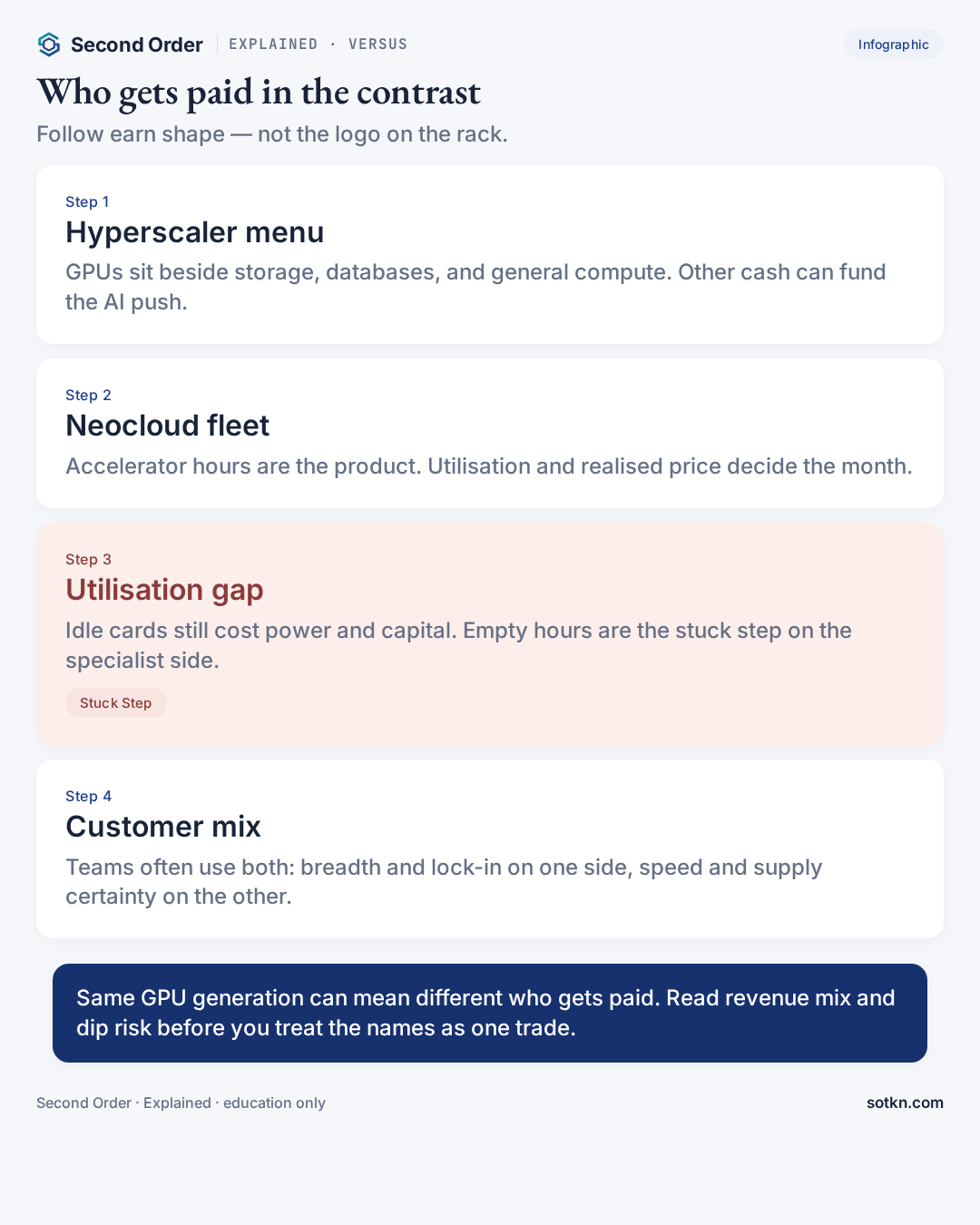
| Step | Hyperscaler path | Neocloud path |
|---|---|---|
| Who gets paid first | Chip, packaging, power, and hall suppliers when CapEx orders bind; SPV investors if a leaseback closes | Owners of live GPUs when reserved or on-demand hours bill |
| Where money sticks | Scarce finish lines (packaging, HBM, watts) and financing close with lag | Utilisation × realised price after discounts |
| Stuck step | Orders vs installs vs closed vehicle — guidance or talks can rise while halls or paper wait | Idle cards still carry capital and power cost |
How does pricing compare?
Hyperscalers often anchor list rates and discount inside large deals. Neoclouds price against that anchor and compete on access speed and committed blocks. As at 4 October 2026, Lambda’s public on-demand list still showed H100 PCIe at US$3.29 per GPU-hour and H100 SXM at US$3.99 on larger nodes (Lambda pricing page) — list, not realised rates. Nebius’s October card move shows the same rule: the posted hour is a starting point.
Common misconceptions
- People assume the same GPU means the same business. Actually revenue concentration decides risk. A GPU SKU inside a hyperscaler is a slice; on a neocloud it is the earn.
- People assume list price is what either side earns. Actually large buyers negotiate off the page. Realised price after discounts — and utilisation — is the number that matters. A list hike is not collected cash.
- People assume CapEx up means neoclouds lose immediately. Actually orders, installs, financing close, and billed hours run on different clocks. Overflow can still fill specialist fleets while guidance rises.
- People assume a big backlog equals booked profit. Actually company-defined backlog is subject to delivery and availability.
- People assume a chip leaseback headline means the financing is done. Actually SPV talks are not closed until investors fund and the lease services the vehicle.
FAQ
What is the difference between a neocloud and a hyperscaler?
A neocloud concentrates revenue on accelerator time. A hyperscaler earns across many services and treats GPUs as one line. That changes funding, pricing power, and demand-dip risk.
When does a neocloud win versus a hyperscaler?
A neocloud often wins when scarce GPUs must land fast without a full platform migration. A hyperscaler wins when data gravity and the multi-service stack matter more than raw GPU access speed.
Who gets paid in each model?
On a neocloud, cash sticks when billed GPU hours cover hardware carry, power, cooling, and financing. On a hyperscaler, CapEx and chip leasebacks pay suppliers and financiers with lag, while cloud fees land across many lines.
Does an Amazon chip leaseback talk mean financing is closed?
No. Reported talks to move about US$8 billion of Nvidia Grace Blackwell chips into an SPV (FT / Financial Post, 2 Oct 2026) are ongoing. Installed racks are not closed financing until investors fund the vehicle and the lease services it.
Why does customer concentration matter more for neoclouds?
Scaled neoclouds often disclose large share from a few customers. A hyperscaler can absorb a lost GPU deal inside a broad book. A neocloud cannot.
Do list GPU prices tell you who earns more?
No. List price is a starting point. Large buyers negotiate off the page. Realised price after discounts, plus utilisation, decides the earn. A list hike is not collected cash.
Related terms
- Neocloud — specialist GPU cloud that bills accelerator time.
- Hyperscaler — broad cloud whose CapEx sets stack demand with lag.
- Who finances GPU clusters — debt, leases, and vehicles behind the same silicon.
Markets and stack doors
Layers: neoclouds · hyperscalers. Markets: CoreWeave neocloud contracts.
Further reading
Anger prints: Amazon $8B Nvidia leaseback Wire · Nebius idle-GPU utilisation Analysis.
Get the Wire — short notes when CapEx or neocloud clocks move.
How we check this
Figures come from company filings and government releases, each dated in the list below. Capacity and timing from press reports are labelled as reported, not guided. Where we work something out ourselves, the arithmetic is shown in full.
Last reviewed: 04 Oct 2026 · Next review: after next CoreWeave earnings, Amazon SPV close print, or hyperscaler AI-capex update
Spot an error? Tell us and we will correct it and note the change here.
Sources
- Financial Post (FT report) — Amazon seeks to offload ~US$8B Nvidia chips via SPV leaseback talks (2 Oct 2026; reported, ongoing)
- Amazon Q2 2026 results (30 Jul 2026) — AWS net sales +37% YoY; CapEx colour ~US$220B for 2026 on call
- CoreWeave Q2 2026 results (11 Aug 2026) — revenue US$2.575B; backlog ~US$104B as of 30 Jun 2026
- CoreWeave Form 10-Q, period ended 30 Jun 2026 — 98% committed; customer concentration
- Nebius newsroom — acquires Inferize; idle GPU tax / Token Factory (1 Oct 2026)
- Lambda GPU cloud pricing page — H100 list rates rechecked 4 Oct 2026
- CNBC — Alphabet raises 2026 CapEx guide to US$195–205B (22 Jul 2026)
- Meta Q2 2026 results (29 Jul 2026) — 2026 CapEx outlook US$130–145B