What Does Nebius's Price Assume About the Idle-GPU Utilization Stuck Step?
Nebius sits at the idle-GPU / utilization stuck step — assigned seats warm for cold starts and SLA spare capacity before a billed hour. At roughly $63.7 billion on about $3.0 billion of ARR, what does that price already assume?
ANALYSIS · MEMBERS CONTINUE · 4 min free / 12 min full · Data as at 2 Oct 2026
Nebius Group sits at the idle-GPU / utilization stuck step — assigned seats that stay warm for cold starts, demand spikes, and SLA spare capacity, before a customer uses a working GPU and pays for that hour. At roughly $63.7 billion on about $3.0 billion of end-June ARR, the question is not whether AI wants more capacity — it is what growth, utilization, and Token Factory economics that price already assumes after Nebius named the idle GPU tax on 1 October.
In short
- The question: what is today’s price for Nebius already assuming about the idle-GPU / utilization stuck step?
- The answer: Scenario B — capacity keeps clearing into billed AI-cloud hours at elevated pricing, utilization keeps improving as an operating print, and the Inferize acquire into Token Factory is an idle-tax option (cut spare-capacity insurance), not a same-day revenue step-up; hall and megawatt clocks (contracted power, AIB-class halls) stay separate from the utilization clock
- Why: Q2 group revenue was $582.3 million (+454% YoY) with AI cloud $574.9 million; ARR hit $3.0 billion end June; AI-cloud adjusted EBITDA margin ~50%; management reaffirmed FY26 path to $3.0–3.4 billion revenue and $7–9 billion year-end ARR; the 1 Oct newsroom named cold starts and SLA spare capacity as the bind — with no disclosed utilization delta and no deal price
Behind the wall: three scenarios with the arithmetic · what ~$63.7B / ~21× ARR implies · six practical takeaways · Members' FAQ - What would break it: idle tax that never shrinks (or SLA breaches when buffers are cut) while the equity still pays for a utilization-compounding ARR path — or connected capacity that fails to clear into billed hours while the multiple still assumes Scenario B
- Nothing here is a recommendation. This is a map of what the price requires, with the working shown
What's in this piece: the numbers that matter · why Nebius sits at the utilization stuck step · what the price implies in one line · members from here · who gets paid · three scenarios, arithmetic shown · our read · what would change the view · practical takeaways · FAQ · sources
The numbers that matter
| What | Figure | Date | What it tells us |
|---|---|---|---|
| NBIS close / market cap | $232.28 / ~$63.67B | Close 1 Oct 2026 | The number we work backwards from |
| Shares out (approx.) | ~274.1M | stockanalysis, Oct 2026 | Cap ≈ price × shares |
| ARR (end June) / multiple | $3.0B / ~21× | Company Q2 / SHL | Primary valuation anchor (trailing NI unusable) |
| TTM revenue / NI | ~$1.36B / ~$42M | stockanalysis, Oct 2026 | Trailing P/E ~1,500× — ignore for scenario work |
| Q2 group rev / AI cloud | $582.3M / $574.9M | Nebius Q2, Aug 2026 | AI cloud ≈ 98% of group |
| Q2 group adj EBITDA / margin | $236.2M / 41% | Same | Operating leverage printing |
| AI cloud adj EBITDA margin | ~50% | Same | Core economics |
| FY26 rev / YE ARR guide | $3.0–3.4B / $7–9B | Reaffirmed on Q2 call | Path the equity is pricing toward |
| FY26 adj EBITDA margin / CapEx | ~40% / $20–25B | Same | Margin + reinvestment clocks |
| Contracted / connected power YE | 5 GW / 800 MW–1 GW | Raised / reaffirmed Q2 | Halls clock — separate from idle tax |
| Customer prepayments 2026 | >$9B expected | Q2 SHL / call | Funding + demand signal |
| ACV / MW (core deals) | ~$20–25M | Q2 commentary | Pricing power on capacity |
| Inferize acquire | Into Token Factory; terms undisclosed | Nebius / EQS, 1 Oct 2026 | Utilization option named |
| Idle tax bind (company) | Cold starts; spikes; mid-run weight updates; SLA spare | Same | Ready ≠ paid |
| AIB capacity (context) | 50 MW critical IT; 12-yr; 65 MW ESA | AIB / GlobeNewswire, 30 Sep 2026 | Separate halls clock |
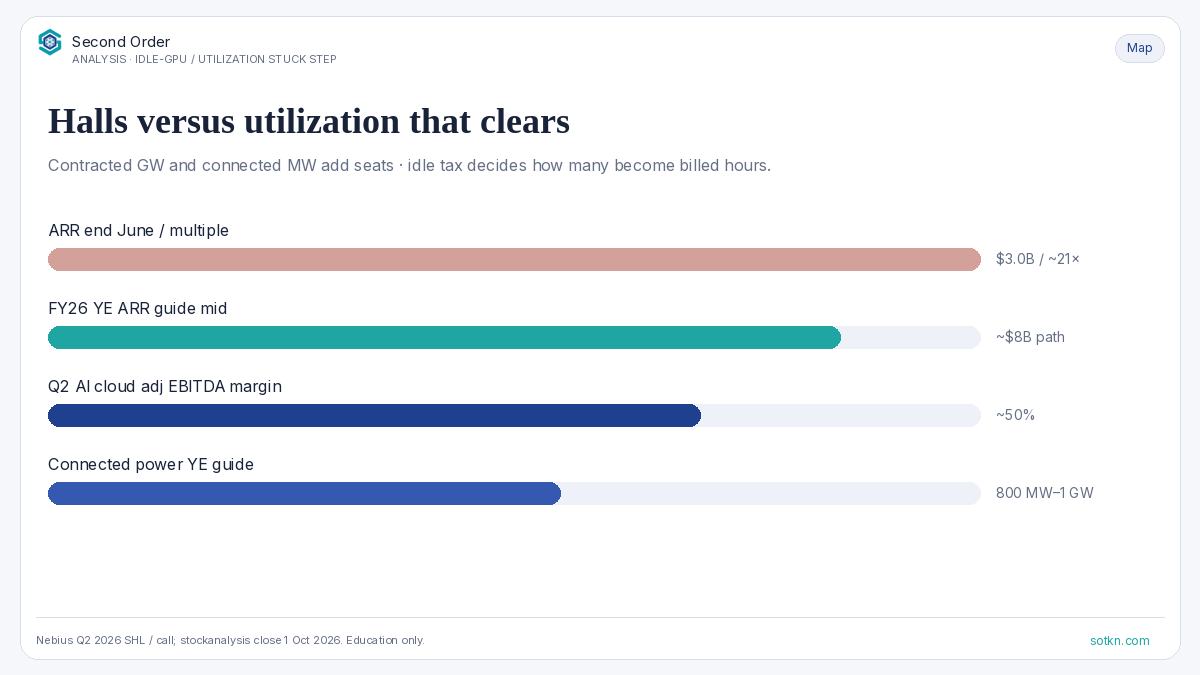
Chart 1 — Two clocks on one equity. Halls and megawatts add seats; idle tax decides how many become billed hours. Sources: Nebius Q2 2026; EQS/newsroom 1 Oct 2026. Education only.
Why does Nebius sit at the idle-GPU / utilization stuck step?
The neoclouds layer turns lit GPU seats into customer invoices. What Is a Neocloud? and What Is GPU as a Service? are the mechanism: cash clears when a customer uses a working GPU and pays for that hour. A seat that is assigned, powered, and cooled — but waiting on a cold start, a spike buffer, or a mid-run weight reload — is ready. It is not yet paid.
Nebius sits where that gap is an operating business. On 1 October 2026, the company said it had acquired Inferize and folded the team and technology into Nebius Token Factory, its managed inference platform. The newsroom / EQS text names the bind in plain language: cold starts leave assigned GPUs idle at launch, on demand spikes, and when weights update mid-run; platforms hold spare capacity to hit service levels; Inferize’s stated job is to cut that “idle GPU tax” so capacity tracks usage more tightly (EQS corporate announcement, 1 Oct 2026; Nebius newsroom, same day). Our Wire covered the signal. This piece asks what NBIS’s equity price already assumes about the bind.
Distinct from Oracle at the power stuck step (lit fleet vs interconnect) and from map theses on take-or-pay / short contracts. Those ask about power and contract shape. This asks what one neocloud’s market value requires of the path from lit seat → utilized seat → billed hour, with Token Factory as the inference layer that claims to shrink spare-capacity insurance.
Keep the clocks separate from the halls print the day before. AIB’s 30 September note — 50 MW of critical IT capacity for Nebius, a 12-year term, a 65 MW electric service agreement, two data halls (AIB / GlobeNewswire, 30 Sep 2026) — is a power-and-halls clock. Inferize does not ship those halls. It claims to waste fewer GPU-hours while the fleet already lit serves production.
So the equity question is not “is demand real?” Q2 already answered that with sold-out capacity, ARR at $3.0 billion, and AI-cloud adjusted EBITDA margin near 50%. The question is what ~$63.7 billion already requires of utilization and Token Factory economics on top of the capacity path — and what it does not require of an undisclosed acquire as same-day cash.
What does ~$63.7 billion already assume?
Work backwards from the close. At $232.28 on 1 October 2026 (~$63.67 billion on ~274.1 million shares), against end-June ARR of $3.0 billion, the ARR multiple is about 21×. Trailing net income (~$42 million) makes the P/E meaningless for this work — ignore it. Against the mid-point of FY26 revenue guidance ($3.2 billion), the equity is about 20× that year’s sales if the guide lands. Against the mid-point of year-end ARR guidance ($8 billion), the same cap is about 8× — which is what a tripling of ARR would do to the multiple if the price held.
Our read, in one line: the price assumes Scenario B — capacity keeps clearing into billed AI-cloud hours at elevated pricing, utilization keeps improving as an operating print, and Inferize into Token Factory is an idle-tax option that need not contribute a same-day revenue step-up, while hall and megawatt clocks stay separate from the utilization clock. The three scenarios and the arithmetic are below.
The free preview ends here.
—— Still to read · ~8 of 12 minutes ——
MEMBERS CONTINUE HERE
- Three scenarios with the arithmetic
- What ~$63.7B / ~21× ARR requires in capacity clearance, utilization, and Token Factory
- Six practical takeaways
- Members' FAQ