What Does Oracle's Price Assume About the Power Stuck Step?
Oracle sits at the hyperscaler power stuck step — lit megawatts that already clear billed hours versus announced gigawatts still waiting on power paper. At roughly $414 billion, what does that price already assume?
ANALYSIS · MEMBERS CONTINUE · 3 min free / 12 min full · Data as at 28 Sep 2026
Oracle sits at the hyperscaler power stuck step — lit megawatts that already clear billed hours versus announced gigawatts still waiting on power paper. At roughly $414 billion, the question is not whether AI demand exists — it is what Project Jupiter’s power clock and the 850 MW / 97.9% fleet that price already assumes.
In short
- The question: what is today’s price for Oracle already assuming about the power stuck step?
- The answer: Scenario B — Cloud Infrastructure keeps compounding on lit, accepted megawatts (850 MW delivered into a 97.9% full fleet) while Project Jupiter’s ~2.45 GW campus stays a power-and-permit clock that need not contribute FY27 revenue
- Why: force majeure is a rent-start risk allocation on New Mexico power delays, not a cancelled campus; William Blair (via Reuters) expects minimal short-term revenue impact because Jupiter contributes no FY27 revenue
Behind the wall: three scenarios with the arithmetic · what ~$414B implies · six practical takeaways · Members' FAQ - What would break it: GPU util falling sharply while delivered MW keeps rising — or a formal Jupiter COD slip / default that forces the equity to treat announced GW as near-term cash that never arrives
- Nothing here is a recommendation. This is a map of what the price requires, with the working shown
What's in this piece: the numbers that matter · why Oracle sits at the power stuck step · what the price implies in one line · members from here · who gets paid · three scenarios, arithmetic shown · our read · what would change the view · practical takeaways · FAQ · sources
The numbers that matter
| What | Figure | Date | What it tells us |
|---|---|---|---|
| ORCL market cap / price | ~$414B / $137.10 | Close ~25 Sep 2026 | The number we work backwards from |
| Shares out (approx.) | ~3.02B | ADVFN / Frontier Stocks, Sep 2026 | Cap ≈ price × shares |
| Trailing P/E sketch | ~24× on FY26 NI $17.1B | ADVFN / Oracle FY26 | Expensive only if Cloud Infra path slips |
| Q1 FY27 total / Cloud / Infra | $19.3B / $11.6B / $7.4B (+121%) | Oracle IR, 10 Sep 2026 | Infra is the growth engine |
| RPO | $664B (+$209B YoY); >$30B AI contracts in Q1 | Same | Backlog clock — not yet paid hours |
| Delivered AI capacity (Q1 add) | 850 MW · >300k GPUs | Same | Lit-fleet clock |
| GPU util / renewal premium | 97.9% · +20% on renewals/resales | Q1 FY27 call | Demand not the bind on lit seats |
| Abilene progress | 131k GPUs Q1; 6/8 buildings · 618 MW delivered | Call | Accepted halls clear |
| Capex / FCF (Q1) | Capex $28.5B · FCF −$5.4B · OCF $23.1B | Oracle IR | Cash outlays fund attach |
| ATM equity | ~$20B completed Q1 | Same | Dilution funded the build |
| FY27 guide | Rev ≥$90B · non-GAAP EPS $8.10 | Same | Near-term print without Jupiter |
| Project Jupiter | ~1,400 acres · ~2.45 GW · ~$18bn loans · Blue Owl ~$3bn equity | Reuters / Bloomberg Law, 24 Sep 2026 | Campus clock |
| Force majeure | Rent-start delay tool if power derails 2028 COD | Same | Power stuck step, not cancel |
| Pipeline paper | Energy Transfer line delayed to 1 Feb 2027 | Wire sources, 24–27 Sep | Dated power path |
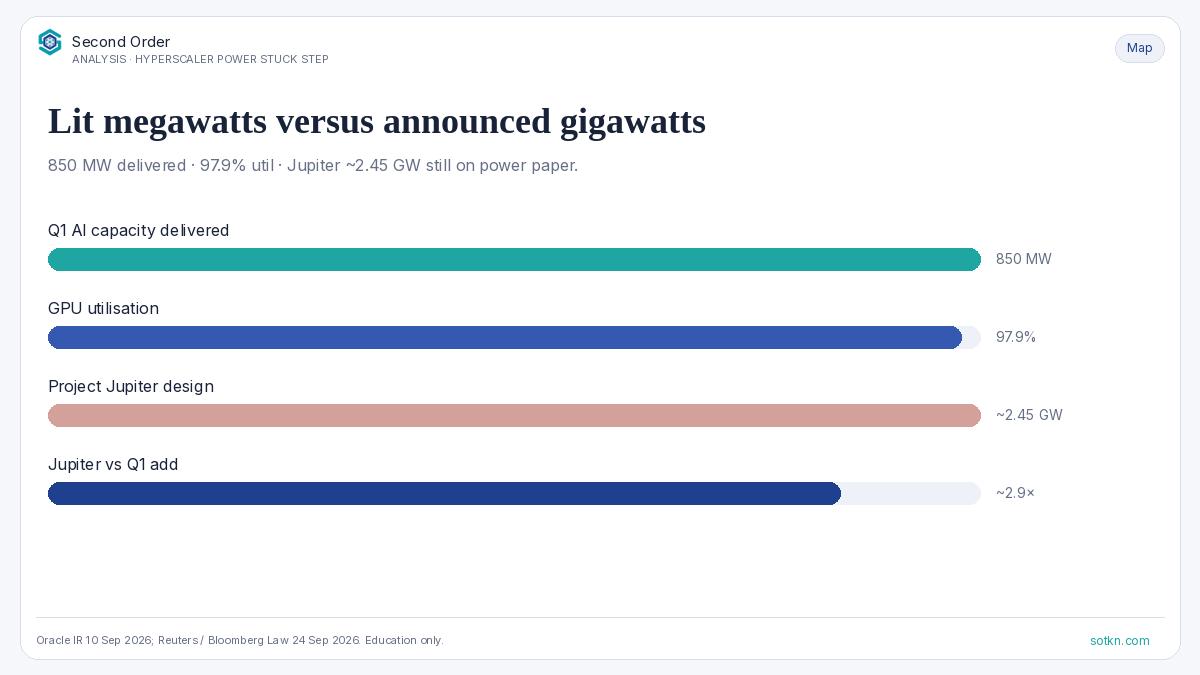
Chart 1 — Two clocks on one equity. Lit fleet clears; Jupiter waits on power paper. Sources: Oracle IR 10 Sep 2026; Reuters / Bloomberg Law 24 Sep 2026. Education only.
Why does Oracle sit at the power stuck step?
The hyperscalers layer sets AI capex — halls, GPUs, and the power that lights them. What Does Oracle Do? is the model: books AI cloud contracts and delivers capacity. Cash clears when a customer uses a working GPU and pays for that hour. Announced gigawatts are not that hour.
Two clocks printed in the same September window. On 10 September 2026, Oracle’s Q1 FY27 release showed 850 MW of AI capacity delivered since the end of Q4, Cloud Infrastructure revenue $7.4 billion (+121%), Remaining Performance Obligations $664 billion, and — on the call — GPU utilisation still 97.9% with renewals/resales at a 20% premium (Oracle IR, 10 Sep 2026; earnings call). That is the lit-fleet clock. On 24 September, Reuters and Bloomberg Law reported a force majeure notice on Project Jupiter — Stack Infrastructure / Blue Owl’s ~2.45 GW Santa Teresa campus — citing potential delays securing power (Reuters, 24 Sep 2026; Bloomberg Law, 24 Sep 2026). That is the campus / power clock. Our Wire covered the signal; this piece asks what ORCL’s equity price already assumes about the bind.
Distinct from the 850 MW delivery-vs-interconnect map (Joliet $1 letter of credit vs accepted halls) and from the neocloud short-contract map. Those ask where cash sticks on the layer. This asks what one company’s market value requires of the power stuck step.
What does ~$414 billion already assume?
Work backwards from the close. At about $137.10 on ~25 September 2026 (~$414 billion on ~3.02 billion shares), against FY26 net income of about $17.1 billion, the trailing earnings multiple is roughly 24×. Against a crude Q1×4 total-revenue run-rate of about $77 billion, sales are about 5.3×; against FY26 sales $67.4 billion, about 6.1×. Cloud Infrastructure alone at Q1×4 ≈ $29.6 billion is already a large franchise slice — and FY27 guidance is total revenue of at least $90 billion with non-GAAP EPS $8.10, while William Blair (via Reuters) notes Jupiter contributes no FY27 revenue.
Our read, in one line: the price assumes Scenario B — lit fleet and Cloud Infra / RPO carry the equity story through FY27, while Project Jupiter stays a power-and-permit clock whose rent-start risk is allocated by force majeure, not priced as if 2.45 GW were already paid hours. The three scenarios and the arithmetic are below.
The free preview ends here.
—— Still to read · ~8 of 12 minutes ——
MEMBERS CONTINUE HERE
- Three scenarios with the arithmetic
- What ~$414B requires in lit MW, RPO conversion, and Jupiter timing
- Six practical takeaways
- Members' FAQ