If 850 MW Lands and the Fleet Stays Full, Who Gets Paid — Delivery or Interconnect?
Oracle delivered 850 MW and the fleet still ran 97.9% full. A 1.8 GW campus sat behind a $1 letter of credit. Who gets paid inside the power clock: accepted halls, or interconnect paper.

ANALYSIS · MEMBERS CONTINUE · 4 min free / 13 min full · Data as at 25 Sep 2026
Oracle delivered 850 MW of AI capacity in Q1 FY27 and the GPU fleet still ran 97.9% full. The same week, a named 1.8 GW Illinois campus sat behind a $1 letter of credit. The money question is not whether power is the long clock — it is who gets paid inside that clock: accepted halls, or interconnect paper.
In short
- The question: if 850 MW lands and the fleet stays full, who gets paid first — delivery or interconnect?
- The answer: cash sticks at credit-backed interconnection before it sticks at the next delivered megawatt. Accepted halls still print; thin-credit gigawatts wait
- Why: Oracle’s 97.9% utilisation after a record add shows demand is not the bind. FERC keeping a 1.8 GW TSA alive over $1 shows the next megawatt is still a clause, not a transformer Behind the wall: three scenarios with the arithmetic · $450m vs $1 · $40m/MW vs $11.1m/MW · six practical takeaways · Members' FAQ
- What would break it: the Illinois court treating $1 as enough and Oracle utilisation falling after the next add — or RTO pro forma credit landing so the bind moves to long-lead gear
- Nothing here is a recommendation. This is a map of where cash collects along the power clock, with the working shown
What's in this piece: the numbers that matter · why 850 MW still leaves the fleet full · delivery or interconnect · members from here · who gets paid · three scenarios, arithmetic shown · our read · what would change the view · practical takeaways · FAQ · sources
The numbers that matter
| What | Figure | Date | What it tells us |
|---|---|---|---|
| Oracle AI capacity delivered | 850 MW + >300,000 GPUs since end-Q4 | Oracle, 10 Sep 2026 | Accepted halls, this quarter |
| GPU utilisation after the add | 97.9% | Q1 FY27 call, 10 Sep 2026 | Delivery did not create spare seats |
| Cloud Infrastructure revenue | $7.4bn (+121% YoY) | Quarter ended 31 Aug 2026 | Cash on live, accepted capacity |
| Remaining performance obligations | $664bn (+$209bn YoY) | 31 Aug 2026 | Booked work, not a shipping schedule |
| New AI cloud contracts in Q1 | >$30bn | Oracle, 10 Sep 2026 | The backlog still grows |
| Capex / free cash flow | $28.5bn / $(5.4)bn | Same quarter | Cash cost of the delivery bind |
| CoreWeave short-dated pricing | ~$40m per MW (3–6 month deals) | CoreWeave, 17 Sep 2026 | What attach clears now |
| CoreWeave contracted power | ~4.2 GW (from 3.7 GW at 30 Jun) | As at 11 Aug 2026 | Contracted ≠ energised |
| Joliet campus | 1.8 GW / $20bn | FERC ER26-3257 | Named load. Not a hall |
| Credit argued in the TSA | $1 letter of credit | Same docket | Thin paper on a GW campus |
| FERC action | Cancellation rejected | 22 Sep 2026 | Paper kept alive, not energised |
| Exelon thick-credit TSAs | ~4 GW / $1bn posted | Exelon Q2 call, 30 Jul 2026 | The book the utility calls real |
| Labs small-MW chase | 20–30 MW | CNBC, 18 Sep 2026 | Speed lane around the GW queue |
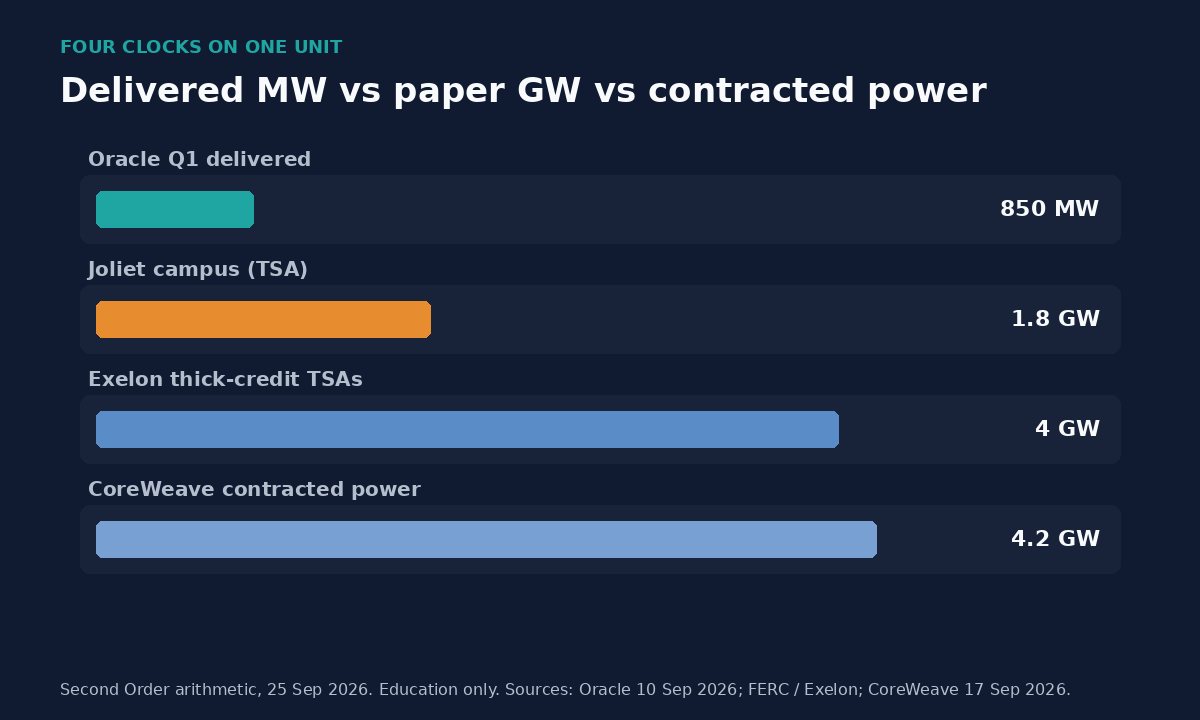
Chart 1 — Four clocks on one unit. Oracle’s 850 MW is accepted capacity. Joliet’s 1.8 GW is a TSA. Sources: Oracle 10 Sep 2026; FERC / Exelon; CoreWeave 17 Sep 2026. Education only.
Why does 850 MW still leave the fleet full?
The hyperscalers layer is where buyers set capex and pull chips, halls, and power. What Oracle does is the Stack read of the model: book → deliver → bill. Remaining performance obligations are the book. Cloud Infrastructure revenue is the bill. Delivery — megawatts accepted by a customer — is the stuck step on that layer. The dated print is the Wire on 850 MW still running full.
On 10 September 2026 Oracle said it delivered 850 MW of additional AI datacentre capacity and more than 300,000 GPUs since the end of Q4 — almost triple Q4 FY26 deliveries — while Cloud Infrastructure revenue rose 121% to $7.4 billion. Remaining performance obligations rose to $664 billion. Co-CEO Clay Magouyrk said GPU utilisation stayed at 97.9%. Renewals of mostly four-year-or-older GPUs repriced about 20% above prior contracts (Oracle press, 10 Sep 2026; Q1 FY27 earnings call).
That is not a demand story. A fleet that stays nearly full after a record add means the short clock on the hyperscaler layer is still capacity that customers will accept. Designs waiting for halls still wait. The 21 September map already said the long clock is power. This piece does not re-ask that. It asks, inside that power clock, whether the next dollar sticks at the hall Oracle just switched on — or one step earlier, at the paper that decides which gigawatts are allowed onto the grid.
Delivery or interconnect — which bind is on the power clock?
Two dated prints sit on the same week and they do not measure the same thing.
The first is accepted delivery. Oracle’s 850 MW went live. Abilene colour on the call — six of eight buildings in, 618 MW, acceptance in 24 hours — is what a cleared hall looks like. CoreWeave’s 17 September print is the neocloud twin: short 3–6 month contracts clearing at about $40 million per megawatt, contracted power up to 4.2 GW as of 11 August from 3.7 GW at 30 June (CoreWeave company press, 17 Sep 2026; Wire). Who gets paid on that print is whoever can attach clusters customers will take now.
The second is credit-backed interconnection. On 22 September 2026 FERC rejected Commonwealth Edison’s notice of cancellation of the transmission security agreement behind PowerHouse Hillwood’s planned 1.8 GW, $20 billion Joliet campus. The fight is a $1 letter of credit. FERC kept the TSA alive and left the clause to the U.S. District Court for the Northern District of Illinois. Full Markets desk: 1.8 GW, $1 credit.
Those two numbers sit on different clocks. Delivery is racing now. A named 1.8 GW campus is a docket. Our read, in one line: with the fleet still full after 850 MW, who gets paid first is the megawatt with thick interconnect paper — delivered halls print after, not instead. The three scenarios and the arithmetic are below.
The free preview ends here.
—— Still to read · ~8 of 12 minutes ——
MEMBERS CONTINUE HERE - Three scenarios with the arithmetic - $450 million versus $1 · $40m/MW versus $11.1m/MW - Six practical takeaways - Members' FAQ
Keep reading free
The scenarios and the maths are members-only.
These three pages are the map.
HBM, explainedMemory is the short clock — stacks, not slots.Speed-to-powerPower is the long clock — years, not quarters.Korea / HBM allocationWho gets paid while memory stays booked.