1.8 GW, $1 Credit: Who Gets Paid When US Interconnect Stays in Court
September 2026 in one line: FERC kept a 1.8 GW Joliet TSA alive over a $1 letter of credit. Who gets paid is the thick-credit book. The stuck step is still interconnection paper.
FERC kept a 1.8 GW Joliet campus on the books over a $1 letter of credit. Here is who gets paid, which step is still stuck, and the arithmetic before the court and the RTO filings.
US PULSE · Data as at 25 Sep 2026 · Next update: after the N.D. Illinois ruling or the mid-November RTO large-load filings
Affects: Hyperscalers · Neoclouds — Markets: US · Taiwan · Korea
In short: On 22 September 2026, FERC rejected Commonwealth Edison's notice of cancellation of the transmission security agreement behind PowerHouse Hillwood Holding's planned 1.8 GW, $20 billion data-centre campus in Joliet, Illinois. The fight is a $1 letter of credit. Who gets paid is the 4 GW of Exelon load that already posted $1 billion in collateral — and the utility that writes those agreements. The stuck step is credit-backed interconnection, not the transformer. The next hard clocks are the Northern District of Illinois case and the 16 November RTO / ISO large-load filings.
Education only, not advice to buy or sell any security. Figures are from company and government releases dated as shown.
The numbers that matter this month
| Figure | Read | |
|---|---|---|
| Joliet campus size | 1.8 GW / $20bn | Named in the FERC dispute. Not a powered hall. |
| Credit argued in the TSA | $1 letter of credit | PowerHouse says this met the initial posting. ComEd filed to cancel. |
| FERC action | Order rejecting cancellation | 22 Sep 2026 · ER26-3257 · accession 20260922-3114 |
| Original TSA | Accepted 10 Mar 2026 | Docket ER26-1032 |
| Exelon high-probability load | ~11 GW | 9 GW ComEd + 2 GW Mid-Atlantic · 30 Jul 2026 |
| Of which, signed TSAs with collateral | ~4 GW / $1bn posted | Jeanne Jones, Exelon Q2 call |
| Exelon interconnection pipeline | ~25 GW | Down from ~43 GW in May |
| Labs small-MW chase | 20–30 MW | CNBC 18 Sep 2026 · reported |
Status chips are Second Order's read. Full sources are at the end of this article.
Why does the US matter now?
Because the US is where the biggest AI buyers, the loudest campus announcements, and the hardest power-ready clocks sit in one queue — and this week a federal order numbered the paper in front of the transformer.
Taiwan still makes most of the leading chips and does much of the CoWoS packaging. Korea still allocates HBM. The US is where those chips are supposed to light up. When a 1.8 GW Illinois campus is kept alive by FERC and left unresolved by a $1 credit clause, the US door is not "more GPUs." It is which megawatts have thick enough paper to get studied and energised.
The buyers are the hyperscalers and the neoclouds. The gatekeepers this month are ComEd / Exelon, FERC, a district court, and six grid operators rewriting large-load rules.
If you only remember one thing: announced gigawatts do not get paid until the credit clause and the interconnect hold.
New to the US clock? Speed-to-power, explained. Siblings: US Speed-to-Power · AI labs, small MW.
What changed
The dated print is FERC's 22 September 2026 order rejecting ComEd's notice of cancellation under docket ER26-3257.
FERC eLibrary lists the order as accession 20260922-3114: "Order Rejecting Notice of Cancellation re Commonwealth Edison Company under ER26-3257." Chairman Laura Swett and Commissioner Lindsay See concur jointly; Commissioners David Rosner and David LaCerte each attach a separate concurrence. Utility Dive wrote it up on 23 September.
That is not a new campus announcement. It is a ruling on paper that already existed.
From the public docket: ComEd filed the TSA on 13 January (ER26-1032). FERC accepted it on 10 March. On 24 July ComEd filed a notice of cancellation, effective 25 July (accession 20260724-5115). PowerHouse protested on 14 August. On 22 September FERC rejected the cancellation, declined primary jurisdiction over the ambiguous credit-support terms, and left that fight with the U.S. District Court for the Northern District of Illinois.
Utility Dive quotes the joint concurrence pointing at the June large-load show-cause orders and the need for "clear and consistent" terms and pro forma cost-recovery agreements. Rosner says security deposits "help ensure both project viability and transparency." LaCerte calls the $1 letter of credit "an embarrassing legal fiction" and "less than the price of a cup of coffee."
What changed this week is narrow and useful. The TSA is not cancelled at FERC. The campus is not energised. The $1 posting is not blessed. A named 1.8 GW, $20 billion project is now a live federal order plus an open contract case.
ComEd had already used this TSA as a weed-out example. Utility Dive, 31 July, reporting the 30 July call: Exelon's "high probability" data-centre load fell nearly 40%, to about 11 GW, from 18 GW. About 9 GW is in ComEd's northern Illinois territory and 2 GW in the Mid-Atlantic. About 4 GW of that book has signed TSAs that posted $1 billion in collateral. The wider pipeline fell to about 25 GW from about 43 GW in May.
Joliet sits in the gap: large enough to move a utility slide, thin enough on the initial credit that the utility tried to tear the paper up.
Our math
Four calculations — labelled our arithmetic — put the dated prints on one unit.
1. Dollars per megawatt on the campus as announced.
$20,000,000,000 ÷ 1,800 MW = $11.11 million per MW.
That is a campus cost claim, not a utility rate and not a GPU bill. It tells you the scale of the thing the $1 posting is asked to secure at the front end.
2. How many small-MW blocks fit inside Joliet.
Using the top of the 20–30 MW chase reported by CNBC on 18 September:
1,800 ÷ 30 = 60.
1,800 ÷ 20 = 90.
One disputed Illinois campus is 60 to 90 times a speed-lane block. That is why labs can hunt 20–30 MW at powered sites while a 1.8 GW TSA sits in court: they are not the same product.
3. Joliet against Exelon's high-probability book.
1.8 ÷ 11 = 16.4% of the 11 GW high-probability total.
1.8 ÷ 9 = 20.0% of the 9 GW ComEd slice.
Treat this as a size check, not as proof that Joliet is still inside the 11 GW. Exelon described the July cancellation as part of the weed-out. FERC has now put the paper back on the table. The arithmetic only says the campus is large relative to the book the utility calls real.
4. The collateral gap — our arithmetic on the $1 posting.
Exelon said about 4 GW of signed TSAs have posted $1 billion.
$1,000,000,000 ÷ 4 GW = $250 million per GW.
Apply that rate to Joliet:
1.8 × $250 million = $450 million.
$450,000,000 ÷ $1 = 450 million times.
If Joliet had posted like the 4 GW book, initial security would be hundreds of millions. The TSA argues one dollar. That ratio is the pulse. It is not a court finding.
Two more book-level checks, still our arithmetic:
4 ÷ 11 = 36% of the high-probability book has the thick collateral.
11 ÷ 25 = 44% of the studied pipeline is in the high-probability bucket.
18 → 11 GW is a 39% cut in the "real" book; 43 → 25 GW is a 42% cut in the pipeline.
What this tells you: the US is already sorting announced load into three piles — thick-credit TSAs, thin-credit paper, and everything still in a study queue. Joliet is the thin-credit pile with a federal order attached.
What it does not tell you: whether the Northern District of Illinois will read the clause PowerHouse's way, ComEd's way, or send the parties back to rewrite it. We do not do price calls and we do not forecast a judge.
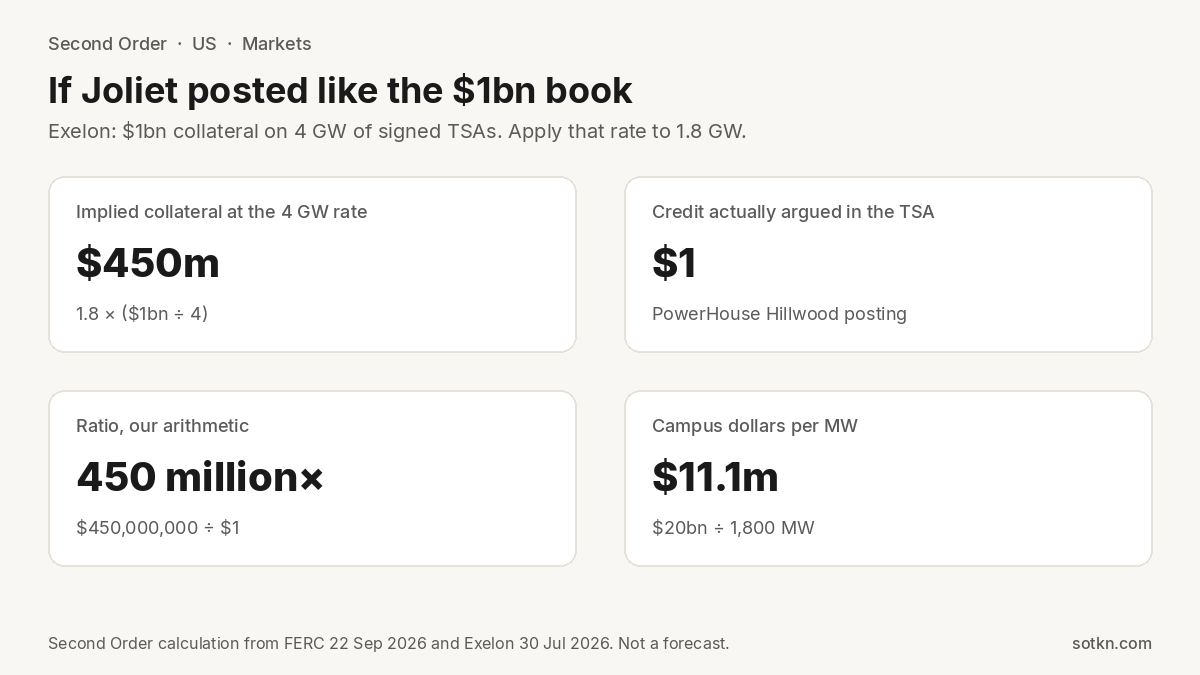
If Joliet posted like Exelon's $1bn / 4 GW book, our arithmetic is $450m against $1. Sources: FERC 22 Sep 2026; Exelon 30 Jul 2026. Education only.
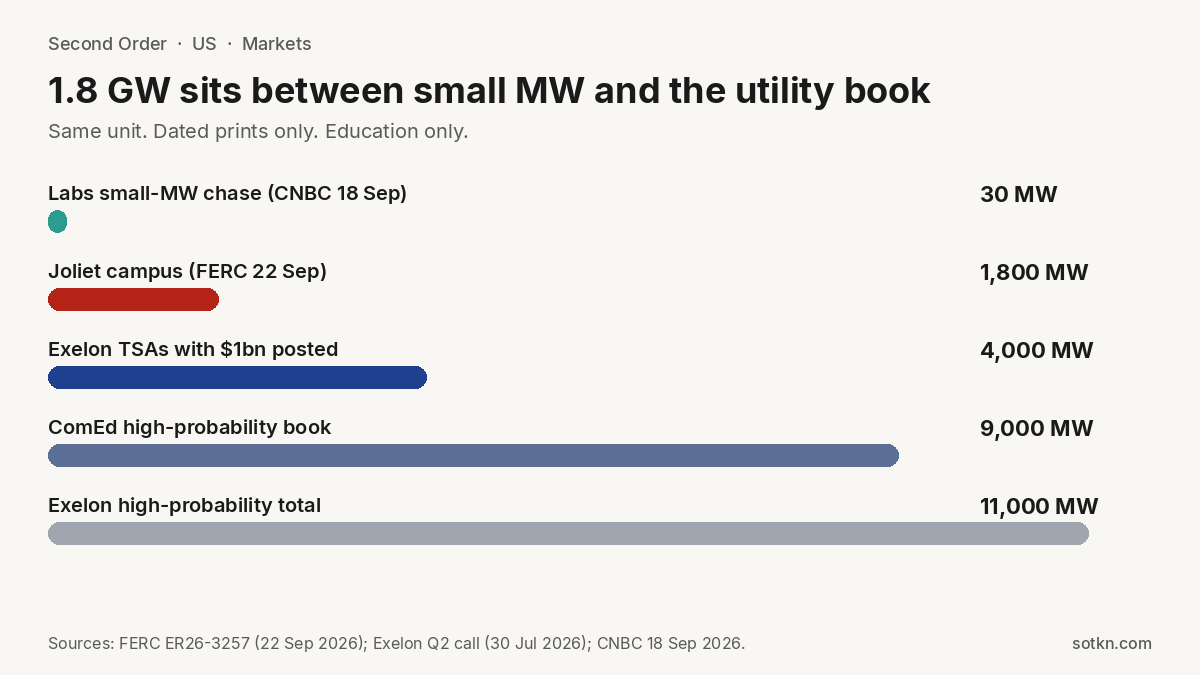
1.8 GW sits between a 20–30 MW speed block and the utility book. Sources: FERC; Exelon; CNBC. Education only.
Where does the money stick?
At the steps with the fewest good substitutes — and, this month, at the paper that decides who is allowed into those steps.
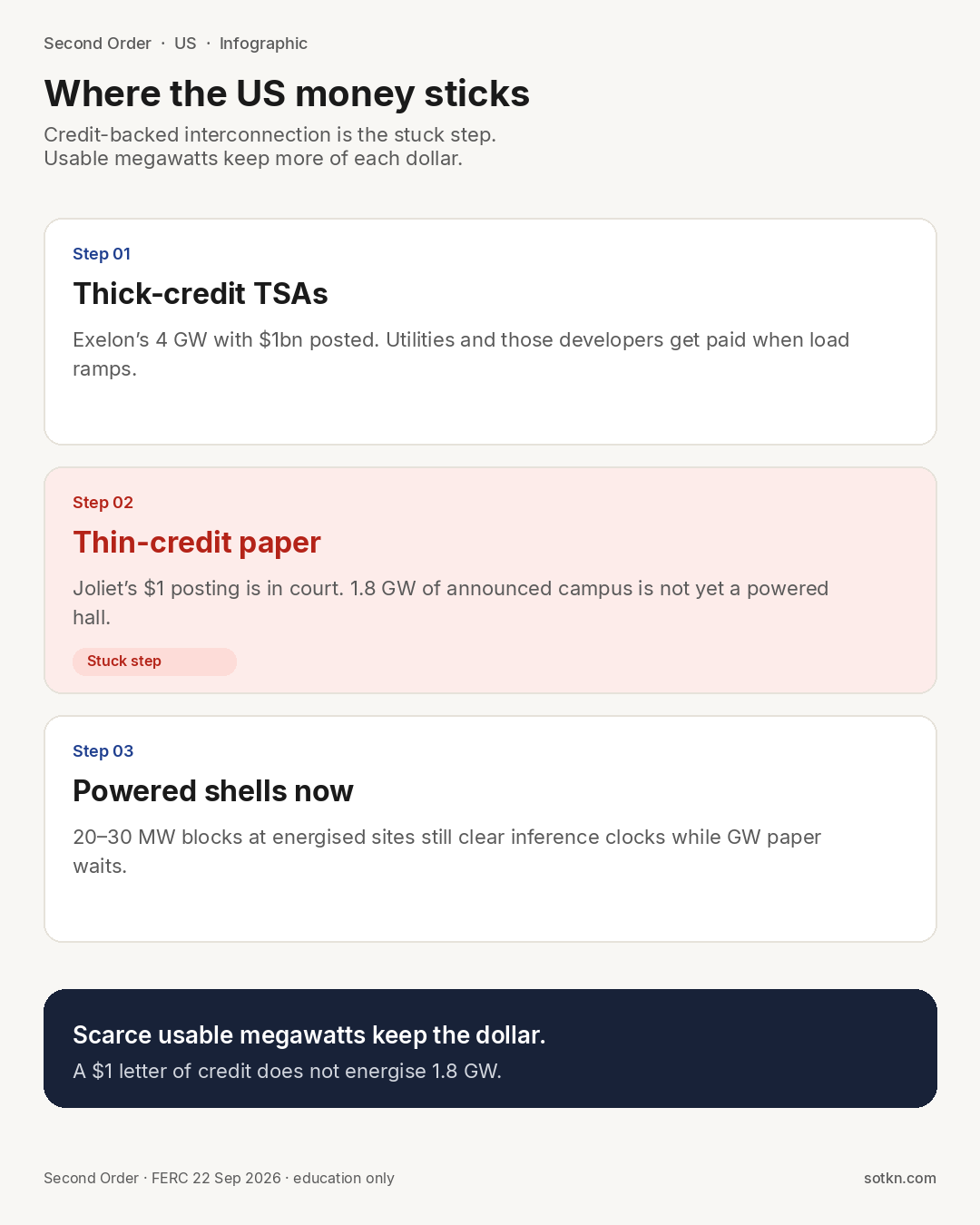
Scarce usable megawatts keep more of each dollar. A $1 letter of credit does not energise 1.8 GW.
1. Thick-credit TSAs. Exelon's 4 GW with $1 billion posted is the pile the utility is willing to call high-probability. Those developers have already paid to be believed. ComEd gets paid if and when that load ramps under the defined schedule, shortfall payments, and termination fees that FERC accepted in the March TSA class. The money sticks with whoever can post nine-figure security and still look like a customer.
2. Thin-credit paper — the stuck step. Joliet's $1 posting is why ComEd filed to cancel and why LaCerte reached for the coffee cup. FERC kept the agreement alive and refused to read the clause. Until the district court does, 1.8 GW is not a hall and not a GPU order. It is a docket.
3. Powered shells and small MW now. The 18 September CNBC print — Anthropic and OpenAI sounding out 20–30 MW blocks — is the speed lane around this stuck step. Landlords and neoclouds that can light existing halls get paid while GW paper waits. That is the small-MW Pulse.
4. Transformers, transmission, and generation. The physical gear is still scarce. Our Speed-to-Power Pulse mapped 160-week transformer leads and ERCOT's large-load queue. Joliet does not erase that. It adds a prior step: you do not get to the long-lead gear if the credit clause fails.
The pattern is the same as Taiwan and Korea, on a different object: the money sticks where the step is stuck. This week the stuck step is the letter of credit that sits in front of the interconnect.
Is credit-backed interconnection still stuck?
Yes. The 22 September order is evidence that the stuck step is binding, not evidence that it cleared.
A TSA that FERC already accepted in March can still be pulled in July and sent to court in September. That is the opposite of a cleared step. The commissioners themselves used the case to advertise the unfinished work: pro forma large-load agreements, consistent credit language, and cost-recovery that does not dump project risk on other customers.
The June 18 show-cause orders to PJM, MISO, SPP, CAISO, ISO-NE and NYISO (EL26-67 through EL26-72) gave the operators 60 days to justify or rewrite large-load tariffs. All six asked for more time. Public calendars now cluster substantive filings around 16 November 2026. Until those pro forma terms exist, every large US campus is still negotiating a bespoke credit clause — which is how a $1 posting and a $1 billion book can live in the same utility territory.
Two cautions before you read too much into "FERC saved the campus":
- Kept alive is not energised. Rejecting a cancellation leaves the TSA in place. It does not study the load, build the substation, or seat a rack.
- A concurrence is not a holding. LaCerte's coffee-cup line is colour. The holding is narrower: FERC will not take primary jurisdiction over this contract fight.
If credit-backed interconnection catches up — thick, standard security on every large load — the stuck step moves. The next candidates are the same as last week's US Pulses: long-lead transformers and the energising of halls that already have paper. Memory and packaging remain Korea and Taiwan doors.
What dates matter
The next clocks are legal and tariff clocks, not a monthly sales print.
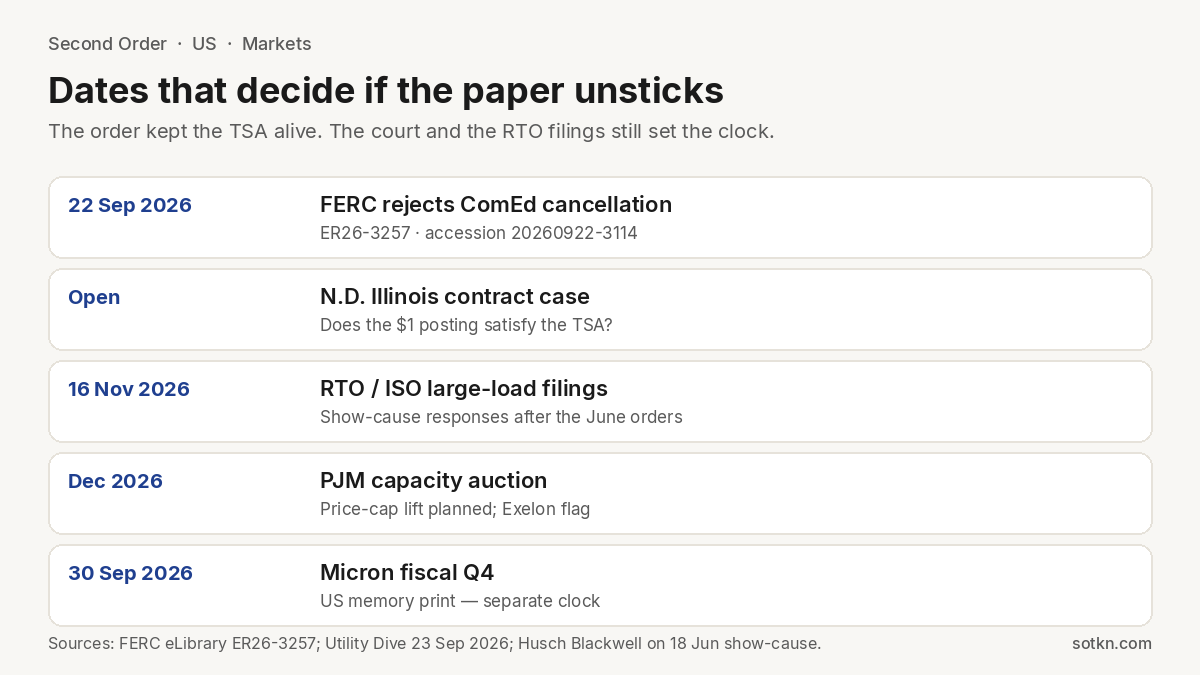
Dates to watch. The TSA is alive at FERC; the credit clause is not settled.
| Date | What | Why it matters |
|---|---|---|
| 22 Sep 2026 | FERC order 20260922-3114 | Cancellation rejected. This Pulse's print. |
| Open | N.D. Illinois | Does the $1 posting satisfy the TSA? If the court voids the agreement, FERC's refusal to cancel is moot. |
| 16 Nov 2026 | RTO / ISO large-load filings | Pro forma credit and cost-recovery language for the next decade of GW campuses. |
| Dec 2026 | PJM capacity auction | Exelon has already flagged a planned lift of the $325/MW-day cap after the next auction. |
| 30 Sep 2026 | Micron fiscal Q4 | Separate US memory clock. Do not mix it into this interconnect print. |
| 8 Oct 2026 | TSMC September revenue | Taiwan door — packaging still sets who ships on time. |
How is this different from last week's US Pulses — and from Taiwan and Korea?
It is the same map. It is a different object.
The 19 September Speed-to-Power Pulse mapped the physical clock — transformers, ERCOT's queue, contracted power running ahead of energised power. This Pulse adds the credit clause that decides who is allowed into that queue.
The 21 September small-MW Pulse mapped the bypass: labs hunting 20–30 MW at powered sites. One 30 MW block is about 60 times smaller than Joliet. The hunt is the bypass. Joliet is the thing being bypassed.
Taiwan's door is still CoWoS. Korea's door is still HBM allocation. A US campus that cannot clear its TSA does not change either stuck step. It changes when those chips have a hall to land in.
CoreWeave backlog → cash is complementary: contracts become cash when halls are power-ready. A FERC order that leaves a 1.8 GW TSA in court is the prior sentence. Some contracts never reach the hall.
What would change this view?
The "credit-backed interconnection is the US stuck step" read weakens if:
- [ ] The Northern District of Illinois treats the $1 posting as enough and ComEd studies the 1.8 GW as a normal large load
- [ ] Exelon's next high-probability update puts Joliet back inside the $1bn / 4 GW collateral book with security that looks like the rest of that book
- [ ] The mid-November RTO filings produce one pro forma credit schedule and utilities stop cancelling accepted TSAs
- [ ] Transformer lead times and hall energisation become the louder constraint and the credit paper stops producing federal orders
- [ ] Labs stop paying up for 20–30 MW powered blocks because GW campuses start lighting in 2026–27
- [ ] A non-power bottleneck — HBM, CoWoS, or cooling — becomes the louder US constraint on who gets paid
The view stays intact while FERC is sending large-load fights to court, utilities are cutting high-probability books with TSA weed-outs, and a $1 posting can sit next to a $1 billion collateral pile in the same territory.
Practical takeaways
- Name the stuck step: credit-backed interconnection — not "the US ran out of GPUs"
- Who gets paid: the 4 GW / $1bn collateral book, and utilities that can enforce thick TSAs
- Who waits: a 1.8 GW, $20bn campus whose initial security is a $1 letter of credit
- Our arithmetic: $20bn / 1,800 MW = $11.1m per MW; 1.8 GW is 60× a 30 MW speed block; the 4 GW rate implies ~$450m against $1
- Read beside Speed-to-Power and small MW — same conversion problem, three lenses
- 16 November is the next industry-wide clock; the Illinois case is the next campus-specific clock
FAQ
What did FERC decide on 22 September 2026?
FERC rejected ComEd's notice of cancellation of the PowerHouse Hillwood transmission security agreement (ER26-3257, accession 20260922-3114). It did not decide whether the $1 letter of credit satisfied the contract. That question is with the U.S. District Court for the Northern District of Illinois.
Who gets paid on this US print?
Developers and customers already inside Exelon's 4 GW of signed TSAs that posted $1 billion in collateral, and the utility that collects on those agreements if load ramps. GPU vendors and a Joliet campus do not get paid by a cancellation being rejected.
Why is a $1 letter of credit the stuck step?
Because the interconnect does not start until the utility believes the load is real. Exelon used TSAs to cut high-probability load from 18 GW to 11 GW. The same tool that sorts the book is the tool that can freeze a named 1.8 GW campus when the initial posting is one dollar.
What is a transmission security agreement?
A contract between a utility and a large-load customer that sets ramp, credit, revenue commitments, shortfall payments, and termination fees so other customers do not eat the cost of a project that never shows up. FERC accepted the ComEd–Hillwood TSA in March 2026 under ER26-1032.
How is this different from the US Speed-to-Power Pulse?
Speed-to-Power maps the physical clock — transformers, queues, energised halls. This Pulse maps the paper clock in front of that gear: credit support on a named 1.8 GW TSA, plus the unfinished pro forma large-load rules due in mid-November.
Is this a buy list of utilities or data-centre stocks?
No. This Pulse maps who gets paid and which step is stuck. It is education only, not a recommendation to buy or sell any security.
Keep reading on the map
- Explained: Speed-to-power · HBM, explained · CoWoS, explained
- Markets: US Speed-to-Power · US small MW · Korea chip exports · Taiwan TSMC revenue
- The Stack: Hyperscalers · Neoclouds · Semiconductors
Members' Analysis. If FERC keeps sending large-load credit fights to court while labs buy 20–30 MW at powered sites, the bottleneck is paper utilities will honour — not campuses announced. Read the Analysis →
Get the Wire. Subscribe free →
How we check this
Figures come from company filings and government releases, each dated in the list below. Capacity and timing from press reports are labelled as reported, not guided. Where we work something out ourselves, the arithmetic is shown in full.
Last reviewed: 25 Sep 2026 · Next review: after the N.D. Illinois ruling or the mid-November RTO large-load filings
Spot an error? Tell us and we will correct it and note the change here.
Sources
- FERC eLibrary — ER26-3257 (ComEd notice of cancellation; order 20260922-3114, 22 Sep 2026)
- FERC eLibrary — ER26-1032 (original ComEd–Hillwood TSA; accepted 10 Mar 2026)
- Utility Dive — FERC rejects ComEd cancellation (23 Sep 2026)
- Utility Dive — Exelon high-probability load 11 GW / $1bn collateral (31 Jul 2026, Q2 call 30 Jul)
- FERC — large-load show-cause orders (18 Jun 2026)
- Husch Blackwell — show-cause dockets EL26-67 to EL26-72
- CNBC — Anthropic / OpenAI 20–30 MW hunt (18 Sep 2026)
- Second Order — US Speed-to-Power · US small MW · Korea chip exports
Education only. Not investment advice. Do your own research. Second Order may correct figures if primary sources revise them.