AI Labs Small MW Deals: Who Gets Paid When Speed Beats Gigawatts
September 2026 in one line: Anthropic and OpenAI are sounding out 20–30 MW capacity deals to get usable compute faster than gigawatt campuses allow — while still holding multi-hundred-MW and GW commitments.
Anthropic and OpenAI are sounding out 20–30 MW capacity deals while still holding multi-hundred-megawatt and gigawatt campuses. The point is not that gigawatts went away. It is that usable megawatts clear inference and deploy clocks faster than big-campus timelines. Who gets paid is whoever can deliver powered capacity now. The stuck step remains energising large sites on the grid.
US PULSE · Data as at 21 Sep 2026 · Next update: after next lab capacity / small-MW contract print
Affects: Hyperscalers · Neoclouds — Markets: US · Korea · Taiwan
Education only, not advice to buy or sell any security. Capacity talks from press are labelled as reported. Company statements are dated as shown.
The numbers that matter this month
Small capacity deals (reported chase)
20–30 MW
Anthropic / OpenAI sounding out · CNBC 18 Sep 2026
Speed buyAnthropic–Nscale West Virginia (reported)
~460 MW
~US$45B cloud deal · people familiar, Aug cite in CNBC
Large rentalOpenAI PORTS-Pike Ohio
~8 GW-IT
Company note 17 Aug 2026 · first ~800 MW expected 2028
GW bookOpenAI Camellia / Georgia Power
3.2 GW
Phases 2028–2032 · utility contract 3,200 MW demand
GW bookInference vs training (JLL via CNBC)
Overtake in 2027
2025: inference 9% / training 14% of DC workloads → 2030: 37% / 13%
Workload shiftBig-campus energise clock
2028+
PORTS first tranche 2028; Camellia phases through 2032
Stuck stepSources: CNBC 18 Sep 2026; OpenAI PORTS-Pike 17 Aug 2026; OpenAI / Georgia Power Camellia materials; JLL figures as cited in CNBC. Status chips are Second Order’s read.
On this page: Why US? · What changed on small MW? · Scale contrast · Our multiples · Where money sticks · Is speed still stuck? · Dates to watch · What would change · FAQ
Why does the US matter for this small-MW chase?
The US still concentrates the biggest AI buyers, the loudest campus announcements, and the hardest power-ready clocks at once. When labs add smaller megawatt blocks beside gigawatt books, the split shows up first in US and US-linked capacity talks — and in who can actually light racks.
Plan + GW campus
Who: Labs / developers
Paid: Multi-year leases, interconnect paper, community and utility packages
Grid + transformers + energise
Who: Utilities / equipment / landlords
Paid: Lead times and post-approval buildout — the Speed-to-Power stuck step
Small powered MW now
Who: Existing shells / neoclouds
Paid: 20–30 MW blocks that can host inference and deployable clusters sooner
Workloads consume
Who: Labs / customers
Paid: Training still likes dense campuses; inference can split across sites
Chain is Second Order’s reading frame. Evergreen: speed-to-power explained · hyperscaler explained · neocloud explained. Sibling Pulses: US Speed-to-Power · CoreWeave backlog → cash.
What changed — labs hunting 20–30 MW
CNBC’s 18 Sep 2026 report is the fresh print. Sources said Anthropic has sounded out agreements in the 20–30 MW range across the UK and the Nordics, and that OpenAI had been exploring similar smaller deployments in the Nordics. At least one source also described talks involving both labs about US capacity at that scale.
Neither company handed CNBC a signed small-MW term sheet. OpenAI’s spokesperson framed a diversified compute portfolio and said the company does not comment on specific commercial discussions. Anthropic did not comment. Read the 20–30 MW band as a reported hunt for speed — not as a single headline deal.
The same piece puts the motive in plain English: smaller allocations help deploy workloads faster amid the AI boom. Structure Research’s Jabez Tan called the advantage “speed to usable capacity.” Securing a few megawatts at an existing powered site can beat waiting for a much larger block in one location — especially when inference can run across separate clusters.
That workload split matters. Training still wants dense, tightly coupled chip islands. Inference can serve separate requests across smaller sites. JLL figures cited by CNBC put inference at 9% of global data-center workloads in 2025 versus 14% for training, with inference expected to overtake training in 2027 and reach 37% by 2030 (training 13%). As serving production models takes more of the hall, the economics of smaller, faster blocks improve — even while frontier training still books campuses measured in gigawatts.
The scale contrast — small MW beside the GW book
The labs are not choosing small instead of large. They are adding a speed lane beside the campus lane.
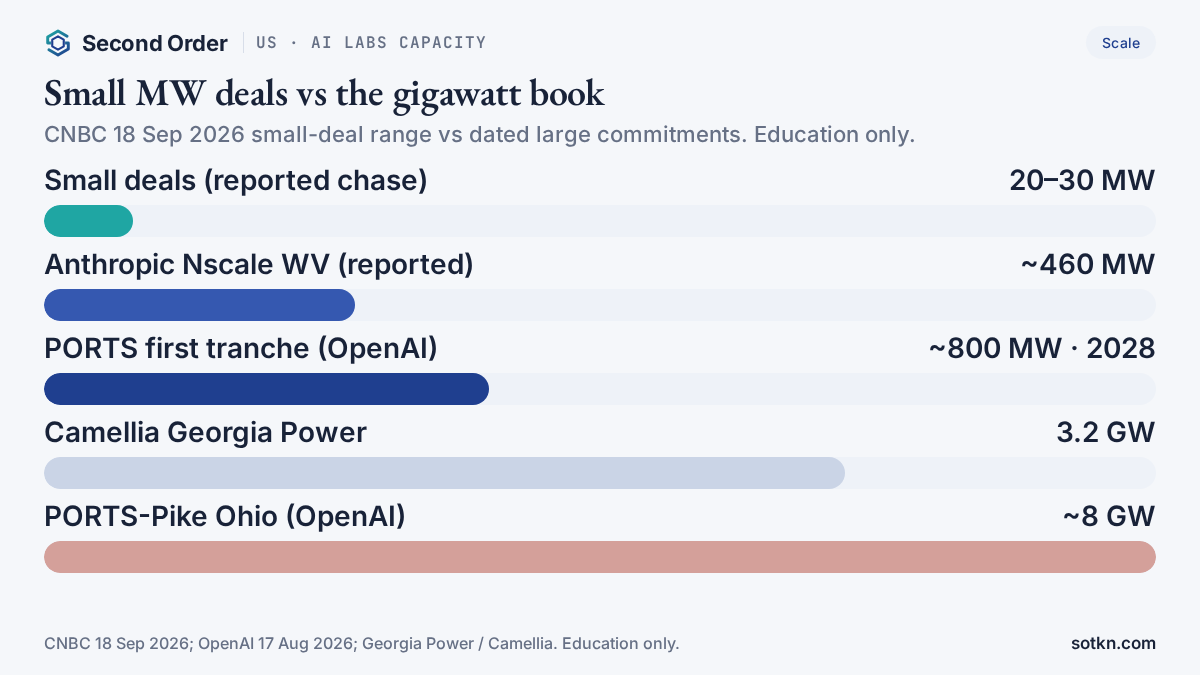
Dated large commitments (contrast)
Large figures: OpenAI company pages (PORTS, Camellia) and Georgia Power contract context; Anthropic–Nscale as reported in CNBC. Small range: CNBC 18 Sep 2026.
OpenAI’s PORTS-Pike note is explicit that the full campus is not built at once. The first 800 megawatts are expected in 2028; further phases need new generation and transmission. Camellia’s Georgia Power path is similarly phased through 2032. Those clocks are why a 20–30 MW powered block can matter to a lab that already signed for gigawatts.
CNBC also noted Crusoe — already linked to large OpenAI-used capacity in Texas — is investing in smaller data centers that the Wall Street Journal described as faster and cheaper than large builds facing US delays. That is a landlord-side echo of the same speed thesis, labelled as reported.
Our multiples — how small sits inside large
Three short calculations — labelled ours — turn the dated large figures into a comparable unit using 30 MW (the top of the reported small-deal range).
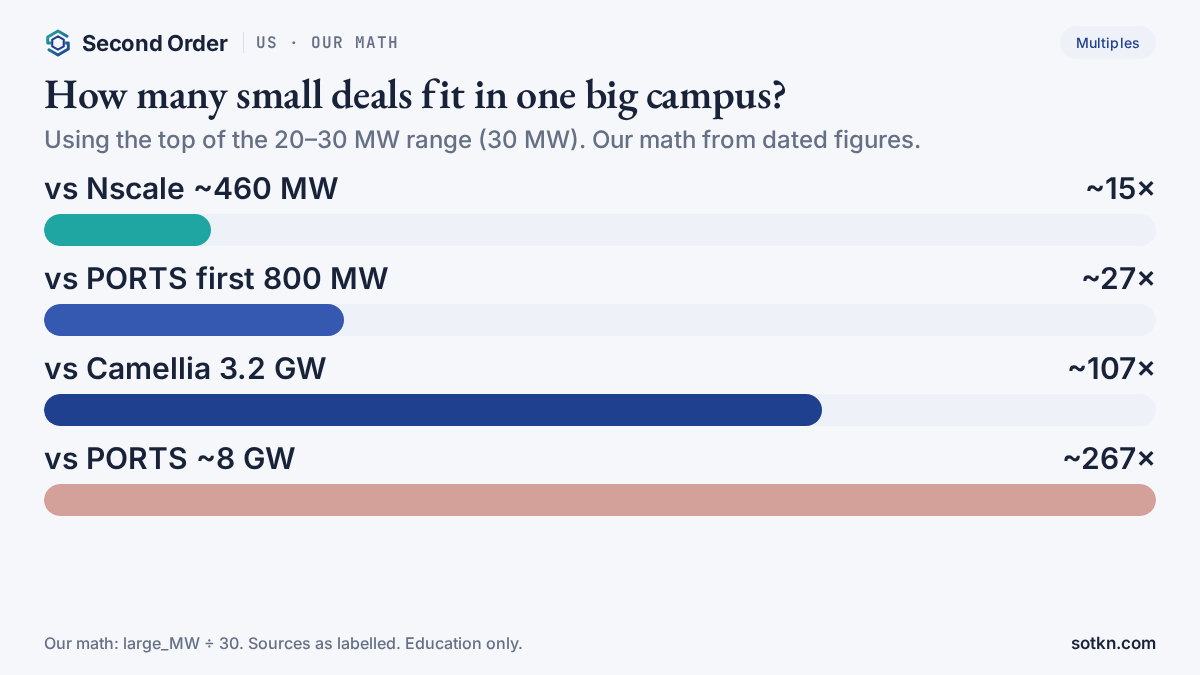
Our calculations (assumptions shown)
Inputs: CNBC 18 Sep 2026 (20–30 MW; Nscale ~460 MW reported); OpenAI PORTS 17 Aug 2026 (~8 GW; first ~800 MW 2028); Camellia / Georgia Power 3.2 GW. Arithmetic is Second Order’s.
What this tells you: one small deal is not a substitute for a campus — it is a timing instrument. A lab can still need hundreds of those blocks to match a single GW tranche, which is why the GW books remain on the table. What it does not tell you: how many 20–30 MW agreements will close, at what price, or in which US regions first.
Where does the money stick?
Cash sticks with timed, deliverable megawatts. When labs pay for speed, the invoice moves toward whoever already holds powered shells — or can stand them up faster than a greenfield gigawatt campus.
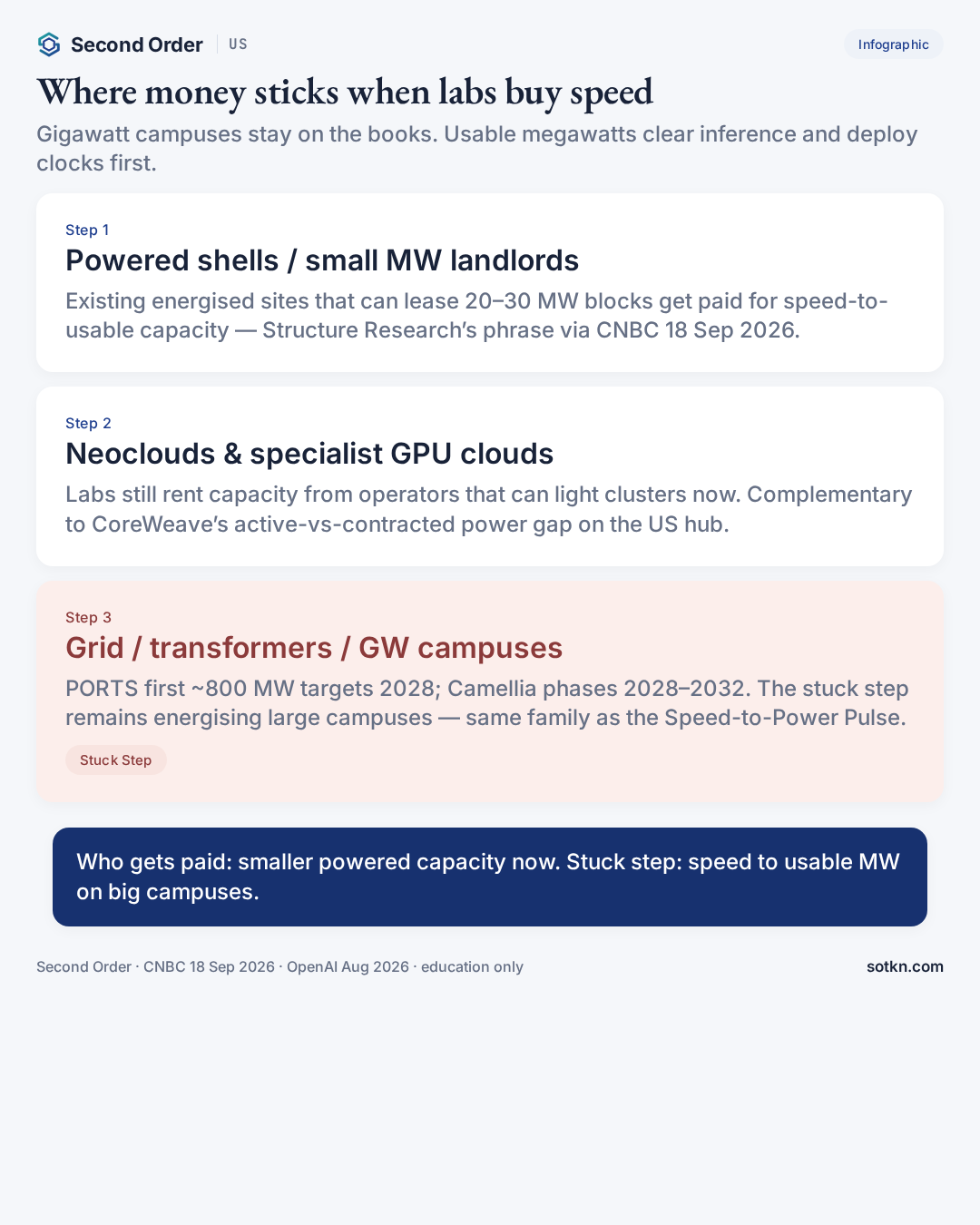
- Step 1 — Powered shells / small MW landlords: Existing energised sites that can lease 20–30 MW blocks get paid for speed-to-usable capacity.
- Step 2 — Neoclouds & specialist GPU clouds: Labs still rent clusters from operators that can light GPUs now — the same conversion world as CoreWeave’s active-versus-contracted power gap.
- Step 3 — Grid / transformers / GW campuses (stuck): Large sites still wait on interconnect, long-lead electrical gear and multi-year buildouts before racks earn.
One-line rule: scarce usable megawatts keep more of each dollar than announced gigawatts that are not yet live.
This complements — it does not replace — the US Speed-to-Power Pulse (transformers, ERCOT queues, power-ready halls) and CoreWeave backlog → cash (contracts become revenue only as halls energise).
Is speed to usable MW still stuck?
Yes on the campus path. The small-MW hunt is evidence that labs are buying around the stuck step — not that the stuck step disappeared.
Stuck-step scorecard (Sep 2026)
Status is Second Order’s read from CNBC 18 Sep 2026, OpenAI Aug 2026 campus notes, and the live US Speed-to-Power / CoreWeave Pulses. Two cautions: (1) small-MW talks are reported, not IR-guided; (2) campus dates are company/utility stated phases, not guarantees.
Dates to watch — small MW and campus clocks
Watch for dated contract or landlord prints that turn the 20–30 MW hunt into named megawatts — and for whether PORTS / Camellia phase language slips or holds.
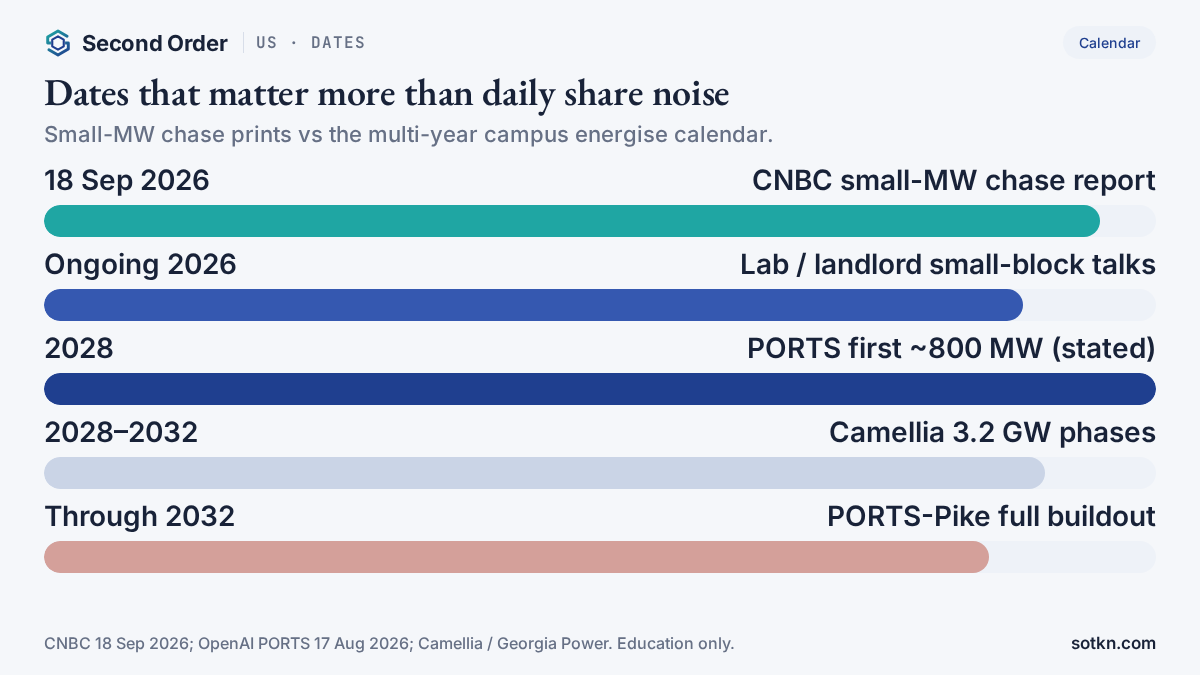
Calendar
Who is exposed if you follow the money?
This is a map of exposure roles — not a recommendation to buy or sell.
- AI labs (OpenAI / Anthropic class): Watch whether small MW becomes a standing procurement lane beside GW campuses.
- Powered-shell landlords & smaller DC developers: Speed inventory is the product; empty shells without power are not.
- Neoclouds / GPU clouds: Paid when clusters are live; complementary to backlog-conversion watches.
- Utilities / electrical equipment: Still set the campus clock — small MW does not erase transformer lead times.
- Hyperscalers: Capex and campus phases still dominate training density; labs’ rental mix is a parallel signal.
Listed access paths vary by account and region. One example broker many readers already use is Interactive Brokers. Education only — we do not advise opening or funding any account.
What would change this view?
- Credible company IR showing labs abandoning small MW and waiting only on GW campuses
- PORTS / Camellia (or peers) pulling first large energise dates into 2026–2027 at scale
- Transformer / power-ready lead times falling back toward ~1 year (Speed-to-Power soften)
- Inference share stalling so multi-site smaller clusters stop mattering
- Neocloud active power closing most contracted gaps while small-MW rents soften
- A non-power bottleneck (advanced packaging, HBM, cooling) becoming the louder US constraint
The view stays intact while labs keep sounding out small powered blocks, GW campuses remain multi-year, and usable megawatts stay scarce relative to announced books.
Practical takeaways
- Name the stuck step: speed to usable MW on big campuses — not “labs stopped building big”
- 20–30 MW (CNBC 18 Sep 2026, reported) is a timing instrument beside GW books
- Who gets paid: powered-shell landlords and neoclouds that can deliver now
- Our math: one 30 MW block is ~15× smaller than Nscale’s ~460 MW and ~267× smaller than PORTS ~8 GW
- Read beside Speed-to-Power and CoreWeave — same conversion problem, three lenses
FAQ
What are the 20–30 MW AI data-center deals?
CNBC reported on 18 Sep 2026 that Anthropic and OpenAI are exploring smaller compute-capacity deals around 20–30 MW — far below the multi-hundred-MW and gigawatt campuses they still hold. Treat the range as reported from sources familiar with the talks, not as a signed contract print.
Why would labs chase small megawatts while booking gigawatts?
Speed to usable capacity. Large campuses need grid upgrades, transformers and multi-year buildouts. Smaller blocks at already-powered sites can host inference and other deployable workloads sooner. Structure Research’s Jabez Tan told CNBC that securing a few megawatts at an existing powered site can be more practical than waiting for a much larger block.
Who gets paid when labs buy speed?
Landlords and developers that already hold energised shells, plus neoclouds and specialist GPU clouds that can light clusters now. The invoice follows usable megawatts — not the loudest gigawatt announcement.
What is still stuck?
Energising large campuses. OpenAI’s PORTS-Pike Ohio project targets a first ~800 MW tranche in 2028 against an ~8 GW book; Project Camellia’s Georgia Power contract phases 3.2 GW from 2028–2032. That is the same stuck-step family as the US Speed-to-Power Pulse.
How does this relate to CoreWeave’s backlog?
Complementary. The CoreWeave Pulse maps contracts becoming cash as halls are power-ready. This Pulse maps why AI labs add smaller MW blocks beside GW campuses — another path to usable capacity while big sites wait on the grid clock.
Is this a buy list of data-centre or AI stocks?
No. This Pulse maps who gets paid and which step is stuck. It is education only, not a recommendation to buy or sell any security.
Keep reading on the map
- Speed-to-power explained · Hyperscaler explained · Neocloud explained
- US Speed-to-Power Pulse · CoreWeave backlog → cash · US Markets hub
- Hyperscalers stack · Neoclouds stack · Analysis · Wire
How we check this
Figures come from company filings and government releases, each dated in the list below. Capacity and timing from press reports are labelled as reported, not guided. Where we work something out ourselves, the arithmetic is shown in full.
Last reviewed: 21 Sep 2026 · Next review: after next OpenAI / Anthropic capacity disclosure or major small-MW contract print
Spot an error? Tell us and we will correct it and note the change here.
Sources
- CNBC — Anthropic, OpenAI hunt smaller 20–30 MW AI data center deals (18 Sep 2026)
- OpenAI — joins PORTS-Pike project (~8 GW Ohio; first ~800 MW 2028) (17 Aug 2026)
- OpenAI — Project Camellia / Effingham County (3.2 GW with Georgia Power)
- Georgia Power — OpenAI contract (3,200 MW) process update
- Project Camellia — public project site (3.2 GW phases 2028–2032)
- Second Order — US Speed-to-Power Pulse (sibling)
- Second Order — CoreWeave / neocloud contracts (sibling)
Education only. Not investment advice. Do your own research. Second Order may correct figures if primary sources revise them — next planned refresh after the next dated small-MW or campus-energise print.