$3.4 Billion for 1.7 GW of Generators: Who Gets Paid While Anthropic’s Power Waits for a Site
Anthropic paid about $3.4 billion to take over someone else's order for 1.7 GW of Caterpillar gas generators, due within two years instead of the six-year wait for a new turbine. The maker and the seller get paid now. The step still open is the site: permits, gas and crews.

Anthropic has paid about $3.4 billion to take over someone else’s order for 1.7 gigawatts of gas generators, so it does not have to wait six years for a new turbine. The machine makers and the seller get paid now. The generators arrive within two years. The stuck step is the site: where they will run, with a permit, a gas line and a crew.
US PULSE · AI DATA CENTRES · POWER · Data as at 10 Nov 2026 (FT report 8 Nov; Reuters 9 Nov) · Next update: first named site or permit filing
Affects: AI Data Centers · Hyperscalers · CoreWeave — Markets: US · Malaysia · Korea
Education only, not advice to buy or sell any security. Dollar figures are US dollars. A megawatt (MW) is a thousand kilowatts, roughly what a large shopping mall draws at full tilt; a gigawatt (GW) is a thousand megawatts. Our own sums are labelled. This piece is about buying power equipment ahead of the queue. It does not re-tell our 4 November US Pulse on GE Vernova’s turbine factory, which covered the maker’s order book (GE Vernova’s turbine slots run to 2032). Here the question is what happens on the buyer’s side once the order is in hand.
The numbers that matter this week
Deal size
~$3.4bn
Anthropic takes over OnePWR’s Caterpillar order (FT)
NewPower bought
1.7 GW
Heavy-duty gas generator sets · due within two years
BoughtPrice per MW
~$2.0m
Our arithmetic · new turbines $2.0–2.5m (Aurora via Reuters)
MarketNew turbine wait
~6 years
Average US delivery (Wood Mackenzie via Reuters)
QueueCaterpillar backlog
$78bn
+96% in a year · big engine orders into 2029
PaidSites
Not named
Permit, gas line and crew still to come
Stuck stepFT via CNBC and DatacenterDynamics, 8–9 Nov 2026; Reuters, 9 Nov 2026; Caterpillar, 29 Oct 2026. Status chips are Second Order’s read.
On this page: Why it matters · The deal · Why buy instead of wait? · How long is the queue? · What did it cost? · Caterpillar’s side · The grid clock · Our math · Who gets paid · What is stuck? · Dates next · FAQ
Why does an AI lab buying generators matter?
Imagine a popular bakery where the oven maker has a six-year waiting list. One bakery down the road ordered ovens two years ago but cannot pay for them. A rich new bakery walks in and buys that place in the line. It gets its ovens in two years instead of six. But it still needs a shop to put them in, a gas line to fire them and bakers to run them.
That is what Anthropic did. Until now, AI labs mostly paid cloud companies and data centre owners to supply computing power, and those partners worried about where the electricity came from. Anthropic has now stepped one level down the chain and bought the power machines themselves. It is the largest known single purchase of power-generation equipment by an AI lab, according to the FT.
For anyone mapping AI infrastructure, this matters because an AI data centre is a building that turns electricity into computing. If the power is late, the chips sit idle, contracts start late and revenue waits. The basics are in the Explained layer (what an AI data center is; how much power one uses; how power gets from the grid to the GPU).
It also tells us where the wait has moved. A year ago the hard part was getting a turbine at all. For the buyers with the most cash, the hard part is becoming everything that comes after the turbine: the land, the permit, the fuel, the wiring and the people.
What exactly did Anthropic agree to?
The Financial Times reported on Sunday 8 November that Anthropic agreed in late September to pay about $3.4 billion for commitments on 1.7 GW of heavy-duty gas-fired generators. The seller was OnePWR Solutions, an equipment supplier based in San Antonio, Texas, which sells ready-to-install on-site power systems to data centre customers. The machines are made by Caterpillar.
The history matters. OnePWR placed the Caterpillar orders about two years ago, before the recent rise in equipment prices, but needed financing to complete the purchase. Anthropic was already lined up to be a OnePWR customer — buying power from OnePWR’s machines — before it chose to take over the orders itself. In plain words, it stopped being the customer of the power plant and became the owner of the machines.
Anthropic did not buy OnePWR as a company, and no OnePWR staff moved across, the FT said, citing a person familiar with the matter. The deal did include the engineering and construction capability needed to install the generators, and OnePWR will help with installation at Anthropic data centres. The investment bank Piper Sandler, which advised OnePWR, lists the deal on its website as a $3.4 billion sale of OnePWR’s “power generation platform” to a frontier AI lab, Five Nines reported.
The power is expected over the next two years. Neither Anthropic nor OnePWR had commented when the reports came out, and none of the reports we read named the sites where the generators will go.
The deal sits on top of a very large set of promises Anthropic has already made to others. DatacenterDynamics reported that Anthropic has disclosed about $895 billion of cloud and data centre commitments through 2045, including $121.3 billion to Google, $120.5 billion to SpaceX, $110 billion to Amazon and $44.9 billion to Microsoft, plus deals with Nscale, Lambda, Fluidstack, TeraWulf and Hut 8. We covered the filing and the Texas campus lease in earlier pieces (Anthropic’s filing and its cloud bills; Riot’s 910 MW Corsicana lease).
Why would an AI lab buy generators instead of waiting for the grid?
Because both waits are long, and this one could be cut. TechCrunch noted that queues to connect to the US electrical grid can stretch as long as the wait for a turbine. A generator on site does not need a new high-voltage line from the utility. It needs a gas pipe and a permit to run.
Five Nines, citing the analysis site Business Model Analyst, said Anthropic first planned to buy electricity from OnePWR under a long-term contract and then bought the equipment after deciding its own cash was cheaper than borrowing. Anthropic had about $131.9 billion in cash and short-term investments at 30 September, according to the same report. When you have that much cash and a supplier cannot find financing, buying the machines outright is the quick way to keep them.
There is a second reason: control. A long-term power contract leaves the owner of the plant in charge of the machines (how a power purchase agreement works). Owning them means no one else can win them in a bidding war. TechCrunch said Anthropic likely wanted to keep the capacity for itself rather than let a rival snap it up.
That is a change of habit. Anthropic has mostly paid others for computing rather than build its own. Five Nines put its reported capital spending at $15 million in 2024, $131 million in 2025 and $482 million in the first half of 2026. The generator deal alone is about 5.4 times all of that put together.
How long is the queue for new power machines?
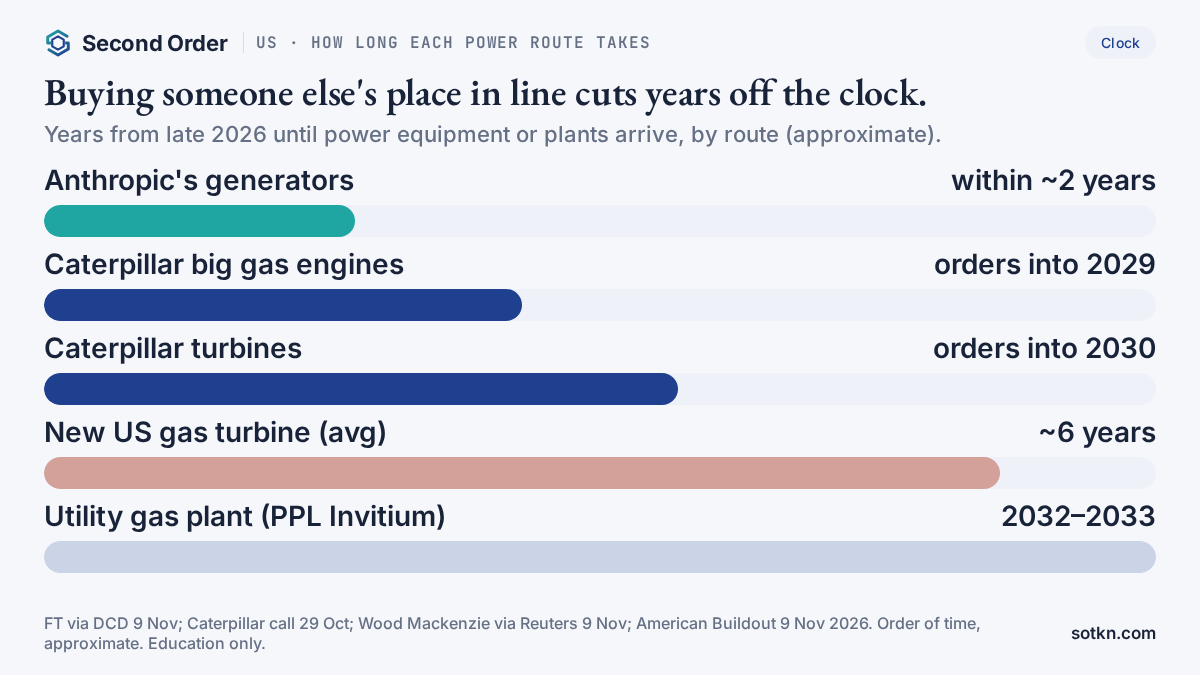
Reuters reported on 9 November that utilities, developers and data centre firms are scouring the world for second-hand gas turbines, reviving mothballed machines and converting retired jet engines, because lead times for new equipment now stretch into the next decade.
In the US, delivery of a new gas turbine takes about six years on average, said Aurora Tenorio of the energy consultancy Wood Mackenzie, and delivery talks are “firmly focused on the 2030 to 2031 window.” Worldwide turbine orders top 100 GW, according to Wood Mackenzie, against estimated factory output of 60 to 70 GW a year.
The bank Jefferies estimated that US data centres alone account for nearly 17 GW of turbine demand this year, and that this could more than triple by 2028. Global turbine factory capacity should rise to about 87 GW in 2028, Jefferies said, still well short of the 129 GW of expected demand. Siemens Energy, GE Vernova and Mitsubishi Heavy Industries, which dominate the market, all say AI has pushed orders beyond what they can build.
Caterpillar’s own clock is a little shorter but still long. On its 29 October call, chief executive Joe Creed said the company is taking some large reciprocating engine orders as far out as 2029 and turbine orders into 2030. Asked about big gas orders for full-time “prime power,” he said: “we’re probably looking at 2029.” Five Nines reported that Caterpillar management said in September that gas engines for prime power had lead times into the second half of 2028 and into 2029.
Against those clocks, an order placed two years ago and due within the next two years is worth a lot. It is the difference between power in 2028 and power in 2030 or later.
We looked at what happens to cash if turbines stay booked into 2030 in an earlier Analysis (if gas turbines stay booked into 2030), and at a hyperscaler backing a gas developer’s turbines in the Wire (the 1,200 MW turbine backstop).
Did Anthropic pay a lot?
On our arithmetic, $3.4 billion for 1.7 GW is about $2 million per megawatt, or about $2,000 per kilowatt. Business Model Analyst worked out the same figure, and noted it includes installation capability, Five Nines said.
Reuters gave the market prices around it. A new gas turbine costs about $2 million to $2.5 million per MW, according to Aurora Energy Research. Well-maintained used units sell for about $1.5 million to $1.7 million per MW, and refurbished units for about $1.3 million, according to Zach Machuca of Origin Partners, which buys power equipment for data centre developers.
Smaller machines can be much cheaper second-hand. Dan Poole of ReflowX, which connects buyers with turbine owners, told Reuters that two 14.5 MW turbines made by Solar Turbines, a Caterpillar unit, recently sold for $12.5 million. A new pair would cost about $35 million and take five years to deliver, he said. On our arithmetic, that used pair works out to about $430,000 per MW, against about $1.2 million per MW new.
So Anthropic paid about what a new machine costs, at the bottom of Aurora’s range, for machines that come years sooner and with installation help attached. The order was placed before the recent price rises, DatacenterDynamics said, which helps explain why the price is not higher. The extra value is time, not metal.
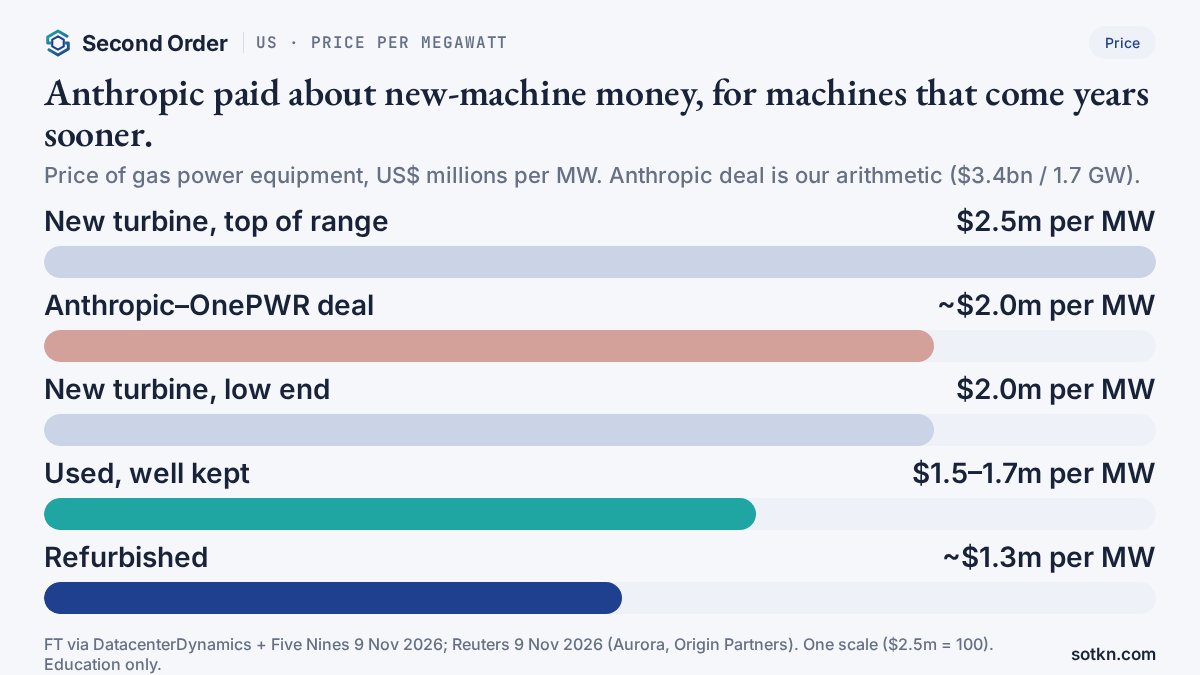
Power equipment: price and wait
FT via DatacenterDynamics and Five Nines, 9 Nov 2026; Reuters, 9 Nov 2026; Caterpillar call, 29 Oct 2026. Figures as published.
What does Caterpillar’s order book say?
Caterpillar reported its highest-ever quarter on 29 October. Sales and revenues were $20.7 billion, up 17%. Its Power & Energy segment, which makes engines, generators and Solar turbines, sold $8.784 billion, up 18%, and made $2.143 billion of profit, up 31%, for a 24.4% margin.
Inside that, Power Generation sales were $3.421 billion, up 30% from $2.634 billion a year earlier. The company said the growth came mainly from turbines and turbine services and from large reciprocating engines, “primarily in data center applications.” Sales to end users in power generation grew 75%. Over nine months, Power Generation sales were $9.336 billion, up 33%.
The backlog — orders taken but not yet delivered — reached a record $78 billion, up about $38 billion or 96% in a year, across all of Caterpillar’s businesses. The company expects 58% of it to be sold within 12 months. Creed said bringing more capacity online is “still the top pacing factor for growth in Power and Energy,” and that customers “still want more from us if we can get them more power.”
Two details are worth slowing down on. First, prime power is growing: data centres are no longer buying Caterpillar machines only as backup for when the grid fails, but to run all day. Second, Caterpillar’s margin rose even as it paid for new factory space, higher freight and depreciation. That is what it looks like when demand runs ahead of supply: the maker gets paid more, and gets paid earlier.
For who makes the rest of the power chain — transformers, switchgear and cables — see who makes data center power equipment.
How does this compare with the grid’s own clock?
The same week, US utilities reported how much data centre demand they are lining up. American Buildout summed up four of them on 9 November.
PPL said its Pennsylvania data centre pipeline reached 35.3 GW in advanced planning, including 11.4 GW under signed electric service agreements and 8.5 GW under construction. Its generation joint venture with Blackstone, Invitium, agreed key terms for about 2 GW of new generation for a QTS data centre project. Fuel cells and batteries could arrive as early as 2029. The combined-cycle gas units are expected in 2032 and 2033.
Arizona Public Service reported 5.8 GW of committed load, including more than 15 data centre sites, with about 4.9 GW still unserved. WEC Energy expects 4.9 GW of extra demand in Wisconsin from 2026 to 2031, including 3.2 GW linked to Microsoft and 1.3 GW to Oracle, where Vantage has four buildings under construction at Port Washington.
Put those dates next to Anthropic’s. A utility gas plant for a data centre in Pennsylvania lands in 2032 or 2033. Anthropic’s generators are due within two years. That gap of four years or more is what $3.4 billion of cash bought.
The utilities also show how the bill is being shifted. PPL says its large-load tariffs make customers who cause new infrastructure bear its cost; WEC says a very large customer that leaves early pays the remaining book value; Arizona proposes assigning generation costs directly to very large users. Owning your own generators takes that bargaining out of the utility’s hands, but puts the full cost on your own balance sheet. Our Analysis on campuses named before the plug is approved looks at the same tension (where cash sticks when the campus comes first).
What do the numbers say?
Price. $3.4 billion divided by 1,700 MW is $2.0 million per MW (our arithmetic). That is the low end of Aurora’s $2.0 million to $2.5 million for a new turbine, and about 18% to 54% above the used-turbine range of $1.3 million to $1.7 million.
Time. A new US turbine takes about six years. Anthropic’s generators come within two. On those two numbers, the deal cuts about four years off the wait (our arithmetic). Against PPL’s 2032–2033 gas units, the gap is similar or longer.
Size against Anthropic. DatacenterDynamics cited a New York Times report that Anthropic is expected to have more than 3.5 GW of compute this year, with a similar amount due in 2027. 1.7 GW of generators is about half of one year’s addition (our arithmetic; generator output and data centre load are not exactly the same measure, so treat this as scale).
Size against the market. Jefferies put US data centre turbine demand at nearly 17 GW this year. Anthropic’s 1.7 GW is about 10% of that in one deal (our arithmetic).
Size against Caterpillar. $3.4 billion is about the same as one quarter of Caterpillar’s Power Generation sales ($3.421 billion in the third quarter) and about 4% of its $78 billion total backlog (our arithmetic). Caterpillar expects about $45 billion of that backlog to be sold in the next 12 months, at 58% (our arithmetic).
Size against Anthropic’s cash. $3.4 billion is about 2.6% of the $131.9 billion of cash and short-term investments Five Nines reported at 30 September, and about 5% of the $69.8 billion of commitments due in the following 12 months (our arithmetic). It is affordable. It is also 5.4 times everything Anthropic spent on its own equipment from 2024 to mid-2026.
The global gap. Jefferies’ 2028 numbers — 87 GW of factory capacity against 129 GW of demand — leave about 42 GW short, or roughly a third of demand (our arithmetic). Today’s orders of more than 100 GW against 60–70 GW of yearly output are about one and a half years of every turbine factory’s production (our arithmetic). That is why an order already in the line can change hands for billions.
For how long a full campus takes to build next to a power plant, see how long it takes to build an AI data center.
Who gets paid while the generators wait for a site?
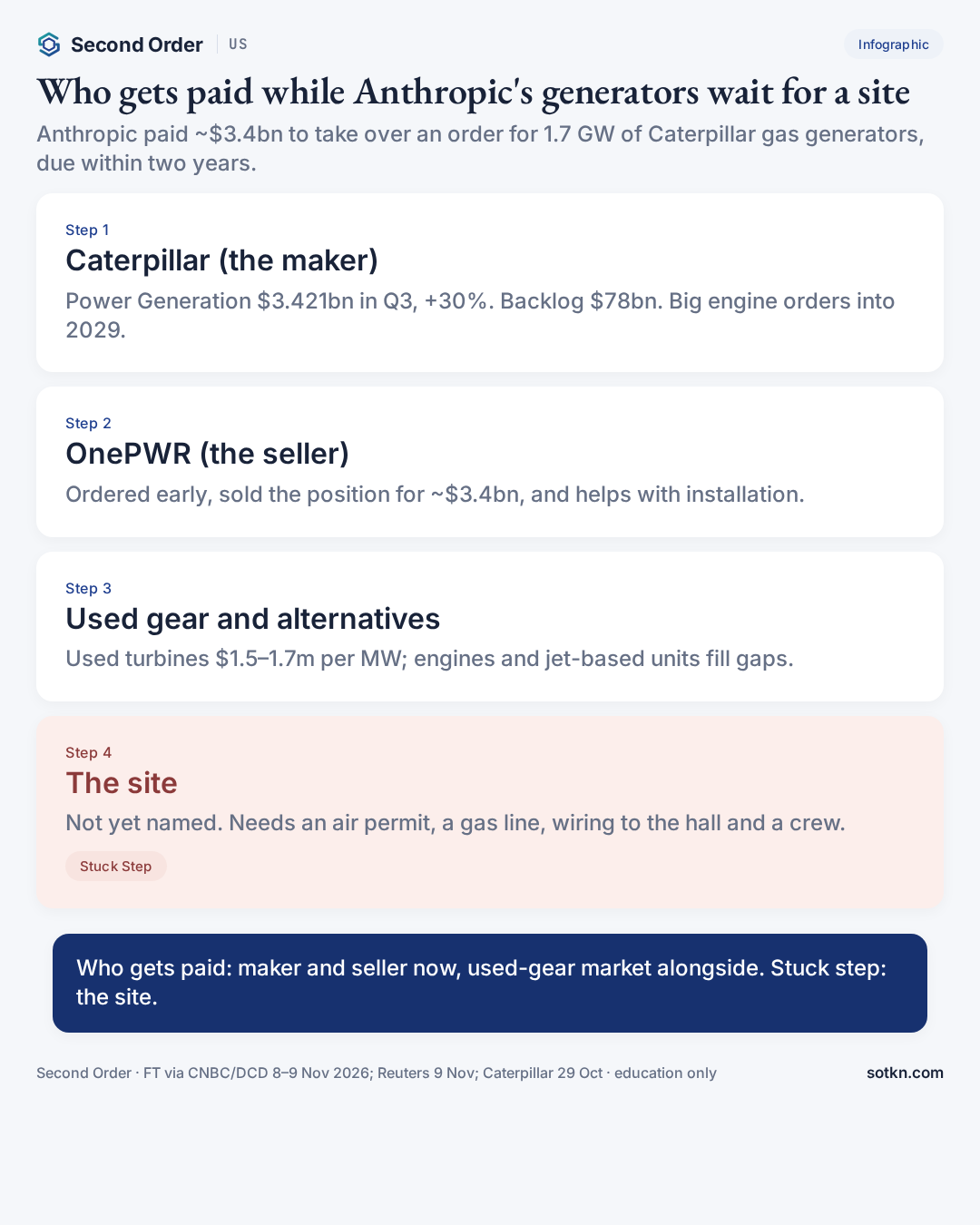
1 · Caterpillar (the maker)
Who: Power Generation $3.421bn in Q3, +30%; backlog $78bn
Paid: A financed order is a firm order
2 · OnePWR (the seller)
Who: ~$3.4bn sale of its order and platform (Piper Sandler listing)
Paid: Plus installation work at the sites
3 · Used-equipment market
Who: Used $1.5–1.7m per MW; refurbished ~$1.3m
Paid: Brokers, refurbishers, engine makers
4 · Utilities
Who: PPL 11.4 GW signed; APS 4.9 GW unserved
Paid: Paid on their own, slower clock
5 · The site
Who: 1.7 GW due within two years; sites not named
Paid: Permit, gas line, crew
First, Caterpillar. An order that was waiting on financing is now backed by one of the richest private companies in the world. On our read, that turns a soft order into a firm one. Caterpillar is already selling its power gear at rising margins, and every big buyer that jumps the line keeps its factories full into 2029.
Second, OnePWR. It ordered the machines before prices rose and sold that position for about $3.4 billion, with installation work to follow. On our read, OnePWR was paid for having been early, which is the most valuable thing in a sold-out market. Piper Sandler, its adviser, was paid for the deal.
Third, the second-hand market and the alternatives. EthosEnergy’s chief executive told Reuters the secondary market is “very, very hot right now,” with prices rising. Sulzer gets a request every few weeks to find a used turbine for a data centre. Origin Partners and ReflowX match buyers and sellers. Wärtsilä has booked about 3 GW of orders from US data centres since spring 2025 for gas engine power units. Crusoe ordered 13 jet-engine-based turbines, 650 MW in total, from ProEnergy in April. Each of them is paid because the main queue is long.
Fourth, the utilities. PPL, WEC, APS and others are paid through approved spending plans as they build plants and lines — WEC’s plan for 2027 to 2031 is $47.5 billion, PPL’s for 2027 to 2030 is $25 billion. Their clock is slower, but their pay is steadier. Some of the newest generation ideas mix both worlds, like fuel cells placed at a campus (Google takes Crusoe’s Wyoming site with 702 MW of fuel cells).
Who waits. Anthropic has paid but does not yet have running power. Its cloud and data centre partners still need their own power. And every other buyer in the queue just watched 1.7 GW of near-term machines leave the market. On the contract side, the difference between paying for something you must take and something you only might take is in our Explained layer (take-or-pay vs purchase commitment; purchase commitments explained).
What is stuck, exactly?
The stuck step is the site. Anthropic has the order, the cash and a delivery window. What has not been made public is where the 1.7 GW will run. A gas generator site needs at least four things before it makes a single kilowatt-hour: an air permit to burn gas, a gas supply line big enough to feed it, foundations and wiring to the data hall, and people to run and maintain it.
It is not the machine. The generators are made by a company that is shipping record volumes, and they are due within two years. It is not the money: $3.4 billion is under 3% of Anthropic’s reported cash. And it is not demand: Anthropic is adding gigawatts of compute every year.
Reuters made the point directly. Turbines are just one obstacle, said Noor Qureshi of Enverus Intelligence Research, with air permits, grid access and other factors also causing delays. And the second-hand market can only partly fill the gap, because it is already short of spare machines.
The running side is also new for Anthropic. Five Nines noted that OnePWR’s operating staff were not part of the deal, and that fuel and price risk move to the owner. A company that has mostly paid others to run its computers now owns 1.7 GW of engines that burn gas every hour. Someone has to buy that gas, schedule maintenance and keep the units running around the clock.
Permits are where on-site gas projects have slowed before. In Wyoming, a utility’s gas plant for a Google campus went to a siting hearing this month (Black Hills’ gas permit hearing), and in Alabama a large AI campus needed a power approval before it could go ahead (Lambda’s Alabama power approval). Until Anthropic names its sites and files for permits, nobody outside can say when the 1.7 GW turns into running power.
This is the same shape we keep seeing across AI infrastructure: the party that owns the slow step does not get paid on time, while the parties around it are paid on their own clocks (where the stuck step moves). Here the slow step has moved from the factory to the site.
Which dates test the read?
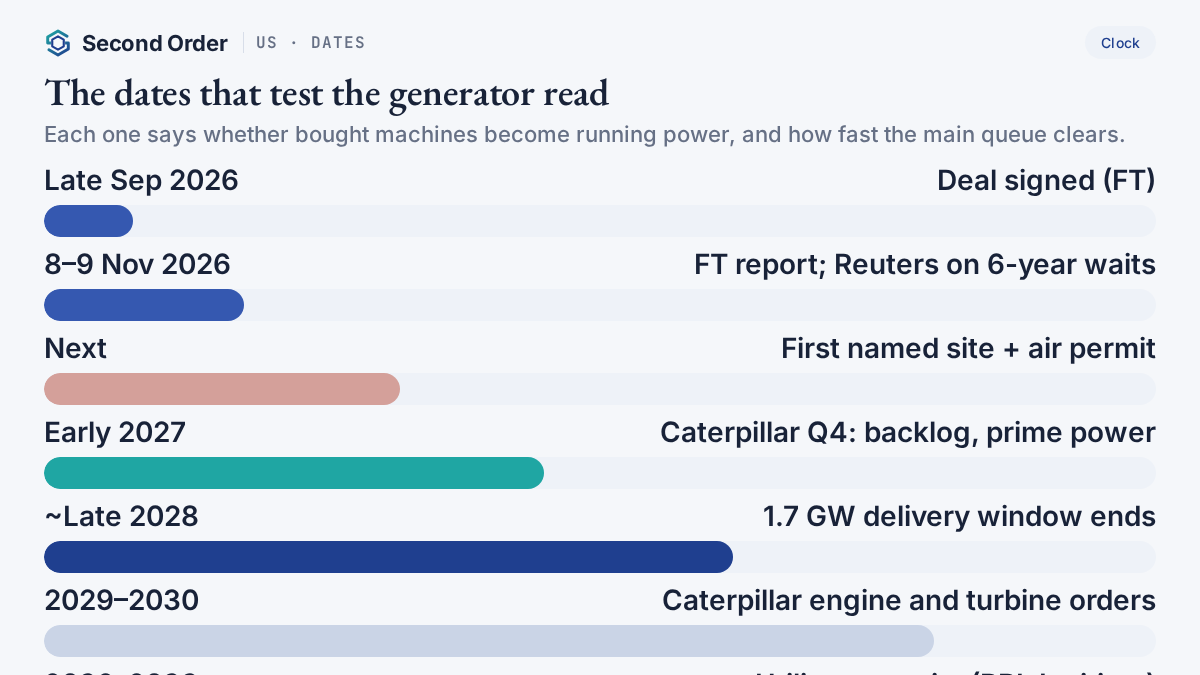
Dates from the FT report as carried by CNBC and DatacenterDynamics (8–9 Nov 2026), Bisnow (9 Nov), Reuters (9 Nov), Caterpillar (29 Oct) and American Buildout (9 Nov). The late-2028 window is our reading of “within two years”.
How does this compare with Malaysia and Korea?
Malaysia’s utility said this week that wires are on track and power plants are the harder part, and the next big gas tender has only bids so far (TNB needs 9,000 MW more). The US story is the private version of the same problem: instead of waiting for the national tender, the richest buyer bought the machines itself. In Korea, the bind this month sits at the chip-tool makers rather than the power plant (Wonik IPS’s Q3 net line).
Inside the US, the October map still holds: data halls signed but not yet billed, turbine factories sold out for years and contracted power that does not always become used power (Digital Realty’s signed-not-billed backlog; contracted power explained; how Stargate gets built). This week moves the bind one step along the chain, from the factory gate to the empty pad where the generator has to stand.
How we check this. The deal size, the 1.7 GW, the late-September signing, the OnePWR order history, the two-year delivery window and the installation help come from the Financial Times report as carried by CNBC, DatacenterDynamics, Five Nines and Bisnow on 8 and 9 November; neither Anthropic nor OnePWR had commented when those were published. The Piper Sandler listing, the per-kilowatt price and Anthropic’s past capital spending are as reported by Five Nines. Turbine prices, wait times and the used-equipment market come from Reuters’ 9 November report. Caterpillar figures come from its 29 October results and call. Utility figures come from American Buildout’s 9 November summary of company reports. Every sum we worked out is labelled “our arithmetic”. Price targets and ratings are left out on purpose. The references we used are listed at the end. Our editorial standards →
FAQ
What did Anthropic buy?
According to the Financial Times, as reported by CNBC and DatacenterDynamics on 8 and 9 November 2026, Anthropic agreed in late September to pay about $3.4 billion for 1.7 gigawatts of heavy-duty gas-fired generator sets made by Caterpillar. It took over orders that OnePWR Solutions, a San Antonio equipment supplier, had placed about two years earlier but could not finance. The generators are expected within two years, and OnePWR will help install them.
Why not just wait for a new turbine?
Because the wait is long. Wood Mackenzie told Reuters that a new gas turbine in the US now takes about six years to deliver on average, with delivery talks focused on 2030 and 2031. Caterpillar said on its 29 October call that it is taking some large engine orders as far out as 2029 and turbine orders into 2030. Taking over an existing order jumps that line.
Is $3.4 billion expensive for 1.7 GW?
On our arithmetic it is about $2 million per megawatt, or $2,000 per kilowatt, including installation help. Aurora Energy Research told Reuters a new turbine costs about $2 million to $2.5 million per MW, while well-kept used units sell for about $1.5 million to $1.7 million. So Anthropic paid roughly new-machine money, but for machines that arrive years sooner.
What is the stuck step?
The site. The generators have a delivery window, but the reports we read do not name where they will run. Each site still needs an air permit, a gas supply line, a foundation and wiring to the data hall, and a crew to run the machines. OnePWR's operating staff were not part of the deal, and the fuel and price risk now sits with the owner.
Is this investment advice?
No. Education only. It maps who gets paid and which step is stuck. It is not a recommendation to buy or sell any security, and we leave out price targets and ratings on purpose.
References
Outbound links below are nofollow. We list only the sources actually used. Internal sotkn.com links in the body are separate.
- CNBC, Anthropic secures $3.4 billion generator deal for AI data centers: FT, 8 Nov 2026. cnbc.com — the Financial Times report of the roughly $3.4 billion deal for 1.7 GW of heavy-duty gas generators, signed in late September with OnePWR Solutions, and that Anthropic did not buy OnePWR itself.
- DatacenterDynamics, Anthropic signs $3.4bn gas generator deal to support 1.7GW of data center power, 9 Nov 2026. datacenterdynamics.com — the Caterpillar gen-set order OnePWR placed two years ago before price rises, delivery within two years, OnePWR's installation help, and Anthropic's compute and cloud commitments.
- Five Nines, Anthropic signs $3.4bn deal for 1.7GW of gas generators, 9 Nov 2026. thefivenines.com — the Piper Sandler deal listing, the roughly $2,000 per kW price, Caterpillar's prime-power lead times into 2028 and 2029, Anthropic's past capital spending and cash, and the point that operating staff and fuel risk were not part of the deal.
- Reuters via Investing.com, AI power rush sends data centres hunting for used turbines and jet engines, 9 Nov 2026. investing.com — the six-year average US turbine delivery, the 2030–2031 delivery window, used, refurbished and new turbine prices per MW, global orders against factory output, Jefferies' 2028 gap, Crusoe's 650 MW of aeroderivatives and Wärtsilä's 3 GW of US data centre engine orders.
- Caterpillar, Third-quarter 2026 results (Form 8-K exhibit 99.1), 29 Oct 2026. sec.gov — Power & Energy sales of $8.784 billion, Power Generation sales of $3.421 billion, segment profit of $2.143 billion and the 24.4% margin, with growth led by turbines and large reciprocating engines for data centres.
- The Motley Fool, Caterpillar (CAT) Q3 2026 earnings call transcript, 29 Oct 2026. fool.com — the record $78 billion backlog up 96%, 58% due within 12 months, power generation sales to users up 75%, large engine orders into 2029 and turbine orders into 2030, and capacity as the top pacing factor.
- American Buildout, Data center growth pushes four utilities toward a larger grid buildout, 9 Nov 2026. americanbuildout.com — PPL's 35.3 GW Pennsylvania pipeline with 11.4 GW signed and 8.5 GW under construction, Invitium's roughly 2 GW for QTS with gas units in 2032 and 2033, APS's 5.8 GW committed and 4.9 GW unserved, and WEC's Oracle and Microsoft load.
- Bisnow, Anthropic pays $3.4B for gas turbines to power its data centers, 9 Nov 2026. bisnow.com — the deal as the largest single power-equipment purchase by an AI lab, OnePWR's turnkey on-site power business, power expected over the next two years, and Anthropic's planned listing as soon as this month.
- TechCrunch, Anthropic joins AI's natural gas frenzy, buys $3.4B worth of turbines, 9 Nov 2026. techcrunch.com — grid connection queues as long as the turbine wait, and the read that Anthropic wanted to keep the capacity rather than let a rival take it.
Not investment advice. Do your own research. Education only. Map of who gets paid and which step is stuck — not a buy list.
More on this desk: US Markets · AI Data Centers · Hyperscalers · all Markets · Malaysia Markets · today’s Wire.