What Is an AI Data Center? Who Gets Paid, Who Waits
An AI data center is built for dense racks of AI chips, which need far more power, cooling and networking than a normal data center. Utilities, landlords and chip makers get paid at different steps. The stuck step is getting power to the hall.
EXPLAINED · Mechanism · Last reviewed: 10 Oct 2026 · Next review: after ERCOT’s reports due 10 Dec 2026
An AI data center is a data center built around racks of AI chips (GPUs) that draw many times the power of ordinary servers, and that need liquid cooling and very fast networking so thousands of chips can work as one machine. A normal data center is built for mixed business computers: its most common rack is designed for about 4–5 kW, while one NVIDIA GB200 NVL72 AI rack is rated at 132 kW.
In short. An AI data center packs racks of AI chips that draw many times the power of ordinary servers. One flagship AI rack is rated at 132 kW; the average typical rack in Uptime Institute’s 2026 survey is just over 11 kW. The money moves in a set order: utilities, landlords, equipment and chip makers are paid as halls are built, and the tenant that rents the chips is paid last. The stuck step is getting power to the hall. Applied Digital has 1.41 GW leased and 250 MW live.
Why an investor cares: AI spending turns into steel, power lines and leases before it turns into revenue. For the clouds that rent the chips inside, see what a hyperscaler is and what a neocloud is.
What is an AI data center?
It is a building, a power connection and a cooling system designed around one job: running AI chips flat out. The chips are GPUs, the processors that train and run AI models, packed into racks and wired together so thousands act as one computer.
Scale is the point. The IEA says a typical AI-focused data center uses as much electricity as 100,000 households, and the largest now under construction will use about 20 times as much. Data centers took about 1.5% of the world’s electricity in 2024, and the IEA expects their demand to more than double by 2030. Source: IEA, Energy and AI.
How is an AI data center different from a normal one?
Power per rack is the clearest gap. A rack is a tall cabinet of servers, and the power it draws sets how much cooling and wiring the hall needs.
| Normal data center vs AI data center |
|---|
| Rack power: the most common normal design is 4–5 kW; the survey average is just over 11 kW. An NVIDIA GB200 NVL72 AI rack is rated at 132 kW; a 64-GPU rack runs at 80–90 kW. |
| Cooling: normal racks use air. The densest AI racks need direct liquid cooling; air can still work under about 50 kW. |
| Chips: mixed business servers, versus 72 GPUs wired as one machine in the flagship AI rack. |
| Networking: standard switches, versus copper links joining all 72 chips inside the AI rack. |
Sources: Uptime Institute Global Data Center Survey 2026 (July 2026); Uptime Institute, “Density choices for AI training are increasingly complex” (25 Jun 2025).
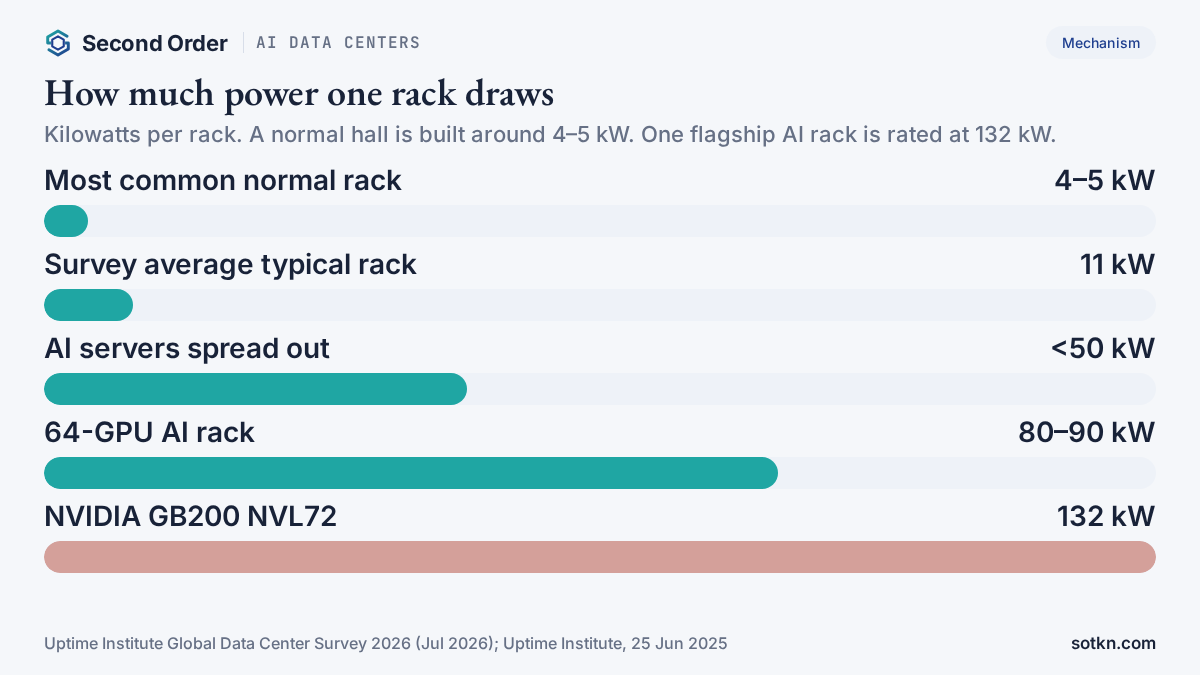
Uptime’s 2026 survey says the 4–5 kW design is still the most common, and the average is 7.8 kW without a few new dense sites. The flagship AI rack is about 12 times the 11 kW average (our arithmetic), and a few small rows of them can use as much power as a sizable hall of normal racks. Sources: Uptime Global Data Center Survey 2026 and Uptime research blog.
Who gets paid at each step, and who waits?
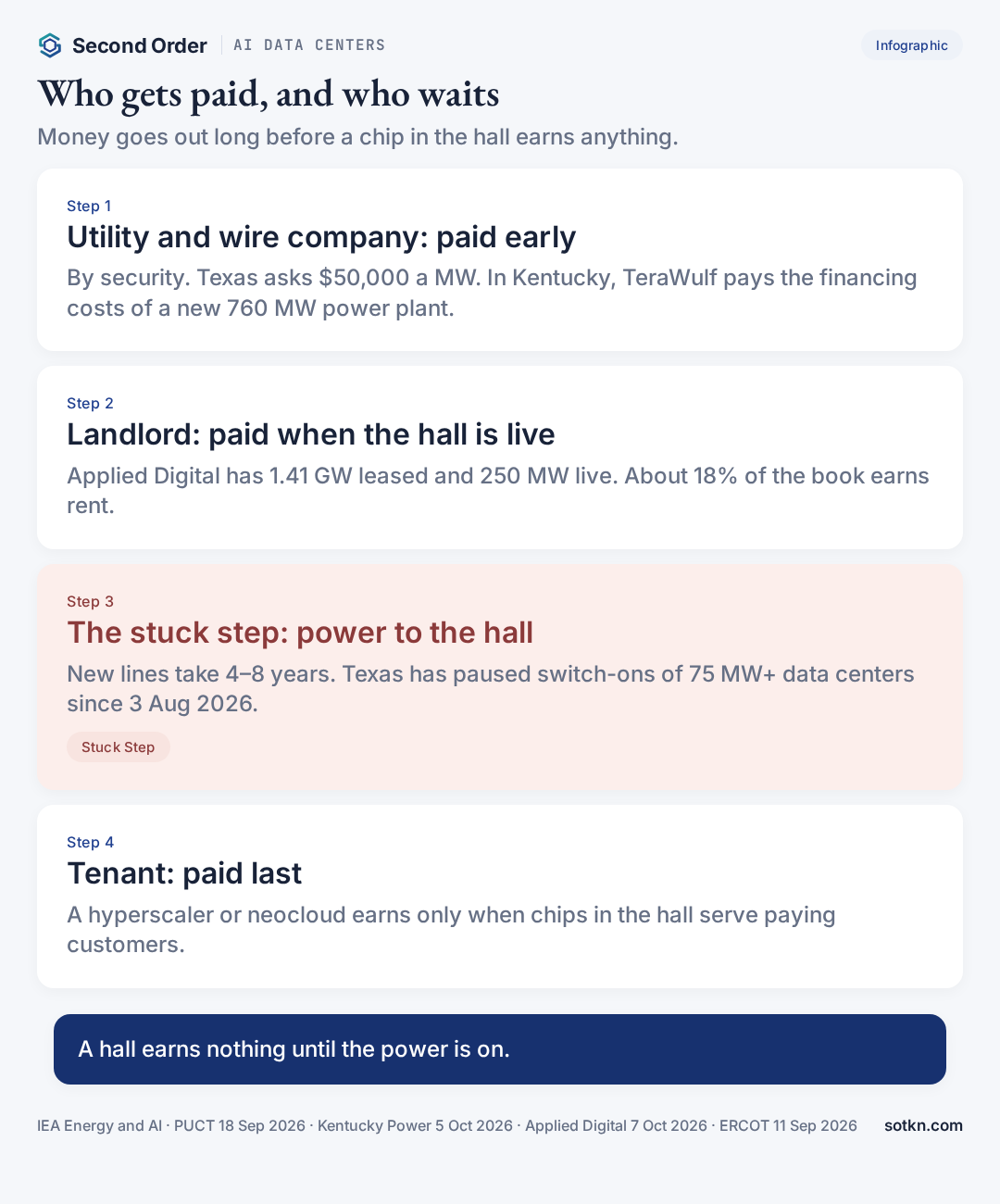
Money goes out long before a chip earns anything.
| Who gets paid at each step |
|---|
| 1. Power and grid — utility and wire company: paid early, by security. Texas now asks $50,000 a MW. In Kentucky, TeraWulf posts collateral and pays the financing costs of a new 760 MW power plant. |
| 2. Powered shell — landlord or host: rent starts when a hall is handed over live. |
| 3. Power and cooling gear — equipment makers: paid on orders (our read). |
| 4. Racks and servers — system makers: paid on delivery (our read). |
| 5. Chips — GPU, memory and packaging makers: paid first in the chain, through the tenant’s capex (our read). |
| 6. Tenant — hyperscaler or neocloud: paid last, only when chips in the hall serve paying customers. |
Steps 1 and 2 are sourced in the text below. Steps 3–5 are Second Order’s read of the order of payment, not company data.
The grid is paid early because it will not build on a promise. In Texas, a rule in force since 8 October 2026 asks any new load of 75 MW or more to post $50,000 a megawatt of security, or $50 million for a 1 GW campus (our arithmetic). In Kentucky, TeraWulf will pay the financing costs of Kentucky Power’s planned 760 MW gas plant. Our Pulse is Who Gets Paid While Texas Holds the Switch. Sources: PUCT order, Utility Dive and Kentucky Power.
The landlord is paid when the hall is live. Applied Digital reported on 7 October 2026 that it has about 1.41 GW leased across five campuses for about $36 billion of base-term rent, with 250 MW live. That is 18% of the leased book earning rent (250 ÷ 1,410, our arithmetic). Source: Applied Digital results. Our read of the price is in What Does Applied Digital’s Price Assume About the Build Clock? and the 75 MW Wire.
The tenant waits longest: it pays rent, then needs paying customers to fill the chips. See GPU utilization and AI tokens.
Where is the stuck step?
Power to the hall. The IEA says new transmission lines can take four to eight years in advanced economies, waits for transformers and cables have doubled in three years, and about 20% of planned data center projects could face delays.
- Applied Digital (US): the build clock. 1.41 GW leased, 250 MW live at 1 October 2026. Its chief executive says the main limit is construction capacity, not power; it expects over 600 MW in service within 12 months. Call transcript.
- Texas (US): the approval. ERCOT has paused switch-on approvals for new data centers of 75 MW or more since 3 August 2026, and its reports are due 10 December. The state’s large-load queue is 474 GW, about 90% data centers. ERCOT update.
- Singapore: the licence. It has over 1.6 GW of data center power across about 70 sites, and handed out just 200 MW of new capacity in August 2026. A law passed on 7 October licenses every hall of 3 MW or more. See our Singapore Pulse. Sources: Business Times and EDB/IMDA.
- TeraWulf (US): the tenant. Here power is the step that is done. It doubled contracted power at Muskie in Kentucky to 1 GW on 5 October 2026: the first 500 MW ramps from 2028, and the second moves from 2030 to 2029 if the regulator approves. No tenant is named. See our Wire. Source: TeraWulf.
So the stuck step moves by place: mostly power or a permit, and where power is signed, the builder or the renter. The AI Data Centers layer tracks it campus by campus; our US construction Pulse shows the build side.
What would prove this wrong?
- Live MW catches up with leased MW fast. If Applied Digital puts 600 MW in service in 12 months and the next campuses land on time, the grid was not the slow part.
- ERCOT clears most paused projects by 10 December. Then the Texas pause was a short delay, not a gate.
- Demand cools first. Uptime found 76% of operators at least somewhat concerned about forecasting future capacity needs, up from 68% in 2024. If AI use slows, empty halls would bind before power does.
Malaysia and Australia in brief
- Malaysia and Johor: Tenaga Nasional had 61 secured data center projects with 8.35 GW of maximum demand at June 2026, 42 of them in the system (5.65 GW). Actual load was 1,256 MW, about 22% of the connected figure (our arithmetic). Wood Mackenzie says Johor’s bottleneck is local substations, not total power. TNB, Wood Mackenzie. Door: Markets Malaysia.
- Australia: AEMO’s central forecast has data centers using about 5 TWh in FY26, about 3% of the grid, rising to about 15 TWh (7.8%) by FY30. AEMO. Door: Markets Australia.
What to check next
Dates to watch: Alphabet and Microsoft results on 28 October (US time), for how much capacity they say they are short of; ERCOT’s reports on 10 December; and Kentucky Power’s filing of the TeraWulf contract for approval, planned for later this year.
Common misconceptions
- People assume an AI data center is just a bigger data center. Actually the difference is density. One flagship AI rack draws about 12 times the average rack, and it needs liquid cooling.
- People assume the chips are the hard part. Actually chips are paid first. The slow step is usually power and permission to switch on.
FAQ
What is an AI data center?
A data center built to run AI chips in dense racks. It needs far more power, cooling and fast networking than a normal one, so thousands of chips can work as one machine.
How is an AI data center different from a normal data center?
Mostly in power per rack. The average typical rack in Uptime Institute’s 2026 survey is just over 11 kW. NVIDIA’s GB200 NVL72 AI rack is rated at 132 kW and needs direct liquid cooling.
How much power does an AI data center use?
The IEA says a typical AI-focused data center uses as much electricity as 100,000 households, and the largest ones being built will use about 20 times as much.
Who owns AI data centers?
Cloud giants (hyperscalers) own some. Landlords such as Applied Digital build halls and lease them. GPU renters (neoclouds) rent chips inside them.
Why can’t more AI data centers just be built faster?
Power gets to the hall last. The IEA says new transmission lines can take four to eight years in advanced economies, and Texas has paused switch-ons of new 75 MW-plus data centers since 3 August 2026.
Is this a list of stocks to buy or sell?
No. Second Order Explained pages explain how the money moves. They do not give buy or sell calls.
Related terms: HBM, the stacked memory inside AI chips; hyperscaler; neocloud.
Stack doors
Layer: AI Data Centers. Also: Hyperscalers, Neoclouds, Semiconductors. Markets: Singapore, Malaysia, US.
Get the Wire — short daily notes when halls, power and leases move.
How we check this
Rack figures come from Uptime Institute, power and grid figures from the IEA, company figures from Applied Digital’s and TeraWulf’s own releases and Applied Digital’s results call, and rules and country figures from regulators, utilities and AEMO. Each is dated below and was re-checked on 10 Oct 2026. Where we work something out ourselves, the arithmetic is shown and labelled “our arithmetic”. This page explains how the money moves. It does not give buy or sell calls.
Last reviewed: 10 Oct 2026 · Next review: after ERCOT’s reports due 10 Dec 2026
Spot an error? Tell us and we will correct it and note the change here.
Sources
- IEA — Energy and AI, executive summary (April 2025; checked 10 Oct 2026)
- Uptime Institute — Global Data Center Survey 2026, keynote report 209 (July 2026; checked 10 Oct 2026)
- Uptime Institute — Density choices for AI training (25 Jun 2025; checked 10 Oct 2026)
- Applied Digital — Fiscal first quarter 2027 results (7 Oct 2026)
- Investing.com — Applied Digital Q1 FY2027 earnings call transcript (7 Oct 2026)
- TeraWulf — Muskie contracted power to 1 GW (5 Oct 2026)
- Kentucky Power — TeraWulf expanded agreement (5 Oct 2026)
- Public Utility Commission of Texas — order adopting 16 TAC §25.194, Project 58481 (18 Sep 2026)
- ERCOT — Batch Zero update (11 Sep 2026)
- Utility Dive — Texas PUC adopts data center interconnection rules (21 Sep 2026)
- Business Times — Digital Infrastructure Bill passed (7 Oct 2026)
- EDB / IMDA — second data centre call, 200 MW fact sheet (21 Aug 2026)
- Tenaga Nasional — analyst briefing, 2Q FY2026 (data centre pipeline as at June 2026)
- Wood Mackenzie — Johor data centre grid constraints (18 Jun 2026)
- AEMO — 2026 ESOO: data centre forecasting overview (2026; checked 10 Oct 2026)