What Are AI Tokens? The Unit Hyperscalers Bill AI By
AI tokens are the chunks of text, image or sound an AI model reads and writes. Clouds bill by the million. Google’s model APIs now handle about 22 billion a minute. The stuck step is capacity to serve them.

EXPLAINED · Mechanism · Last reviewed: 09 Oct 2026 · Next review: after Alphabet and Microsoft results (28 Oct 2026, US time)
AI tokens are the small chunks of text, image or sound that an AI model reads and writes, and the unit cloud providers use to bill for it.
In short. AI tokens are the chunks of text, image or sound an AI model reads and writes. A token is about 4 characters, so 100 tokens are about 60–80 English words. Clouds bill AI by the million tokens, with output priced well above input. Google’s model APIs handled about 22 billion tokens a minute in mid-2026, up 37.5% in a quarter. The stuck step is capacity: a token earns only if a chip is free to serve it, and both Google and Microsoft say they are short.
Why an investor cares: tokens are the meter on AI. Every token a cloud sells is a slice of chip time it had to build first. Token counts are the closest thing the big clouds give to a usage gauge for AI revenue. For who those clouds are, see what a hyperscaler is.
What are AI tokens?
A model does not read words. It reads tokens. Before a prompt reaches the model, software splits it into tokens: single characters, parts of words or whole words. The model then writes its answer back one token at a time.
Pictures, video and sound are turned into tokens too. That matters for the bill, because a few seconds of video can cost more tokens than a page of text.
| What goes in | Tokens (Gemini) |
|---|---|
| Text | About 4 characters per token |
| 100 tokens of English | About 60–80 words |
| A small image (up to 384 pixels a side) | 258 tokens |
| A larger image | 258 tokens per 768×768 tile |
| Video | 263 tokens per second |
| Audio | 32 tokens per second |
Source: Google AI for Developers, “Understand and count tokens”, updated 23 Sep 2026. Other model makers split text differently, so counts vary by model.
How many words is a token?
About three-quarters of a word in English. Google says a Gemini token is about 4 characters, and 100 tokens are about 60–80 English words. So one trillion tokens is roughly 600–800 billion words (our arithmetic).
Long or rare words take several tokens. Other languages and computer code often take more tokens per word than English. That is why the same request can cost different amounts on different models.
How are AI tokens priced?
By the million, with one price for input and a higher one for output. Output costs more because the model writes its answer one token at a time, which holds the chip for longer. Thinking tokens, the hidden working a reasoning model does before it answers, are billed as output.
| Gemini model | Input, per 1M | Output, per 1M |
|---|---|---|
| 2.5 Flash-Lite | $0.10 | $0.40 |
| 3.5 Flash-Lite | $0.30 | $2.50 |
| 3.8 Flash, to 31 Dec 2026 | $0.75 | $3.75 |
| 3.8 Flash, from 1 Jan 2027 | $1.50 | $7.50 |
| 3.1 Pro preview | $2.00 | $12.00 |
Source: Gemini Developer API pricing, standard paid tier, text, updated 7 Oct 2026, checked 9 Oct 2026. Pro prices are for prompts up to 200,000 tokens. Batch requests cost half. Large customers can negotiate volume discounts.
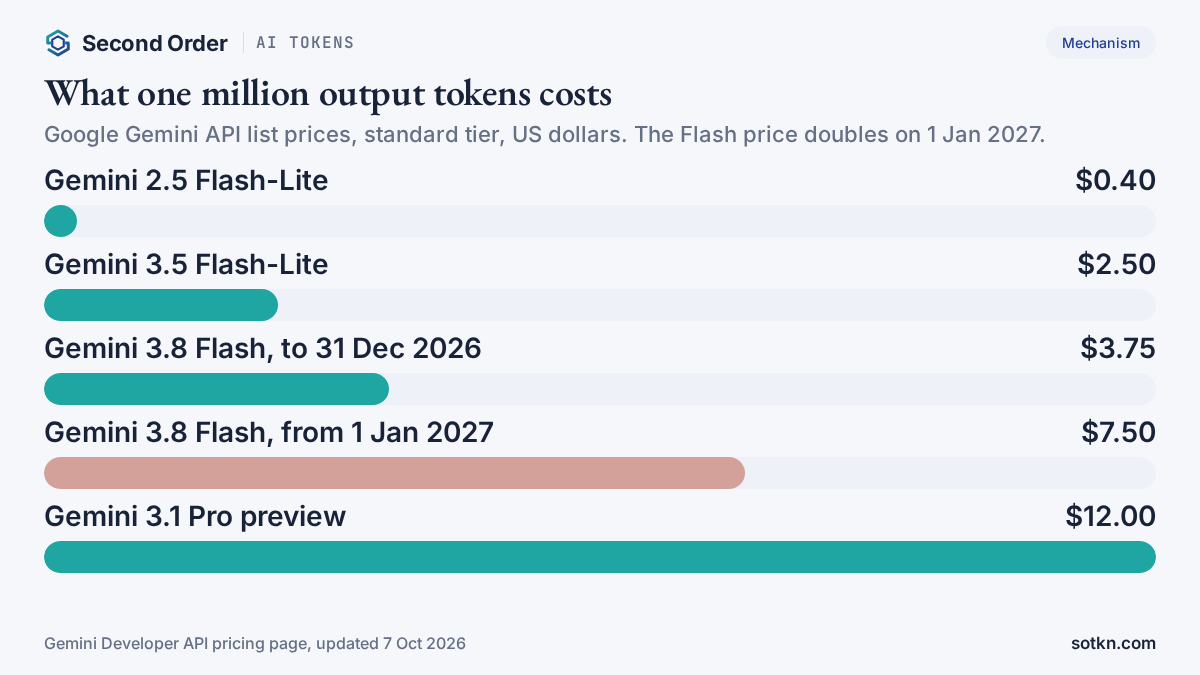
Two things stand out. Newer, stronger models cost more per token, not less: Flash-Lite output went from $0.40 on 2.5 to $2.50 on 3.5. And Google has put a date on a price rise. Its newest Flash model is at a launch price until 31 December 2026, then doubles.
How many tokens do hyperscalers process?
More every quarter, and the two biggest clouds now report token figures on their results calls.
| What Google and Microsoft said about tokens |
|---|
| Google, 22 Jul 2026: model APIs process about 22 billion tokens a minute, up from 16 billion a quarter earlier. Nearly 500 Cloud customers each processed over 1 trillion tokens in the past year. |
| Microsoft, 29 Jul 2026: 100,000 Foundry customers; Foundry revenue more than doubled. Customers at a 1-trillion-token annual run rate rose 4x in a year. |
Sources: Google CEO remarks, Q2 2026 call; Microsoft FY26 Q4 call. Neither company gives a total paid-token count or revenue per token.
Google’s 22 billion a minute is about 950 trillion tokens a month: 22 billion × 60 × 24 × 30 (our arithmetic). The jump from 16 billion is 37.5% in one quarter. These are model API tokens; Google does not say how many are paid.
What is a trillion tokens worth?
At list price, between about $0.75 million and $3.75 million a year on Gemini 3.8 Flash today. A trillion is a million millions, so the bill is the price per million times one million: $750,000 if every token is input, $3.75 million if every token is output (our arithmetic). From 1 January 2027 the same trillion costs $1.5 million to $7.5 million.
Real bills are lower and messier. Batch work costs half, big customers get discounts, and most traffic is a mix of input and output. Treat these as the scale of the money, not as anyone’s revenue.
Who gets paid per token?
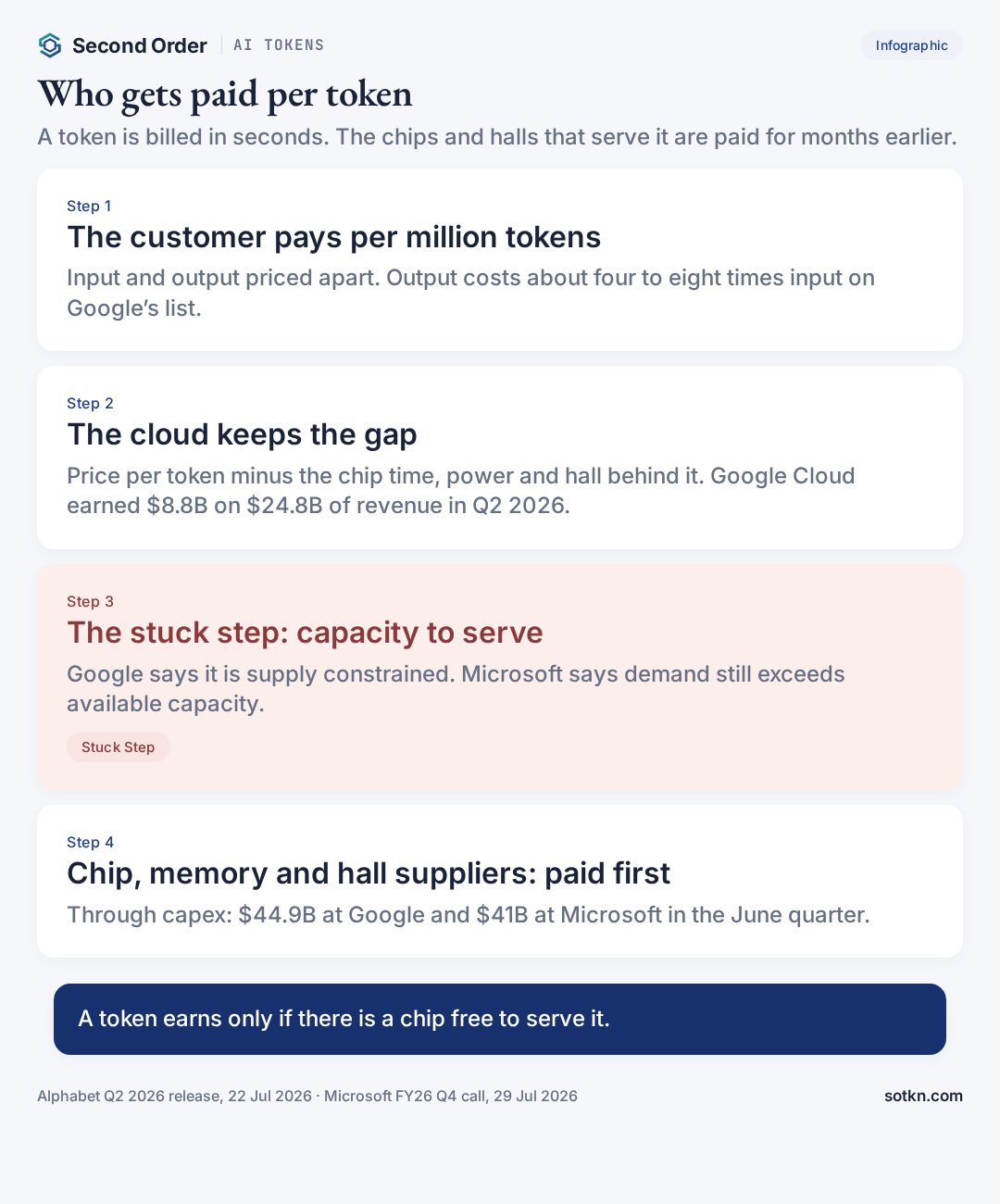
The cloud that serves the token is paid each time. It keeps the gap between the price of the token and the cost of the chip time, power and hall behind it.
That gap is widening at Google for now. Google Cloud earned $8.8 billion of operating income on $24.8 billion of revenue in the June 2026 quarter, a 35.6% margin. A year earlier it was $2.8 billion on $13.6 billion, or 20.7% (our arithmetic from Alphabet’s release).
Billing by the token is also spreading beyond the cloud. Microsoft moved GitHub Copilot to usage-based billing in June 2026 and added usage-based billing to Cowork in July. Its finance chief said customers will need to watch “token spend” across business processes. For how chip hours turn into money, see GPU utilization.
Where is the stuck step for AI tokens?
Capacity. A token can only be sold if there is a chip, in a powered hall, free to serve it. Right now there are not enough.
Google said on 22 July 2026 that it continues to be “supply constrained”. Microsoft said a week later that customer demand “continues to exceed available capacity”, and that extra Azure capacity it freed up in the quarter “was quickly monetized”. Azure grew 43% and Microsoft guided to about 45% in constant currency for the September quarter.
So the chips and halls get paid first. Alphabet spent $44.9 billion on property and equipment in the June quarter, more than the $39.1 billion of cash its operations brought in. Its free cash flow was minus $5.9 billion. Microsoft’s capital spending was $41 billion including finance leases, and it added another gigawatt of capacity in the quarter. For where those halls come from, see AI data centers; for the cash side, cash capex.
What to check next
Alphabet and Microsoft both report on 28 October 2026, US time (early 29 October in Singapore). Check Google’s tokens per minute against 22 billion, Google Cloud’s margin against 35.6%, and Azure growth against the roughly 45% guide.
Then watch 1 January 2027, when the Gemini 3.8 Flash price doubles. If token growth holds after a price rise, that is pricing power. Also watch backlog: Google Cloud’s was $514 billion and Microsoft’s commercial RPO $678 billion. See what RPO is.
Common misconceptions
- People assume a token is a word. Actually a token is about 4 characters. 100 tokens are about 60–80 English words, and images and audio are tokens too.
- People assume more tokens means the same rise in revenue. Actually the counts include free use, batch work at half price and discounts. Neither Google nor Microsoft reports revenue per token.
- People assume cheaper tokens mean less spending. Actually Google’s tokens rose 37.5% in a quarter while its capex rose too. Cheaper tokens bring more use.
- People assume the clouds can serve any demand. Actually Google and Microsoft both say demand is ahead of the capacity they have.
FAQ
What are tokens in AI?
Tokens are the small chunks of text, image or sound that an AI model reads and writes. A token can be one character, part of a word or a whole word. Cloud providers count them to bill for AI use.
How many words is a token?
About three-quarters of a word in English. Google says a Gemini token is about 4 characters, and 100 tokens are about 60–80 English words.
How are AI tokens priced?
By the million, with separate prices for input and output. Google lists Gemini 3.8 Flash at $0.75 per million input tokens and $3.75 per million output tokens through 31 December 2026, doubling to $1.50 and $7.50 from 1 January 2027.
Why do output tokens cost more than input tokens?
Output costs more because the model writes its answer one token at a time, which holds the chip for longer. On Google’s list, output is priced at about four to eight times input across Gemini models. Thinking tokens are billed as output.
How many tokens does Google process?
Google said on 22 July 2026 that its model APIs process about 22 billion tokens a minute, up from 16 billion a quarter earlier. That is roughly 950 trillion a month on our arithmetic.
Is this a list of stocks to buy or sell?
No. Second Order Explained pages explain how the money moves. They do not give buy or sell calls.
Related terms
- GPU utilization — why idle chip hours earn nothing.
- TPU — Google’s own chip that serves many Gemini tokens.
- Hyperscaler — the clouds that sell tokens and build the halls.
- Remaining performance obligation — the backlog behind future cloud revenue.
Stack doors
Layer: Hyperscalers. Markets: Amazon’s Nvidia chip leaseback. Wire: Nebius and the idle GPU tax. Analysis: Amazon’s site permission stuck step.
Get the Wire — short daily notes when token counts, cloud capacity or AI prices move.
How we check this
Token rules and prices come from Google’s own developer pages, checked on the date shown. Usage and money figures come from Alphabet’s and Microsoft’s results releases and call transcripts. Each is dated in the list below. Where we work something out ourselves, like tokens per month or the bill for a trillion tokens, the arithmetic is shown and uses list prices, not what customers actually pay. This page explains how the money moves. It does not give buy or sell calls.
Last reviewed: 09 Oct 2026 · Next review: after Alphabet and Microsoft results (28 Oct 2026, US time)
Spot an error? Tell us and we will correct it and note the change here.
Sources
- Google AI for Developers — Understand and count tokens (page updated 23 Sep 2026; checked 9 Oct 2026)
- Google AI for Developers — Gemini Developer API pricing (page updated 7 Oct 2026; checked 9 Oct 2026)
- Google — Q2 2026 earnings call: remarks from our CEO (22 Jul 2026)
- Alphabet — Q2 2026 results, Form 8-K Exhibit 99.1, SEC (22 Jul 2026)
- Microsoft — FY26 Q4 earnings release (29 Jul 2026)
- Microsoft — FY26 Q4 earnings conference call transcript (29 Jul 2026)
- Alphabet — date of Q3 2026 results call (6 Oct 2026)
- Microsoft — quarterly earnings release date (7 Oct 2026)