What Does Amazon's Price Assume About the Site-Permission Stuck Step?
Amazon can buy chips months ahead and sign power for 20 years. It cannot buy a county's yes. At about $2.76 trillion, how much of that permission clock has the price allowed for?

ANALYSIS · MEMBERS CONTINUE · 5 min free / 14 min full · Data as at 6 Oct 2026
Amazon can buy chips a few months ahead and sign power for 20 years. It cannot buy a county's yes. A data-centre shell is paid for about two years before servers go in, and it starts only once a local board approves the site. At about $2.76 trillion, how much of that permission clock has the price allowed for?
In short
- The question: what is Amazon's price already assuming about the site-permission stuck step?
- The answer: Scenario B. Take out a plain value for stores and ads, and the price leaves about $1.9 trillion for AWS. At a plain 20× operating income, that needs AWS revenue of about $242 billion a year, about 1.4× today's run-rate. That is roughly what Amazon's plan delivers if sites keep getting approved on time
- Why: AWS grew 37% in Q2 to a $169 billion run-rate, with a $496 billion backlog. Amazon says capacity stays short of demand in 2026 and 2027, even at about $220 billion of capex. On 2 October, its cloud chief wrote that over 100 data-centre moratoriums are being weighed, and pledged more than $1 billion to host towns
- Behind the wall: three scenarios with the arithmetic · what ~$2.76T leaves for AWS · who gets paid while sites wait · six practical takeaways · Members' FAQ
- What would break it: more counties pausing approvals, so the build slips. Or sites clearing faster, so the backlog bills sooner than the price allows
- Nothing here is a recommendation. This is a map of what the price requires, with the working shown
What's in this piece: the numbers that matter · why Amazon sits at the site-permission stuck step · what the price implies in one line · members from here · who gets paid while sites wait · three scenarios, arithmetic shown · our read · what would change the view, with dates · practical takeaways · FAQ · sources
The numbers that matter
| What | Figure | Date | What it tells us |
|---|---|---|---|
| AMZN close / market value | $256.29 / ~$2.76T | Close 6 Oct 2026 | The number we work backwards from |
| AWS Q2 revenue / growth | $42.2B / +37% | Quarter to 30 Jun 2026 | Fastest growth in 18 quarters |
| AWS run-rate / Q2 operating income | $169B / $16.6B | Same | Margin about 39% |
| AWS backlog | $496B; average life 6.4 years | 30 Jun 2026 | About 2.9 years of run-rate revenue (ours) |
| Cash capex 2026 | ~$220B (was ~$200B) | Call, 30 Jul 2026 | Raised for memory costs |
| Capacity vs demand | Short in 2026 and 2027 | Same | Lion's share of 2027 already reserved |
| Power plan | 2× 2025 power by end-2027 | Same | The build the price is leaning on |
| Shell lead time | Spent "two years before" servers | Same | The money that waits on the site |
| Moratoriums weighed (US) | Over 100 | Amazon, 2 Oct 2026 | The permission clock |
| Built Together | >$1B over five years | Amazon, 2 Oct 2026 | Amazon paying to keep sites moving |
| Calvert Cliffs campus | Up to 500 MW proposed in May; withdrawn | 4 Aug 2026 | Power next door, no yes |
| Local support | 79% back US AI lead; 14% want a data centre nearby | JLL, 11 Aug 2026 | The gap behind the votes |
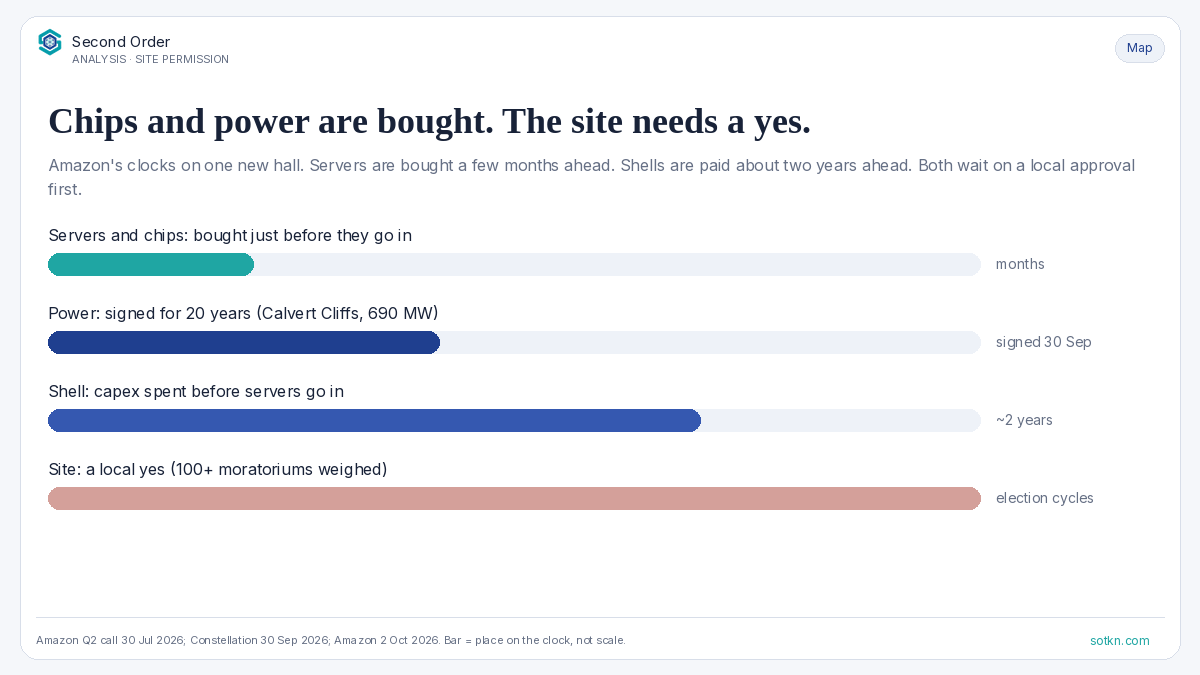
Chart 1 — Three clocks on one hall: chips months ahead, shells two years ahead, the local yes before both. Sources: Amazon, 30 Jul and 2 Oct 2026. Education only.
Why does Amazon sit at the site-permission stuck step?
The Hyperscalers layer covers the companies that build halls, buy chips and sell computing. What does Amazon do? shows how AWS turns capex into revenue. The chain is: find a site, get it approved, build the shell, bring in power, install servers, bill customers.
Amazon has worked hard on the later steps. It designs its own chips. It buys servers only "a few months" before they go in. "If the demand isn't there, we won't spend the capital," CEO Andy Jassy said on 30 July. And on 30 September it signed a 20-year power deal with Constellation for 690 MW from the Calvert Cliffs nuclear plant (Constellation, 30 Sep 2026).
The early steps are different. Jassy said data-centre capital "is spent starting two years before we can put servers into them" (Amazon Q2 2026 call, 30 Jul 2026). Those two years only start once a local board says yes.
That yes is getting harder to get. In May, Amazon applied to build up to 500 MW across eight buildings next to Calvert Cliffs. In the county's 23 June primary, voters removed the three commissioners who had voted against pausing data centres. On 4 August, the county said Amazon had withdrawn, and set a hearing on a six-month pause on data-centre site approvals (Maryland Matters, 4 Aug 2026; Data Center Knowledge, 11 Aug 2026). Amazon called it a business decision. Eight weeks later it signed for the plant's power anyway, with no campus attached. Power was signed. The site was not.
Then on 2 October, AWS chief Matt Garman published Amazon's Data Center Commitment and a program called Built Together. He wrote that "over 100 data center moratoriums" are being considered across the country. Amazon will add more than $1 billion over five years for host communities. It will stop using non-disclosure agreements with government agencies, and hold open houses (Amazon, 2 Oct 2026). A company does not write that unless the permission step is costing it time.
JLL found that 79% of Americans back US leadership in AI, but only 14% want a data centre in their own community (JLL, 11 Aug 2026).
Our Oracle piece asked what a price assumes about the power clock. Amazon has power and chips on order. So this piece asks: what does Amazon's market value assume about how fast sites get approved?
What does ~$2.76 trillion already assume?
Work backwards from the close. At $256.29 on 6 October 2026, Amazon is worth about $2.76 trillion. Add about $129 billion of net debt and the whole company is valued at about $2.89 trillion. Its private stakes, mainly Anthropic and OpenAI, were carried at $122 billion on 30 June. Take those out and the operating businesses are valued at about $2.77 trillion (ours).
Stores and ads earned $10.8 billion of operating income in Q2, or about $43 billion a year. At a plain 20×, that is about $0.86 trillion. That leaves about $1.91 trillion for AWS, or roughly 29× its run-rate operating income of $66 billion (ours).
Twenty-nine times is a price for growth. Growth needs halls. Halls need sites.
Our read, in one line: the price assumes Scenario B. Amazon's plan to double its 2025 power by the end of 2027 lands roughly on time, sites keep getting approved, and AWS reaches about $242 billion a year with margins near today's. The permission step, not the chip, is what decides whether that happens on time. The three scenarios and the arithmetic are below.
The free preview ends here.
—— Still to read · ~9 of 13 minutes ——
MEMBERS CONTINUE HERE
- Three scenarios with the arithmetic
- What ~$2.76T leaves for AWS, and what AWS must earn
- Who gets paid while sites wait for a yes
- Six practical takeaways
- Members' FAQ