
When GPUs Are Ordered Before Renters Sign, Where Does Cash Stick?
More GPU buyers are ordering next year's chips before anyone signs to rent them. The chips get paid for when they ship. The buyer gets paid only when a renter signs. Where does the cash sit in between?
ANALYSIS · MEMBERS CONTINUE · 4 min free / 13 min full · Data as at 6 Oct 2026
More GPU buyers are ordering next year's chips before anyone has signed to rent them. The chips get paid for when they ship. The buyer gets paid only when a renter signs and the halls go live. This piece maps where the cash sits in between, and which step is stuck.
In short
- The question: when a neocloud orders GPUs before renters sign, where does the cash stick?
- The answer: Scenario B. Nvidia and the rack chain get paid when the systems ship. Memory makers get paid through higher 2027 HBM4 prices already being set. The buyer waits for a renter. The stuck step is the renter's signature, not the chips
- Why: on 5 October 2026, AM Intelligence (AMI) placed two firm orders for about 20,000 Nvidia Rubin GPUs, about 70 MW, for delivery in Q2 2027. No customer was named. Mint put the order at about $4 billion (two people aware; not in the release). That is about $200,000 per GPU, rack included (ours)
- The contrast: Nebius says 70% of its Q2 deals came with prepayments covering 50–60% of the hardware cost. Lambda's new $1 billion loan only pays out as clusters for committed customers go live. Both have the renter first. AMI has the chips first
- Behind the wall: three scenarios with the arithmetic · payback at long-deal and short-deal prices · what an empty month costs · why HBM4 prices barely move the buyer's bill · six practical takeaways · Members' FAQ
- What would break it: AMI naming renters with prepayments before delivery (cash moves earlier), or Rubin supply catching up through 2027 so the price per megawatt slides (cash waits longer)
- Nothing here is a recommendation. This is a map of what today's prints already assume, with the working shown
What's in this piece: the numbers that matter · why the renter sits at the end of the chain · what the map assumes in one line · members from here · who gets paid, in order · three scenarios, arithmetic shown · our read · what would change the view, with dates · practical takeaways · FAQ · sources
The numbers that matter
| What | Figure | Date | What it tells us |
|---|---|---|---|
| AMI new orders | ~20,000 Rubin GPUs, ~70 MW, India and Malaysia | AMI, 5 Oct 2026 | Firm and binding. Chips are spoken for |
| Delivery | Q2 2027 | AMI, 5 Oct 2026 | When the chain gets paid |
| Renter named | None in the release | AMI, 5 Oct 2026 | When the buyer gets paid is open |
| Order value (reported) | ~$4B | Mint, 5 Oct 2026 (two people aware) | Not in the release |
| AMI first order | 9,000 GPUs, 30 MW, Q1 2027; a US customer bought it (unnamed) | Bloomberg, 25 Aug 2026 | The first tranche had a renter |
| Nebius long deals | $20–25M a year per MW; 70% with prepay covering 50–60% of capex | Nebius Q2 letter, 12 Aug 2026 | The renter pays part of the hardware up front |
| Short deals | ~$40M a year per MW, 3–6 months | CoreWeave, 17 Sep 2026 | Scarcity price for renters in a hurry |
| HBM4 price ask | mid-to-high $4 per Gb vs ~$1.50 for HBM3E | Maeil Business, 2 Oct 2026 | Memory makers set 2027 prices now |
| Our cost per GPU | $4B ÷ 20,000 ≈ $200,000 | Second Order arithmetic | All-in rack system, if the reported value holds |
| Our HBM4 extra per GPU | 8 × ($1,300 − $600) = $5,600 ≈ 2.8% | Second Order arithmetic | Memory price is a small line for the buyer |
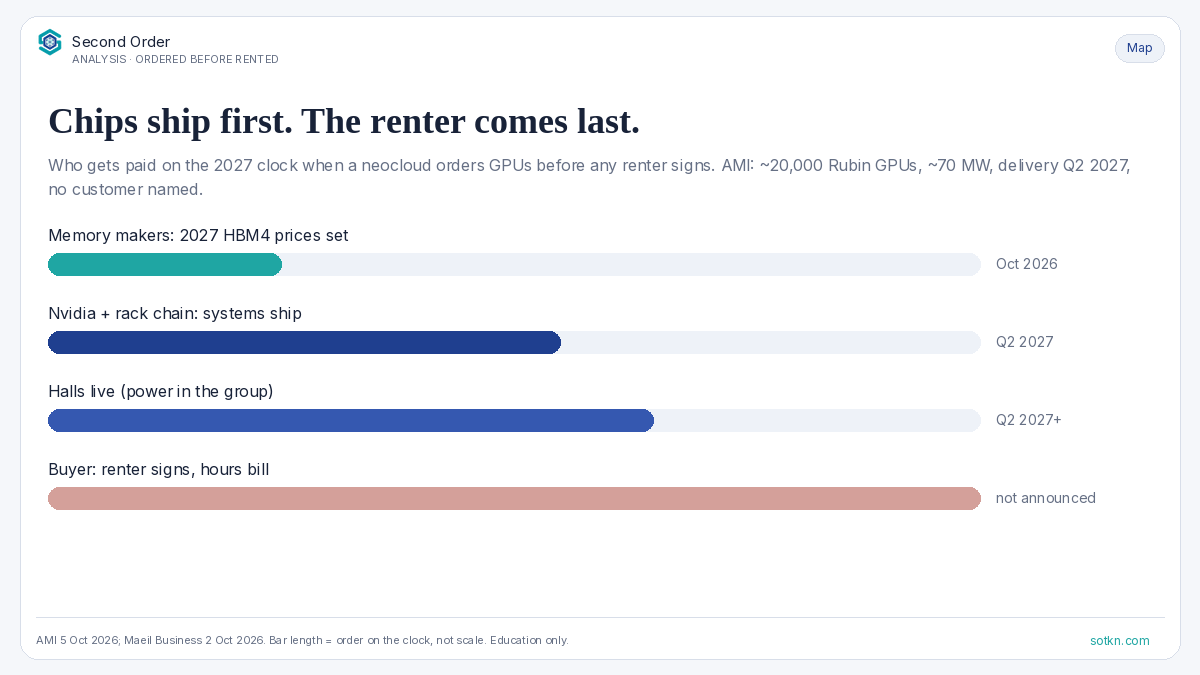
Chart 1 — Where each player sits on the 2027 clock: chips ship Q2 2027, memory prices set October 2026, renter still unnamed. Sources: AMI 5 Oct 2026; Maeil Business 2 Oct 2026; Nebius 12 Aug 2026. Education only.
Why does the renter sit at the end of the chain?
A neocloud is a company that buys GPUs, puts them in powered halls, and rents the computing time out by the hour or by contract. The neoclouds layer shows who they are. Neocloud, explained and Who Finances GPU Clusters? teach how the model works. The short version: the cash goes out long before it comes back. Cash capex, explained covers that gap.
There are three clocks on one chain:
- Chip clock. Nvidia and the rack builders get paid when the systems ship. A firm, binding order means this clock is already set
- Hall clock. Power, cooling and racks have to be live. AMI's founders run a power business (Greenko), so on paper this clock is in-house
- Renter clock. Someone signs to use the GPUs and pays for the hours. This is the only clock that pays the buyer
On 5 October 2026, AMI said it had placed two firm and binding orders for about 20,000 Nvidia Rubin GPUs, to be built as Vera Rubin NVL72 racks. That adds about 70 MW in Malaysia and India, with delivery in Q2 2027. With its first order, AMI now has about 29,000 Rubin GPUs and close to 100 MW committed. It says $6 billion is already committed for that first 100 MW, and it plans another 300 MW over the next 15 months for more than $20 billion (AMI release; BusinessLine, 5 Oct 2026). Mint reported the order at about $4 billion, citing two people aware (Mint, 5 Oct 2026).
The release says the capacity is meant for cloud providers, companies and AI developers. It names no customer. That is the gap this piece is about.
The first order was different. When AMI ordered 9,000 GPUs for Hyderabad on 25 August, a founder told Bloomberg that an unnamed US customer had already bought that initial capacity (Bloomberg, 25 Aug 2026). So tranche one had a renter. The new 70 MW, on what has been said so far, does not.
Compare two other neoclouds. Nebius said in August that 70% of its Q2 deals included prepayments that covered 50–60% of the related hardware cost, and that payback had dropped to 1 year and 10 months (Nebius Q2 2026 letter). Lambda closed a $1.008 billion loan on 1 October that funds GPUs for three committed customer deployments, two of them investment grade, and only pays out as clusters go into service (Lambda, 1 Oct 2026). In both cases the renter comes first. In AMI's new tranche, the chips come first.
Today's Wire flagged the AMI order. Yesterday's Analysis was a company piece on Micron's clean rooms. This piece asks the map question: when chips are ordered before renters, who gets paid, and who waits?
What does the map already assume?
Three answers compete:
- Renters sign early. Contracts and prepayments land before the chips arrive. The buyer gets cash soon after switch-on
- Renters sign around switch-on. The chips ship on time, the halls go live, and contracts arrive in the months around delivery at normal long-deal prices. The buyer waits, but not for long
- Renters are slow and cheaper. By late 2027 more Rubin capacity is live across the market. Renters take their time and pay less per megawatt. The buyer waits longer, on a lower price
A tip sheet would pick a stock. Analysis asks which answer today's prints already need, then shows the arithmetic.
Our read, in one line: the map already assumes Scenario B. Nvidia, the rack chain and the memory makers get paid on the 2027 ship date, while the buyer waits for renters who sign around switch-on at normal long-deal prices. The renter, not the chip, is the stuck step. The three scenarios and the arithmetic are below.
The free preview ends here.
—— Still to read · ~9 of 13 minutes ——
MEMBERS CONTINUE HERE
- Three scenarios with the arithmetic
- Payback at long-deal and short-deal prices
- What an empty month costs, and why HBM4 prices barely matter to the buyer
- Six practical takeaways
- Members' FAQ