What Does Applied Digital's Price Assume About the Build Clock?
Applied Digital has about $36 billion of leases signed and 250 MW live. Its chief says crews, not power, set the pace. What does a ~$7.1 billion price need from the build clock, and who gets paid while halls rise?
ANALYSIS · MEMBERS CONTINUE · 5 min free / 14 min full · Data as at 8 Oct 2026
Applied Digital has signed 1.41 gigawatts of AI data-centre leases worth about $36 billion. Only 250 megawatts are live. Its chief executive says the limit now is not power. It is how fast his crews can build and hand over halls. At about $7.1 billion for the shares, how much of that build clock has the price allowed for?
In short
- The question: what is Applied Digital's price already assuming about the build-and-handover stuck step?
- The answer: Scenario B. Add the debt, the cash and Macquarie's stake, and the business is valued at about $11.8 billion (ours). Add the roughly $8.7 billion of new debt the unfunded campuses still need, and that is about 9.6 times the yearly operating income the whole signed book earns once it is built (ours). The price is a plain value on halls landing on time, funded near 7%
- Why: on 7 October 2026, Applied Digital reported ~1.41 GW leased for ~$36 billion over 15-year terms, with 250 MW live. It expects over 600 MW into service in the next 12 months, against 250 MW in the last 12. Wes Cummins said the main challenge to its 2030 goal is "construction capacity, not power"
- The size of the clock: each signed megawatt earns about $1.70 million a year once live (ours). A month's slip on the next 600 MW moves about $85 million of lease income. Interest paid in the last quarter was about $81 million a month
- Behind the wall: who gets paid, in order, while halls are built · three scenarios with the arithmetic · where each megawatt's income goes · six practical takeaways · Members' FAQ
- What would break it: the build or the next debt slipping, so lease income starts late and costs more (Scenario A). Or halls landing early and debt pricing cheaper, plus pricier expansion leases (Scenario C)
- Nothing here is a recommendation. This is a map of what the price requires, with the working shown
What's in this piece: the numbers that matter · why Applied Digital sits at the build stuck step · what ~$7.1 billion already assumes · members from here · who gets paid while halls rise · how fast the clock has to run · three scenarios, arithmetic shown · our read · what would change the view, with dates · practical takeaways · FAQ · sources
The numbers that matter
| What | Figure | Date | What it tells us |
|---|---|---|---|
| Signed leases | ~1.41 GW, five campuses; ~$36B over 15-year base terms (~$86B with renewals) | Applied Digital, 7 Oct 2026 | The demand is signed |
| Live capacity | 250 MW at Polaris Forge 1 (CoreWeave), after a 75 MW phase on 1 Oct | Applied Digital, 7 Oct 2026 | About 18% of the signed book is earning (ours) |
| Next 12 months | Over 600 MW into service, vs 250 MW in the last 12 | Earnings call, 7 Oct 2026 | The clock has to more than double its pace |
| Lease income, quarter to 31 Aug | $65.8M base; operating income on it (NOI) $58.8M, an 89% margin | Applied Digital, 7 Oct 2026 | Live halls are very profitable |
| Interest, same quarter | Expense $77.4M; cash interest paid $242.9M | Applied Digital, 7 Oct 2026 | Lenders are paid before halls earn |
| Build spend, same quarter | $2.07B of property and equipment | Applied Digital cash flow, 7 Oct 2026 | Builders and suppliers are paid first |
| Debt and cash | $6.4B debt; $3.7B cash incl. restricted; Macquarie's stake $2.01B | Balance sheet, 31 Aug 2026 | The build runs on borrowed money |
| Latest notes | $1.59B at 7.00% for a 150 MW building, vs 9.25% on earlier notes | Applied Digital, 7 Oct 2026 | Funding got cheaper as halls landed |
| Still to fund | Polaris Forge 3, Delta Forge 1 and Delta Forge 2 | CFO on the call, 7 Oct 2026 | ~810 MW of the book is not yet financed (ours) |
| Share price | $23.85 close; ~297M shares | 8 Oct 2026 | Market value ~$7.1B (ours) |
Why does Applied Digital sit at the build stuck step?
Applied Digital is a landlord for AI computers. It finds land and power, builds the halls, then leases them for 15 years to a tenant who fills them with chips. The AI Data Centers layer shows where landlords sit in the chain. Lease income starts only when a hall is "ready for service": built, powered, cooled and handed over.
So the money runs on one clock: signed is not live, and live is not paid until handover. Take-or-pay contracts, explained covers why a signed lease still waits for the building.
Three of the usual stuck steps look clear here:
- Tenants. Signed. CoreWeave leases all of Polaris Forge 1. An investment-grade cloud company leases Polaris Forge 2. One tier-one investment-grade cloud company leases the other three campuses, the last a 210 MW lease worth $5.2 billion signed in June
- Power. Mostly held. Applied Digital says power is "the gating factor" for the industry, but it has grid capacity at its North Dakota sites. It also signed to buy power from a planned ~1,200 MW gas plant near Polaris Forge 3, with deliveries from 2030
- Local approval. Held where it builds. North Dakota has a set framework for data centres
What is left is the build. On the call, Cummins said the 3.5–4 GW goal for 2030 is limited "much more so" by "the ability and capacity to do construction and deliver for customers". To reach the top of that range, it would need to deliver about 1 GW a year in 2029 and 2030.
The second part of the build is money. Polaris Forge 1 (400 MW) and Polaris Forge 2 (200 MW) are fully funded. The other three campuses are not yet. The CFO said talks with lenders are "active".
Our Wire on 4 October covered one 75 MW handover. The 7 October print shows the whole clock.
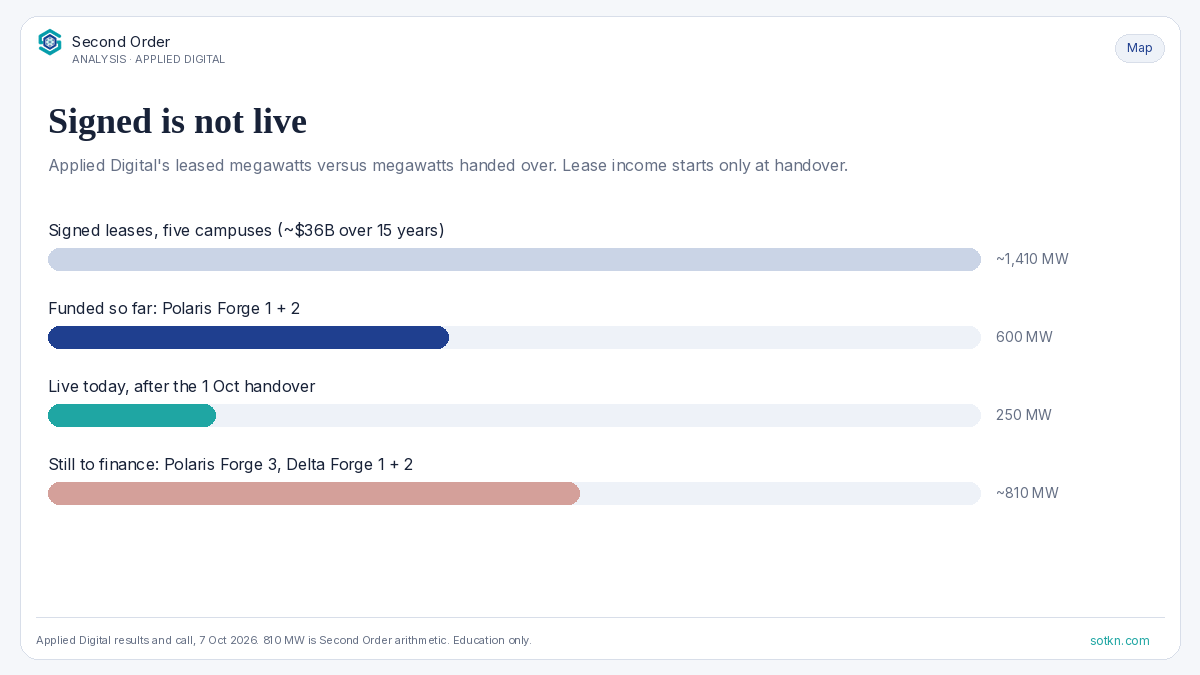
Chart 1 — Signed versus live. Applied Digital, 7 Oct 2026. Second Order arithmetic.
What does ~$7.1 billion already assume?
Three answers compete:
- The build slips. Halls land months late, and the next debt costs what the first notes did (9.25%)
- The build keeps its clock. Over 600 MW lands in 12 months, Louisiana and Alabama start paying in the first half of 2027, and the next debt prices near 7%
- The build runs early and cheap. Halls land ahead of plan, debt prices nearer investment grade, and the ~250 MW of expansion leases sign at "north of 15%" higher rates
A tip sheet would pick a side. Analysis asks which answer today's price already needs.
Our read, in one line: the price already assumes Scenario B. At about 9.6 times the operating income of the whole signed book once it is built and funded, the price pays for 1.41 GW landing on time at roughly 7% debt, and little more. Power and tenants are in hand. The stuck step is crews and money turning signed megawatts into live ones. The scenarios and the arithmetic are below.
The free preview ends here.
—— Still to read · ~9 of 14 minutes ——
MEMBERS CONTINUE HERE
- Who gets paid, in order, while halls are built
- Where each live megawatt's income goes
- How fast the build clock has to run
- Three scenarios with the arithmetic
- Six practical takeaways
- Members' FAQ