If AI Optics Stay Sold Out Into 2029, Where Does Cash Stick?
Lumentum's CEO says AI data center optics are sold out through early 2029, with about 70% of demand unmet on some lines. Where does cash stick? Three scenarios, arithmetic shown.
ANALYSIS · MEMBERS CONTINUE · 5 min free / 14 min full · Data as at 12 Oct 2026
Lumentum's chief executive said on 9 October that its AI data center optical parts are completely sold out through early 2029. Nvidia has already put $2 billion into Lumentum and another $2 billion into Coherent for capacity access. If the lasers that move data between AI chips stay booked that far out, where does the cash stick?
In short
- The question: if AI optics stay sold out into 2029, where does cash stick?
- The answer: Scenario B. Cash sticks first with the laser makers whose books are full, then with the chip firm that paid for capacity access, then with the hyperscalers sharing the cost of new fabs. Halls and GPU clouds without a locked allocation wait
- Why: on 9 October 2026, Lumentum said it is sold out through early 2029, with about 70% of demand unmet for some products through next year and about 30% unmet for others through 2028. New laser capacity takes three to five years. Greensboro, its new US fab, ramps only in mid-2028
- The size of the book: Lumentum's last quarter was $1.01 billion, more than double a year earlier, with non-GAAP gross margin above 50%. Four quarters at the guided midpoint would be about $5 billion a year (ours). That is still not enough to clear the queue
- Behind the wall: who gets paid, in order · three scenarios, arithmetic shown · what a sold-out clock costs buyers without allocation · six practical takeaways · Members' FAQ
- What would break it: a US ban that deepens the shortage (A), or early capacity and soft prices (C)
- Nothing here is a recommendation. This maps what today's interview and filings already assume, with the working shown
What's in this piece: the numbers that matter · why laser fab became the clock · what the map assumes in one line · members from here · who gets paid, in order · three scenarios, arithmetic shown · our read · what would change the view, with dates · practical takeaways · FAQ · references
The numbers that matter
| What | Figure | Date | What it tells us |
|---|---|---|---|
| Sold-out clock | Completely sold out through early 2029 | Lumentum CEO, Bloomberg, 9 Oct 2026 | Books are full more than two years out |
| Unmet demand, some products | About 70% unmet through next year | Same interview, 9 Oct 2026 | For those parts, shipments cover only about three in ten orders |
| Unmet demand, other products | About 30% unmet through 2028 | Same interview, 9 Oct 2026 | Even the easier lines stay short for two years |
| Clock move | Six months ago: sold out by 2028; now early 2029 | Same interview, 9 Oct 2026 | The sold-out window moved out about a year despite expansion |
| Build time | New capacity takes 3–5 years | Bloomberg, 9 Oct 2026 | Money alone does not clear the queue fast |
| US fab ramp | Greensboro InP line ramps mid-2028 | Lumentum, 26 Mar 2026 | Relief starts after most of the sold-out window |
| Nvidia stakes | $2B into Lumentum and $2B into Coherent, plus purchase commitments | Nvidia, 2 Mar 2026 | The biggest GPU seller paid for access before the clock moved out |
| Lumentum Q4 revenue | $1.01B, up from $480.7M a year earlier | Lumentum results, 11 Aug 2026 | Revenue more than doubled and the books are still full |
| Non-GAAP gross margin | 50.4% | Same results, 11 Aug 2026 | Pricing is holding while supply is short |
| Q1 FY27 guide | $1.225B–$1.275B | Same results, 11 Aug 2026 | Midpoint about 2.6× the year-ago quarter (ours) |
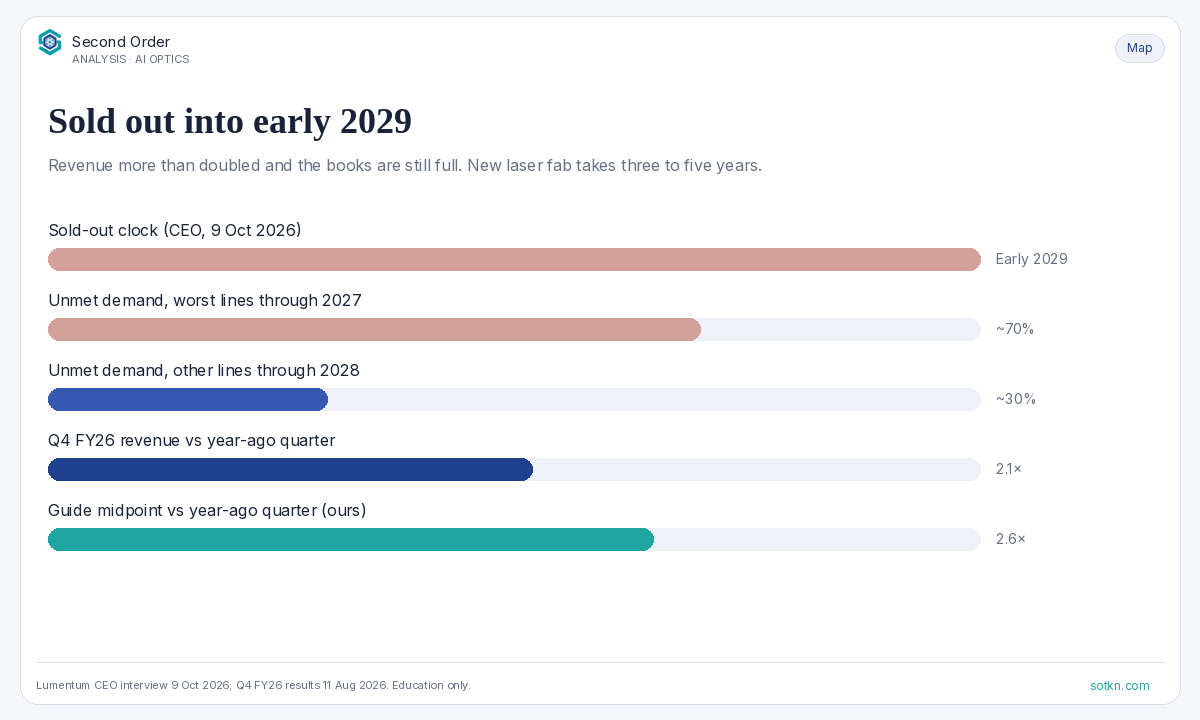
Chart 1 — Lumentum's sold-out clock against a year of revenue growth. Second Order arithmetic from the 9 Oct interview and 11 Aug results. Education only.
Why did laser fab become the clock?
An AI cluster needs three things that must arrive together: chips, power and the optical links that move data between them. What is an AI data center? covers the hall. The Semiconductors layer shows where packaging and memory sit. Optics sit one step further downstream of the GPU: without indium phosphide lasers inside the modules, a rack of chips cannot talk at the speeds AI training and inference need.
Lumentum and Coherent make those lasers. On 9 October, Lumentum's chief executive told Bloomberg in Tokyo that capacity is "completely sold out" through early 2029, that about 70% of demand for some products goes unmet through next year, and that about 30% of demand for other products stays unmet through 2028. Six months earlier he had said capacity would be fully committed by 2028. The sold-out window moved out about a year even after a twelvefold scale-up at the Tokyo-area factory.
Nvidia had already paid for a seat. On 2 March it put $2 billion into Lumentum and $2 billion into Coherent, with multibillion purchase commitments and future capacity access rights. Lumentum then said it would convert a 240,000-square-foot Greensboro site into a US indium phosphide fab, with production expected to ramp in mid-2028. Hyperscalers, the CEO said on 9 October, are "willing to put money behind" new capacity.
Our Lumentum Wire has the interview. This piece asks the money question: when the lasers are booked into 2029, who gets paid, and who waits?
What does the map already assume?
Three answers compete:
- The shortage deepens. A US ban on new Chinese transceiver models pushes more orders onto Lumentum and Coherent. The sold-out clock extends past early 2029. Prices rise further
- The shortage holds as stated. Books stay full into early 2029. Greensboro and Japan expansions ease the queue slowly from mid-2028. Margins hold near today's levels
- The shortage softens. Chinese supply stays open, new lines arrive early, and average selling prices fall. The sold-out clock shortens
A tip sheet would pick a laser stock. Analysis asks which answer today's interview and filings already need.
Our read, in one line: the map already assumes Scenario B. Laser capacity stays sold out into early 2029 as the CEO said, so cash sticks first with the makers whose books are full and whose margins are already above 50%, then with Nvidia for the capacity access it prepaid, then with hyperscalers sharing fab build cost. Buyers without a locked allocation wait: for some parts, seven in ten orders go unfilled through next year. The stuck step is indium phosphide fab output, which takes three to five years to add and only starts to ease when Greensboro ramps in mid-2028. The scenarios and the arithmetic are below.
The free preview ends here.
—— Still to read · ~9 of 14 minutes ——
MEMBERS CONTINUE HERE
- Who gets paid, in order, and who waits
- Three scenarios with the arithmetic
- What a sold-out clock costs buyers without allocation
- Six practical takeaways
- Members' FAQ