CoreWeave Has 4.2 GW Signed and 1.5 GW Live. What Does the Price Assume?
CoreWeave has signed for 4.2 GW of power but only 1.5 GW is live, while interest runs near $900M a quarter. What does a ~$45B price assume about power-on? Three scenarios, arithmetic shown.
ANALYSIS · MEMBERS CONTINUE · 5 min free / 14 min full · Data as at 10 Oct 2026
CoreWeave has signed for 4.2 gigawatts of power. Only 1.5 gigawatts is switched on. Customers have committed about $129 billion of future revenue, and CoreWeave guided interest to about $900 million for the quarter just ended. At about $45 billion for the shares, how much of the wait for power-on has the price allowed for?
In short
- The question: what is CoreWeave's price already assuming about the power-on stuck step, the gap between power it has signed for and power that is live?
- The answer: Scenario B. Add the debt and take off the cash, and the business is valued at about $73 billion (ours). That is about 3.9 times the yearly revenue run-rate CoreWeave expects to exit 2026 with. The price pays for power landing on the path to 8 GW by 2030 and margins climbing past about 18%, the point where a live megawatt covers its own interest (ours)
- Why: CoreWeave had 1.5 GW active at 30 June and 4.2 GW contracted by 11 August. It guides to more than 1.85 GW active by year-end. On 6 October it signed for 240 MW in Navi Mumbai, first phase due mid-2028
- The size of the gap: each live megawatt brings in about $10.3 million a year (ours). Debt per live megawatt is about $23 million, so interest takes about $1.8 million at CoreWeave's 7.8% cost of debt (ours)
- Behind the wall: who gets paid, in order, while power waits · one live megawatt's arithmetic · three scenarios, arithmetic shown · six practical takeaways · Members' FAQ
- What would break it: late power and stalled margins (A), or early power, cheaper debt and pricier short contracts (C)
- Nothing here is a recommendation. This is a map of what the price requires, with the working shown
What's in this piece: the numbers that matter · why CoreWeave sits at the power-on stuck step · what ~$45 billion already assumes · members from here · who gets paid while power waits · one live megawatt, one year · three scenarios, arithmetic shown · our read · what would change the view, with dates · practical takeaways · FAQ · references
The numbers that matter
| What | Figure | Date | What it tells us |
|---|---|---|---|
| Active power | 1.5 GW, up nearly 500 MW in the quarter; more than 300 MW of it in June alone | Q2 results, 11 Aug 2026 | Power is arriving, in lumps |
| Contracted power | About 3.7 GW at 30 June; about 4.2 GW by 11 August | Q2 results and call, 11 Aug 2026 | About 2.7 GW is signed but not live (ours) |
| Year-end target | More than 1.85 GW active, raised from 1.7 GW; at least 8 GW by 2030 | Q2 call, 11 Aug 2026 | The clock CoreWeave has set itself |
| Revenue backlog | About $104B at 30 June, plus more than $25B signed early in Q3 | Q2 results, 11 Aug 2026 | Demand is signed for years |
| Revenue and run-rate | Q2 revenue $2.58B; exit-2026 run-rate guided to $18.5–19.5B | Q2 results and call, 11 Aug 2026 | About $10.3M per live MW a year (ours) |
| Interest | $640M in Q2; $860–940M guided for Q3 | Q2 results and call, 11 Aug 2026 | Lenders' share is rising fast |
| Adjusted operating income | $128M in Q2 (5%); $200–260M guided for Q3 | Q2 results and call, 11 Aug 2026 | Interest is about four times operating income (ours) |
| Debt and cash | About $35.1B of debt; $6.9B of cash and restricted cash; then $4.2B of 2.875% convertible notes on 22 Sep | Balance sheet 30 Jun; 8-K 22 Sep 2026 | The build runs on borrowed money |
| Share price | $82.08 close; market value about $45.3B | 9 Oct 2026 | The price we test |
Why does CoreWeave sit at the power-on stuck step?
CoreWeave is a cloud built only for AI. It buys Nvidia systems, puts them in halls that landlords mostly build, and sells the computing time on contracts. What does CoreWeave do? covers the business. The Neoclouds layer shows where it sits in the chain.
Revenue starts only when a cluster is live: the hall built, the power on, the chips installed and the customer running. So the money runs on one clock: signed is not live, and power on paper is not power in the hall.
Three of the usual stuck steps look clear here:
- Customers. Signed. Backlog was about $104 billion at 30 June, up 246% in a year, and more than half is on contracts where delivery has started
- Price. Rising. CoreWeave told bond investors in September that it raised prices across its chip types in July, and that short contracts of three to six months were signing at about $40 million of yearly revenue per megawatt
- Money. Available, at a cost: about $18 billion raised in the second quarter, $4.2 billion more in September
What is left is power-on. CoreWeave added a record 500 MW in the second quarter, yet 2.7 GW of signed power still waits. Its finance chief said the June power arrived "very late in Q2". Work in progress rose to $11.9 billion: equipment bought and waiting for live power.
On 6 October CoreWeave signed for 240 MW at AdaniConneX's campus in Navi Mumbai, as sole tenant across three 80 MW buildings. The first phase is due in mid-2028. That is the stuck step in one deal: signed today, live in about two years. How long does it take to build an AI data center? explains why.
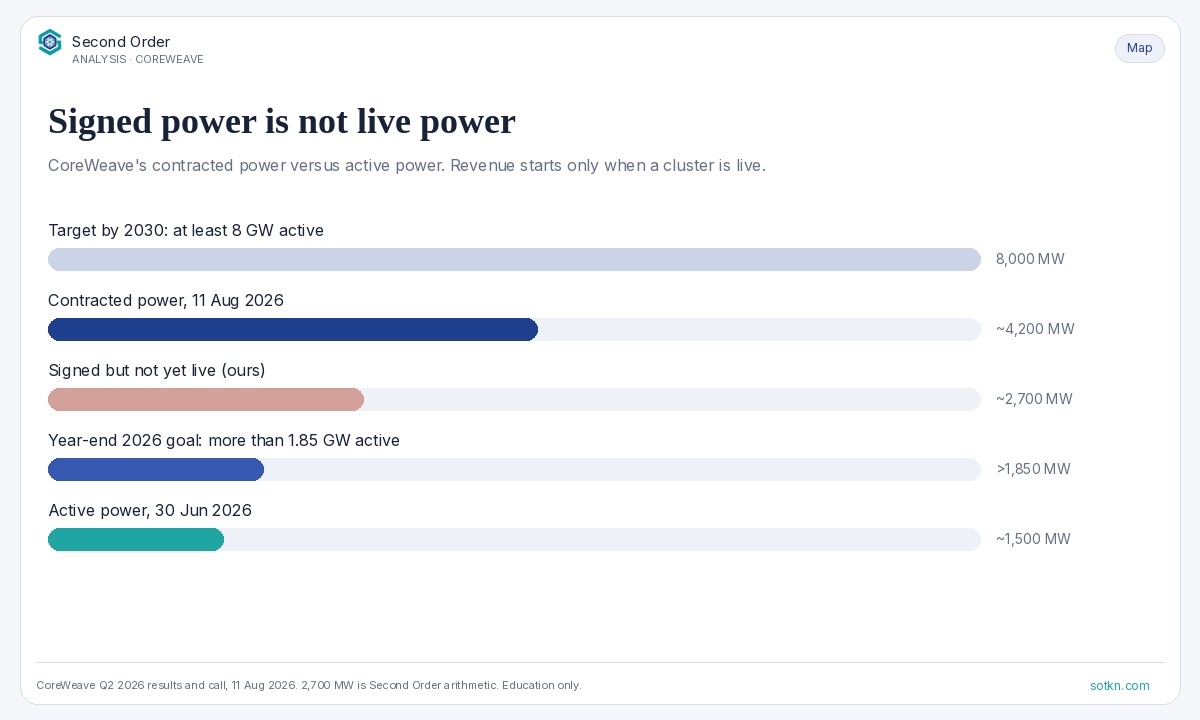
Chart 1 — Contracted versus active power at CoreWeave, with the year-end and 2030 targets. Second Order arithmetic from company figures.
What does ~$45 billion already assume?
Three answers compete:
- Power arrives late. Year-end lands short of 1.85 GW, 2027 runs months behind, and margins stay in the low teens. Lenders keep taking more than live halls earn
- Power keeps its clock. Active power climbs on a straight line to 8 GW by 2030, about 3.4 GW by the end of 2027 (ours). Margins pass about 18% and each live megawatt starts to cover its interest
- Power arrives early and cheap. Halls switch on ahead of plan, the cost of debt keeps falling, and pricier short contracts lift margins toward the mid-20s that CoreWeave's own charts show for settled deployments
A tip sheet would pick a side. Analysis asks which answer today's price already needs.
Our read, in one line: the price already assumes Scenario B. At about 3.9 times the run-rate CoreWeave expects to exit 2026 with, the price pays for power landing on the path to 8 GW and margins passing about 18%, where a live megawatt covers its own interest. Customers, prices and money are in hand. The stuck step is turning 4.2 GW of signed power into live halls before the interest bill outruns them. The scenarios and the arithmetic are below.
The free preview ends here.
—— Still to read · ~9 of 14 minutes ——
MEMBERS CONTINUE HERE
- Who gets paid, in order, while power waits
- One live megawatt, one year
- Three scenarios with the arithmetic
- Six practical takeaways
- Members' FAQ