How Long Does It Take to Build an AI Data Center? The Building Is the Quick Part
The building takes about one to three years: Applied Digital's first 100 MW AI hall took two, from groundbreaking to live. Getting power to it often takes longer, with grid connection waits of five to ten years in many places. Power is the wait.
EXPLAINED · Mechanism · Last reviewed: 11 Oct 2026 · Next review: after the US Census September construction data (2 Nov 2026)
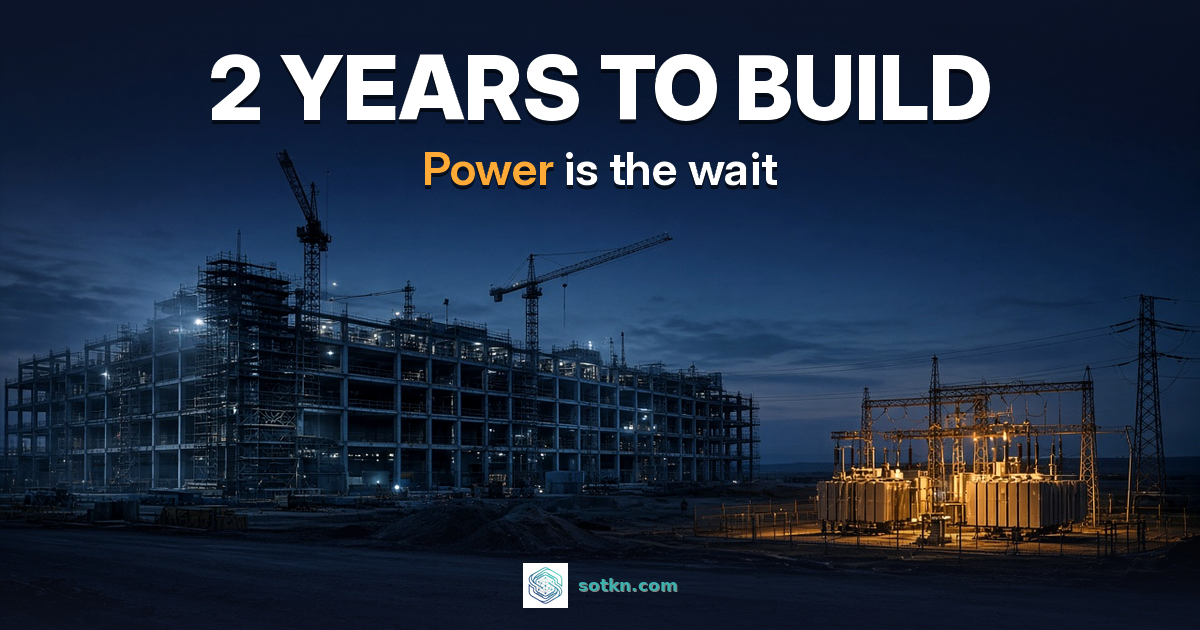
Building an AI data center usually takes about one to three years from groundbreaking to the first live hall; Applied Digital's first 100 MW AI building took about two. The longer wait is often the power: in many places a grid connection takes five to ten years, so the real clock starts when the power is secured, not when the digging starts.
In short. The building takes about one to three years. Applied Digital broke ground on its first 100 MW AI hall on 31 October 2023 and had it fully live on 24 November 2025, about 25 months later (our arithmetic). The power often takes longer: the IEA says grid connection waits of five to ten years are common in many places. Builders and the landlord get paid while the hall goes up; the tenant gets paid last. The stuck step is the power connection, so the date to watch is when the power is secured, not when the digging starts.
Why an investor cares: AI money turns into rent only when a hall is live, so the build clock decides when a landlord’s signed leases start paying and when a tenant’s chips can earn. This page builds on what an AI data center is and looks at the time it takes, step by step.
How long does it take to build an AI data center?
About two years for the building, if the power is already lined up. The IEA puts the time to build a data centre at one to three years, against 5 to 15 years to plan, permit and finish new grid infrastructure. That gap is the whole story: the hall is the quick part.
The cleanest dated example is Applied Digital in North Dakota. It broke ground on its first 100 MW AI building at Ellendale on 31 October 2023. The first 50 MW was handed over live on 27 October 2025 and the second 50 MW on 24 November 2025, about 25 months from groundbreaking to a full building (our arithmetic). How that landlord makes money is in what Applied Digital does.
| Applied Digital, Polaris Forge 1 (Ellendale, North Dakota): the build clock |
|---|
| 31 Oct 2023: groundbreaking on the first 100 MW AI building. |
| 27 Oct 2025: first 50 MW ready for service, about 24 months after groundbreaking (our arithmetic). |
| 24 Nov 2025: second 50 MW ready; the whole 100 MW building live, about 25 months after groundbreaking (our arithmetic). |
| 1 Jul 2026: first 75 MW half of Building 2 ready (175 MW live). |
| 1 Oct 2026: second 75 MW half ready (250 MW live, across two buildings and 10 data halls). |
| Still building: a third 150 MW building at the same campus, plus four more campuses. About 1.41 GW is leased in total. |
Applied Digital press releases of 31 Oct 2023, 27 Oct 2025 and 24 Nov 2025, and its results of 7 Oct 2026. Months are Second Order arithmetic.
The second building went faster because the site, power and design were already there. Its 150 MW came online in two 75 MW halves on 1 July and 1 October 2026, three months apart. Live capacity at the campus went from 100 MW in November 2025 to 250 MW in October 2026. Our 75 MW Wire covered the second half.
What are the steps, and how long does each take?
An AI data center is built on several clocks that run at once. The building is only one of them, and usually not the longest.
| How long each step of an AI data center takes |
|---|
| 1. Power request and grid connection: waits of five to ten years in many places (IEA). New lines and substations take 5 to 15 years to plan and build. This is the step that binds. |
| 2. Permission to build or switch on: months to years, set by each place. Singapore took about nine months to pick four winners for 200 MW in 2026; Texas paused approvals for new loads of 75 MW or more from 3 August 2026. |
| 3. Long-lead equipment: big transformers average two to three years; gas turbines for on-site power about five years (IEA). |
| 4. The building and its fit-out: about one to three years (IEA). Applied Digital’s first 100 MW hall took about two years; xAI says it built Colossus in 122 days. |
| 5. Lease to rent start: nine months on average for Digital Realty’s new leases signed in the second quarter of 2026. |
| 6. Filling the hall: Malaysia’s data centres used 1,256 MW in June 2026, about 22% of the 5.65 GW connected (our arithmetic). |
From the IEA, Applied Digital, Digital Realty, xAI, Singapore’s EDB and IMDA, and Tenaga Nasional, listed under References. Percentages are Second Order arithmetic.
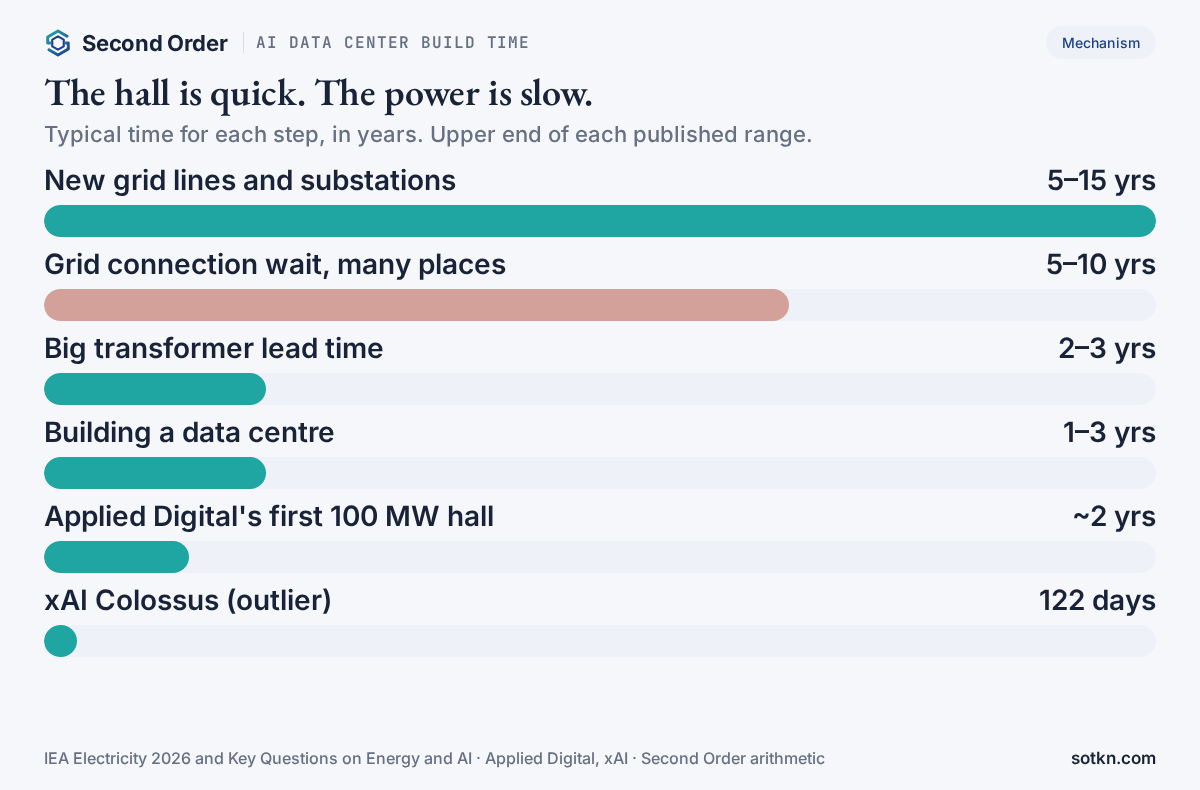
Equipment adds its own wait. The IEA says lead times for transformers now average two to three years, and gas turbines for power plants could take around five. A builder that orders late can have a finished shell and nothing to switch it on with.
Why does the power take longer than the building?
Because the grid is built for decades, not for one tenant. The IEA says grid connection waits can be as long as five to ten years in many jurisdictions, and that new grid infrastructure takes 5 to 15 years to plan, permit and build. A data hall of the same size takes one to three.
Rules add a step. Texas paused approvals to switch on new loads of 75 MW or more from 3 August 2026 and now asks for $50,000 a megawatt of security before connecting large loads, as our Texas Pulse explains. In Kentucky, TeraWulf’s 1 GW of contracted power at Muskie starts in 2028 at the earliest; see our TeraWulf Wire.
Our view: a site with signed power and a two-year build is further along than a site with a signed lease and no grid date. The lease is a promise of rent. The power date is when the rent can start.
What is the fastest an AI data center has been built?
xAI says it built its Colossus cluster in Memphis in 122 days, after being told the job would take 24 months, and then doubled it to 200,000 GPUs in 92 days. That is the outlier. It shows how fast the inside of a hall can be filled when everything else is ready; it does not show a faster grid. xAI’s page does not break down how its power was arranged, so we do not count it as a normal build.
Who gets paid while the hall is built?
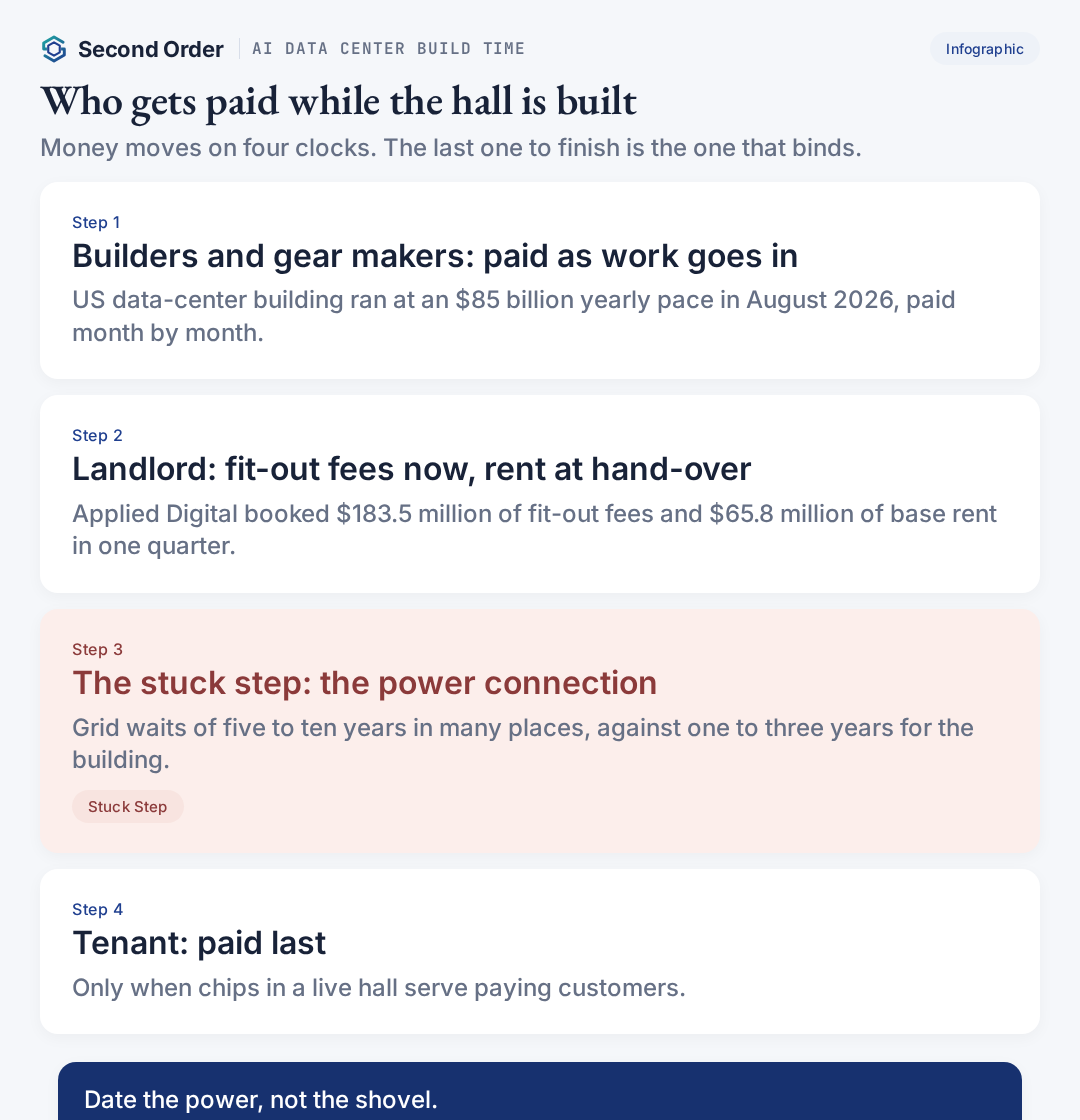
Money moves before a single chip earns anything, and it moves in a set order.
- 1. Builders and equipment makers, as the work goes in. US private data-center construction ran at an $84.95 billion yearly pace in August 2026, up 73% from $49.05 billion a year earlier, the US Census Bureau said on 1 October (our arithmetic for the change). That money is paid month by month as concrete, steel and wiring go in; servers are not in the number. Our US construction Pulse has the detail.
- 2. The utility, early, through security and deposits. Grid owners ask for money up front before they build for a large load, as the Texas rule shows. That cash is a guarantee, not a fee.
- 3. The landlord, twice. Applied Digital earns fit-out fees while it builds and rent once a hall is ready. In the quarter to 31 August 2026 it booked $183.5 million of tenant fit-out services and $65.8 million of base rent, so fit-out brought in about 2.8 times the rent (our arithmetic). Digital Realty’s new leases signed in the second quarter of 2026 started paying, on average, nine months after signing, and it had $1.9 billion of annual rent signed but not yet started. See what Digital Realty does.
- 4. The tenant, last. A hyperscaler or neocloud pays rent from hand-over, then needs paying customers to fill the chips. How chip time turns into money is in GPU utilization; who lends against the chips is in who finances GPU clusters.
Where is the stuck step?
The power connection, in most places. Where power is already signed, the stuck step moves to the build itself. Applied Digital’s chief executive said on 7 October that its 2030 goal is limited by construction capacity, not power, as our Applied Digital build-clock Analysis reports. It expects to put over 600 MW into service in the next 12 months, against 250 MW live today.
And once a hall is live, it still has to fill. Leased is not live, and live is not full. That is the third clock, and Malaysia shows it best.
How long does it take in Singapore, Malaysia and Australia?
- Singapore: the allocation clock. Singapore rations data centre power. Its second call for applications opened on 1 December 2025, and on 21 August 2026 the EDB and IMDA provisionally gave 200 MW to four operators: Digital Realty, Equinix, Keppel Data Centres and ST Telemedia Global Data Centres, 50 MW each. That selection alone took about nine months (our arithmetic), before any digging. The halls will sit in a low-carbon park on Jurong Island, and the agencies will review the need for another call in 18 to 24 months. See our Singapore Pulse and what Keppel DC REIT does.
- Malaysia: the fill clock. Tenaga Nasional had 61 secured data centre projects with 8.35 GW of maximum demand in June 2026, 42 of them already in its system at 5.65 GW. Actual load was 1,256 MW, about 22% of the connected figure, though it had doubled from 603 MW a year earlier (our arithmetic). Johor holds about two-thirds of the secured capacity. See our Malaysia Pulse.
- Australia: the power-condition clock. In Sydney, approved data centre capacity is waiting on power; our New South Wales Pulse walks through it, and what NEXTDC does covers the largest local landlord.
What would prove this wrong?
- Builds slip with power in hand. If Applied Digital misses its 600 MW in 12 months on sites with power signed, the building, not the grid, is the slow step.
- Grid waits shrink fast. If connection reforms and non-firm connections cut waits to a year or two, the power clock stops binding.
- Halls finish and sit empty. If live capacity grows faster than load, as Malaysia’s 22% hints, demand becomes the limit instead of power.
What to check next
The US Census Bureau publishes September construction data on 2 November 2026. Applied Digital expects its North Dakota campuses to reach 300 MW live by the end of 2026, which is the next dated test of the build clock. Digital Realty’s third-quarter report will show whether the nine-month lag from signing to rent is getting longer.
Common misconceptions
- People assume the building is the slow part. Actually the building takes one to three years; the grid connection often takes five to ten.
- People assume a signed lease means rent. Actually rent starts at hand-over. Digital Realty’s new leases took nine months on average to start paying.
- People assume 122 days is the new normal. Actually Applied Digital, a specialist builder, took about two years for its first 100 MW hall. Colossus is the exception.
FAQ
How long does it take to build a data center?
The building itself usually takes about one to three years, according to the IEA. The grid connection can take longer: the IEA says waits of five to ten years are common in many places, so the full timeline depends on when the power was secured.
How long does it take to build an AI data center?
About two years for a large purpose-built hall. Applied Digital broke ground on its first 100 MW AI building in North Dakota on 31 October 2023 and had the whole building live on 24 November 2025. Its next 150 MW building came online in two 75 MW halves three months apart in 2026.
Why do data centers take so long to build?
Mostly because of power. The concrete and steel are fast compared with the grid: new lines and substations can take 5 to 15 years to plan and build, and big transformers have lead times of two to three years.
What is the fastest an AI data center has been built?
xAI says it built its Colossus cluster in Memphis in 122 days, after being told it would take 24 months. That is the outlier, not the norm, and xAI's page does not break down the power side.
When does a data center start earning money?
The landlord earns rent when a hall is handed over live, which it calls ready for service. Digital Realty's new leases in the second quarter of 2026 started paying, on average, nine months after signing. Applied Digital also earns fit-out fees while it builds.
Is this a list of stocks to buy or sell?
No. Second Order Explained pages explain how the money moves. They do not give buy or sell calls.
Related: what is an AI data center; what is a hyperscaler; what is a neocloud; what Equinix does.
Stack doors
Layer: AI Data Centers. Also: Hyperscalers, Neoclouds, Semiconductors. Markets: US, Singapore, Malaysia, Australia.
Get the Wire — short daily notes when data center power, leases and build dates move.
How we check this
Dates, megawatts and money come from company releases and filings, the IEA, the US Census Bureau, Singapore’s EDB and IMDA, and Tenaga Nasional, listed under References. Each was re-checked on 11 Oct 2026. Where we work something out ourselves, such as months between two dates or a share of capacity, it is labelled “our arithmetic”. This page explains how the money moves. It does not give buy or sell calls.
Last reviewed: 11 Oct 2026 · Next review: after the US Census September construction data (2 Nov 2026)
Spot an error? Tell us and we will correct it and note the change here.
References
- IEA — Electricity 2026, Grids chapter (read 11 Oct 2026) — 1–3 years to build a data centre against 5–15 years for new grid infrastructure
- IEA — Key Questions on Energy and AI, World Energy Outlook Special Report (read 11 Oct 2026) — grid connection waits of five to ten years; transformer lead times of two to three years
- Applied Digital — Groundbreaking of 100 MW HPC facility in Ellendale, North Dakota (31 Oct 2023) — start date of the first building
- Applied Digital — Ready for Service for Phase 1 at Polaris Forge 1 Building 1 (27 Oct 2025) — first 50 MW live
- Applied Digital — Fiscal first quarter 2027 results (7 Oct 2026) — building dates, 250 MW live, 1.41 GW leased, fit-out and rent revenue
- Digital Realty — Second quarter 2026 financial supplement (SEC Form 8-K exhibit, 23 Jul 2026) — nine-month lag from lease signing to rent start; signed-not-commenced backlog
- US Census Bureau — Value of private construction put in place, monthly table (1 Oct 2026 release) — data center construction pace
- xAI — Colossus (read 11 Oct 2026) — 122-day build and 24-month estimate
- EDB and IMDA — Fact sheet: four data centre proposals selected in DC-CFA2 (21 Aug 2026) — Singapore's 200 MW allocation and its timeline
- Tenaga Nasional — Analyst briefing, 2QFY2026 (Aug 2026) — Malaysia data centre load, secured and connected capacity