
96 MW Approved, Not Powered: Who Gets Paid While Sydney Data Centres Wait on Power
On 1 Oct 2026 New South Wales approved two Sydney data centres, Microsoft's 96 MW Huntingwood hall and Stockland's 34.3 MW Macquarie Park tower. Neither can switch on until its full power use is matched with new, firmed clean power from NSW. Halls already past the power gate get paid first.
On 1 Oct 2026 New South Wales approved two Sydney data centres: Microsoft's 96 MW hall at Huntingwood and Stockland's 34.3 MW tower in Macquarie Park. Neither can switch on until every megawatt it uses is matched with new, firmed clean power from NSW. Approval is no longer the finish line. Power is. The money goes first to halls that already have it.
AUSTRALIA PULSE · Data as at 10 Oct 2026 · Next update: when Huntingwood's federal environment decision or NEXTDC's next update lands
Affects: AI Data Centers · Hyperscalers · Neoclouds — Markets: Australia · Singapore · Malaysia · US
Education only, not advice to buy or sell any security. Company and government figures are as reported. Approvals can still change at the federal step. Our own sums are labelled.
The numbers that matter this week
Microsoft Huntingwood, approved 1 Oct
96 MW
Computing load · total power capped at 140 MW · A$1.26B
PrimaryStockland Macquarie Park, approved 1 Oct
34.3 MW
Computing load · capped at 49 MW · A$630.4M
PrimaryGoodman Project Mars, withdrawn 28 Sep
Up to 90 MW
Lane Cove West · 374 submissions, 9 in favour
PrimaryNEXTDC order book
565.1 MW
Binding contracts · says new rules don't touch it
PrimaryGrid power per MW of computers (our math)
~1.45 MW
140 ÷ 96 at Huntingwood · 49 ÷ 34.3 at Stockland
Our mathFirmed NSW clean power
Still the bind
Matched at all times · signed before the hall runs
Stuck stepSources: Mingtiandi and w.media, 5 Oct 2026 (NSW consents of 1 Oct); The Guardian, 28 Sep 2026; Sydney Morning Herald, 29 Sep 2026; NEXTDC ASX release, 27 Aug 2026. Status chips are Second Order’s read.
On this page: Why Australia? · What NSW approved · The power condition · Our math · Who gets paid · Is power stuck? · Dates next · What would change this · FAQ
Why do two Sydney approvals matter now?
Because they show the new price of saying yes. For years a data centre approval in Sydney was mostly about noise, height, traffic and diesel. The 1 Oct consents add a harder test: bring your own clean power, backed up, from inside the state, before you switch on. That moves the stuck step from the planning desk to the power market.
This is our first Pulse from the Australia door. If you are new to the layer, start with what an AI data center is and the AI Data Centers stack: who owns the powered halls, who rents the computers inside them, and which step slows the money down. The question here is not “does Australia want AI halls?” Microsoft, Stockland, AirTrunk and NEXTDC are all building. The question is who gets paid once an approval stops being the same thing as power.
The timing is not an accident. In August NSW set a 75-day fast track for data centres that fund their own power and water. In late September Goodman, Australia's biggest listed property group, walked away from its Lane Cove West project, citing “emerging federal and state policy”. Then on 1 Oct the planning department approved two other projects with the power test written into the consent. Same city, same fortnight, three outcomes.
1 · Cloud and AI buyers want Sydney space
Who: Hyperscalers, neoclouds, government
Paid: Demand is not the problem: contracts are signed years ahead
2 · Halls already past the power gate get paid
Who: Operators with power and grid agreed
Paid: New rules apply at new connections and new approvals
3 · New approvals wait on firmed power
Who: Huntingwood, Macquarie Park and the pipeline
Paid: Signed NSW clean power, matched at all times, before the hall runs
What exactly did NSW approve?
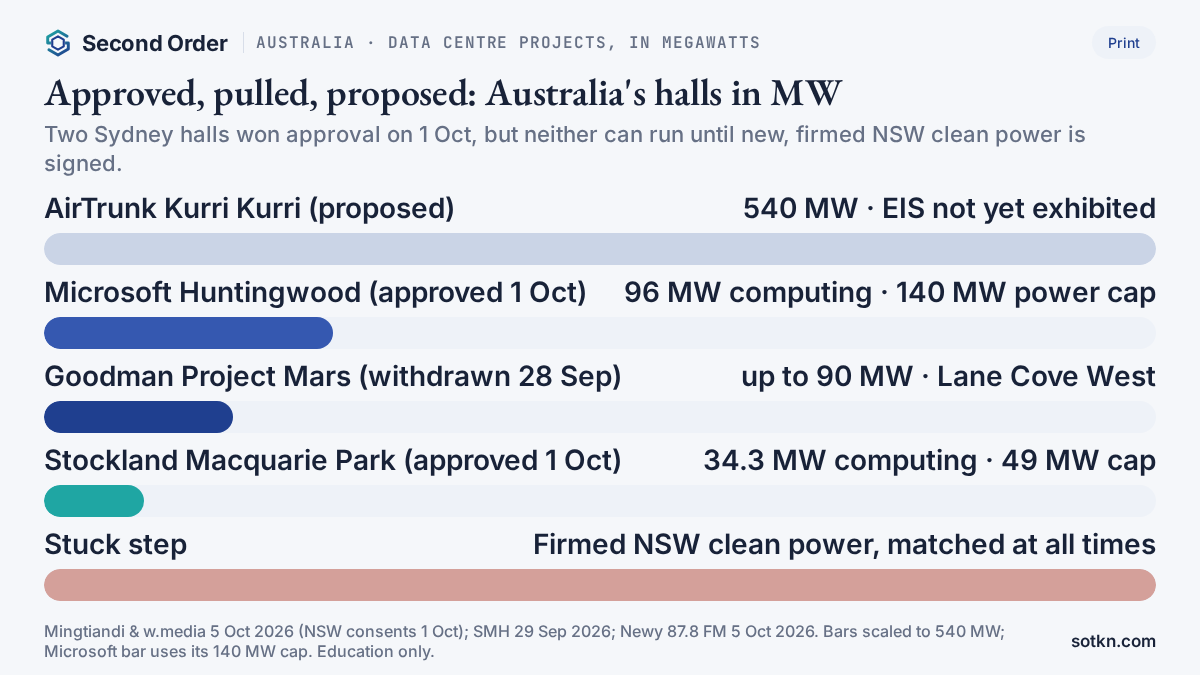
The NSW Department of Planning, Housing and Infrastructure approved Microsoft's Honeman Close Data Centre at Huntingwood on 1 Oct 2026, Mingtiandi reported from the assessment report. Huntingwood is an industrial estate beside the M4, about 10 km west of Parramatta and next to the Eastern Creek data centre cluster.
- A$1.26 billion of capital investment, 40 data halls over five floors, 96 MW of computing load.
- Total power use capped at 140 MW. Back-up from 46 diesel generators and about 159 tonnes of lithium-ion batteries.
- About 3.9 megalitres of water a day for 36 rooftop cooling towers.
- Around 24 months to build, 250 construction jobs and 74 operating roles.
- Still needs a separate federal environment approval, because it clears 0.33 hectares of critically endangered woodland. Work cannot start until that is granted.
The application was lodged in 2023 without naming the end user, and public comment closed on 1 Feb 2024. That is more than two and a half years from exhibition to consent, much of it spent in talks with Blacktown City Council over bulk, landscaping and drainage.
On the same day the department approved Stockland's Road 1 Data Centre at 1–5 Khartoum Road, Macquarie Park, w.media reported. It is a 10-storey, A$630.4 million tower with eight data halls and 34.3 MW of computing load. Total power is capped at 49 MW and generator capacity at 55 MW. Outside real outages, the generators may run only 55.4 hours a year, and they may not sell power into the grid or help with load shedding. Stockland targets a power usage effectiveness (PUE) of 1.35. The consent lapses after five years if building has not started. It sits next to a 76.4 MW Stockland hall approved in March.
Microsoft · Huntingwood (approved 1 Oct 2026)
Stockland · Macquarie Park (approved 1 Oct 2026)
Mingtiandi, 5 Oct 2026; w.media, 5 Oct 2026 (both citing NSW assessment reports and consents).
What does the power condition actually ask for?
Before the Huntingwood hall operates, Microsoft must show that all of its electricity use is matched by additional, firmed renewable supply, secured through power purchase agreements for NSW-based generation. Stockland's consent carries the same requirement. Three words do the work.
- Additional: new clean power, not a claim on wind and solar farms that already feed the grid.
- Firmed: backed by batteries or other supply so it is there when the hall needs it. A data centre runs all night; solar does not.
- NSW-based: built in the state, so the hall does not lean on the rest of the grid while counting power made elsewhere.
This matches the state's August framework. Under the NSW Data Centre Guidelines, projects that want the 75-day fast track must commit to sourcing 100% of their energy from new renewable agreements within four years, including 40% from wind, The Guardian reported. Planning minister Paul Scully said projects that do not comply face no “automatic knockback”, but they lose the fast lane. At the time, 19 data centre projects worth a combined A$50.3 billion were already in the state's major-project pipeline.
The Commonwealth is moving too. National Cabinet agreed in August to develop mandatory national standards for large data centres, with legislation promised for early 2027, Mingtiandi reported. The Prime Minister has said those rules would not apply to projects already approved. That single line is why the date of your approval — and your grid connection — now carries a price.
It is the same move we saw in the US this week. Duke's new terms make big data centre users pay for 75% of their contracted power whether they use it or not (our Wire on Duke). Texas charges $50,000 a megawatt just to join the queue (the Texas Pulse). Different tools, one idea: the new hall pays for its own power before it earns.
Our math: how much power is 96 MW really?
The headline number and the power bill are not the same thing. A data centre's “MW” usually means the power that reaches the computers. Cooling, lighting and losses come on top. The two NSW consents show the gap in black and white.
- Huntingwood: 140 MW cap ÷ 96 MW of computing load ≈ 1.46 MW from the grid for every MW of computers (our arithmetic).
- Macquarie Park: 49 MW cap ÷ 34.3 MW ≈ 1.43 (our arithmetic). Stockland's own target PUE is 1.35, so the cap leaves some room.
- If Huntingwood ran flat out at its cap all year: 140 MW × 8,760 hours ≈ 1.23 TWh. Macquarie Park at its cap: about 0.43 TWh. Together about 1.66 TWh a year as an upper bound (our arithmetic, not a forecast).
- Build cost per MW of computing load: about A$13.1 million at Huntingwood (1,260 ÷ 96) and about A$18.4 million at the 10-storey Macquarie Park tower (630.4 ÷ 34.3) (our arithmetic).
What this tells you: the power contract Microsoft must sign is sized to 140 MW of round-the-clock demand, not 96 MW. Matching that “at all times” with wind, solar and storage means contracting much more nameplate capacity than 140 MW, because wind and solar run only part of the day. That is a real procurement job, and it has to be done before the hall earns a dollar.
What it does not tell you: the price of that power, how fast Microsoft can sign it, or how much of its existing Australian deals will count. Those numbers are not public. For how to read money spent before it earns, see cash capex, explained.
Who gets paid first?
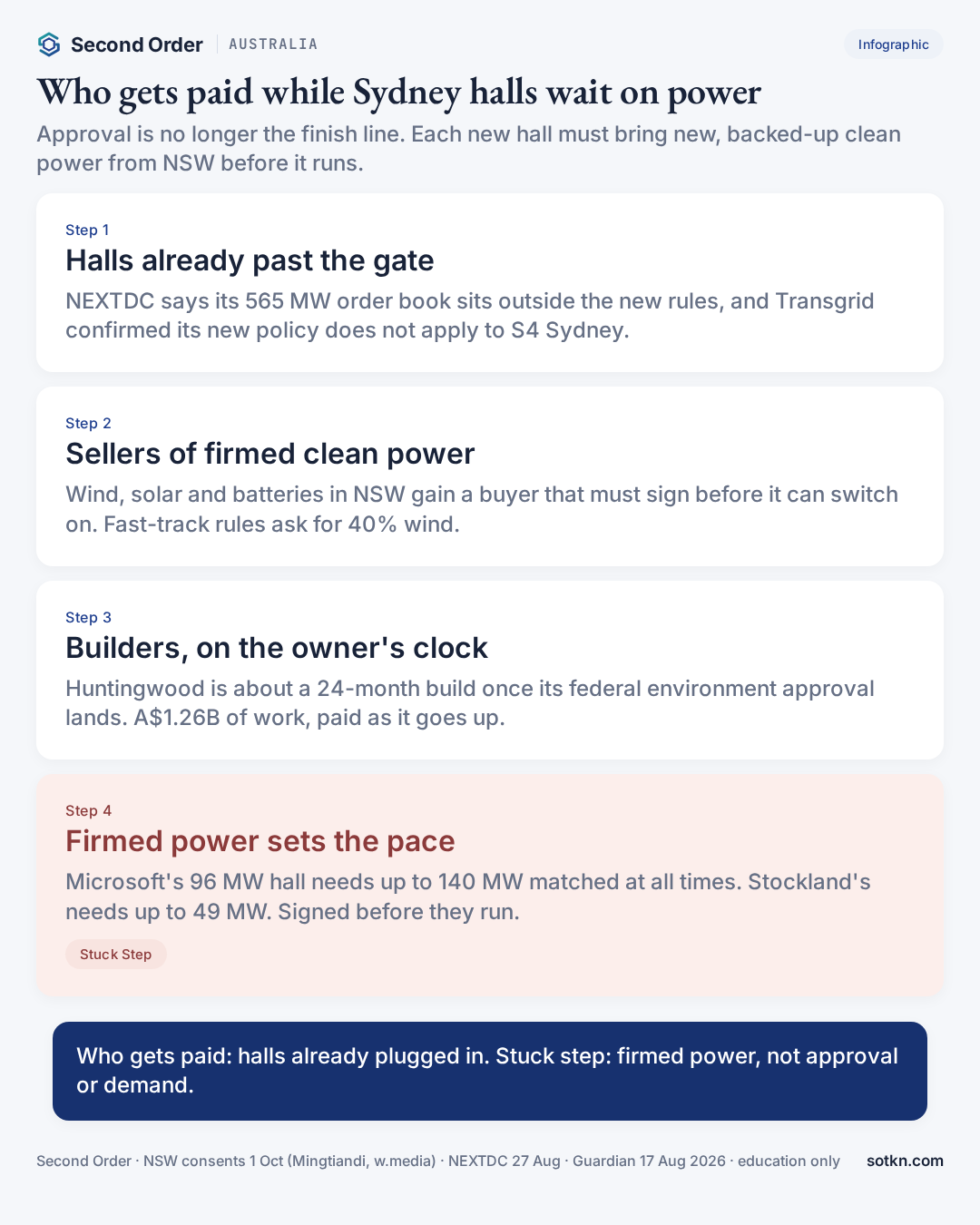
Follow one cloud customer who needs more room in Sydney next year. The money moves in a short line, and each stop runs on its own clock.
First, owners of halls that already have power and a grid connection. NEXTDC is the clearest public case. In its 27 Aug results it said its operating halls and its 565.1 MW forward order book are not affected by the proposed NSW and federal reforms, because those apply “at the point of new grid connection and planning approval”. It also said Transgrid, the NSW grid operator, confirmed in writing that its new capacity allocation policy does not apply to S4 Sydney, a campus NEXTDC has upgraded to 365 MW in total.
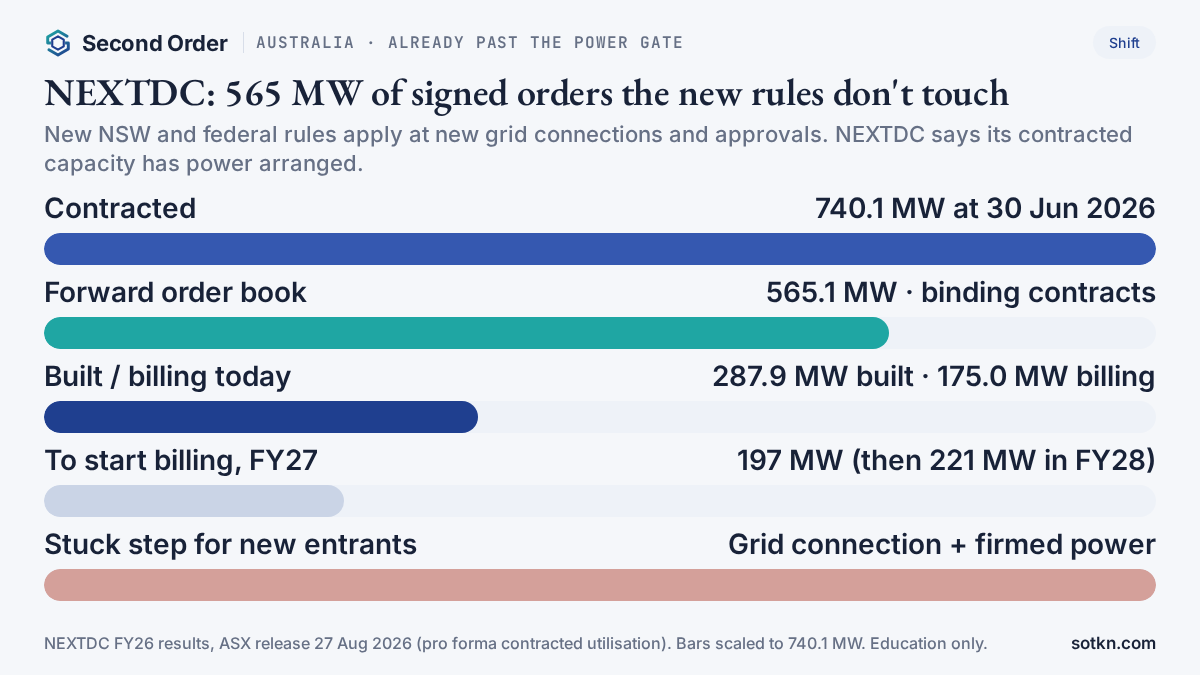
NEXTDC's numbers show what “past the gate” is worth. At 30 Jun 2026 it had 287.9 MW built, 175.0 MW billing and 740.1 MW contracted. It expects 197 MW to start billing in the year to June 2027 and a further 221 MW the year after — 74% of the order book within two years. It guides net revenue of A$615–640 million for the year to June 2027, up from A$405.0 million, and plans to spend A$5.25–5.75 billion on building. Every MW in the order book, it says, is a binding customer contract.
Second, sellers of new, firmed clean power in NSW. Wind farms, solar farms and big batteries that can sign long contracts with data centres now have a buyer that must sign before it can operate. The fast-track rules ask for 40% wind and storage alongside. That is a pull on wind and battery projects in particular, because they are what keep a hall running after dark.
Third, the builders — but on the hall owner's clock. Microsoft's consent implies about two years of construction once the federal sign-off arrives. Contractors, electrical gear suppliers and cooling suppliers get paid as the hall goes up, which only happens once power is lined up.
Fourth, the tenants carry the new cost. Microsoft is its own tenant at Huntingwood. In multi-tenant halls, NEXTDC says some of the renewable and firming burden may be handled by customers through their global energy buying. See hyperscaler, explained and neocloud, explained for who rents what inside these buildings.
One-line rule: who gets paid first is the owner of a hall already past the power gate; the stuck step is firmed power, not approval and not demand.
Is power still the stuck step?
Yes. The rest of the country shows the same pattern from other angles.
- Goodman, Lane Cove West: Project Mars, reported at up to 90 MW and A$1.2 billion, was withdrawn on 28 Sep 2026 after 374 public submissions, nine in favour. Goodman cited “emerging federal and state policy”. Sydney Water and Ausgrid had raised concerns about strain on local water and power.
- AirTrunk, Kurri Kurri: a proposed 540 MW hall on the old Hunter smelter site, filed as a State Significant Development. Its environmental impact statement has not yet been put on exhibition and no decision has been made. AirTrunk says it will pay for its own grid connection and has offered Cessnock council more than A$37 million for local works.
- AirTrunk, Kemps Creek: a planned 1.2 GW campus in Sydney's west that the company is scaling up despite local push-back, the SMH reported.
- Firmus, Tasmania: approved for a 288 MW hall at George Town with 276 diesel generators limited to emergencies and tests. Firmus has appealed to run them more often during “energy market stress”; on 7 Oct Tasmania's EPA board asked to join the appeal. Firmus is negotiating 444 MW of power from Hydro Tasmania, ABC reported on 10 Oct.
What binds a new Australian hall
What it does not bind
So-what: Australia's stuck step is not money and not customers. It is new, backed-up clean power and the grid connection to carry it. That keeps new supply slow — which is good for owners of connected halls and slow for everyone holding only an approval.
Compare Singapore, where the state hands out power in small rounds and has just licensed every hall of 3 MW or more (yesterday's Singapore Pulse). Australia does not ration by tender; it rations by making each new hall bring its own firmed power.
Which dates test this read next?
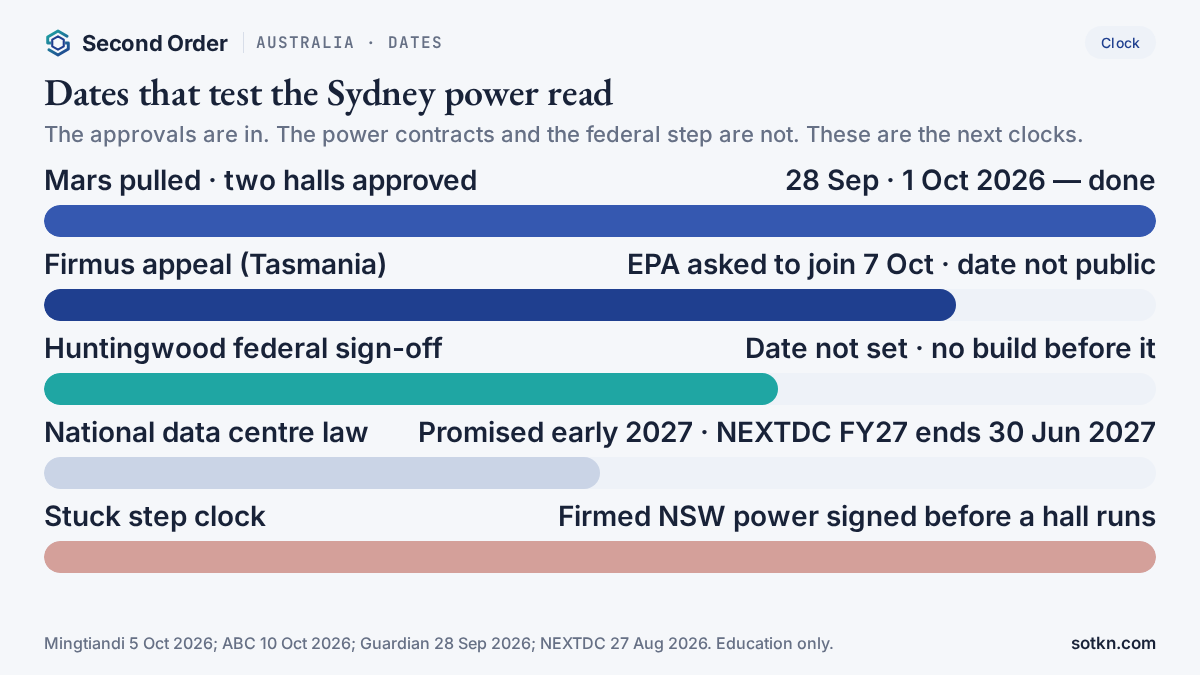
- 28 Sep 2026 — Goodman withdraws Project Mars. Done.
- 1 Oct 2026 — NSW approves Huntingwood (96 MW) and Macquarie Park (34.3 MW) with the power condition. Done.
- October 2026 — TASCAT appeal on Firmus's generator use, with the EPA board asking to join. Hearing date not public.
- Date not set — federal environment decision on Huntingwood. Building cannot start before it.
- Date not set — AirTrunk's Kurri Kurri environmental impact statement goes on public exhibition.
- Early 2027 — Commonwealth legislation for national data centre standards, as promised.
- 30 Jun 2027 — end of NEXTDC's year; test of whether 197 MW starts billing as guided.
- About late 2028 at the earliest (our reading of a 24-month build after a federal sign-off) — Huntingwood could run, if its firmed power is signed by then.
The federal step matters most for Huntingwood. Until it lands, the 24-month build clock has not started, and neither has the power contract clock in any visible way.
What would change this view?
- Microsoft signs and shows its firmed NSW power quickly, and the federal step clears — the power gate is shorter than it looks.
- NSW softens “matched at all times” to a yearly total — firming stops being the bind.
- National rules in 2027 reach halls already approved or connected — the head start of connected owners shrinks.
- NEXTDC's billing slips well short of 197 MW this year — the bind is building, not power.
- Firmus wins its appeal and diesel use widens — back-up power becomes a way around the clean-power test.
- Big tenants pause Sydney orders — demand, not power, becomes the bind.
The view stays intact while new Sydney approvals carry the firmed-power test, connected halls stay outside it, and order books keep filling faster than new power arrives.
Practical takeaways
- NSW approved Microsoft's 96 MW Huntingwood hall and Stockland's 34.3 MW Macquarie Park tower on 1 Oct 2026
- Neither can run until its full power use is matched with new, firmed NSW clean power
- Grid power runs about 1.45 MW per MW of computers on these consents (our arithmetic)
- Who gets paid first: owners of halls already past the power gate, such as NEXTDC's 565 MW order book
- Stuck step: firmed power and the grid connection, not approval and not demand
FAQ
What did New South Wales approve on 1 Oct 2026?
Two Sydney data centres. Microsoft's Honeman Close hall at Huntingwood, in Sydney's west, is A$1.26 billion, 96 MW of computing load across 40 data halls, with total power capped at 140 MW. Stockland's Road 1 tower in Macquarie Park is A$630.4 million, 34.3 MW of computing load across eight halls, capped at 49 MW. Both were approved by the NSW planning department on the same day.
What is the power condition?
Before either building runs, the owner must show that all of its electricity use is matched with new, “firmed” renewable power from NSW, under signed contracts. Firmed means wind or solar backed by batteries or other supply, so the power is there when the hall needs it, not just on sunny or windy hours.
Who gets paid first?
Owners of halls that already have power arranged and grid connections agreed. NEXTDC says its 565 MW order book is not affected by the new rules, and that the grid operator Transgrid confirmed in writing that its new capacity policy does not apply to its S4 Sydney campus. New approvals get paid later, after power contracts and a two-year build.
Why did Goodman pull Project Mars?
Goodman withdrew its Lane Cove West data centre on 28 Sep 2026, citing “emerging federal and state policy” and community views. Reports put it at up to 90 MW and A$1.2 billion. It drew 374 public submissions; nine supported it.
What is the stuck step?
Power. Not the approval and not the customer. A Sydney hall now needs a grid connection, a signed bundle of new firmed clean power, and in Microsoft's case a federal environment sign-off, before it earns rent.
Is this investment advice?
No. Education only. It maps who gets paid and which step is stuck. It is not a recommendation to buy or sell any security.
Keep reading on the map
- Australia Markets hub — country page
- AI Data Centers stack — layer map
- What is an AI data center? — the basics
- Singapore data centre licence Pulse (9 Oct) — the rationed-power case
- Texas large-load rule Pulse (8 Oct) — the US power gate
- Duke's 75% data center power terms (Wire) — pay for power, used or not
- All Markets doors — Taiwan, Korea, US, China, Singapore, Australia, Malaysia
- Hyperscaler, explained · Neocloud, explained
How we check this. Approval figures come from reports of the NSW planning department's assessment reports and consents (Mingtiandi, w.media). NEXTDC figures come from its own ASX release. Withdrawals and the Tasmanian appeal come from named news reports. Anything we worked out ourselves is labelled “our arithmetic”. We do not invent power prices, lease rates or dates. Our editorial standards →
Not investment advice. Do your own research.
Sources
- Mingtiandi (5 Oct 2026) — Microsoft Huntingwood consent 1 Oct: 96 MW, 140 MW cap, A$1.26B, power condition; Stockland same day — mingtiandi.com
- w.media (5 Oct 2026) — Stockland Road 1 consent: 34.3 MW, 49 MW cap, generator limits, PUE 1.35 — w.media
- NEXTDC FY26 results, ASX release (27 Aug 2026) — 565.1 MW order book, power and regulatory position — asx.com.au
- The Guardian (28 Sep 2026) — Goodman withdraws Project Mars — theguardian.com
- Sydney Morning Herald (29 Sep 2026) — Project Mars 90 MW, 374 submissions; AirTrunk Kemps Creek — smh.com.au
- The Guardian (17 Aug 2026) — NSW 75-day data centre fast track and renewable terms — theguardian.com
- ABC News (10 Oct 2026) — Tasmania EPA joins Firmus generator appeal; 444 MW request to Hydro Tasmania — abc.net.au
- Newy 87.8 FM (5 Oct 2026) — AirTrunk 540 MW Kurri Kurri proposal at EIS stage — newy878fm.com.au