Big Tech signs Duke's data center power terms: pay 75%, used or not
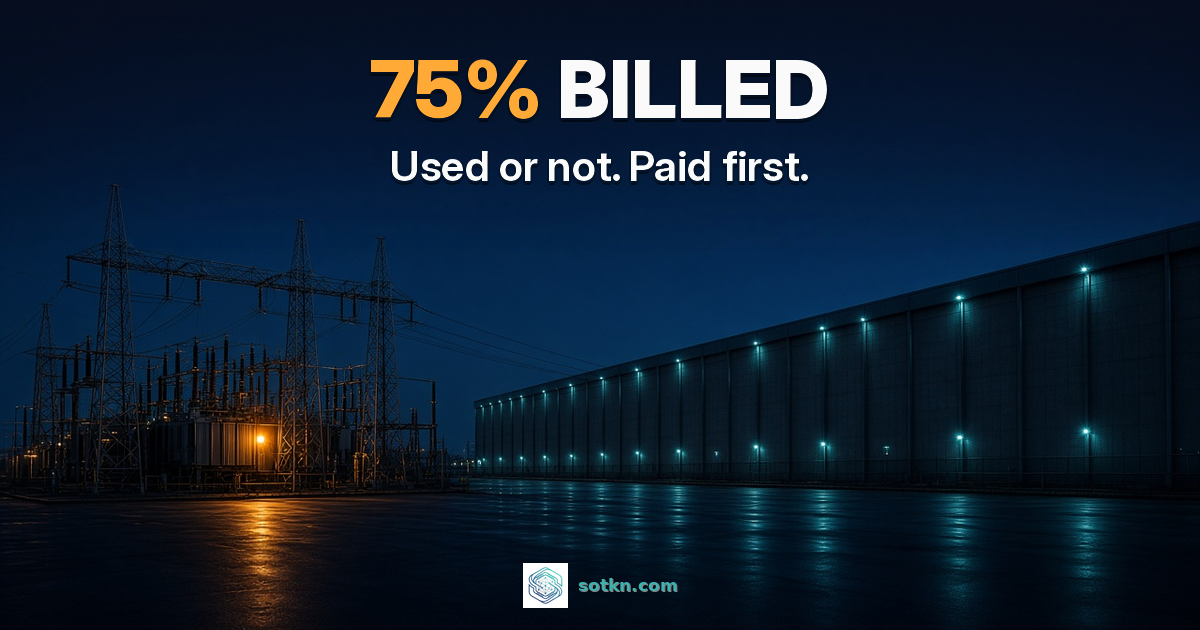
Duke Energy's North Carolina settlement (filed 6 Oct): new data centers of 50 MW or more fund their own substation upfront and pay 75% of demand charges, used or not. Amazon, Google, Meta and Microsoft signed. The commission rules by mid-November.
WIRE · HYPERSCALERS · US · Data as at 9 Oct 2026
Amazon, Google, Meta and Microsoft have signed up to pay for North Carolina's grid before they use it. Under a settlement Duke Energy filed on 6 October 2026, any new data center of 50 MW or more would pay upfront for its own substation, post a letter of credit for shared transmission, and pay at least 75% of its contracted power demand charges every month, used or not. On the hyperscalers layer, this is the power step, and the bill now lands on the cloud buyer before the first hall switches on. Regulators still have to say yes.
What happened
Duke Energy Carolinas and Duke Energy Progress filed the deal with the North Carolina Utilities Commission on 6 October, and Duke announced it on 7 October. The other parties are the state's Public Staff, which represents utility customers, an industrial users' group, the US Department of Defense, and the four cloud companies (Duke Energy release, 7 Oct 2026).
The terms as filed:
Who it covers
New loads of 50 MW or more running at an 80% load factor, or any load of 150 MW or more
Only service agreements signed on or after 1 June 2026. Duke's old threshold was 100 MW
Paid upfront
The full estimated cost of the customer's own substation and lines, within 60 days, nonrefundable
Plus a letter of credit for the full cost of shared transmission upgrades
Minimum bill
Demand charges on at least 75% of contracted demand, every month
Contracts run at least 15 years for 100 MW or more
Walking away
48 months' notice for 500 MW or more, then damages, backed by cash, a letter of credit or a parent guarantee
24 months below 250 MW; 36 months from 250 to 499 MW
Power can be cut
During the ramp plus one year, Duke may cut up to 95% of the load for up to 50 hours a year, unpaid
Or 50% for up to 100 hours. No more than six hours a day
Next step
Commission decision expected by mid-November 2026
Duke Energy release, 7 Oct 2026. Tariff text says effective for service from 1 January 2027
So the order is now written down. The cloud company pays and posts security first. The utility builds. Power flows last, and even then it can be cut in the early years.
Why cash cares
A data hall needs three things signed: power, money and a renter. For a hyperscaler, the renter is usually itself and the money is its own balance sheet. Power is the step it cannot buy outright. This deal is the price of that step, in writing.
It moves risk off the utility. Before, Duke built substations and lines and hoped the load showed up. Now the data center owner funds its own substation within 60 days, posts a letter of credit for the shared lines, and owes a minimum bill for at least 15 years. That is the same pattern as TeraWulf's Kentucky deal this week, where the utility wanted protection before building (our Wire). The difference is that here the four biggest buyers signed it as a rule, not a one-off.
Here is what that costs, using the filing's own worked example for a 500 MW data center on Duke Energy Carolinas' high-load-factor rate of $22.28 per kW a month. The arithmetic is ours, and it matches the filing.
- Minimum bill. 75% of 500 MW is 375 MW. At $22.28 per kW a month, that is about $100 million a year in demand charges, whether the halls are full or empty. On Duke Energy Progress' $29.55 rate it would be about $133 million.
- Security. In Duke's example, the damages it can secure peak at about $587 million in the fourth year of service. That is nearly six years of minimum bills, held as cash, a letter of credit or a parent guarantee.
- Before power. Four years before the hall is energised, the example already puts the damages at about $331 million.
For Amazon, Google, Meta or Microsoft, a parent guarantee is cheap. For a smaller landlord or a GPU cloud building in North Carolina, the same rule means hundreds of millions of dollars of letters of credit before any rent comes in. The stuck step is the commission's order. Until it lands, nobody knows if these terms hold, tighten or loosen.
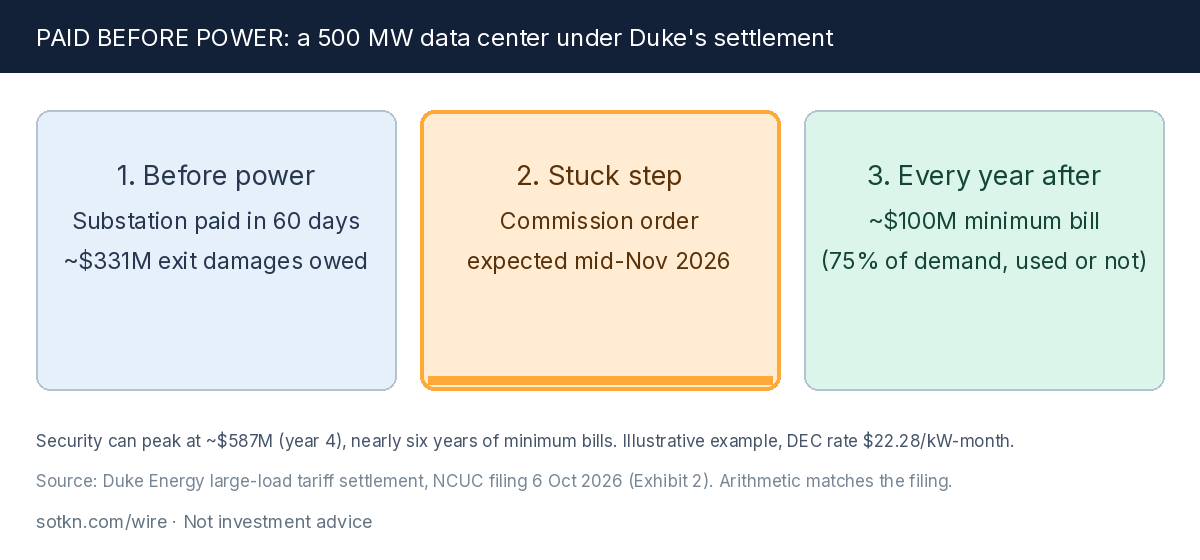
Figure: Paid before power. In Duke's 500 MW example, the customer funds its substation, posts security and owes about $100 million a year of minimum bills. Amber marks the stuck step: the commission's order, expected by mid-November.
The second-order read
Who gets paid. Duke Energy, which gets its substation money upfront and a long minimum bill to earn on. Banks that write the letters of credit.
Who pays. The data center owner: the four hyperscalers here, and any landlord or GPU cloud that signs after 1 June 2026.
Who is protected. Duke's other customers, who no longer carry the cost if a data center never shows up or leaves early.
Stuck step. The North Carolina Utilities Commission. No order, no tariff.
Two cautions
The worked example in the filing is illustrative. It is not a real customer, and real costs depend on each site's substation and lines.
The exit is softer than the minimum bill. After the notice period, a leaving customer owes only 25% of the remaining minimum bills, plus the value of remaining facility charges. Contracts signed before 1 June 2026 are not covered.
What to watch
- The commission's order, expected by mid-November 2026: approved as filed, or tightened.
- The first service agreement signed under these terms, with megawatts and a security figure.
- Copycats. Other utilities with big data center queues adopting the same 75% minimum bill. Texas is already setting its own rules (our Markets note).
Read: Hyperscalers, AI Data Centers, and TeraWulf doubles Kentucky data center power to 1 GW
Get the Wire. A free brief every day, here and in your inbox. Subscribe free →
Sources: Agreement and Stipulation of Settlement on Large Load Tariff, NCUC Docket Nos. E-7 Sub 1329 and E-2 Sub 1380, filed 6 Oct 2026: applicability (50 MW at 80% load factor or 150 MW, agreements on or after 1 June 2026), advance funding of dedicated facilities within 60 days, letter of credit for network upgrades, minimum contract terms, 75% minimum billing demand, 24/36/48-month notice periods, liquidated damages (25% of remaining minimum bills after notice), security in cash, letter of credit or parent guarantee, interruptibility options, and Exhibit 2 illustrative 500 MW example (about $100.26M a year minimum bills, $587.4M peak damages basis for security, HLF-T rates $22.28 DEC and $29.55 DEP); Duke Energy release, 7 Oct 2026: parties including Amazon, Google, Meta and Microsoft, prior 100 MW threshold, decision expected by mid-November; NC Business Desk, 8 Oct 2026. The $133 million and "nearly six years" figures are our arithmetic. Not investment advice. Do your own research.