Indiana approves AES plan to power Google's 390 MW Monrovia data center
Indiana's IURC unanimously approved AES Indiana's plan to power Google's 390 MW Monrovia data center — the first under the state's 2025 80% large-load law. Google pays $32.3M for direct connection; $73.8M of network upgrades enter AES's rate base.

WIRE · HYPERSCALERS · INDIANA · Data as at 12 Oct 2026
Indiana's utility commission has cleared the power path for Google's next Midwest campus. On 7 October 2026 the Indiana Utility Regulatory Commission unanimously approved AES Indiana's plan to build the solar, battery storage and electric lines that will serve a 390 MW Google data center in Monrovia, Morgan County. WFYI reported the order on 12 October. It is the first data center filed under Indiana's 2025 large-load law that requires big users to cover 80% of costs reasonably assigned to them.
What happened
22 April 2026
AES Indiana files the Google Monrovia customer-specific contract
First data-center case under Indiana's 2025 large-load law (HEA 1007)
7 October 2026
IURC unanimously approves the 390 MW Monrovia power plan
AES: $1.3 billion infrastructure; $737.3 million for two battery systems plus solar
Cost split
Google pays $32.3M direct connection; $73.8M network upgrades enter AES's rate base
Citizens Action Coalition objected; the commission said the upgrades can benefit all customers
Term
At least 15 years; AES models about $770M of customer savings
AES and Google say Google covers electricity and new infrastructure required to serve the campus
Why cash cares
The bind is who pays for the wires. Indiana's 2025 law sets an 80% floor. AES and Google say Monrovia clears 100% of Google's energy and new infrastructure; Commissioner Joby Jerrells said the deal "exceeds [the requirement] substantially." The contested line is $73.8 million of network upgrades in AES's transmission rate base versus $32.3 million Google pays for direct connection. Same cost-allocation fight as Duke's 75% minimum-bill tariff — different state, same grid step before the hall.
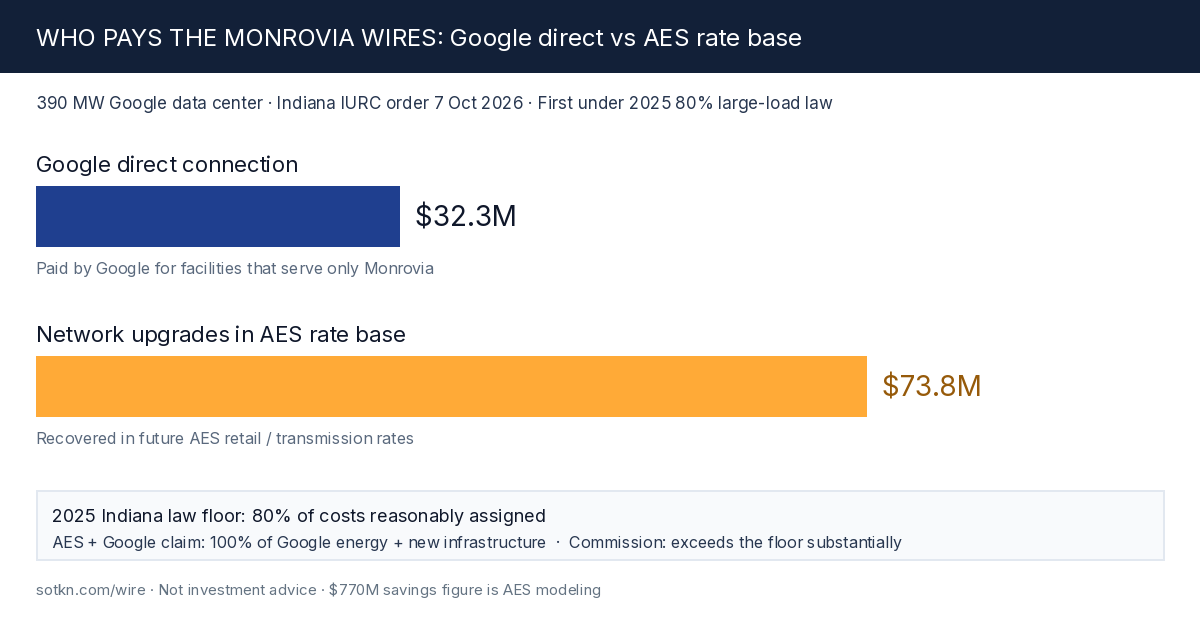
Figure: Who pays the Monrovia wires. Google's direct connection versus network upgrades recovered in AES rates, against the 80% floor.
The second-order read
Who gets paid. AES Indiana on a 15-year-plus contract, then the builders of solar, batteries and lines. Google's Americas data-centers head Will Conkling says Google pays for electricity and required new infrastructure.
Who waits. AES retail customers, until the modeled $770 million shows up in rates — and until a reopened AES rate case that now folds in Monrovia runs into 2027.
Who carries the risk. AES on the rate-base upgrades if load underperforms; Google on exit and minimum-demand terms AES says keep stranded costs off residential bills.
Stuck step. Cost allocation on shared network upgrades. The hall is approved; the open cash question is how much of the transmission step stays in the rate base.
Two cautions
The $770 million figure is AES modeling, not a commission forecast. Dollar amounts and timelines inside the service agreements remain partly redacted. Monrovia is also an input to the reopened AES rate case, not the end of it.
What would change the view
- A later order shifting more of the $73.8 million onto Google.
- Google scaling back Monrovia load so exit protections are tested.
- The reopened AES rate case assigning Monrovia costs differently in 2027.
What to watch
- In-service dates for solar, batteries and lines once published without redaction.
- Other Indiana large-load filings under the same 80% bar.
- How the $73.8 million appears in AES retail schedules after the reopened case.
Read: Hyperscalers, AI Data Centers, Duke's 75% minimum-bill tariff, and BKV's 1,200 MW turbine order
Get the Wire. A free brief every day, here and in your inbox. Subscribe free →
Not investment advice. Do your own research. The $770 million savings figure is AES modeling; the $32.3 million / $73.8 million split is from AES testimony in the commission record.
References
- WFYI / Zak Cassel, "Indiana approves AES plan to power Google data center in Monrovia", 12 Oct 2026. Unanimous IURC approval 7 Oct; 390 MW; $1.3B infrastructure; $737.3M energy kit; $32.3M / $73.8M split; 80% law; 15-year term; ~$770M modeled savings.
- Indianapolis Business Journal, "IURC approves AES plan to power Google data center in Morgan County", 7 Oct 2026. Same-day commission coverage.
- Inside INdiana Business / IBJ, "IURC approves AES plan to power Google data center in Morgan County", 7 Oct 2026. Syndicate of the IBJ report.
- AES Indiana, Data centers. Google pays 100% of energy and new infrastructure; ~$770M modeled savings; $1.3B infrastructure; minimum 15-year CSC; IURC order 7 Oct 2026; HEA 1007.
- Second Order by TKN, "Duke's 75% minimum-bill data-center tariff". Prior Wire on large-load cost allocation.
- Second Order by TKN, "BKV's 1,200 MW hyperscaler-backed turbine order". Same-day power-path contrast.