
200 MW and a Licence: Who Gets Paid While Singapore Rations Data Centre Power
Singapore passed its Digital Infrastructure Bill on 7 Oct 2026. Every data centre of 3 MW or more now needs a licence, and only 200 MW of new halls were handed out in August. Owners of full halls get paid first. Power and the licence set the pace.
Singapore passed its Digital Infrastructure Bill on 7 Oct 2026. From here, every data centre that uses 3 MW or more needs a licence, and the promises firms made to win scarce power can be written into that licence. Only 200 MW of new halls were handed out in August. The money moves to owners of halls that are already full. Power, and now the licence, sets the pace.
SINGAPORE PULSE · Data as at 9 Oct 2026 · Next update: after the Digital Core REIT vote on 22 Oct 2026
Affects: AI Data Centers · Hyperscalers · Neoclouds — Markets: Singapore · Malaysia · Australia · US · China
Education only, not advice to buy or sell any security. Company and government figures are as reported. Deal terms still need a unitholder vote. Our own sums are labelled.
The numbers that matter this week
Data centre power in Singapore
1.6 GW+
About 70 sites · includes the August 200 MW
PrimaryNew halls allowed, Aug 2026
200 MW
4 firms × 50 MW · Jurong Island · more than 20 bids
PrimaryLicence line in the new law
3 MW
DC licence from 3 MW · stricter licence from 10 MW
PrimaryDigital Core REIT Singapore buy
S$87.4M for 2.5%
11 Loyang Close · 94% leased · vote 22 Oct
PrimaryWhole hall at that price (our math)
~S$3.5B
S$87.4M ÷ 2.5% · not a valuation
Our mathPower + licence
Still the bind
Half green power · PUE 1.25 · rules not yet written
Stuck stepSources: EDB/IMDA, 21 Aug 2026; Business Times, 7 Oct 2026; Digital Core REIT, 12 Aug 2026 and EGM notice, 7 Oct 2026. Status chips are Second Order’s read.
On this page: Why Singapore? · What the law does · The 200 MW round · Our math · Who gets paid · Is power stuck? · Dates next · What would change this · FAQ
Why does Singapore’s data centre law matter now?
Because Singapore is the clearest case of a country that has decided it cannot say yes to every data centre. It has little land, it imports most of its fuel, and it has said so out loud. When a market rations power on purpose, the halls already running become the scarce thing — and the owners of those halls are the first to get paid.
This is our first Pulse from the Singapore door. If you are new to the layer, start with the AI Data Centers stack: who owns the powered halls, who rents the computers inside them, and which step slows the money down. The question here is not “does Asia want more AI halls?” It plainly does. The question is who gets paid when one of Asia’s busiest hubs keeps the tap nearly shut.
Senior Minister of State Tan Kiat How put the policy in one line during the debate: “We are not seeking to attract every megawatt of data centre capacity we can.” He added that scarce capacity “should not simply be allocated; it should be put to productive use and deliver the value that was promised.” That second sentence is the new part. Promises now have teeth.
1 · Cloud and AI buyers want space
Who: Hyperscalers, neoclouds, banks
Paid: Demand for powered halls in Singapore is not the problem
2 · Owners of full halls get paid
Who: Landlords and DC REITs
Paid: Little new space allowed; a 94%-leased hall changes hands at a full price
3 · New halls wait on power and a licence
Who: Jurong Island 50 MW builds
Paid: Green power, PUE 1.25, licence terms the regulator can still tighten
What does the new law actually do?
The Digital Infrastructure Bill passed Parliament on 7 Oct 2026 after a five-hour debate across 6 and 7 Oct, with support from all MPs, the Business Times reported. It creates two licences.
- A data centre licence for any site that uses at least 3 MW to run its computing gear — servers, storage and network kit. Holders must meet efficiency (PUE) targets that have not been set yet.
- A stricter foundational digital infrastructure licence for sites that need 10 MW or more, and for cloud firms with at least S$100 million a year of Singapore revenue over three years. Holders need security plans, back-up plans and must report outages to IMDA.
About two-thirds of Singapore’s roughly 70 data centres cross one of those lines. Fines for failing the security and back-up rules can reach S$1 million or 10% of Singapore turnover, whichever is higher. The detailed rules will come later in subsidiary regulations and codes of practice.
PUE is power usage effectiveness: total power into the building divided by power that reaches the computers. A perfect score is 1. Singapore asked for 1.3 in the 2023 round and 1.25 in the August 2026 round. The minister said older halls will find the new targets harder and some will need time to adjust. He also said water use and equipment-level efficiency may be measured in future.
Digital Infrastructure Bill (passed 7 Oct 2026)
Where Singapore stands
Business Times, 7 Oct 2026 (Parliament debate report).
What did the 200 MW round hand out?
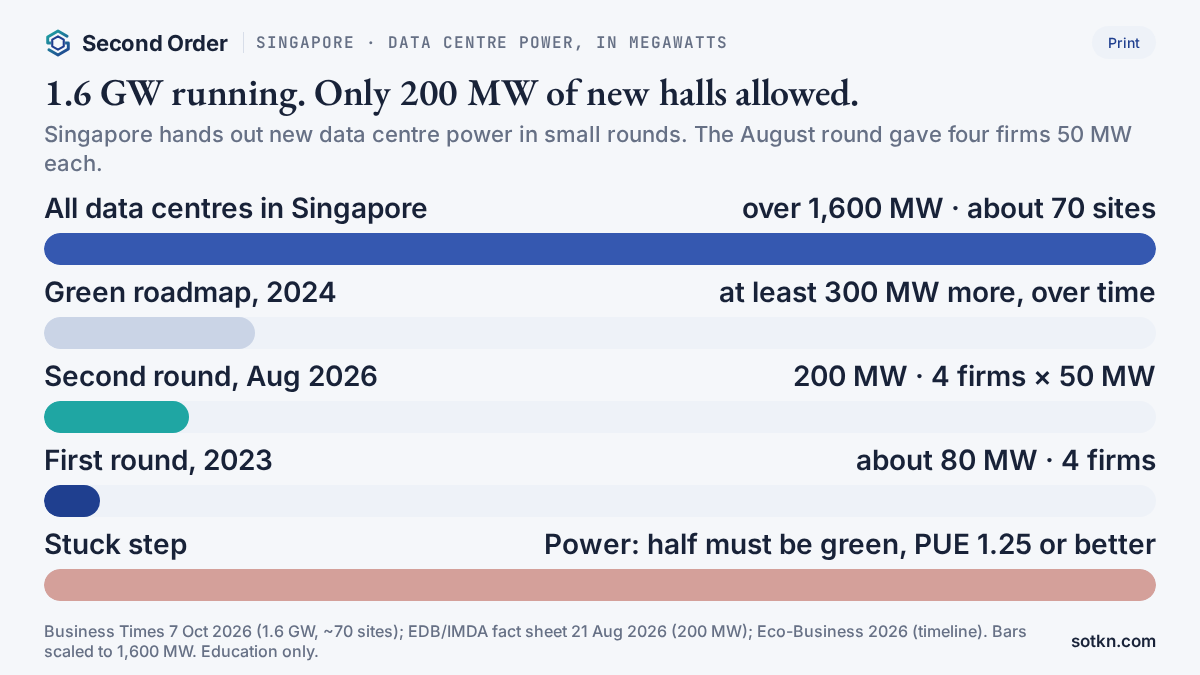
On 21 Aug 2026 the Economic Development Board and IMDA picked four winners from more than 20 bids in the second Data Centre Call for Application. Each got a provisional 50 MW on Jurong Island: Digital Realty, Equinix, Keppel Data Centres and ST Telemedia Global Data Centres. That is 200 MW in total.
The terms were tight. Winners had to bring advanced computing such as AI, spend beyond the building itself, power at least half of each hall from green sources such as biomethane, low-carbon ammonia or hydrogen, and use liquid cooling with highly efficient equipment. EDB and IMDA said they will review the need for another round in 18 to 24 months.
Keppel has put a size on its share. Its new hall, Keppel Data Centre Singapore 11, is an AI-ready build on Jurong Island with expected investment of more than S$1 billion, funded by Keppel Data Centre Fund III and co-investors. Keppel said the award is not expected to have a material effect on its earnings per share this year. That is the honest clock: the money is committed now, the cash comes when the hall is built and leased.
Put the round in proportion. 200 MW is about one-eighth of what Singapore already runs, and it took a competitive tender to get it. The 2023 round was about 80 MW. The 2024 green roadmap pointed to at least 300 MW more over time. Small rounds, long gaps, hard terms. That is what rationing looks like.
EDB/IMDA fact sheet, 21 Aug 2026; Keppel release, 21 Aug 2026; Eco-Business timeline.
Our math: what is a full Singapore hall worth?
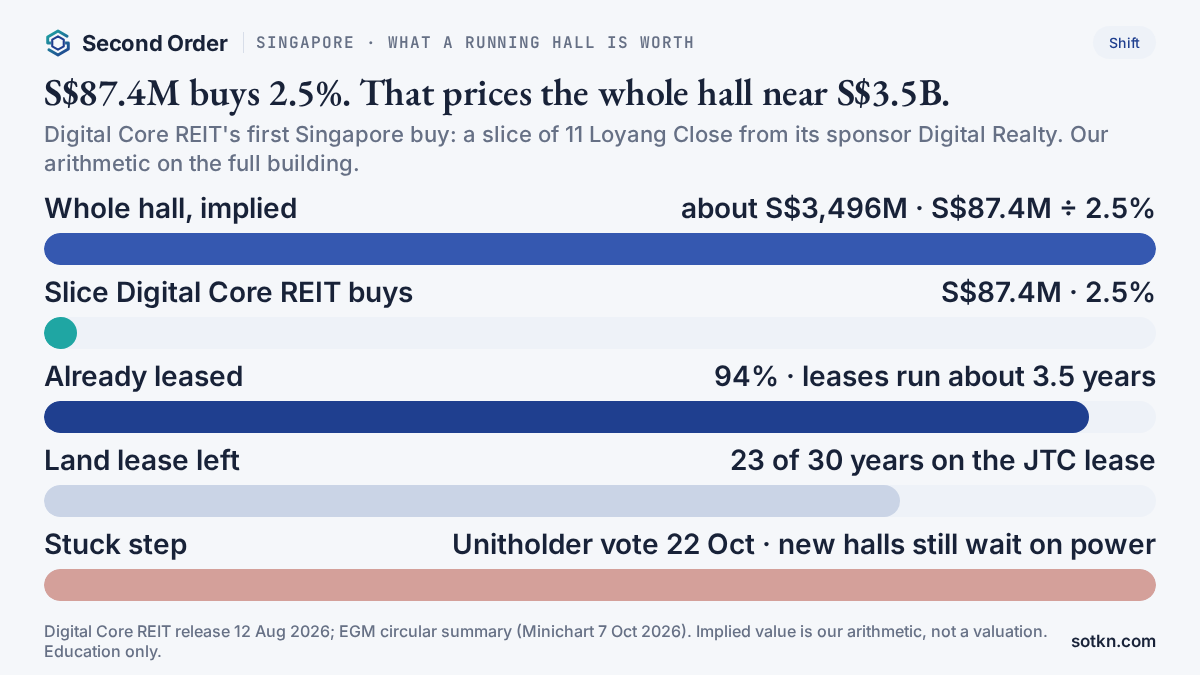
Digital Core REIT is Singapore-listed and sponsored by Digital Realty. On 12 Aug 2026 it agreed to sell interests in three North American halls and use part of the money to buy into Singapore for the first time: 2.5% of 11 Loyang Close, bought from Digital Realty for S$87.4 million. It called the unitholder meeting for 22 Oct in a notice summarised on 7 Oct.
- S$87.4 million for 2.5% works out to about S$3.5 billion for the whole hall at the same price (our arithmetic: 87.4 ÷ 0.025 ≈ 3,496). That is a price check, not a valuation, and final prices adjust at closing.
- The hall is 94% leased, with leases that run about 3.5 years on average. The circular summary says lease prices have room to rise as old leases roll to today’s market.
- It sits on a 30-year JTC land lease with 23 years left. Renewal is not guaranteed and needs a land premium.
- On the whole deal, the manager says distribution per unit rises 2.9% to 4.1% and leverage falls from 39.2% to 35.2%, or 36.3% with up to US$20 million of buybacks.
What this tells you: a REIT is giving up North American halls to own a small slice of a full Singapore one. Asia rises from 11% to 22% of its assets. In a market where new halls come 50 MW at a time, a hall that is already built, powered and leased is the thing people pay up for.
What it does not tell you: that every Singapore hall is worth the same per square metre, that lease prices will rise on schedule, or that the vote will pass. Net asset value per unit also dips 1.3%, from 79 to 78 US cents, mostly on deal costs. For how to read money spent before it earns, see cash capex, explained.
Who gets paid first?
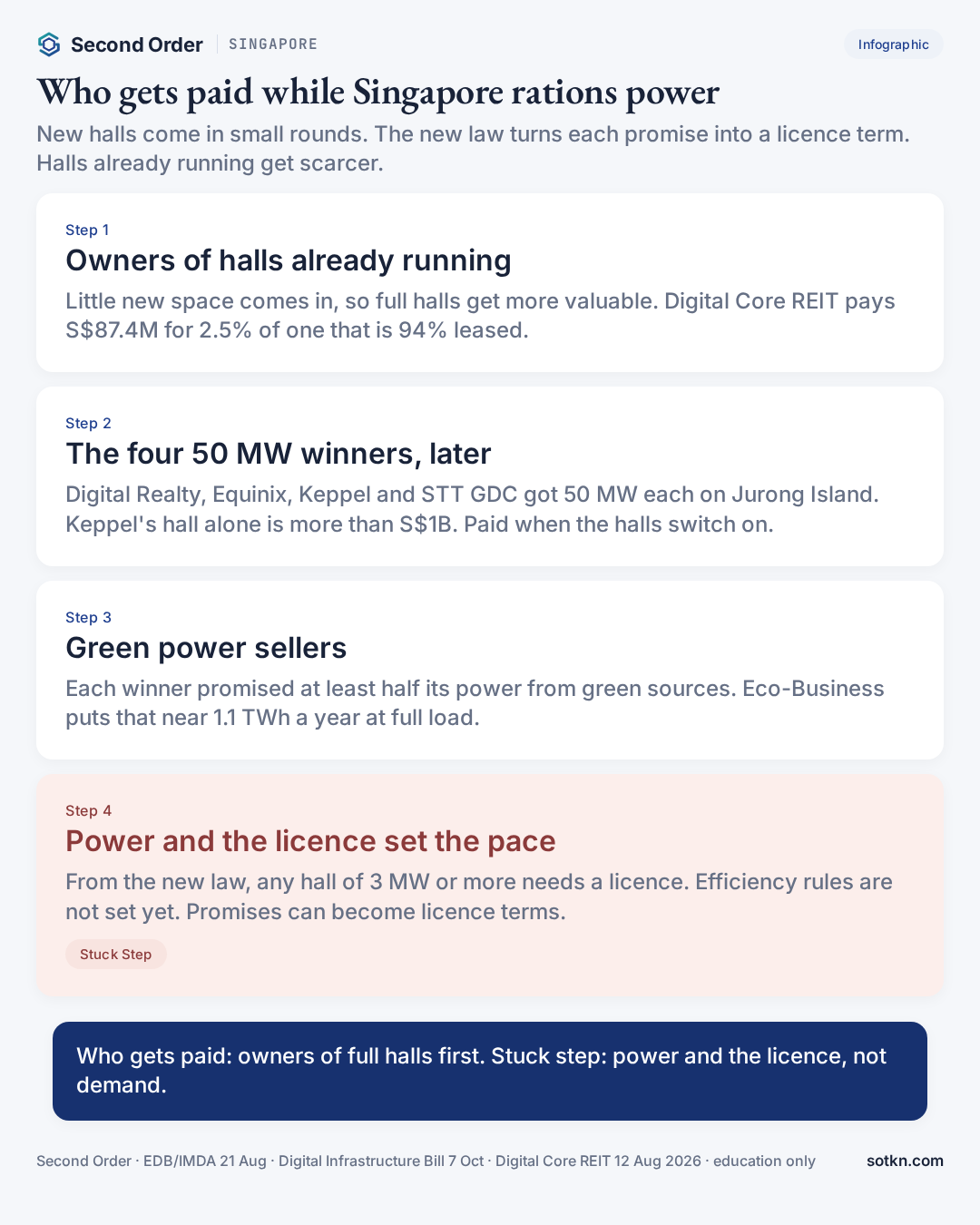
Follow one cloud customer who wants more room in Singapore. The money moves in a short line, and each stop runs on its own clock.
First, owners of halls that are already running. When the government lets in only a little new space, the customer either renews where it is or pays more to move. Landlords with full, powered halls collect first. The Digital Core REIT price is the cleanest public marker of that this month.
Second, the four 50 MW winners — but later. Digital Realty, Equinix, Keppel and ST Telemedia have the right to build, not the cash. They get paid when halls are built, licensed, switched on and leased. That is the same pattern we mapped in Texas on the $50,000-a-megawatt Pulse: the place in line is not the power.
Third, sellers of green power and efficient kit. Each winner promised at least half its power from green sources. Eco-Business estimates that adds up to about 1.1 TWh of clean power a year if the four halls ran at full load — treat that as its estimate. Much of that fuel, such as ammonia or hydrogen, has to be shipped in. Liquid-cooling and power-equipment suppliers get paid on the build.
Fourth, the cloud firms themselves now carry new costs. Business Times named Amazon Web Services, Microsoft Azure and Google Cloud Platform as operators of this scale in Singapore. See hyperscaler, explained and neocloud, explained for who rents what inside these halls.
One-line rule: who gets paid first is the owner of a full, powered hall; the stuck step is power and the licence, not demand.
Is power still the stuck step?
Yes. The law did not add a single megawatt. It added a rulebook for the megawatts Singapore already allows, and a way to hold firms to the promises they made to win new ones.
What binds a new Singapore hall
What it does not bind
So-what: Singapore’s stuck step is not money and not customers. It is power, set by the state, and a licence that can be tightened over time. That keeps new supply slow — which is good for owners of full halls and slow for everyone waiting to build.
The overflow goes next door. Johor, across the causeway, is where much of the space Singapore turns away gets built — with its own power and water questions. We will cover that from the Malaysia door when there is a dated story with a number on it.
Which dates test this read next?
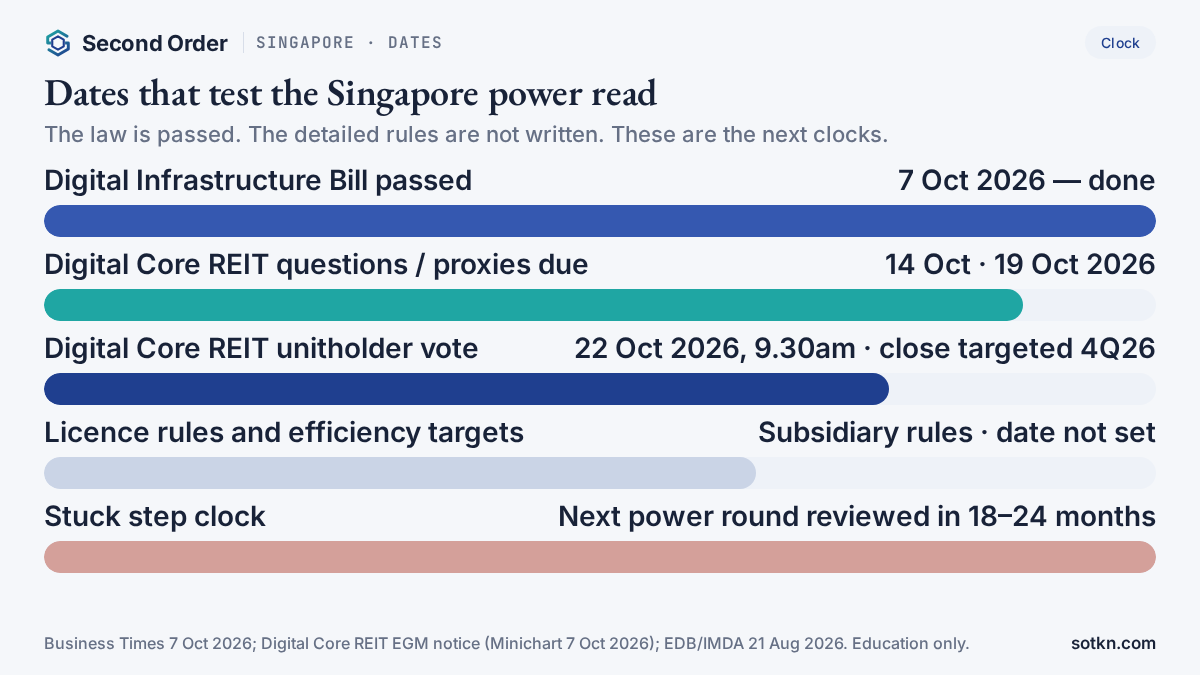
- 7 Oct 2026 — Digital Infrastructure Bill passed. Done.
- 14 Oct 2026, 9.30am — deadline for Digital Core REIT unitholder questions.
- 19 Oct 2026, 9.30am — deadline for Digital Core REIT proxy forms.
- 22 Oct 2026, 9.30am — Digital Core REIT vote. Digital Realty and its associates abstain. Completion targeted for the fourth quarter of 2026.
- Date not set — subsidiary regulations, codes of practice and the PUE targets under the new law.
- About Feb–Aug 2028 (our reading of “18 to 24 months” from August 2026) — EDB and IMDA review whether to run another power round.
The licence clock matters most. If the PUE target for existing halls lands hard and fast, some older space could need upgrades or leave the market, making full modern halls scarcer still.
How this fits the other Markets doors
- US: Texas now charges $50,000 a megawatt to join the line, but switch-on approvals are paused. Different gate, same lesson.
- US: data-hall building hit a record $85B a year. That is a market that builds first and asks for power later.
- China: Alibaba asked for 20 GW by 2032. Power is planned at state scale; chips are the bind.
- Singapore: power is rationed on purpose and now licensed. The bind is policy, written down.
Same layer. Different stuck step. See the US construction Pulse, Alibaba’s 20 GW Pulse and this morning’s SMIC margin Pulse for the other clocks.
What would change this view?
- Singapore runs a bigger or earlier power round than 18–24 months — scarcity softens.
- New green power, such as a Jurong Island ammonia or hydrogen plant, gets a firm build decision — the power step loosens.
- PUE targets for existing halls land easy and late — older space stays in the market longer.
- Digital Core REIT unitholders vote the deal down on 22 Oct — the clean price marker goes away.
- Lease prices on renewals fall instead of rise — the full-hall premium is weaker than the price implies.
- Cloud firms shift big new builds to Johor or elsewhere and let Singapore space go — demand, not power, becomes the bind.
The view stays intact while Singapore keeps new power to small rounds, the licence keeps promises binding, and full powered halls keep trading at full prices.
Practical takeaways
- Singapore passed the Digital Infrastructure Bill on 7 Oct 2026: a licence for every data centre of 3 MW or more
- Only 200 MW of new halls were handed out in August — 50 MW each to Digital Realty, Equinix, Keppel and ST Telemedia
- Digital Core REIT pays S$87.4M for 2.5% of a 94%-leased hall; about S$3.5B for the whole at that price (our arithmetic)
- Who gets paid first: owners of full, powered halls; new builds get paid later
- Stuck step: power and the licence, not demand
FAQ
What does Singapore’s Digital Infrastructure Bill do?
Passed in Parliament on 7 Oct 2026, it brings in two licences. Any data centre using at least 3 MW for its computing gear needs a data centre licence and must meet efficiency (PUE) targets that are not yet set. Sites of 10 MW or more, and cloud firms with at least S$100 million a year of Singapore revenue, need a stricter foundational digital infrastructure licence. About two-thirds of Singapore’s roughly 70 data centres cross those lines, the Business Times reported.
How much new data centre power did Singapore hand out?
200 MW in the second call for applications, announced by EDB and IMDA on 21 Aug 2026. Digital Realty, Equinix, Keppel Data Centres and ST Telemedia Global Data Centres got 50 MW each on Jurong Island. Singapore has over 1.6 GW across about 70 data centres, and that figure already includes the 200 MW.
Who gets paid first?
Owners of halls that are already built, powered and leased. When little new space is allowed, a full hall gets more valuable. Digital Core REIT is paying S$87.4 million for 2.5% of 11 Loyang Close, a hall that is 94% leased. The four 50 MW winners get paid later, when their new halls switch on.
What is the stuck step?
Power, and now the licence that comes with it. New halls need scarce grid power, at least half of it from green sources for the August winners, and an efficiency score of 1.25 or better. The new law lets IMDA turn the promises firms made to win power into licence terms.
What is the Digital Core REIT vote about?
On 22 Oct 2026 unitholders vote on one deal: sell US$315.9 million of North American interests, buy more of an Osaka hall and 2.5% of the Singapore hall. The manager says distribution per unit rises 2.9% to 4.1% and leverage falls from 39.2% to 35.2% (36.3% with buybacks). Digital Realty, the sponsor, cannot vote.
Is this investment advice?
No. Education only. It maps who gets paid and which step is stuck. It is not a recommendation to buy or sell any security.
Keep reading on the map
- Singapore Markets hub — country page
- AI Data Centers stack — layer map
- Texas large-load rule Pulse (8 Oct) — the US power gate
- US data-hall construction Pulse (6 Oct) — the build side
- Alibaba 20 GW Pulse (7 Oct) — the China power ask
- All Markets doors — Taiwan, Korea, US, China, Singapore, Australia, Malaysia
- Hyperscaler, explained · Neocloud, explained
How we check this. Capacity and licence figures come from the EDB/IMDA fact sheet and Business Times’ report on the Parliament debate. Deal figures come from Digital Core REIT’s own release and a summary of its EGM circular. Anything we worked out ourselves is labelled “our arithmetic”. We do not invent lease prices, dates or valuations. Our editorial standards →
Not investment advice. Do your own research.
Sources
- Business Times (7 Oct 2026) — Digital Infrastructure Bill passed; licences, 1.6 GW, PUE — businesstimes.com.sg
- EDB / IMDA fact sheet (21 Aug 2026) — DC-CFA2: 200 MW to four operators — edb.gov.sg
- Keppel (21 Aug 2026) — 50 MW award; Keppel DC SGP 11 on Jurong Island — keppel.com
- Digital Core REIT (12 Aug 2026) — Singapore entry, Osaka stake, North America sales — digitalcorereit.com
- Minichart (7 Oct 2026) — summary of Digital Core REIT EGM circular — minichart.com.sg
- Eco-Business (Oct 2026) — binding rules and clean power demand — eco-business.com