20 GW by 2032: Who Gets Paid While Alibaba Waits on Chips
Alibaba says it will run more than 20 GW of data centers by 2032, and that global shortages limit how fast it can build. Its June-quarter capex hit RMB67.7 billion, up 75%, partly on higher chip-part prices. Chip and parts sellers get paid first. Chips set the pace.
Alibaba wants a lot more data centers. On 22 Sep 2026 its CEO set a target: more than 20 GW run by Alibaba Cloud by 2032. In the same speech he said global shortages limit how fast it can build. Who gets paid first is plain: the people selling chips and parts. The stuck step, on our read, is the chips themselves.
CHINA PULSE · Data as at 7 Oct 2026 · Next update: after Alibaba’s September-quarter results (date not yet set)
Affects: Hyperscalers · Semiconductors · Neoclouds — Markets: China · US · Taiwan · Korea
Education only, not advice to buy or sell any security. Company figures are as reported. Targets and chip dates are company plans, not facts yet. Press-report and broker figures are labelled as such.
The numbers that matter this month
Alibaba Cloud capacity target
20 GW+
By 2032 · CEO speech, 22 Sep 2026 · a target, not built
PrimaryCapex, quarter to 30 June 2026
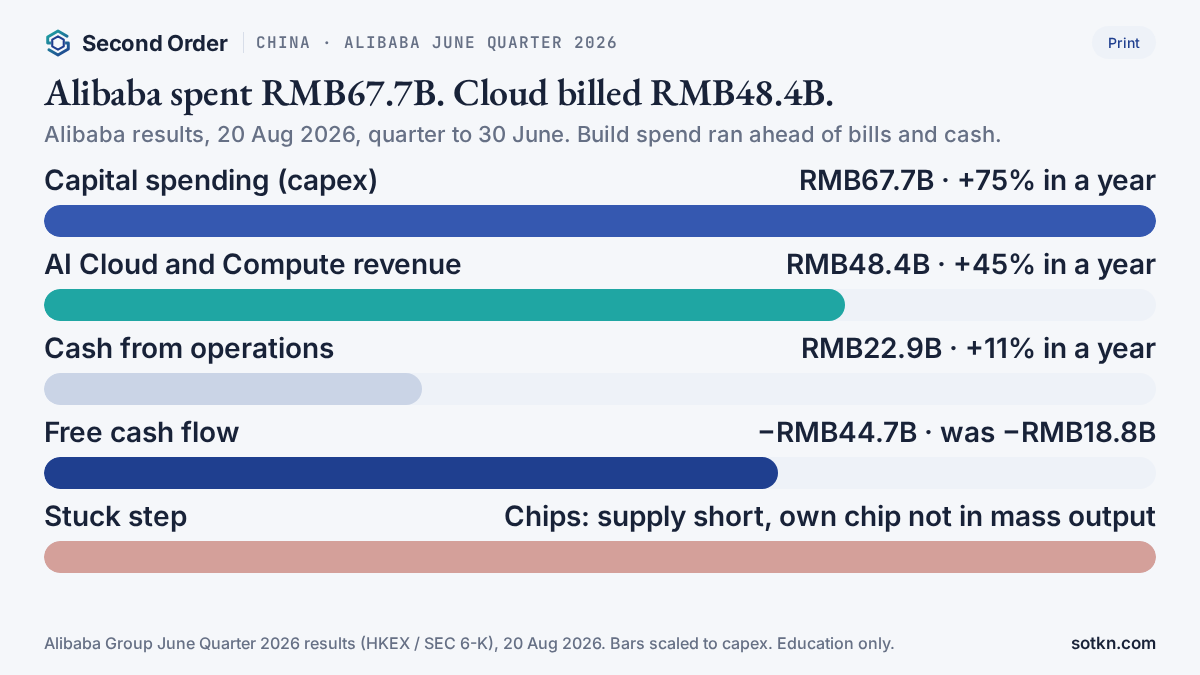
RMB67.7B
US$10.0B · +75% on a year ago
PrimaryAI Cloud and Compute revenue
RMB48.4B
+45% on a year ago · the bills coming in
PrimaryFree cash flow, same quarter
−RMB44.7B
Was −RMB18.8B a year ago
PrimaryChips for the build
Still the bind
“Global shortages” limit the pace · V900 mass production Q1 2027
Stuck stepOwn chips in Alibaba Cloud
Under 10% → 40–50%
Share target over time, per a BofA note (GMT Eight)
ReportedTencent rents abroad
~100,000 chips
Five-year Oracle lease, ~$7B (FT via Reuters, unverified)
ReportedSources: Alibaba Group results, 20 Aug 2026; Alibaba CEO speech and Alibaba Cloud release, 22 Sep 2026; GMT Eight on BofA, Sep 2026; Reuters, 30 Sep 2026. Status chips are Second Order’s read.
On this page: Why China? · What changed · Our math · Where money sticks · Are chips still stuck? · Dates next · How this differs · What would change this · FAQ
Why does Alibaba matter for China now?
Because Alibaba is China’s biggest cloud. Its results cite Omdia: a 38.1% share of China’s AI cloud market in 2025. When the biggest buyer says how much it wants to build, and what is slowing it down, that tells you where the money goes.
It also matters because of chips. US export rules limit which advanced chips Chinese firms can buy. So Alibaba is doing two things at once. It buys chips from others, and it designs its own through its T-Head unit.
This sits on the same map as Hyperscalers, explained, the Hyperscalers stack and the China Markets hub. The question is not “does Alibaba want more data centers?” It plainly does. The question is who gets paid while it builds, and what stops the halls filling up.
1 · Alibaba spends (results 20 Aug)
Who: Chip, memory and parts sellers; builders
Paid: RMB67.7B capex in one quarter; +75% in a year
2 · Chips set the pace
Who: Supply of AI chips and parts
Paid: CEO: global shortages limit the speed · own V900 chip due Q1 2027
3 · Alibaba Cloud earns later
Who: Customers using the capacity
Paid: RMB48.4B AI cloud revenue, +45% · free cash flow −RMB44.7B
What changed in September?
Three things changed. The size of the plan, the chip and the words about supply.
The plan. Wu set a number: more than 20 GW of data center capacity run by Alibaba Cloud by 2032. That is about six years away. It is a target. It is not what Alibaba runs today, and Alibaba did not give today’s figure in the speech.
The chip. T-Head launched the Zhenwu V900. Alibaba says it has three times the performance of the Zhenwu M890, which came out in May. It has 216 GB of memory. It is due for mass production and commercial release in Q1 2027. Zhenwu chips already serve more than 650 customers, Alibaba says.
The words about supply. This is the part that matters most for cash. Wu said: “The industry’s mid-to-long-term demand far outpaces our supply capabilities. Global shortages across the AI data center supply chain are currently limiting the speed at which we can scale our compute infrastructure.” The shares rose 5% that day, Reuters reported.
That last quote is the story. In Wu’s words, the limit is not demand. Nor is it cash on hand: Alibaba had RMB474.5 billion of cash and liquid investments at the end of June. The limit he names is supply — how fast it can get the parts.
Alibaba, quarter to 30 June 2026 (results, 20 Aug)
What Alibaba said on 22 Sep (Apsara)
Alibaba Group June Quarter 2026 results (HKEX, 20 Aug 2026); Alibaba CEO speech and Alibaba Cloud release (22 Sep 2026); Reuters, 22 Sep 2026.
Our math: what does the build cost?
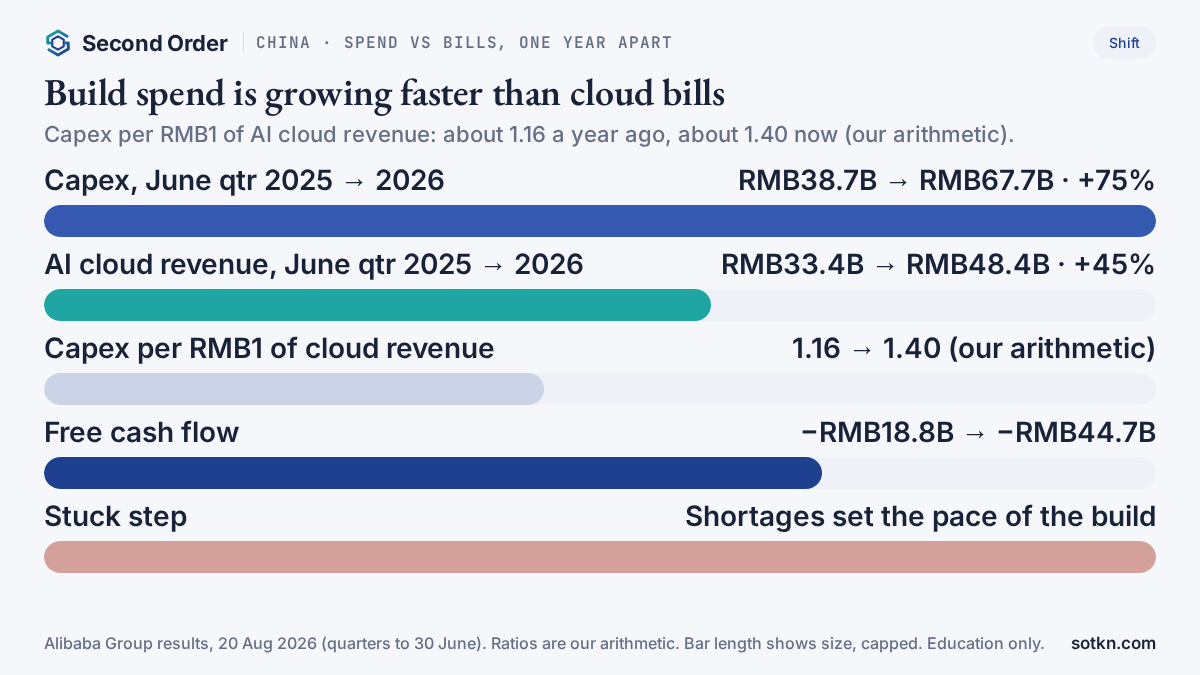
A fair question. Is Alibaba’s spending keeping pace with what it earns from the cloud? Not yet. Spending is growing faster. Here are the sums. This is our arithmetic where marked.
- Capex rose from RMB38.7B to RMB67.7B in a year. That is RMB29.0B more in one quarter (our arithmetic).
- AI cloud revenue rose from RMB33.4B to RMB48.4B. Up 45%, against 75% for capex.
- Capex per RMB1 of AI cloud revenue: about 1.16 a year ago, about 1.40 now (our arithmetic).
- Capex was about 2.9 times the cash that came in from operations, RMB22.9B (our arithmetic).
- US$10.0B of capex in a quarter is about US$40B a year if the pace held (our arithmetic). Not all of it is data centers.
Now set that against the target. BofA, in a note reported by GMT Eight, said 20 GW by 2032 implies adding about 2 GW a year on average. It put the building cost at roughly US$30–35 billion per GW. On those broker figures, 2 GW a year is about US$60–70 billion a year of building (our arithmetic). That is well above the June quarter’s US$40 billion yearly pace.
So who pays the gap? BofA expects much of the cost to be carried through leases and partners, not all on Alibaba’s own books. It kept its capex forecast for fiscal 2027–2028 at RMB230–250 billion. These are a broker’s estimates, not Alibaba’s.
One more cash point. On the 20 Aug results call, Wu said Alibaba had already spent half of its RMB380 billion AI investment plan. He said it expects to break even on AI-related capex within three years, based on current average gross margins (Reuters). Break even is a forecast, not a print. If the words capex and opex are new, see cash capex, explained and capex vs opex.
Where does the money stick?
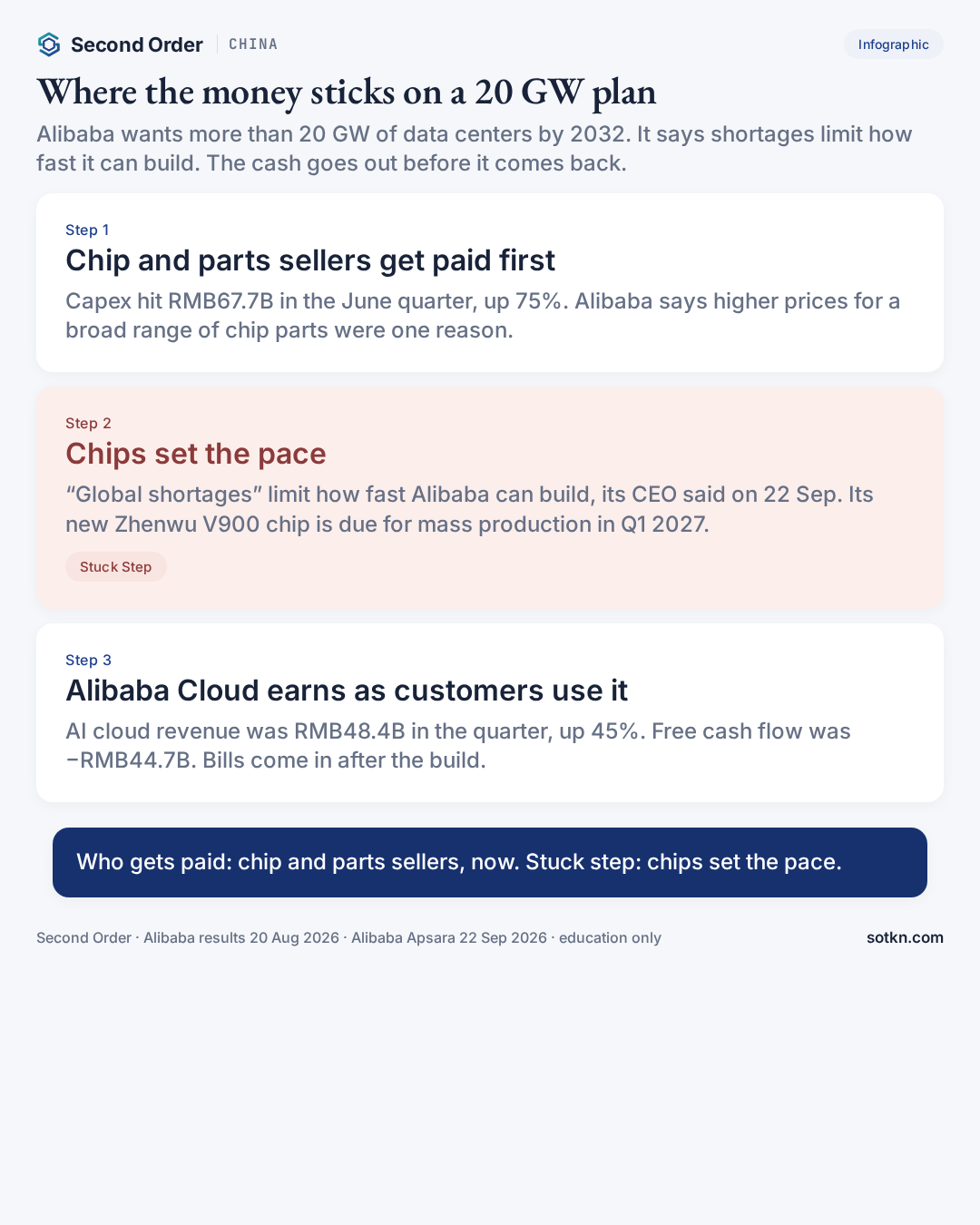
Follow the bill. Alibaba pays for chips, servers and halls as they arrive. Customers pay Alibaba only when they use the capacity.
First, the chip and parts sellers. Alibaba said capex jumped for three reasons: the timing of purchases, more CPU compute for AI agents, and “higher pricing of a broad range of chip components.” That last reason is cash straight to suppliers. Alibaba does not name the sellers.
This is not only Alibaba. On 10 Sep, Reuters reported that Huawei and Cambricon had sharply raised prices for their AI chips as high-bandwidth memory got scarce. The memory side is in the China HBM Access Pulse. On the factory side, SMIC was 93.7% full in its June quarter. The supply chain is busy at every step.
Second, the builders and landlords. A 20 GW plan needs halls, cooling and power. If BofA is right that partners and leases carry much of the cost, then landlords and partners get paid on rent over many years. Alibaba did not say where it will build most of the new capacity.
Third, Alibaba Cloud itself. It earns when customers run work on the capacity. AI cloud revenue was RMB48.4 billion in the June quarter, up 45%. That is real money. But it is still smaller than what goes out the door. Free cash flow was −RMB44.7 billion.
Sellers are at the front of the pay line. Alibaba is at the back. In between: chips in the racks.
Are chips still the stuck step?
Yes, on the evidence so far. Alibaba named supply shortages itself, and its results point at chip parts. A bigger target makes the gap bigger, not smaller.
There are two chip paths. Buy from others: part prices are rising and shortages limit the pace. Build its own: the Zhenwu V900 is not due for mass production until Q1 2027.
How much does Alibaba rely on its own chips today? Not much, on one broker’s read. BofA said Alibaba’s own chips are under 10% of the compute it has in place. The target over time is 40–50%. That figure is from BofA’s note as reported by GMT Eight. It is not in Alibaba’s own release.
Why does the mix matter for cash? Wu explained it on the results call. “As we ramp up deployment of our own proprietary chips in our data centers … and replace commercially procured chips, we can expect to see substantially higher gross margin as well as profitability,” he said (Reuters). Read that the other way round: until its own chips ramp, more of the margin goes to the sellers.
Tencent shows what waiting looks like. On 30 Sep, Reuters carried a Financial Times report that Tencent signed a five-year lease with Oracle for about 100,000 advanced AI chips not available in China. The chips sit in Oracle data centers in south-east Asia. The FT put the deal at about US$7 billion, with about 30% paid upfront. Reuters could not verify it. On those figures, the upfront part is about US$2.1 billion, and the deal works out to about US$70,000 per chip over five years (our arithmetic). Oracle gets paid before Tencent’s customers pay Tencent. See what Oracle does and GPU as a service, explained.
Two cautions before you read “20 GW” as “20 GW of income”:
- A target is not a hall. 2032 is six years out, and Alibaba has not said where most of it will be built.
- A hall is not paid. Racks need chips, and chips need paying customers, before cash comes back.
If chips loosen, the stuck step can move — to power or to halls. China’s power side is in the Power–Computing Pulse and the data-services power Pulse. The general pattern is in Where does the stuck step move?.
What dates matter
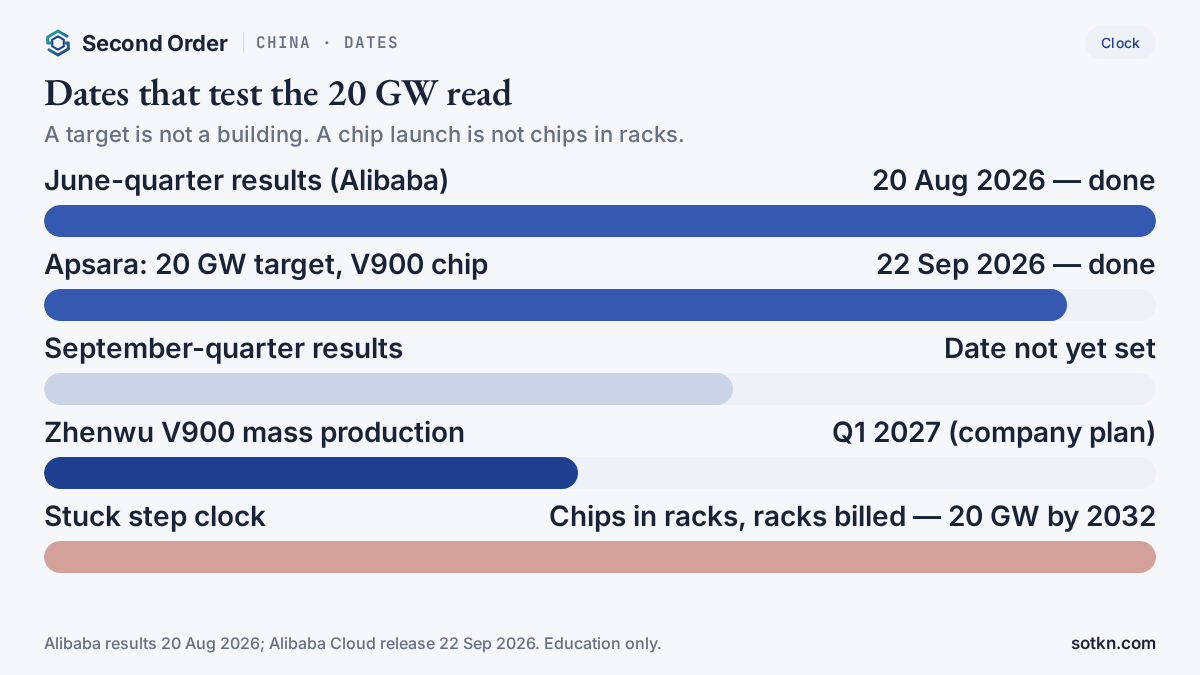
Dates to watch
Alibaba results 20 Aug 2026; Alibaba Cloud release 22 Sep 2026; Reuters 30 Sep 2026; The Register 22 Sep 2026 (updated 24 Sep). We do not invent a date for results that are not yet scheduled.
How is this different from …
- China HBM Access Pulse (19 Sep): That piece was about memory supply for China’s AI chips. This piece is about one buyer’s build plan and the cash it spends while it waits for chips.
- China power Pulses (22 Sep, 28 Sep) and electronics profits (2 Oct): Those read electricity and factory profits. This piece follows one company’s bill.
- China SMIC utilization (4 Oct): That was the foundry side. This is the buyer side of the same chip squeeze.
- US data-hall building Pulse (6 Oct): In the US, power was the stuck step. Alibaba’s CEO names supply-chain shortages, and its results point at chip parts.
What would change this view?
The “racks wait on chips” read weakens if:
- Alibaba says supply has caught up with demand, or drops the shortage language
- The Zhenwu V900 reaches mass production early, or own chips pass a large share of its compute
- Capex falls while AI cloud revenue keeps growing — a sign the build is filling
- Chip-part prices fall in Alibaba’s next results, rather than rise
It stays intact while capex grows faster than cloud revenue, free cash flow stays negative, and Alibaba keeps saying shortages set the pace.
Practical takeaways
- Alibaba targets more than 20 GW of data centers run by Alibaba Cloud by 2032 (CEO, 22 Sep 2026)
- Its June-quarter capex was RMB67.7 billion, up 75%; free cash flow was −RMB44.7 billion
- Who gets paid first: chip, memory and parts sellers — Alibaba cites higher chip-part prices
- Alibaba Cloud gets paid later: AI cloud revenue RMB48.4 billion, up 45%
- Stuck step: chips — Alibaba cites supply-chain shortages and dearer chip parts; its own V900 is due Q1 2027
- Tencent is renting about 100,000 chips abroad from Oracle, per the FT (unverified)
- Watch the September-quarter results: capex, cloud revenue and any word on supply
FAQ
What did Alibaba announce on 22 Sep 2026?
At its Apsara Conference in Hangzhou, Alibaba Group CEO Eddie Wu said the target is for the global data center capacity run by Alibaba Cloud to pass 20 GW by 2032. He also launched the Zhenwu V900 AI chip from Alibaba's T-Head unit, which Alibaba says is due for mass production and commercial release in Q1 2027. Wu said global shortages across the AI data center supply chain limit how fast Alibaba can scale.
How much is Alibaba spending now?
Alibaba's capital spending was RMB67,678 million (US$9,975 million) in the quarter to 30 June 2026, up 75% from RMB38,676 million a year earlier, per its 20 Aug 2026 results. Reasons it gave include higher prices for a broad range of chip components. Free cash flow was an outflow of RMB44,670 million.
Who gets paid?
First, the sellers of chips, memory and other parts, and the builders. They are paid as Alibaba spends. Alibaba Cloud gets paid later, as customers use the capacity: AI Cloud and Compute Services revenue was RMB48,437 million in the June quarter, up 45%. This is a map of who gets paid, not a buy list.
What is the stuck step?
Chips, on our read. Alibaba's CEO said demand far outpaces its supply and that global shortages across the AI data center supply chain limit the speed of the build. Its results blame higher chip-component prices for part of the capex jump. Its own new chip, the Zhenwu V900, is not due for mass production until Q1 2027.
Is this investment advice?
No. Education only. It maps who gets paid and which step is stuck. It is not a recommendation to buy or sell any security.
Keep reading on the map
- China Markets hub — country page
- China SMIC utilization Pulse (4 Oct) — the foundry side
- China data-services power Pulse (28 Sep) — the power side
- China HBM Access Pulse (19 Sep) — the memory squeeze
- US data-hall building Pulse (6 Oct) — where power binds
- Who makes AI chips — primer
- Hyperscalers stack — layer map
How we check this
Spending, revenue and cash figures come from Alibaba Group’s June Quarter 2026 results filed with HKEX on 20 Aug 2026. The 20 GW target, the Zhenwu V900 details and the shortage quote come from Alibaba’s own CEO speech and Alibaba Cloud’s release of 22 Sep 2026. Comments from the results call come from Reuters. The Tencent–Oracle lease is a Financial Times report carried by Reuters, which could not verify it. The BofA figures are a broker estimate as reported by GMT Eight, not company data. Where we work something out ourselves, the sum is shown and labelled our arithmetic.
Last reviewed: 7 Oct 2026 · Next review: after Alibaba’s September-quarter results (date not yet set)
Spot an error? Tell us and we will correct it and note the change here.
Not investment advice. Do your own research.
Sources
- Alibaba Group — CEO Eddie Wu keynote, 2026 Apsara Conference (22 Sep 2026): alibabagroup.com
- Alibaba Cloud — Alibaba unveils roadmap on full-stack AI strategy (22 Sep 2026): alibabacloud.com
- Alibaba Group — June Quarter 2026 results, HKEX filing (20 Aug 2026): hkexnews.hk (PDF)
- Reuters — Alibaba quarterly results and call comments (20 Aug 2026), via BNN Bloomberg: bnnbloomberg.ca
- Reuters — Alibaba unveils strategy on AI models, chips and data centres (22 Sep 2026), via The Business Times: businesstimes.com.sg
- Reuters — China's AI chipmakers raise prices as high-bandwidth memory shortage bites (10 Sep 2026): reuters.com
- The Register — Alibaba Cloud plans 20GW of datacenters (22 Sep 2026, updated 24 Sep): theregister.com
- Reuters — Tencent leases 100,000 chips from Oracle, FT reports (30 Sep 2026): 740thefan.com (Reuters)
- GMT Eight — BofA Securities on the 2026 Apsara Conference (Sep 2026): gmt8press.com