93.7% Full: Who Gets Paid When SMIC Prints $3B
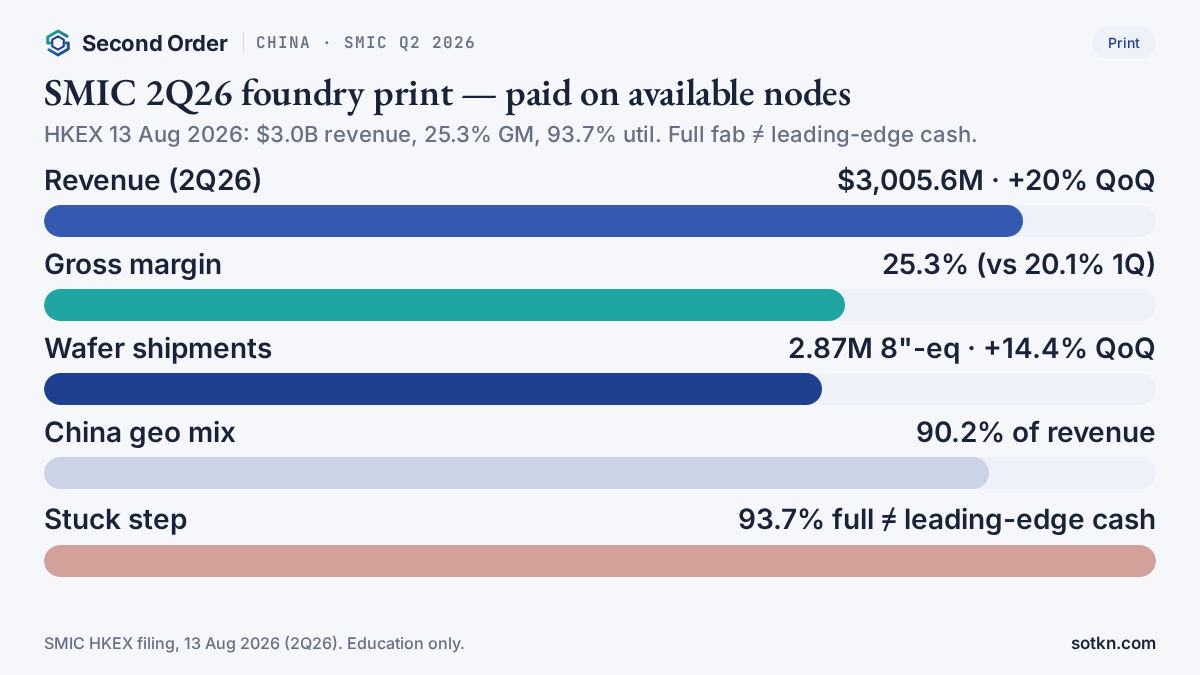
October 2026 in one line: SMIC’s 2Q26 HKEX print shows $3.0B revenue, 25.3% gross margin, and 93.7% utilization — who gets paid is SMIC on wafer invoices at available nodes; the stuck step is 93.7% full ≠ leading-edge cash / new capacity still must qualify.
Semiconductor Manufacturing International Corporation’s 2Q26 HKEX filing (13 Aug 2026) prints US$3,005.6 million of revenue, a 25.3% gross margin, and 93.7% utilization. Who gets paid is SMIC on wafer invoices — shipment volume, average selling price, and mix at the nodes it can actually run, with China at 90.2% of revenue. The stuck step is still 93.7% full ≠ leading-edge cash: high util and $1.8 billion of quarterly capex are not EUV parity or cleared advanced HBM for domestic accelerator cards, and management says newly added capacity still must qualify. Ready is not paid.
CHINA PULSE · Data as at 4 Oct 2026 · Next update: after SMIC’s next quarterly print or a dated capacity-qualification update
Affects: Semiconductors · Hyperscalers · Neoclouds — Markets: China · Taiwan · Korea · US
Education only, not advice to buy or sell any security. Official HKEX figures are labelled as reported. Huawei Connect capacity colour is secondary demand context — not this Pulse’s lead. Prior China HBM Access, Power–Computing, data-services power, and electronics-profits Pulses are cross-linked, not re-led.
The numbers that matter this month
SMIC 2Q26 revenue (HKEX)
$3,005.6M
+20.0% QoQ · +36.1% YoY — primary print
PrimaryGross margin (HKEX)
25.3%
vs 20.1% 1Q26 · 20.4% 2Q25
PrimaryUtilization (HKEX)
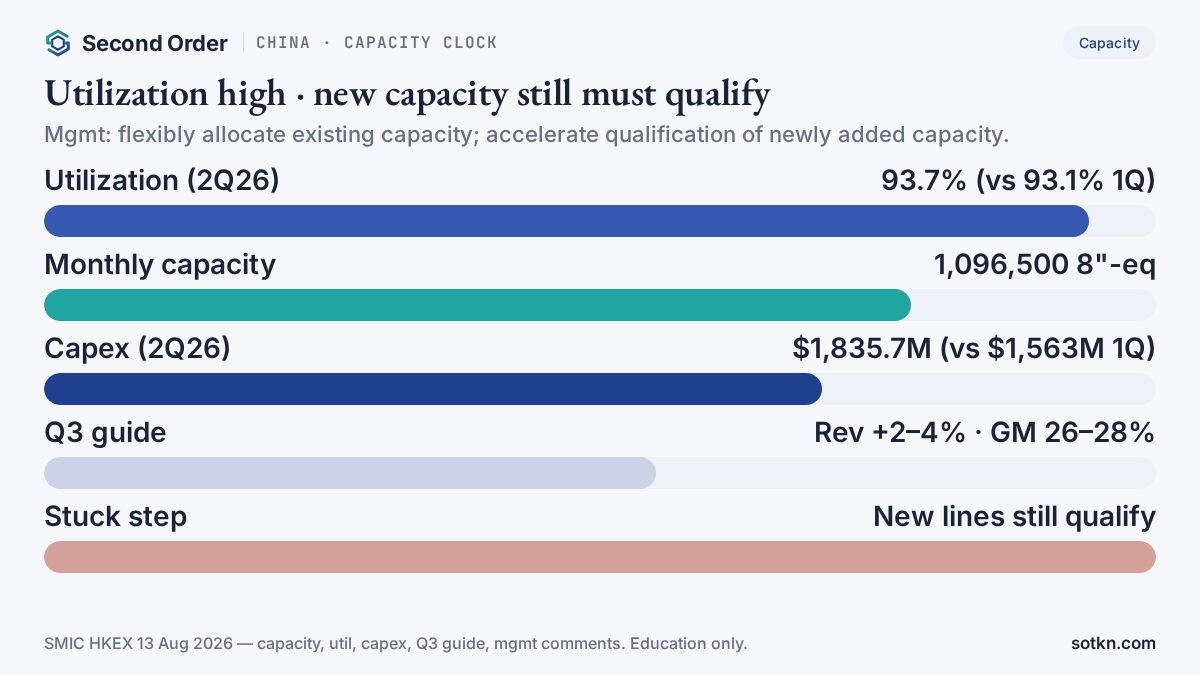
93.7%
vs 93.1% 1Q26 · 92.5% 2Q25
PrimaryWafer shipments (HKEX)
2,869,495 8"-eq
+14.4% QoQ · +20.1% YoY
Primary93.7% full ≠ leading-edge cash
Still the bind
High util + capex ≠ EUV parity / cleared advanced HBM
Stuck stepChina revenue mix (2Q26)
90.2%
America 8.2% · Eurasia 1.6%
PrimaryQ3 guide (HKEX)
+2–4% · GM 26–28%
Company guidance — not a closed Q3 print yet
GuideSources: SMIC HKEX filing, 13 Aug 2026 (2Q26). Status chips are Second Order’s read. Utilization ≠ leading-edge parity.
On this page: Why China? · What changed · Our math · Where money sticks · Is util still stuck? · Dates next · How this differs · What would change this · FAQ
Why does China matter now?
Because the domestic foundry that prints the largest China wafer mix is running near full — and the cash question is not “is utilization high?” (it is), but whether that print is leading-edge cash or invoices at available nodes while new lines still qualify.
That is the same map as Semiconductors stack, HBM, explained, and the China Markets hub. The fresh question this month is not “did SMIC grow?” — the filing already shows $3.0 billion and 93.7% util — it is who gets paid on that wafer invoice, and which stuck step still sits between full fabs and leading-edge cash.
1 · Foundry print (HKEX 13 Aug)
Who: SMIC wafer invoices
Paid: $3.0B revenue · 25.3% GM · 93.7% util — paid on available nodes
2 · 93.7% full ≠ leading-edge cash
Who: Qualification / node ceiling
Paid: New capacity still must qualify; high util ≠ EUV parity
3 · Domestic demand colour (secondary)
Who: Huawei Connect / Ascend supply
Paid: Not enough capacity for China demand (Reuters 17 Sep) — colour, not this lead
4 · Neighbour China clocks
Who: HBM · power · electronics P&L
Paid: Separate doors — cross-link prior Pulses, do not re-lead
Chain is Second Order’s map. Neighbours: China HBM Access Pulse · China Power–Computing Pulse · China Electronics Profits Pulse · Where does the stuck step move?.
What changed
The fresh primary print is dated 13 Aug 2026 on HKEX — SMIC unaudited 2Q26 results. It is the company’s own foundry scorecard: revenue, margin, utilization, shipments, capacity, capex, geography and application mix, plus Q3 guidance and management’s capacity-qualification language.
What the filing actually says, in plain English: revenue hit $3,005.6 million because wafer shipments and average selling price rose and product mix shifted; gross margin moved to 25.3% on the same ASP and mix story; utilization sat at 93.7% against monthly capacity of 1,096,500 8-inch-equivalent wafers; China took 90.2% of revenue (America 8.2%, Eurasia 1.6%); wafer revenue by application put Consumer Electronics at 44.2%, Smartphone 16.9%, Industrial and Automotive 16.5%, Computer and Tablet 15.6%, Connectivity and IoT 6.8%; 12-inch wafers were 78.2% of wafer revenue; Q3 guide is revenue +2% to +4% QoQ and GM 26%–28%; management says AI industrial momentum and spillover effects will persist, and the company will flexibly allocate existing capacity and accelerate the qualification of newly added capacity to help ease supply constraints.
What the filing does not say: that 93.7% utilization equals leading-edge process parity with unrestricted peers; that advanced HBM access for domestic accelerator cards is cleared; or that newly added capacity has finished qualification. Those gaps are the stuck step.
- HKEX (13 Aug 2026): 2Q26 revenue $3,005.6M; GM 25.3%; util 93.7%; shipments 2.87M 8"-eq
- Same: monthly capacity 1,096,500 8"-eq; capex $1,835.7M; owners’ profit $479.2M
- Same: China 90.2% / America 8.2% / Eurasia 1.6% of revenue
- Same: 12" wafers 78.2% of wafer revenue; Consumer Electronics 44.2% of wafer revenue by app
- Same: Q3 guide revenue +2–4% QoQ; GM 26–28%; accelerate qualification of newly added capacity
- Secondary (Reuters 17 Sep, Huawei Connect): Eric Xu — not enough capacity for China demand; limited overseas
- Secondary (The Register 30 Sep): same capacity/export framing; Xu Ascend share claim without company data
Secondary demand colour only: Reuters from Huawei Connect (17 Sep 2026) quotes Eric Xu that Huawei does not have enough capacity to satisfy China demand and has no fully-fledged international expansion plan, with only limited overseas supply. The same piece carries Xu’s Ascend share claim without company data — we do not invent a share percentage. The Register (30 Sep 2026) retells the same capacity/export framing. That colour explains why domestic wafer and accelerator demand stays loud; it is not SMIC’s lead print and we do not make Huawei the protagonist of this Pulse.
Our math — labelled our arithmetic
The filing already prints the cash scoreboard. The arithmetic here is about what that scoreboard does and does not clear — not inventing a leading-edge share.
Our arithmetic — print vs stuck step
Inputs: SMIC HKEX 13 Aug 2026; Reuters 17 Sep (share claim explicitly without company data). “Not automatic” is Second Order’s judgment, not official guidance.
What this tells you: $3.0 billion at 25.3% GM and 93.7% util is a real foundry cash print at available capacity, with China still the overwhelming geo mix. What it does not tell you: that the same util rate equals unrestricted leading-edge economics, or that newly added capacity is already qualified and shipping at the same mix.
Primary vs neighbour clocks (label carefully)
Primary clocks: SMIC HKEX 13 Aug 2026. Prior Pulses: live China Markets doors — cross-link, do not re-lead.
Where does the money stick?
At the steps with the fewest good substitutes — and only after the stuck step can actually invoice. A high utilization print clears wafer cash at available nodes. Leading-edge parity and qualified new capacity clear a different clock.
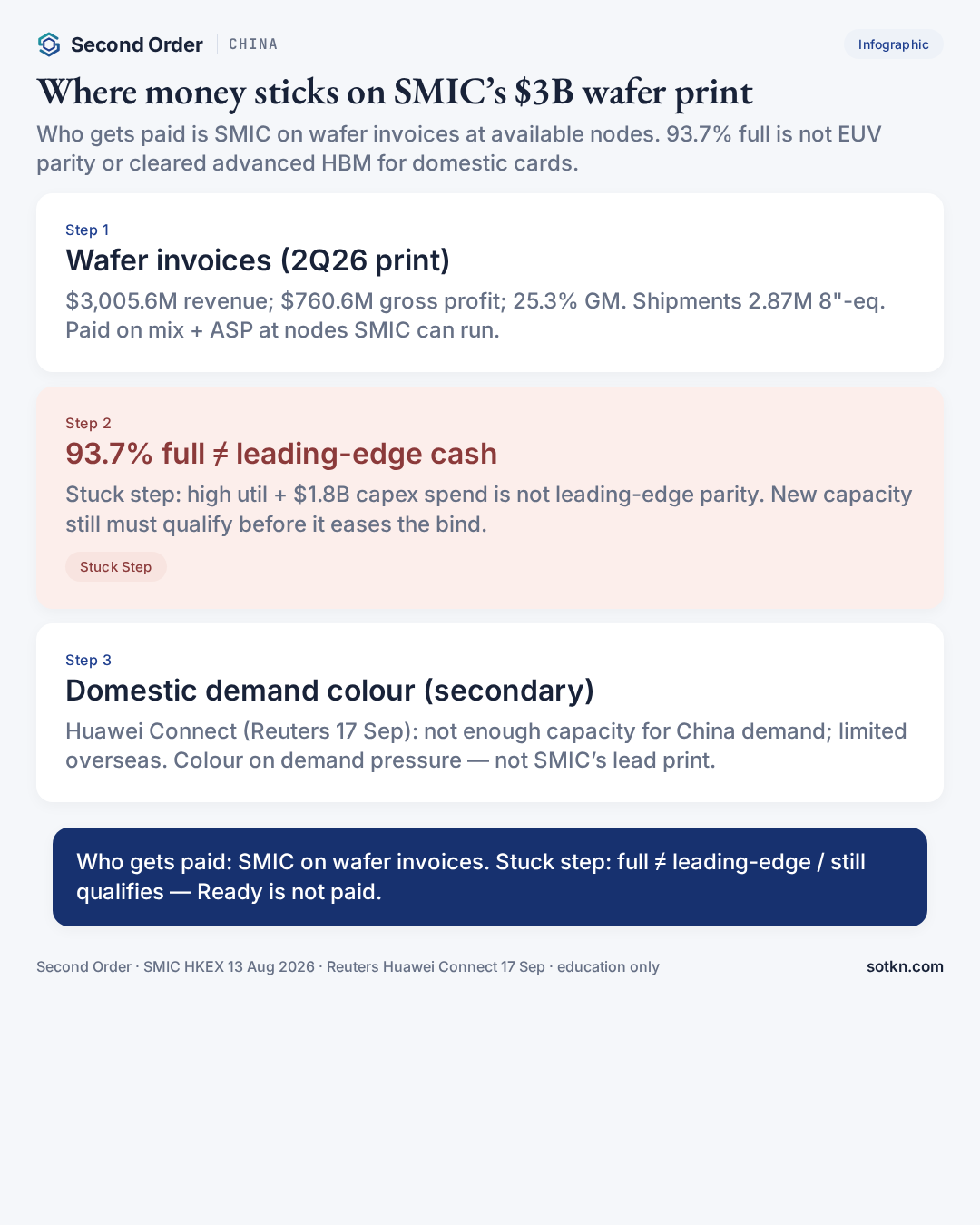
- SMIC wafer invoices (paying now). Shipment volume, ASP, and mix at nodes SMIC can run — $3.0B revenue and 25.3% GM in 2Q26 — is the cash that already cleared in this print.
- Not the stuck step alone: the revenue headline. A dated $3B print is useful. It is not proof that newly added capacity has finished qualification or that advanced domestic memory access is cleared.
- Neighbour scarcity (secondary). Huawei Connect colour says domestic AI compute demand still outruns local supply. That raises the value of every qualified wafer start — it does not rewrite SMIC’s lead scoreboard.
Same pattern as China HBM Access and Where does the stuck step move?: a loud utilization or demand print can sit next to a quieter qualification or memory-access bind. Full fabs are not the same as leading-edge cash.
Is 93.7% full ≠ leading-edge still stuck?
Yes. An official utilization print does not settle process parity, advanced HBM access, or qualification of newly added capacity by itself.
Earlier China Pulses already mapped neighbour doors: HBM Access for domestic accelerators, Power–Computing coordination, data-services power, and electronics profits. This Pulse adds the foundry utilization / wafer-invoice gate — and insists on the gap between 93.7% full and leading-edge cash.
Two cautions before you read “SMIC nearly full at $3B” as leading-edge victory:
- Full is not leading-edge. 93.7% utilization is a capacity-use print at the nodes SMIC runs. It is not an EUV-parity claim.
- Capex is not qualification complete. $1.8B of quarterly capex and management’s “accelerate qualification of newly added capacity” line both say new lines still have a clock before they ease supply constraints.
If qualification clears and mix moves, the stuck step can shift toward neighbour binds — memory access and energisable power — see Where does the stuck step move?, HBM Access, and Power–Computing.
What dates matter
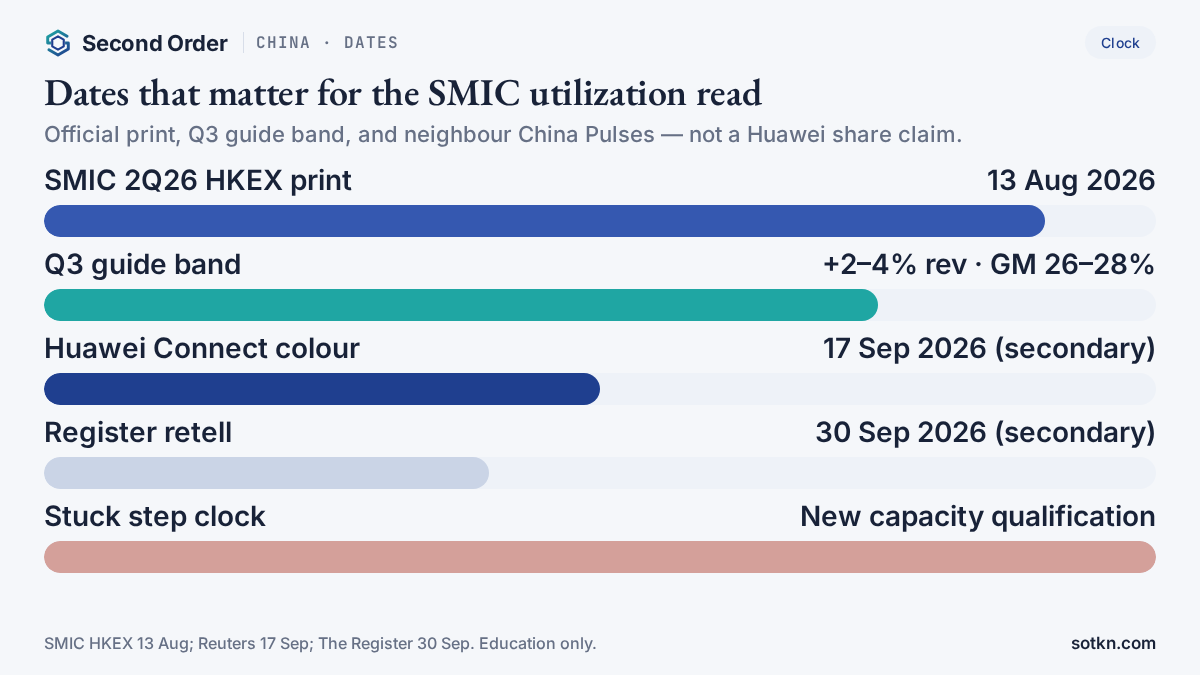
Dates to watch
SMIC HKEX 13 Aug; Reuters 17 Sep; The Register 30 Sep. Do not invent a qualification close date.
How is this different from …
- China HBM Access Pulse (19 Sep): That piece led on advanced HBM access for domestic accelerators. This piece does not re-lead Ascend price or CXMT small-batch; it links HBM as the neighbour memory door next to SMIC’s wafer print.
- China Power–Computing Pulse (22 Sep): That piece centred on 算电协同 / energisable power. This piece centres on SMIC’s official utilization and wafer-invoice print.
- China data-services power Pulse (28 Sep): That piece mapped power for data services. This Pulse stays on foundry cash and capacity qualification.
- China Electronics Profits Pulse (2 Oct): That piece led on NBS electronics P&L. This Pulse does not re-lead that macro profits print; it leads on SMIC’s company filing.
- US Amazon leaseback Pulse (4 Oct morning): Neighbour door on hyperscaler financing ask ≠ closed. This Pulse stays on China foundry util ≠ leading-edge cash.
- Taiwan TSMC revenue Pulse: Peer foundry scoreboard on a different process and geo mix. Cross-link; do not flatten SMIC’s China print into TSMC’s.
What would change this view?
The “93.7% full ≠ leading-edge / capacity still qualifies” read weakens if:
- A dated qualification update shows newly added capacity accepted and shipping at stated mix
- A later SMIC print shows utilization and GM moving with clear leading-edge mix disclosure (still label carefully)
- Primary evidence that advanced HBM access for domestic cards clears — then the neighbour memory door moves
- A guide cut or utilization drop that breaks the “near-full at available nodes” cash story
- Power or memory access, not foundry qualification, becomes the louder bottleneck in primary commentary
It stays intact while the only dated primary scoreboard is a high-util available-node print, management still flags qualification of newly added capacity, and neighbour HBM / power Pulses remain separate binds.
Practical takeaways
- SMIC HKEX dated a real 2Q26 foundry print on 13 Aug — $3,005.6M revenue, 25.3% GM, 93.7% util
- Who gets paid: SMIC on wafer invoices (shipment + ASP + mix) at available nodes — China 90.2% of revenue
- Shipments 2.87M 8"-eq; monthly capacity 1,096,500; capex $1,835.7M in 2Q26
- Q3 guide: revenue +2–4% QoQ; GM 26–28% — guide band, not a closed Q3 print
- Stuck step remains 93.7% full ≠ leading-edge cash / new capacity still qualifies — ready is not paid
- Mgmt: AI industrial momentum persists; accelerate qualification of newly added capacity
- Huawei Connect capacity colour is secondary demand context — do not invent Ascend share %
- Cross-link HBM Access, Power–Computing, data-services power, electronics profits; do not flatten them into this print
- Watch the next SMIC quarterly print and any dated qualification language
FAQ
What did SMIC report for 2Q26?
In its HKEX filing dated 13 Aug 2026, Semiconductor Manufacturing International Corporation reported 2Q26 revenue of US$3,005.6 million (+20.0% QoQ, +36.1% YoY), gross profit of $760.6 million, gross margin of 25.3%, profit attributable to owners of $479.2 million, utilization of 93.7%, and wafer shipments of 2,869,495 8-inch-equivalent wafers. Monthly capacity rose to 1,096,500 8-inch-equivalent wafers. Capex was $1,835.7 million in 2Q26.
Who gets paid on this China read?
SMIC gets paid on wafer invoices — shipment volume, average selling price, and product mix at the nodes it can actually run. China was 90.2% of 2Q26 revenue. This is a map of who gets paid — not a buy list.
What is the stuck step?
93.7% full ≠ leading-edge cash. High utilization and rising capex are a foundry print at available capacity. They are not EUV parity, cleared advanced HBM for domestic accelerator cards, or proof that newly added capacity has finished qualification. Management said it will accelerate qualification of newly added capacity to ease supply constraints. Ready is not paid.
What is SMIC’s Q3 2026 guidance?
Per the same HKEX filing: revenue expected +2% to +4% QoQ; gross margin expected 26% to 28%. Treat as company guidance, not a closed cash print for the quarter yet.
How is this different from prior China Pulses?
HBM Access (19 Sep) led on memory access for domestic accelerators. Power–Computing (22 Sep) led on 算电协同 / grid match. Data-services power (28 Sep) led on power for data services. Electronics profits (2 Oct) led on NBS electronics P&L. This Pulse leads on SMIC’s official 2Q26 foundry print — utilization, wafer cash, and qualification of new capacity. Cross-link those clocks; do not re-lead them.
Is this investment advice?
No. Education only. It maps who gets paid and which step is stuck. It is not a recommendation to buy or sell any security.
Keep reading on the map
- China Markets hub — country door
- China HBM Access Pulse (19 Sep) — memory neighbour
- China Power–Computing Pulse (22 Sep) — grid / 算电协同
- China Electronics Profits Pulse (2 Oct) — NBS P&L neighbour
- Taiwan TSMC revenue Pulse — peer foundry scoreboard
- HBM, explained — primer
- Semiconductors stack — layer map
- Where does the stuck step move? — Analysis
- US Amazon leaseback Pulse (4 Oct) — neighbour ask≠closed
How we check this
Figures come from SMIC’s dated HKEX filing (13 Aug 2026) and labelled secondary colour from Reuters Huawei Connect / The Register. Utilization and revenue prints are not treated as leading-edge parity or cleared advanced-memory access. Where we work something out ourselves, the arithmetic is shown in full and labelled our arithmetic.
Last reviewed: 4 Oct 2026 · Next review: after SMIC’s next quarterly print, a dated capacity-qualification update, or a primary change to Q3/Q4 guidance
Spot an error? Tell us and we will correct it and note the change here.
Not investment advice. Do your own research.
Sources
- SMIC HKEX unaudited results (13 Aug 2026, 2Q26): hkexnews.hk PDF
- Reuters — Huawei Connect / Eric Xu (17 Sep 2026): reuters.com
- The Register — Huawei Ascend / capacity framing (30 Sep 2026): theregister.com