
China Power–Computing Coordination: Who Gets Paid When Compute Must Match the Grid
September 2026 in one line: Beijing’s computing-network meeting makes power–computing coordination the gate — green-power direct connection, source-grid-load-storage, planning link — while NEA clocks computing electricity at +>100 TWh/yr toward ~800 TWh by 2030.
Beijing is no longer treating computing halls as a server count problem. The State Council’s 11 Sep 2026 computing-network meeting put power–computing coordination on the critical path: green-power direct connection, source-grid-load-storage, and a planning link between compute and power facilities. Against that sits the NEA demand clock — computing electricity adding more than 100 TWh a year through the 15th Five-Year Plan toward roughly 800 TWh by 2030. Who gets paid is whoever can energise halls that match that path. The stuck step is matching compute build to energisable power — not stacking more servers on paper.
CHINA PULSE · Data as at 22 Sep 2026 · Next update: after next NEA computing-electricity / green direct-connect print
Affects: Hyperscalers · The Stack — Markets: China · US · Korea
Education only, not advice to buy or sell any security. Policy figures are dated government readouts or NEA-path reporting. Wood Mackenzie and Rystad numbers are labelled as forecasts or announced-project scopes.
The numbers that matter this month
NEA computing electricity add (15th FYP)
>+100 TWh/yr
Reported path 2026–2030 · Dialogue Earth / NEA plan Jun–Jul 2026
Demand clockNEA-path computing load ~2030
~800 TWh · ~6%
vs ~170 TWh / ~1.6% in 2025 (trade coverage of NEA path)
Plan pathJuly internet data-services electricity
+40.1% YoY
9.9 TWh in Jul 2026 · NEA 21 Aug 2026
Fresh printWoodMac DC demand 2030 (forecast)
774 TWh · ~6%
Press release 25 Aug 2026 · same share band as NEA path
ForecastState Council computing-network meeting
11 Sep 2026
算电协同 · 绿电直连 · 源网荷储 · 8+10+3 layout
Policy gateMatching compute to energisable power
Stuck step
Halls without connectable green/hub power stay paper
Stuck stepSources: gov.cn / Xinhua 12 Sep 2026; NEA electricity data 21 Aug 2026; Dialogue Earth 2 Jul 2026 (NEA plan reporting); WoodMac 25 Aug 2026. Status chips are Second Order’s read.
On this page: Why China? · What the meeting changed · Demand clock · Our math · Where money sticks · Is matching still stuck? · Dates to watch · vs HBM Access · What would change · FAQ
Why does China’s power–compute bind matter now?
Because AI compute demand is colliding with a power system that Beijing wants greener, more flexible, and jointly planned — not just bigger. When policy says compute and power must co-plan, the scarce step shifts from “who can order more GPUs” to “who can land energisable megawatts next to a permitted hall.” That is a different money map from the US speed-to-power story, and a different layer from China’s HBM access bind.
Policy + hub layout
Who: State Council / NDRC / NEA / NDA
Paid: 8+10+3 spatial plan; 算电协同 and 算网融合 as operating rules
Green power + grid path
Who: Utilities / renewables / direct-connect projects
Paid: 绿电直连 and 源网荷储 must land before halls become useful load
Computing halls + clusters
Who: State cloud / hyperscaler-class buyers / EDWC hubs
Paid: Training and storage prefer power-rich west; latency-sensitive stays east
Workloads consume
Who: AI training / inference / internet data services
Paid: July data-services electricity already +40% YoY — demand is not theoretical
Chain is Second Order’s reading frame. Evergreen: speed-to-power explained · hyperscaler explained. Sibling Pulses: China HBM Access · US Speed-to-Power.
What changed — State Council puts 算电协同 on the critical path
The fresh policy print is the 11 Sep 2026 State Council executive meeting on computing-network construction, interpreted the next day by Xinhua on gov.cn. Computing networks are framed as basic support for AI. The meeting restated China’s national layout — eight national computing hubs, ten national computing clusters, and three power–computing coordination regions (“8+10+3”) — and then narrowed to how the system must run.
The operating instructions matter more than the map redraw. Officials called for pushing power–computing coordination and compute–network integration, strengthening computing-resource monitoring and dispatch plus backbone fibre, reinforcing the planning link between computing and power facilities, and accelerating landing of green-power direct-connection projects and source-grid-load-storage projects. In plain English: stop treating halls and electrons as separate paperwork.
That is not a soft slogan. Green-power direct connection and source-grid-load-storage are project classes with capital, interconnection, and utilisation rules. When the State Council names them beside monitoring/dispatch and fibre, the gate for new capacity is energisable coordination — not another pile of idle racks. Market language from Wood Mackenzie’s 25 Aug 2026 release already described the same shift as moving from “power follows compute” toward “compute follows power” for latency-tolerant loads. The September meeting puts a cabinet stamp on that direction.
The demand clock — +100 TWh/yr toward ~800 TWh
Policy without a demand clock is just architecture. The NEA’s 15th Five-Year new-energy system plan (released around 25 Jun 2026) is the first national energy plan to put “computing power” in the frame. Reporting via Dialogue Earth (2 Jul 2026), citing Shanghai Securities News coverage of the NEA plan, says computing-related electricity demand is projected to rise by more than 100 billion kilowatt-hours each year from 2026 to 2030 and to account for about 6% of total electricity use — nearly four times the 2025 share of about 1.6%.
Trade coverage of the same NEA path cites about 170 TWh of computing-facility electricity in 2025 and about 800 TWh by 2030. We treat those as NEA-path figures as reported — not as a signed utility forecast for any single operator. Wood Mackenzie’s 25 Aug 2026 press release sits in the same order of magnitude: China data-centre electricity to 774 TWh by 2030, about 6% of national consumption. Two independent prints in the same band is a signal; it is still not a purchase order.
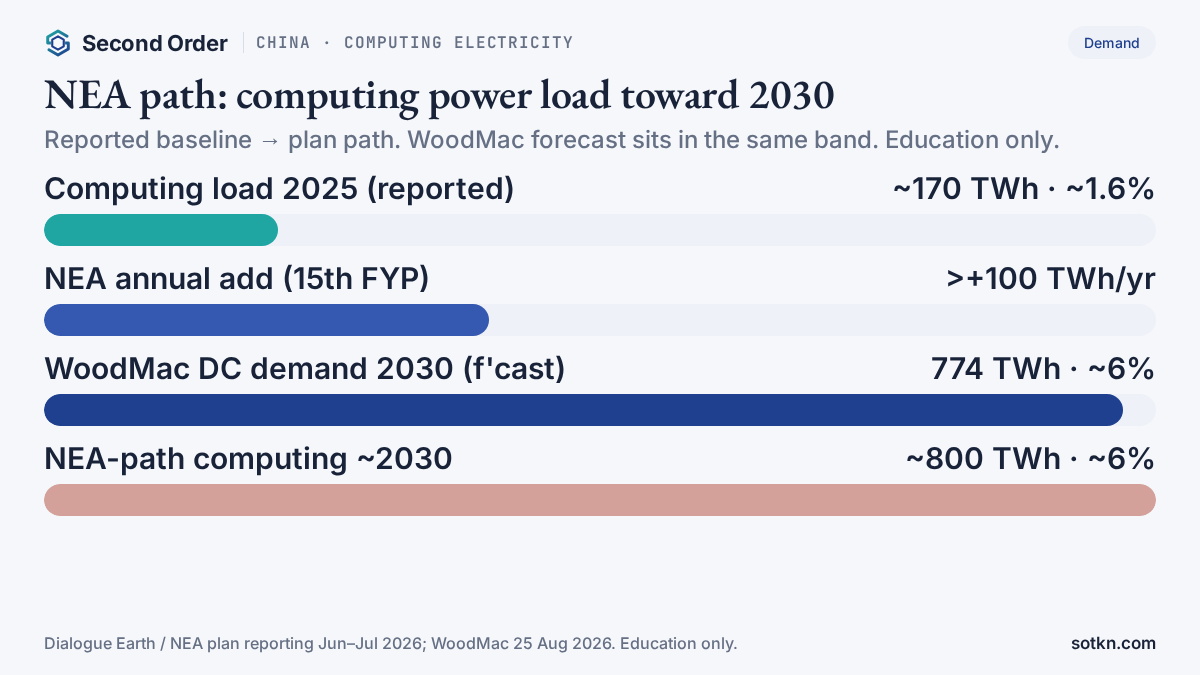
Demand prints this month
NEA official July release 21 Aug 2026; English Xinhua/gov.cn same day; Dialogue Earth 2 Jul 2026; WoodMac press 25 Aug 2026.
The July print keeps the story from floating into 2030 abstractions. Internet data-services electricity hit 9.9 TWh in July alone (+40.1% year on year) and 59.3 TWh in the first seven months (+43.3%). National July load was 1,040 TWh, so the sector is still a small share of the total — but the growth rate is the tell. Demand is already bending the monthly bar while policy bends the planning rules.
Rystad Energy’s announced-project lens is useful for capacity geography, not as a veto of the NEA/WoodMac energy totals. Rystad sees roughly 32 GW of China data-centre capacity at end-2025, about 40 GW by end-2026, and about 60 GW by 2030 if 28 GW of announced additions land — with East Data West Computing hubs (including ~10 GW associated projects around Ulanqab) as the spatial answer to eastern land and energy pressure. Rystad’s corresponding announced-project electricity path (~289 TWh / ~2.3% by 2030) is a narrower scope than the NEA ~800 TWh computing path. We use Rystad for hubs and capacity shape; we do not force the two energy totals into a fake fight.
Our math — does +100 TWh/yr fit the 170→800 path?
Second Order arithmetic from the dated NEA-path figures as reported:
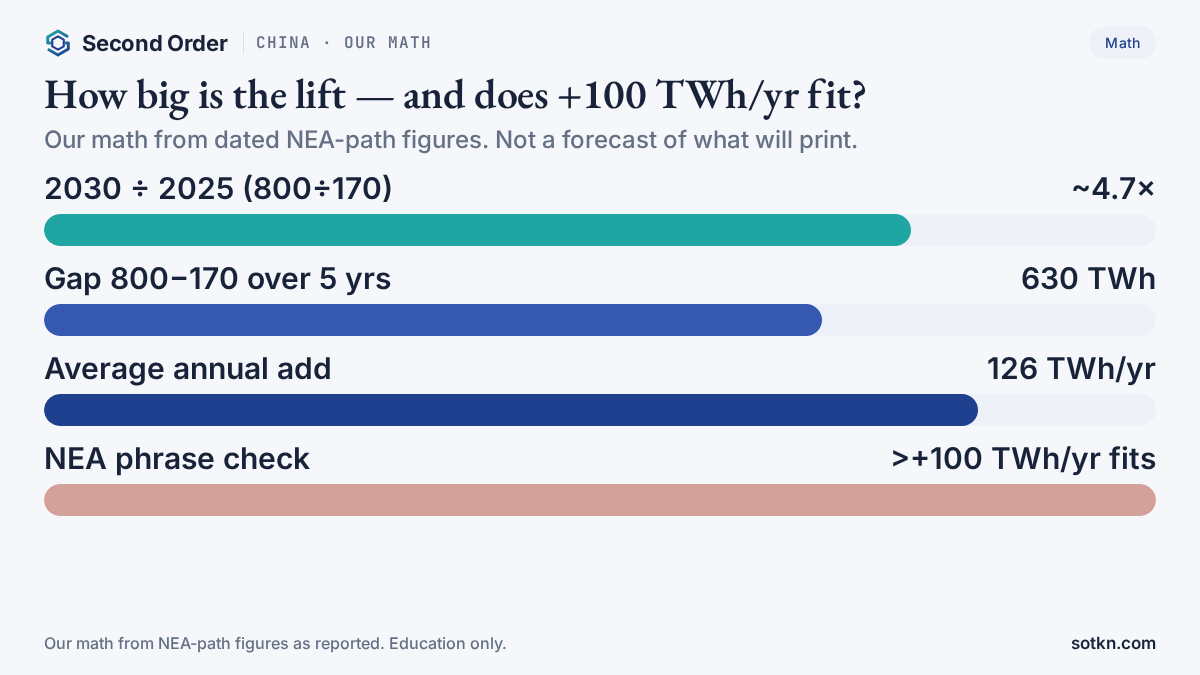
Second Order calculation — NEA-path lift
Our math only. Inputs are NEA-path figures as reported via Dialogue Earth / trade coverage. Not a forecast of what any year will print.
What this tells you: the “+100 TWh/yr” phrase is not a decorative round number. It is consistent with a near-fivefold lift in computing electricity over the plan window. What it does not tell you: which western hub, which direct-connection project, or which listed name clears the gate first.
Share arithmetic for context: moving from ~1.6% to ~6% of national electricity is about a 3.75× share lift. July’s internet data-services 9.9 TWh was only ~0.95% of July’s 1,040 TWh national total — still small as a slice, already loud as a growth rate. The plan path says the slice gets much larger; the monthly print says the bend has started.
Where does the money stick when compute must match power?
At the step that turns announced halls into energisable load.
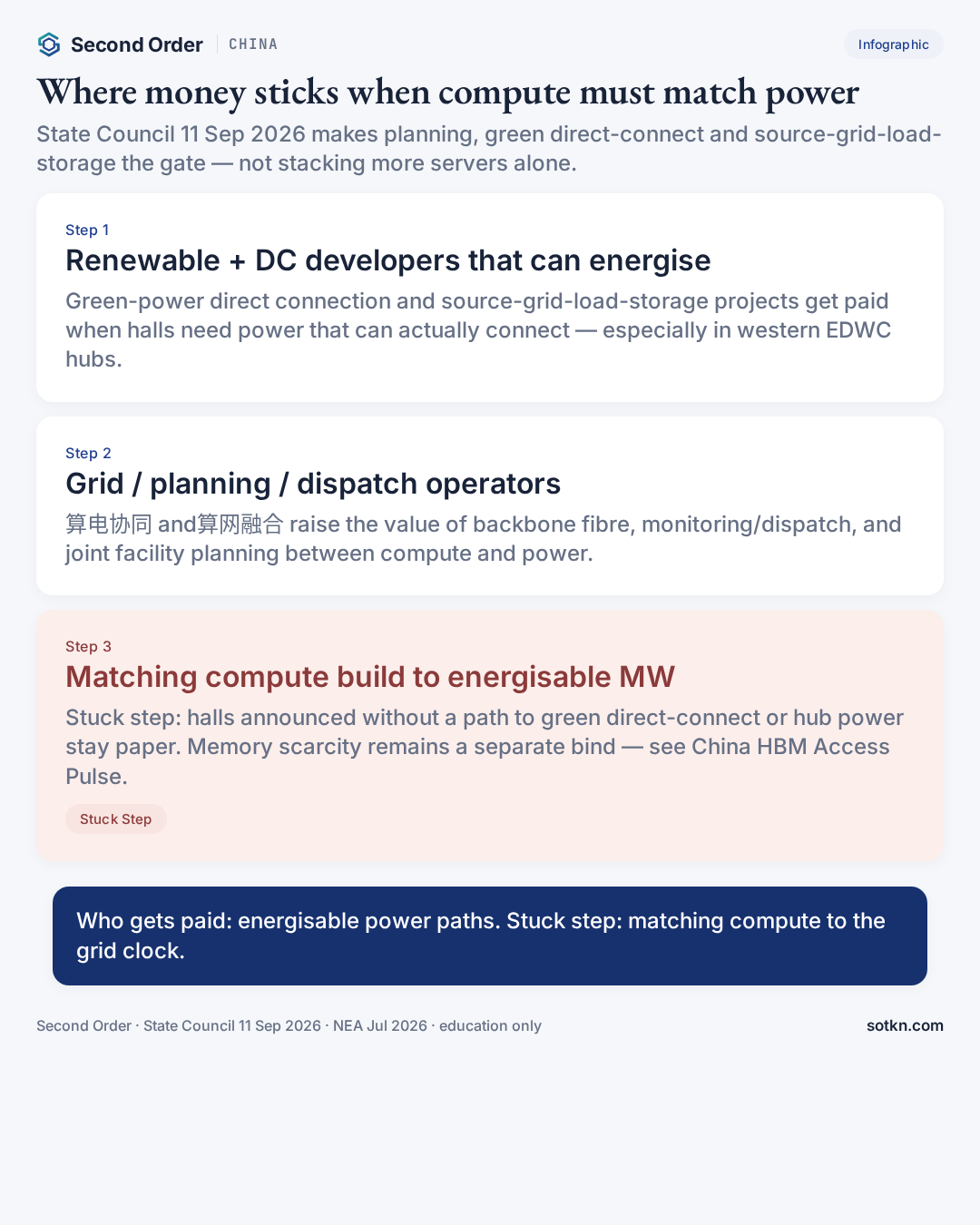
- Renewable and DC developers that can energise. Green-power direct connection and source-grid-load-storage packages get paid when a hall needs power that can actually connect — especially in western EDWC hubs where renewable endowment is the point of the map.
- Grid, planning, and dispatch operators. 算电协同 and 算网融合 raise the value of backbone fibre, resource monitoring/dispatch, and joint facility planning. Paper compute without a co-planned power path is the thing Beijing is trying to stop.
- Not “whoever stacks more servers.” Server OEM and accelerator invoices still matter — but under this month’s policy print, idle racks without energisable MW are the failure mode. Ease off reading everything as pure “rent”; follow who gets paid for connected power.
One-line rule: when policy forces compute to co-plan with green power, money sticks with whoever can deliver the connectable megawatt — not the loudest hall announcement.
Is matching compute to energisable power still stuck?
Yes — as a system problem. The September meeting is an instruction to close the gap, not evidence the gap is closed. Direct-connection and source-grid-load-storage projects still have to land. Western hubs still have to convert renewable endowment into reliable compute power without stranding eastern latency needs. Eastern sites still need greener local packages or transmitted clean power for workloads that cannot move west.
What is open vs still binding (Sep 2026)
US contrast: the US Speed-to-Power Pulse maps transformers, interconnect, and campus energise clocks when labs chase usable MW. China’s September print is the policy twin — force compute and power onto one plan — against a steeper national computing-electricity path. Same family of stuck step (energisable MW); different institutional machinery.
What dates and prints come next?
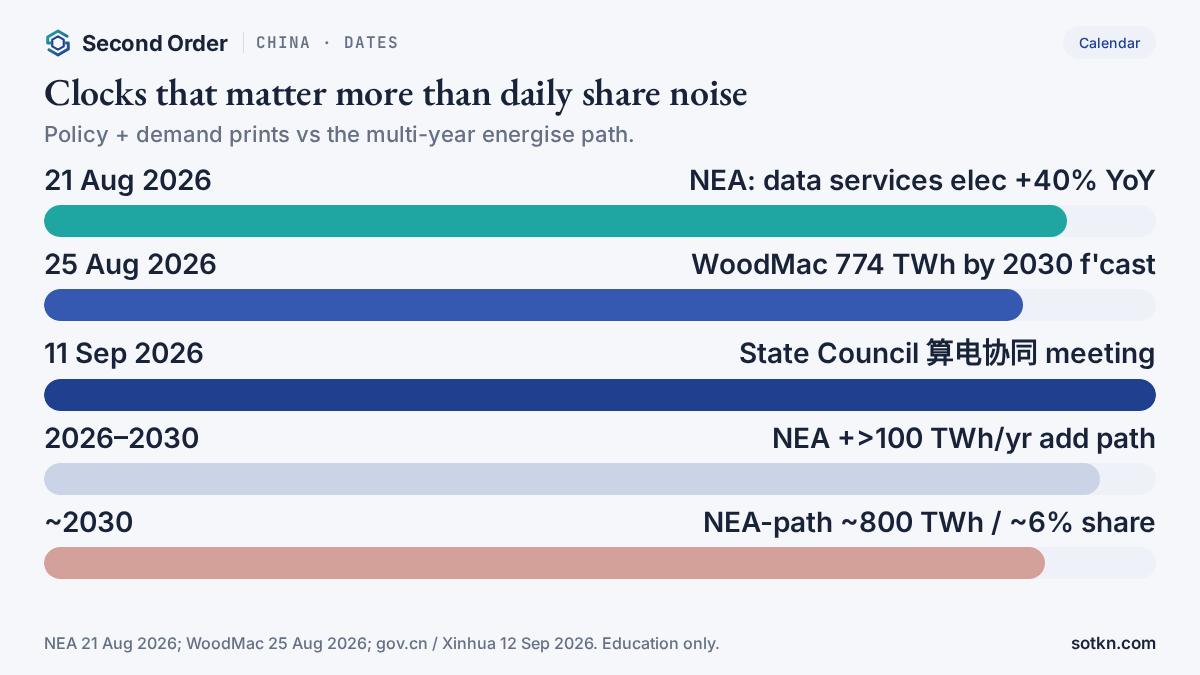
Dates and signals to watch
How does this sit beside China HBM Access?
As a second bind, not a rewrite. The live China HBM Access Pulse (19 Sep 2026) maps advanced HBM access as the stuck step inside the domestic AI stack — MIIT’s 9,800-EFLOPS target, Ascend indicated price hikes, CXMT HBM3E still small-batch. That is the memory layer. This Pulse owns the power/grid layer: even if memory clears, halls still need energisable megawatts under 算电协同 rules.
Practical read: do not collapse September into one China AI story. Memory scarcity shows up in card prices; power coordination shows up in where halls can actually light and who gets paid for the connection. Both can bind in the same year.
- Hyperscalers / state cloud buyers: Pay for usable clusters — memory and power both gate utilisation.
- Power / renewable / DC developers: Paid when direct-connect and hub packages clear; stranded if halls stay paper.
- Domestic accelerator / memory names: Still live on the HBM Access map — not the lead of this Pulse.
Listed access paths vary by account and region. One example broker many readers already use is Interactive Brokers. Education only — we do not advise opening or funding any account.
What would change this view?
- A string of dated green-power direct-connection / 源网荷储 energise prints that show hubs clearing the gate at scale
- NEA monthly data-services electricity growth collapsing while national computing targets stay loud — a demand-path miss
- Official revisions that walk back the ~6% / ~800 TWh computing-electricity path
- Evidence that eastern latency halls can expand without co-planned power (policy softens)
- Power stop being scarce relative to memory — then re-weight toward the HBM Access stuck step
- A non-power, non-memory bottleneck (packaging tools, cooling, fibre) becoming the louder primary constraint
The view stays intact while cabinet language keeps forcing 算电协同, the NEA-path demand clock stays in the +100 TWh/yr / ~800 TWh band, and project-level energise remains the conversion problem.
Practical takeaways
- Name the stuck step: matching compute build to energisable power — not “China lacks AI ambition”
- State Council 11 Sep 2026 makes green direct-connect + source-grid-load-storage + planning link the operating gate
- NEA-path clock: +>100 TWh/yr → ~800 TWh / ~6% by 2030; our math average add ~126 TWh/yr fits
- Who gets paid: renewable/DC developers and grid/planning paths that can energise — especially western hubs
- Keep HBM Access as the memory bind; do not rehash Ascend/CXMT as this Pulse’s lead
FAQ
What is 算电协同 (power–computing coordination)?
China’s policy frame for co-planning computing facilities with power — especially green-power direct connection, source-grid-load-storage (源网荷储), joint facility planning, and monitoring/dispatch. The State Council executive meeting on 11 Sep 2026 made it a headline directive for national computing-network (算力网) construction.
What did the 11 Sep 2026 State Council meeting decide?
Per the Xinhua/gov.cn readout (12 Sep 2026), the meeting studied computing-network construction, restated the 8+10+3 spatial layout (8 national hubs, 10 clusters, 3 power–computing coordination regions), and called for stronger planning links plus faster landing of green-power direct-connection and source-grid-load-storage projects.
What is the NEA +100 TWh/yr figure?
Reporting on the NEA’s 15th Five-Year new-energy system plan (released ~25 Jun 2026) says computing-related electricity demand is projected to increase by more than 100 billion kWh (~100 TWh) annually during 2026–2030, reaching roughly 6% of national electricity use — versus about 1.6% in 2025. Trade coverage of the same path cites ~170 TWh in 2025 and ~800 TWh by 2030. Treat as a policy/demand path, not a purchase order.
Who gets paid under this bind?
Developers and operators that can deliver energisable power to computing halls — green-power direct connection, source-grid-load-storage projects, western East-Data-West-Computing hubs with renewable packages — plus grid/planning/dispatch that make 算电协同 and 算网融合 work. Announced halls without a connectable power path stay paper.
How is this different from the China HBM Access Pulse?
HBM Access maps the memory stuck step inside China’s domestic AI stack (Ascend price prints, CXMT small-batch). This Pulse maps the power/grid stuck step: matching compute build to energisable megawatts. Both can bind at once; they are different layers.
Is this a buy list of China grid or data-centre stocks?
No. This Pulse maps who gets paid and which step is stuck. It is education only, not a recommendation to buy or sell any security.
Keep reading on the map
- Speed-to-power explained · Hyperscaler explained · HBM explained
- China HBM Access Pulse · US Speed-to-Power Pulse · China Markets hub
- Hyperscalers stack · The Stack · Analysis · Wire
How we check this
Figures come from government releases and dated industry forecasts, each named below. Policy paths and forecasts are labelled as such — not as guidance. Where we work something out ourselves, the arithmetic is shown in full.
Last reviewed: 22 Sep 2026 · Next review: after next NEA computing-electricity print or major green-power direct-connection / EDWC hub energise disclosure
Spot an error? Tell us and we will correct it and note the change here.
Sources
- 中国政府网 / 新华社 — 国务院常务会议研究算力网建设有关工作(算电协同、绿电直连、源网荷储) (12 Sep 2026; meeting 11 Sep)
- 国家能源局 — 2026年1–7月全社会用电量(互联网数据服务用电 +40.1% / +43.3%) (21 Aug 2026)
- english.gov.cn / Xinhua — Power use surges in EV charging, data service sectors (21 Aug 2026)
- Dialogue Earth — Computing power features in China’s new-energy plan (NEA +>100 TWh/yr path) (2 Jul 2026)
- Wood Mackenzie — China’s AI boom to drive data centre power demand to 774 TWh by 2030 (25 Aug 2026)
- Rystad Energy — China data center capacity set to top ~60 GW by 2030 (announced-project scope)
- 国家能源局 — 以算电协同赋能新型能源体系 (15 May 2026 commentary)
- Second Order — China HBM Access Pulse (sibling · memory bind)
- Second Order — US Speed-to-Power Pulse (sibling · energise clock)
Education only. Not investment advice. Do your own research. Second Order may correct figures if primary sources revise them — next planned refresh after the next dated NEA computing-electricity or green direct-connection / hub energise print.


