Offshore Chips Need a License: Who Gets Paid While China’s AI Labs Wait for Compute
Chinese AI labs could not buy the best US chips, so some used them in data centres abroad. A US rule released on 16 November puts a license in that path. China’s own chipmakers rose; its AI labs fell. The catch: home fabs are already full.

China’s AI labs could not buy the best American chips, so some of them used those chips somewhere else. On 16 November Washington put a license in that path. Any data centre in the world that gives large amounts of computing power to companies headquartered in China now needs US permission before it can receive new advanced chips. On 17 November investors sold China’s AI labs and Malaysia’s data centre builders, and bought China’s own chipmakers. The stuck step is the license. Behind it sits a second wait: China’s home fabs are already full.
CHINA PULSE · AI DATA CENTRES · EXPORT CONTROLS · SEMICONDUCTORS · Data as at 17 Nov 2026 (rule released 16 Nov; markets 17 Nov) · Next update: when the rule is published and takes effect, expected 19 Nov 2026
Affects: AI Data Centers · Semiconductors · Hyperscalers · Neoclouds — Markets: China · Malaysia · Singapore · US
Education only, not advice to buy or sell any security. All figures are US dollars unless we say otherwise. TPP, or total processing performance, is the measure US export rules use for how much arithmetic a chip can do; a bigger number means a stronger chip. A “GPU cloud” is a company that lets customers use its AI chips over the internet instead of buying them (GPU cloud providers explained). We last wrote about China two days ago, when SMIC said its fabs were 97.3% full and new tools take 16 to 24 months (SMIC’s tool wait). That turns out to matter a great deal for this story.
The numbers that matter this week
Rule released
16 Nov
Expected to be published and take effect 19 Nov
NewSize test
12 million TPP
About 758 H100s or 333 B200s (our arithmetic)
GateNew license countries
5
Malaysia · Singapore · Thailand · Indonesia · Brazil
NewMalaysian builders
Nearly −20%
MN Holdings and Critical Holdings · YTL Power nearly −10%
WaitsChina’s chipmakers
Up
SMIC up about 6%–10% · Hua Hong up about 12%–16% during the day
PaidLicense clock
90 days
For data centres already serving big Chinese customers · case-by-case review
Stuck stepUS interim final rule as summarised by Nixon Peabody, 16–17 Nov 2026; share moves from Reuters, Bloomberg and Business Insider, 17 Nov 2026, intraday. Status chips are Second Order’s read.
On this page: Why it matters · What the rule says · How big is 12 million? · How markets read it · Why not build at home? · Our math · Who gets paid · What is stuck? · Dates next · FAQ
Why does a rule about data centres abroad matter for China’s AI?
Picture a family that is not allowed to buy a fast car. The shop will not sell to them. So every weekend they cross the border, hire the same car from a garage there, and drive it as much as they like. Nobody sold them anything. They only paid for the hours. Now picture a new rule that says the garage must check where each driver lives, and must get a permit before it takes delivery of any new fast car if it hires them out to that family. The family can still ask. The garage can still apply. But nothing new moves until the permit comes back.
That is roughly what changed. Since 2022 US rules have stopped Nvidia’s best AI chips from being sold into China. They did not stop a Chinese company from using those chips in a data centre in another country, through the internet, the way any customer uses a cloud. Senator Maria Cantwell wrote to the Commerce Secretary the day before the rule to say that Alibaba and ByteDance had trained advanced AI models on Nvidia chips in overseas data centres. Reporting earlier in the month described Megaspeed, a Singapore-based company that rents out computing power, building data centres around Southeast Asia to serve Chinese clients including Alibaba (what Alibaba does, who the neoclouds are).
Using chips at a distance was legal. US officials worried that some chips bought for those halls were being moved into China illegally, and the story became front-page news when Nvidia’s chief executive Jensen Huang resigned last week after reports linking him to a Megaspeed executive. CNBC called the 16 November rule the first US policy response to that scandal. Whatever one makes of the politics, the business question is simple: Chinese AI labs had a second route to the world’s best chips, and that route now has a gate on it.
What does the rule say?
The Commerce Department released an interim final rule, Addressing Remote Access to Advanced Semiconductors, on Monday 16 November. An interim final rule takes effect first and collects comments afterwards. This one is expected to appear in the Federal Register, and start, on 19 November. Unusually, the rule says it was written by and at the direction of the Treasury Department and the White House National Security Council, not by the Commerce bureau that normally drafts export rules. These are the parts that move money:
- A new data centre test. A license is needed to export, re-export or transfer advanced AI chips or servers if the seller knows they are going to a data centre anywhere in the world that gives, or will give, more than 12 million aggregate TPP of computing power to companies headquartered in China, Macau or the other countries in the US “D:5” group. News reports read that as covering mainland China, Hong Kong and Macau.
- Ultimate owners count. A company whose ultimate parent is headquartered in China counts, even if it is registered somewhere else.
- Linked halls count together. The 12 million can be reached in one building or across “linked data centres”, and that includes halls joined only by a network, not by a fence.
- Middlemen count. If a data centre knows its customer is training models for a Chinese company, that also counts.
- Know your customer. Sellers are expected to get each data centre’s customer checks. A data centre that will not or cannot hand them over is treated as a red flag.
- No small-share escape. A US chip built into a foreign-made server is still covered.
- One narrow exception: computing used only for shopping-style recommendation engines, which must be reported to the US.
- Five new license countries. Advanced chips going to or within Indonesia, Malaysia, Singapore, Thailand and Brazil now need a license, reviewed case by case. Shipments to users headquartered in the US are excluded if the exporter files monthly reports.
- Clocks. Data centres already serving big Chinese customers must get a license within 90 days of the start date or risk future restrictions. Shipments already on the way may finish within 30 days. Comments are due 60 days after publication.
- Old rules out. The Biden-era AI Diffusion Rule, including its country tiers and the approved data centre programme, is formally withdrawn.
The important word is “knowledge”. The rule does not ban anything outright. It moves the burden. Chipmakers, server makers and distributors now have to know who is at the end of the cable, and data centre operators have to prove it. Counterpoint’s Neil Shah put it plainly to Reuters: the regulatory burden has shifted from hardware makers to cloud providers and their customers.
How big is 12 million TPP?
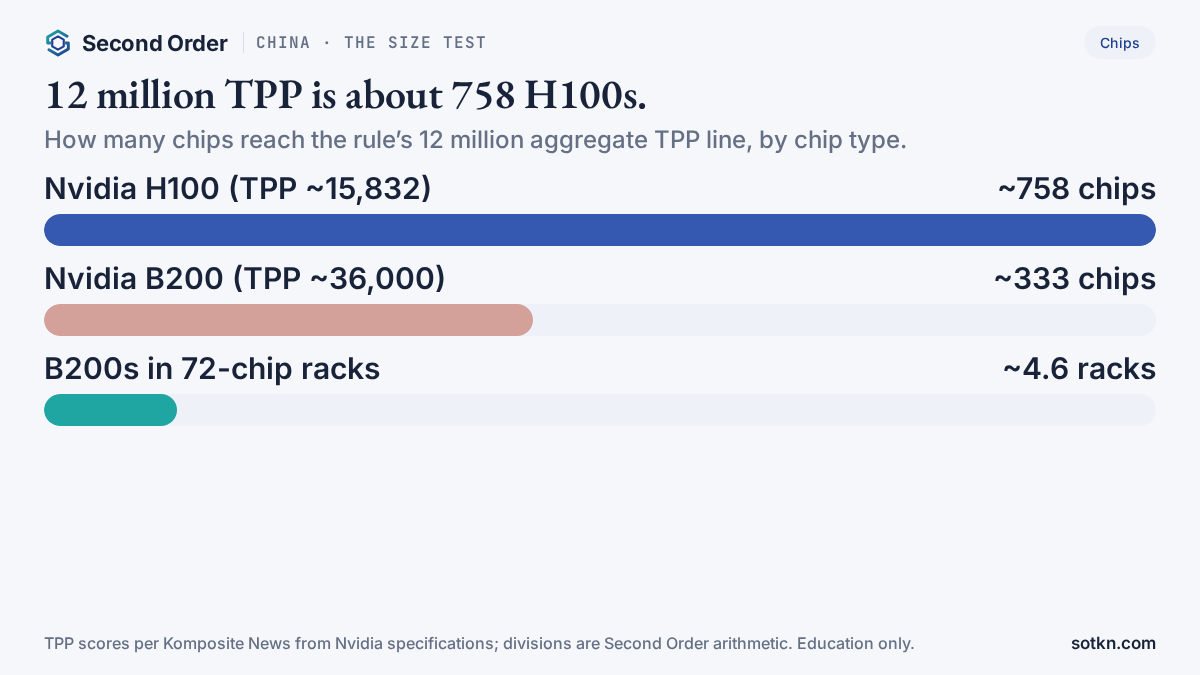
A bare number like 12 million means nothing until you turn it into chips. TPP is worked out from a chip’s dense arithmetic speed multiplied by the size of each number it handles. On published tables built from Nvidia’s own specifications, an H100 scores about 15,832 and a B200, one chip of the current Blackwell generation, about 36,000.
Our arithmetic: 12,000,000 divided by 15,832 is about 758 H100s. Divided by 36,000 it is about 333 B200s. A rack of the newest Nvidia systems holds 72 Blackwell chips, so the line sits at roughly five such racks. That is a serious training cluster for a university or a start-up. It is a rounding error for a large Chinese tech group, whose overseas deals are measured in tens of thousands of chips. So the threshold does not spare the big users. It spares small ones.
The linked-hall clause closes the obvious workaround of splitting one large job into several small buildings. If the halls are joined by a network and serve the same Chinese customer, the computing power is added up. In plain terms, the rule asks how much US-chip power is pointed at a Chinese company in total, not how big any one shed is.
How did markets read it on 17 November?
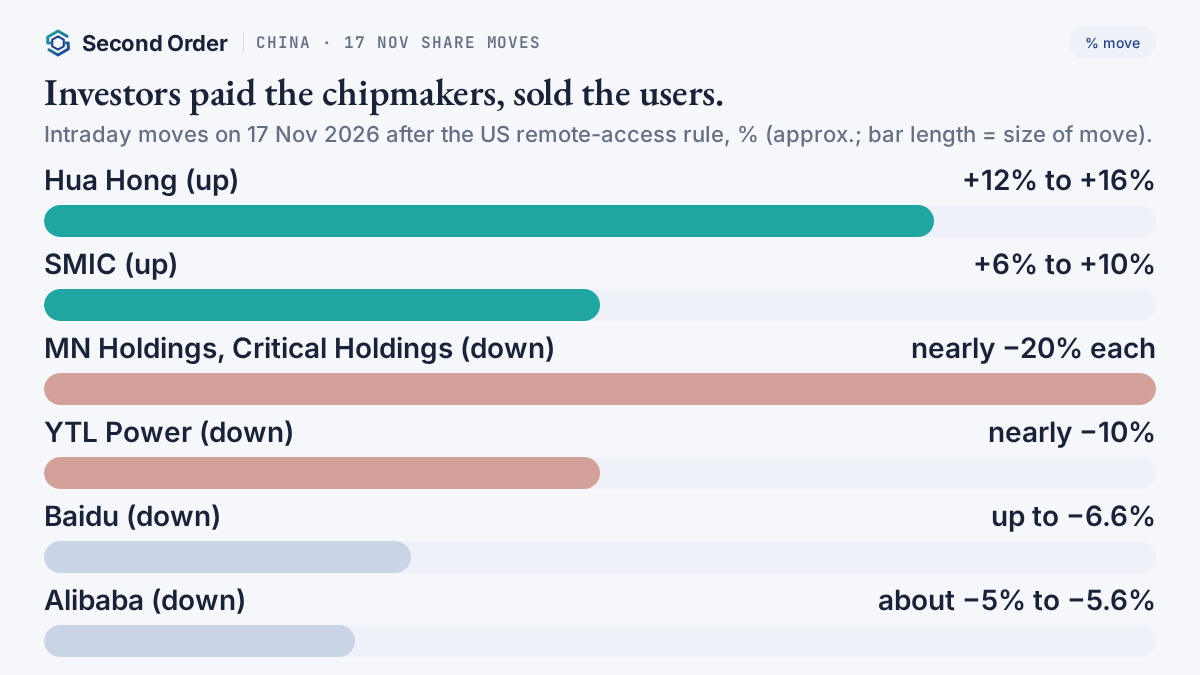
Asian markets answered on Tuesday, and they split China’s AI industry in two. The users of computing power fell. The makers of Chinese chips rose.
- Chinese AI users: Alibaba fell as much as 5.6% in Hong Kong and Baidu as much as 6.6%, pulling the Hang Seng Tech Index down 2.3%. Tencent lost about 3%. The AI model makers MiniMax and Zhipu, also called Z.ai, each fell more than 6%.
- China’s chipmakers: SMIC rose during the day by between about 6% and 10% depending on when the quote was taken, and Hua Hong by between about 12% and 16%.
- Malaysia: the data centre builders MN Holdings and Critical Holdings fell nearly 20% each, and YTL Power, an Nvidia partner on AI infrastructure, fell nearly 10%.
- Singapore: Frencken, a supplier to ASML, slid 3.91% and the chip tester AEM fell 2.9%.
- The wider chain: Japan’s Mitsui Kinzoku and Furukawa Electric and Taiwan’s Delta Electronics, Asia Vital Components and Auras Technology each fell more than 5%. Samsung and SK hynix fell as much as about 3%, Advantest about 6% and Kioxia about 7%.
- The night before in New York, Nvidia fell about 4%, and the Philadelphia chip index fell more than 5%.
These are moves during the trading day, not closes, and they landed in a market already nervous about AI spending and about Nvidia, which reports its quarter after the US close on 17 November, the first under its interim chief executive. So not every point of every fall belongs to this rule. But the split inside China is hard to read any other way. Nomura’s analysts called the rule negative for China’s AI cloud industry because less access to advanced computing could slow model training and cloud growth. Saxo’s Charu Chanana summed up the divide: what benefits China’s domestic chipmakers may hurt its AI developers.
Why can’t China just build the computing power at home?
That is the bet investors placed when they bought SMIC and Hua Hong. If Chinese labs cannot easily reach US chips abroad, they will lean harder on Chinese chips at home: Huawei’s Ascend accelerators, Cambricon’s chips and the foundries that make them (what Huawei does, the Ascend 950DT pool, Cambricon’s inventory). Counterpoint called losing remote access a severe short-term bottleneck for Chinese tech giants and a massive long-term push towards self-reliance.
The short-term part is the problem. Last week SMIC reported that its fabs ran 97.3% full in the third quarter, so full that it pushed its own research wafers aside to fit paying orders. Its co-chief executive said suppliers now quote 16 to 24 months for new chipmaking tools, and longer for the scarcest. Hua Hong’s management has been reported as saying roughly half of customer demand goes unmet (SMIC’s tool wait, Hua Hong’s full slots). So when a Chinese lab turns to domestic chips, it joins a queue that is already long, for factories that cannot grow quickly because the machines to grow them are on back order.
Memory is a second limit. A strong AI accelerator needs high-bandwidth memory stacked beside it, and China’s access to the best of it is already restricted, as our September note on HBM access set out (China’s HBM access). Halls and power at home are less of a constraint for the largest groups, which have announced big domestic build plans (Alibaba’s 20 GW plan). The building is not the gap. The chips to fill it are.
That is why the market can be right twice. SMIC and Hua Hong are likely to see even stronger demand, because more Chinese AI work has nowhere else to go. And Chinese AI labs are likely to see higher costs and slower training, because the domestic replacement cannot be built faster than tools arrive. Investors paid the factory and sold the customer.
What does the arithmetic say?
Everything below is our arithmetic from published figures, not a forecast by any company or government. The dates after 19 November assume the rule is published that day, as expected.
The size test in chips
The clocks, if published 19 Nov
Concentration at one offshore operator
Where the money sits in Southeast Asia
Two of those lines need care. DayOne’s filing describes its largest customer as a global technology company with a leading short-form video platform, and several outlets report that customer is ByteDance; DayOne does not name it. We do not know how much of that customer’s use would cross the 12 million line or which halls are linked. What the filing does show is how much one offshore operator can depend on one customer (DayOne’s Johor financing, what GDS does). The Singapore figure is from the city-state’s own statement last year and describes billing addresses, not diversion.
Rule terms per Nixon Peabody; TPP scores per Komposite News; DayOne shares per its filing as reported by Asia Tech Review; Southeast Asia figures per Reuters, 17 Nov 2026. Divisions and dates are Second Order arithmetic.
Who gets paid, and who waits?
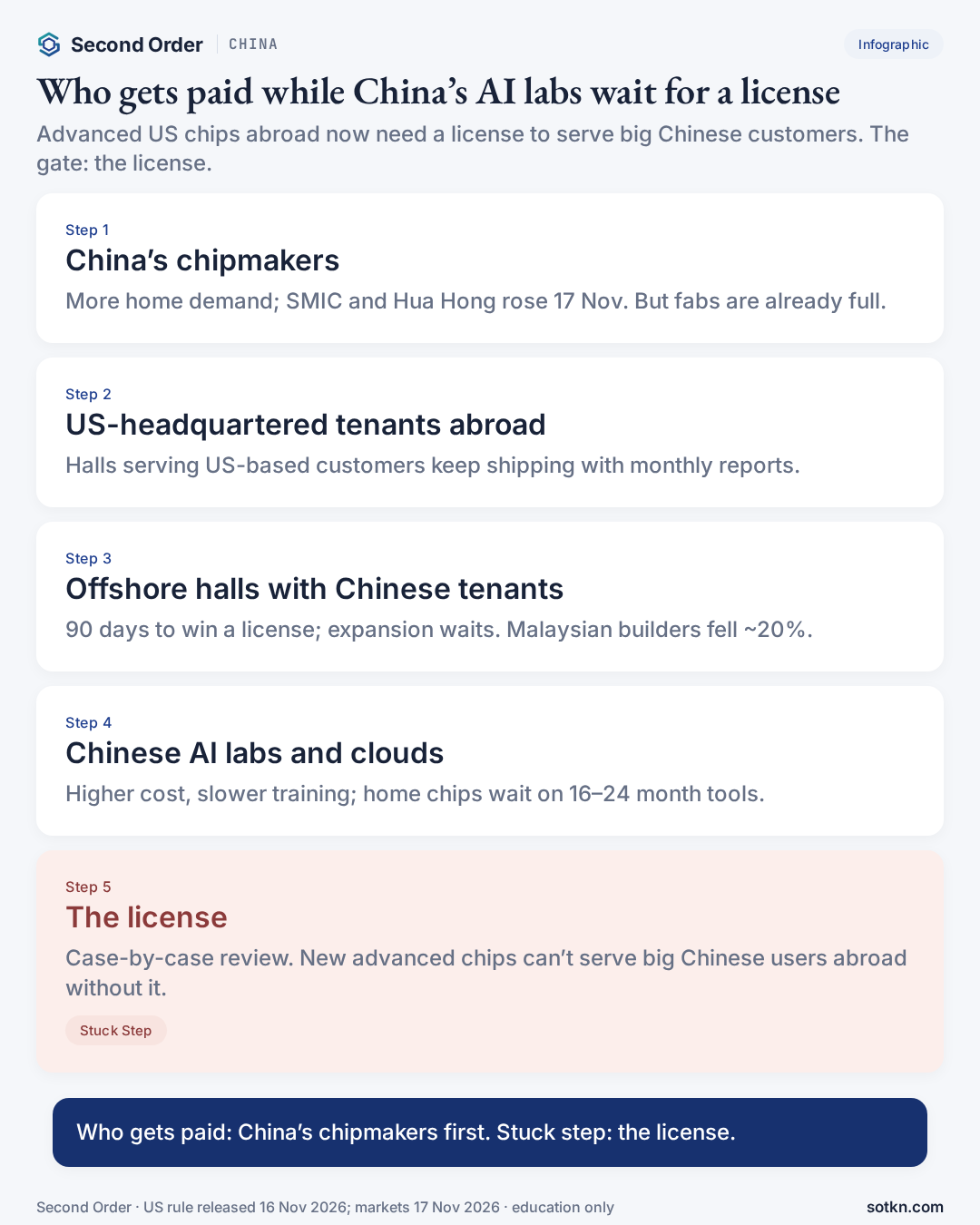
1 · China’s chipmakers
Who: SMIC, Hua Hong and the domestic accelerator makers
Paid: More demand with nowhere else to go; shares rose 17 Nov
2 · US-headquartered tenants abroad
Who: Halls in the five countries serving US-based customers
Paid: Can still ship if suppliers file monthly reports
3 · Compliance and checks
Who: Customer checks, records and license applications
Paid: Every seller and operator now needs them
4 · Offshore operators with Chinese tenants
Who: Data centres abroad serving big Chinese customers
Paid: Need a license within 90 days to keep growing
5 · Chinese AI labs and clouds
Who: Alibaba, ByteDance, Tencent, Baidu, the model makers
Paid: Higher cost, slower training while home fabs catch up
6 · The license
Who: Case-by-case review; 90-day clock for existing users
Paid: Sets when new advanced chips can serve Chinese customers abroad
First in line are China’s own chipmakers. Every lab that loses easy access to US chips abroad adds to demand for wafers at home. The catch is that they are already close to full, so the gain shows up first as pricing power and a longer order book, not as many more chips. SMIC said on its 13 November call that it follows the market on price rather than leading it. A tighter market makes following easier.
Second, data centre operators in Malaysia, Singapore and elsewhere whose customers are headquartered in the US. The new country rule exempts them if the chip exporter files monthly reports. Halls already let to US-headquartered customers can keep receiving chips; the paperwork grows, but the path stays open. For background on who those operators are, see our AI Data Centers layer and our Malaysia desk (AI Data Centers, Malaysia Markets).
Third, the people who do the checking. Chip sellers must now gather each data centre’s customer checks, keep records, and send written notices down the chain. That is real cost for operators and steady work for those who provide it. It is not a large pool of money, but it is paid on day one.
Fourth, and waiting, the offshore operators whose growth was built around Chinese tenants. If a hall already serves a big Chinese customer, it has 90 days to win a license or face future limits, and no new advanced chips can be shipped there for that customer without one. The rule, as summarised, works on shipments and changes of use, so the first thing it stops is expansion. That is why the builders who would have put up the next hall, such as MN Holdings and Critical Holdings, fell harder than the operators themselves (Malaysia’s chip pass-through).
Fifth, the Chinese AI labs and clouds. Alibaba, ByteDance, Tencent and the model makers can still use what they already reach, and can still apply. But the cheapest and fastest route to frontier chips now runs through a US license office, and the fallback runs through full Chinese fabs. Saxo’s strategist expects rising costs and slower timelines (what Tencent does).
What is stuck, exactly?
The stuck step is the license. It is not demand: Chinese labs want more computing power than ever. It is not money: the largest Chinese groups can pay. It is not the building: halls in Johor and elsewhere were built quickly. It is US permission to put new advanced chips in front of a Chinese customer, reviewed one case at a time.
The clock has three parts. First, publication: expected on 19 November, which starts every other timer. Second, the grace periods: 30 days for shipments already moving, and 90 days for data centres already serving big Chinese customers to get a license. Third, the review itself, which has no published deadline. Behind that sits the slower clock at home: 16 to 24 months for the tools that would let China’s fabs make more of their own AI chips.
There are honest reasons for caution. First, this is an interim rule; it is open for comment for 60 days and can be changed. Second, the link that the rule gives for the recommender exception was not working when the first legal summaries were written, so details may still move. Third, case by case can mean approval; some licenses may well be granted. Fourth, the rule covers advanced US chips. Older or less powerful chips, and Chinese chips, are not touched by it. Fifth, Singapore said it is studying the rule and talking to the US, and other countries may do the same. The pattern our Analysis desk keeps returning to still applies: the slow step sets the timing, and money gathers around whoever controls it (where the stuck step moves, Lam Research and the China licence).
Which dates test the read?
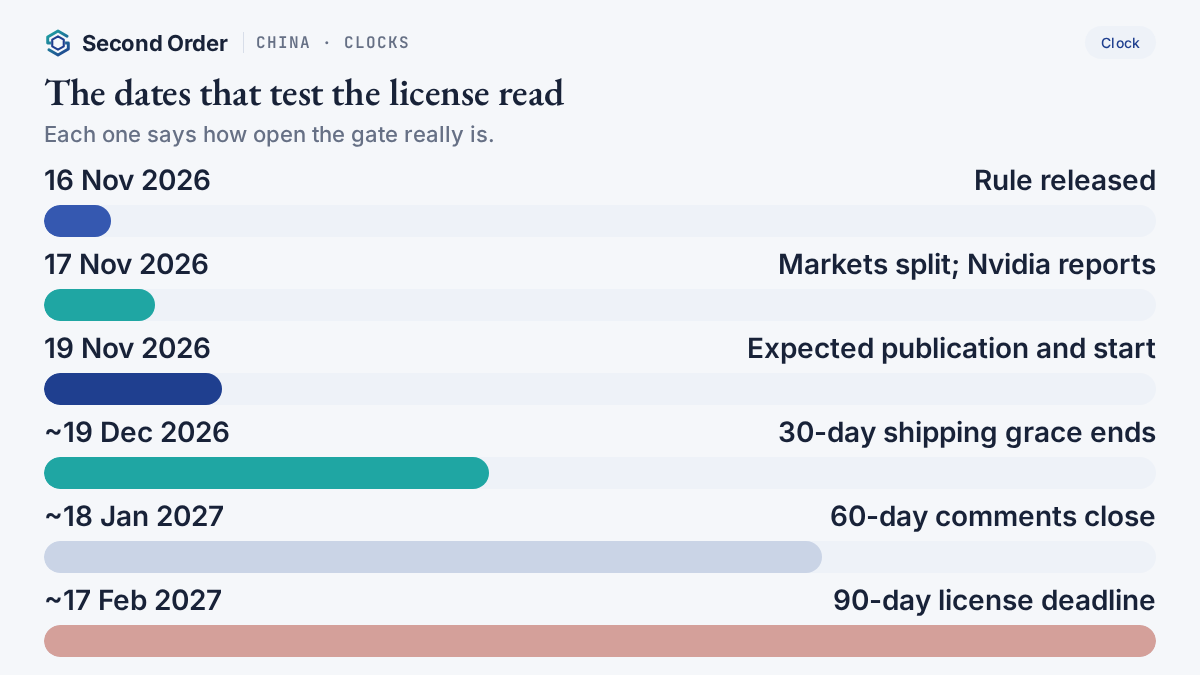
- 16 November 2026 — the rule is released.
- 17 November 2026 — Asian markets split: Chinese chipmakers up, Chinese AI users and Malaysian builders down. Nvidia reports after the US close the same day. Alibaba and Tencent also report this week.
- 19 November 2026 — expected publication in the Federal Register and the start date. From here, anyone shipping covered chips without a license must tell the buyer in writing that permission is needed.
- About 19 December 2026 — 30 days on: shipments that were already moving under the old rules must be complete (our arithmetic).
- About 18 January 2027 — 60 days on: public comments close (our arithmetic). Watch for changes to the size test or the five countries.
- About 17 February 2027 — 90 days on: data centres already serving big Chinese customers need a license (our arithmetic). The first approvals or refusals tell us how open the gate really is.
- Around February 2027 — SMIC’s fourth-quarter results: does home demand show up in prices, and do tools arrive?
Dates from the rule as summarised by Nixon Peabody and from Business Insider and Bloomberg on earnings timing. Dates after 19 Nov are Second Order arithmetic and assume publication that day.
How does this look from Malaysia, Singapore, the US and Taiwan?
From Malaysia, it is the sharpest hit. The country has approved RM385.7 billion of data centre investment since 2021, and data centre building lifted its construction sector 6% in the third quarter. Much of that is now in front of a license office whenever the tenant is Chinese (Malaysia Markets). From Singapore, the government said it takes its reputation seriously and does not condone companies using a Singapore address to break other countries’ rules (Singapore Markets).
From the US, the rule is a demand question for Nvidia and the memory makers rather than an instant earnings hit, as Saxo put it: fewer Chinese customers abroad means fewer future orders for the newest chips and the memory stacked on them (US Markets). From Taiwan, the server and cooling suppliers fell with everyone else; our Taiwan desk has already traced how export rules move the assembly lines (Taiwan’s export-control shift). For all of our China notes, see China Markets.
How we check this. The rule’s terms come from a law firm’s line-by-line summary of the interim final rule released on 16 November 2026, checked against news reports of the same document. The background to the rule comes from CNBC. Share moves come from Reuters, Bloomberg via The Edge Malaysia, and Business Insider; they are moves during the trading day on 17 November, not closing prices, and the sources caught them at different times, so we give ranges where they differ. DayOne’s customer shares come from its own US listing papers as reported. TPP scores come from a published table built on Nvidia’s own specifications. SMIC’s utilization and tool waits come from our own SMIC Pulse two days ago. Every sum we worked out, including the chip counts and the dates after 19 November, is labelled “our arithmetic”. We do not guess which data centre serves which Chinese customer when no filing says so. Price targets and ratings are left out on purpose. The references we used are listed at the end. Our editorial standards →
FAQ
What did the US announce on 16 November?
The Commerce Department released an interim final rule called Addressing Remote Access to Advanced Semiconductors. It says a license is needed to send advanced US AI chips or servers to any data centre, anywhere, that gives more than 12 million “aggregate TPP” of computing power to companies headquartered in China or other countries of concern. It also adds a license need for advanced chips going to Indonesia, Malaysia, Singapore, Thailand and Brazil. It is expected to be published and take effect on 19 November.
How big is 12 million TPP?
TPP is the export-control yardstick for raw chip arithmetic. On published scores, an Nvidia H100 is about 15,832 and a B200 about 36,000. So 12 million is roughly 758 H100s or about 333 B200s, by our arithmetic. That is a mid-sized training cluster, not a giant campus, so the test catches most serious AI work.
What is the stuck step?
The license. A data centre that already serves large Chinese AI customers has 90 days from the effective date to get one, and reviews are case by case. Until a license is granted, new advanced chips cannot be sent to serve those customers. The fallback, building at home, runs into a second wait: China’s leading foundry is already 97.3% full and says new tools take 16 to 24 months.
Who gets paid first?
On 17 November investors paid China’s domestic chipmakers: SMIC and Hua Hong rose while Alibaba, Tencent, Baidu and the AI model makers fell. Data centre operators whose customers are headquartered in the US can still ship under the new country rule if their suppliers file monthly reports. Operators that depend on Chinese tenants, and the Malaysian builders around them, wait.
Is this investment advice?
No. Education only. It maps who gets paid and which step is stuck. It is not a recommendation to buy or sell any security, and we leave out price targets and ratings on purpose.
References
Outbound links below are nofollow. We list only the sources actually used. Internal sotkn.com links in the body are separate.
- Nixon Peabody, BIS targets remote access to advanced chips through overseas data centers, 16–17 Nov 2026. nixonpeabody.com — the rule’s terms: the 12 million TPP test, linked data centres, know-your-customer checks, no de minimis, the recommender carve-out, the five countries, monthly reports, the 30, 60 and 90 day clocks and the expected 19 November publication.
- CNBC, Nvidia fallout: Commerce targets loophole for China’s data center use, 16 Nov 2026. cnbc.com — the background to the rule, the Megaspeed reports, Senator Cantwell’s letter, and who wrote the rule.
- Reuters via Investing.com, US AI chip curbs threaten Southeast Asia data centre boom, shares slump, 17 Nov 2026. investing.com — share moves in Malaysia, Singapore, China, Japan and Taiwan; Malaysia, Thailand and Singapore investment figures; analyst quotes; the Singapore government statement.
- The Edge Malaysia (Bloomberg), Chinese AI stocks down as US chip curbs hit labs and hyperscalers, 17 Nov 2026. theedgemalaysia.com — Hong Kong and Shanghai share moves, the Nomura note, and the earnings due this week.
- Business Insider, Asian tech stocks are getting caught in a fresh AI squeeze, 17 Nov 2026. businessinsider.com — later intraday moves in SMIC and Hua Hong, and the timing of Nvidia’s results.
- South China Morning Post, US tightens AI chip export curbs to close China’s overseas data centre loophole, 16–17 Nov 2026. scmp.com — which headquarters the rule covers: mainland China, Hong Kong, Macau and arms-embargoed countries.
- Asia Tech Review, DayOne Data Centers is hugely reliant on TikTok as it tests IPO waters, 2026. asiatechreview.com — DayOne’s own disclosure of how much revenue comes from its two largest customers.
- Komposite News, The H200 licence rule, line by line, 2026. kompositenews.com — TPP scores for the H100, H200 and B200 used in our chip-count arithmetic.
- MarketWatch, China’s Hua Hong defies global tech selloff on strong earnings, 6 Nov 2026. marketwatch.com — the Bernstein account of Hua Hong management saying roughly half of customer demand is unmet.
Not investment advice. Do your own research. Education only. Map of who gets paid and which step is stuck — not a buy list.
More on this desk: China Markets · AI Data Centers · GPU cloud providers explained · SMIC’s tool wait · all Markets.