What Does GDS Do? China's Big Data Center Landlord, Explained
GDS Holdings builds and runs large data centers around Shanghai, Beijing and Shenzhen and in China's power-rich west, renting space and power to cloud and internet giants. It has 784,802 sqm committed, but almost a third is not yet in use.
GDS Holdings Limited (Nasdaq: GDS; Hong Kong: 9698) is a Shanghai-based company that builds and runs large data centers in mainland China and rents the space, power and cooling inside them to cloud providers and internet companies. At 30 June 2026 it had 684,977 square metres of data center floor in service, 170,355 more under construction, and customers committed to 784,802 square metres in all. It earns about RMB3.1 billion (US$455 million) a quarter. It also owns about a fifth of DayOne, the Singapore-headquartered data center company it spun out. The catch: almost a third of the space customers have committed to is not yet in use, so it is not yet earning full rent.
AI DATA CENTERS · Data as at 30 Jun 2026 · Next update: after GDS's Q3 2026 results (date not yet announced in its filings)
Affects: AI Data Centers · Hyperscalers · China · Singapore
GDS is the first mainland China company on the AI Data Centers layer. It sits in the same job as Equinix and Digital Realty: it owns the building, the power connection and the cooling, and the customer brings its own servers. Its customers are mostly the large Chinese cloud and internet platforms, the kind of buyers covered on our Alibaba and Tencent pages. GDS does not name its customers in its filings. Read What Is an AI Data Center? and Hyperscale vs Colocation Data Centers first if the terms are new.
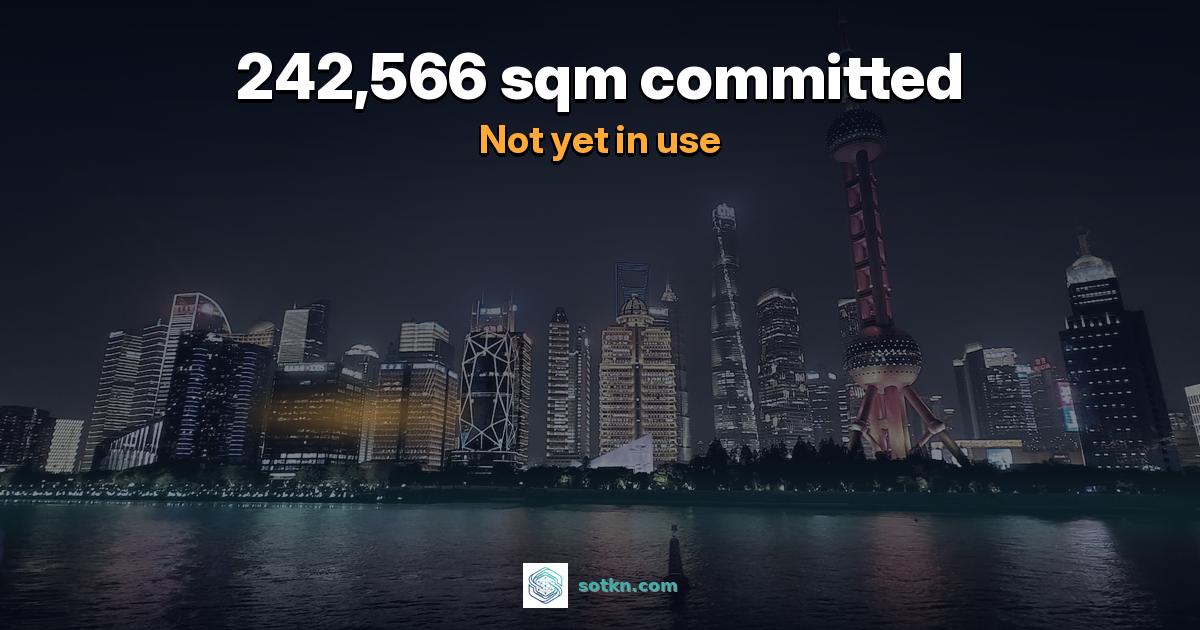
In short: GDS secures land, power quotas and grid connections in and around China's big cities and in western power hubs, builds large data halls, and rents them to cloud and internet companies on contracts of three to ten years. It charges for floor space or power capacity, plus the electricity customers actually use. Colocation was 90.8% of its 2025 revenue. It has 3.7 GW of land and power held for future building. Separately, it owns about 19.9% of DayOne, which GDS valued at over US$2.2 billion in April 2026. The stuck step is move-in: 242,566 square metres committed by customers were not yet being used at 30 June 2026 (our arithmetic), and GDS mostly bills only once customers move in.
Education only, not advice to buy or sell any security. Figures are from GDS's second-quarter 2026 results release of 13 August 2026, its first-quarter 2026 results release of 20 May 2026, its 2025 annual report on Form 20-F of 29 April 2026, its fourth-quarter 2025 results release of 17 March 2026 and its shareholder meeting results of 10 March 2026, all filed with the US SEC. GDS reports in renminbi (RMB); US dollar figures use the rate GDS itself used (RMB6.7851 to US$1 for June 2026). GDS measures capacity in square metres of net floor area, not megawatts, except where stated.
Numbers that matter
Area committed
784,802 sqm
Committed and pre-committed by customers at 30 Jun 2026, up 18.2% in a year · Q2 2026
Growing
Area in use
542,236 sqm
79.2% of the 684,977 sqm in service is actually used by customers · 30 Jun 2026
Ramping
Committed, not yet in use
242,566 sqm
About 31% of committed space, waiting for move-in or for halls still being built (our arithmetic) · 30 Jun 2026
Bind
Q2 2026 revenue
RMB3,088.0m
US$455.1m, up 6.5% on a year earlier; adjusted EBITDA RMB1,406.0m (45.5% margin)
Steady
2026 capex plan
RMB10bn
Raised from about RMB9bn in August 2026 on stronger sales; 2026 adjusted EBITDA guided at RMB5.9–6.1bn
Spending
DayOne stake
~19.9%
Valued by GDS at over US$2.2bn (April 2026); DayOne had 1,250 MW of IT power committed at end-2025
Option
Status chips are Second Order's read. Area, revenue, guidance and the DayOne valuation are GDS's own figures. The 242,566 sqm and the 31% share are our arithmetic (784,802 − 542,236, divided by 784,802).
What does GDS actually do?
Secure the land and the power quota. Build big halls. Sign cloud and internet tenants. Wait for them to move in. Bill for space, power and electricity.
Power quota first. Building second. Commitment third. Move-in and billing last.
- It finds sites where it can get power approved. In China a data center needs a fixed-asset investment filing and an energy conservation review opinion, which sets its energy quota, before it can get power. GDS runs most of its business in and around Shanghai, Beijing, Shenzhen, Guangzhou and Chengdu/Chongqing, which it calls established markets, for low-latency uses. It is also building in new growth markets such as Inner Mongolia, Ningxia and Shaoguan, where land and power are easier to get, for large computing clusters that do not need to sit near users. Power comes from three grid companies, State Grid, Southern Grid and Mengxi Grid, and GDS has to fund the power infrastructure it needs, including assets outside its own sites.
- It designs and builds the halls itself. GDS does its own design, costing and project management, uses a modular, prefabricated build method, and starts construction six months to more than two years before delivery. At the end of 2025 it ran 90 self-developed data centers and had 98 in service or under construction, with 3.7 GW of land and power it estimates it can still develop.
- It signs large customers before the space is ready. At 30 June 2026, 89.2% of the 170,355 square metres under construction was already pre-committed. Cloud and large internet customers sign for three to ten years; banks and other enterprises for one to five. In the first quarter of 2026 GDS reported about 200 MW of net new bookings, its highest ever for one quarter.
- It bills when customers move in. GDS says it does not usually charge for reserving capacity before the service period starts. The gap between committed and utilised space is, in its own words, mainly customers who have signed but not yet started using revenue-generating services.
- It recycles finished buildings into investors' money. In 2025 GDS sold a 70% interest in several data centers into an asset-backed scheme led by China Life Insurance, and sold two stabilised data centers in Kunshan to a new Shanghai-listed infrastructure REIT (C-REIT), keeping 20% of its units. The cash goes back into new building. In the June 2026 quarter it moved a subsidiary internally to prepare a possible second injection into the C-REIT.
| Measure, 30 Jun 2026 | Amount | What it tells you |
|---|---|---|
| Area in service | 684,977 sqm | Finished floor GDS can rent today, up 10.8% in a year |
| Committed share of area in service | 92.4% | Almost all finished space is spoken for |
| Area utilised | 542,236 sqm | Space customers actually use, so it earns full revenue |
| Utilisation rate | 79.2% | Up from 77.5% a year earlier |
| Area under construction | 170,355 sqm | Up 43.9% in one quarter |
| Pre-committed share of construction | 89.2% | Up from 74.7% a year earlier |
Most of GDS's money comes from colocation: renting space, power, racks and cooling. In 2025 colocation earned RMB10,373.4 million, 90.8% of net revenue, and managed services and other services the remaining 9.2%. At the end of 2025 it served 989 customers. Cloud service providers made up 56.0% of committed area, large internet companies 33.3%, and banks and other enterprises 10.7%.
How does GDS make money?
Two prices, and both are fixed per contract. Cloud and internet customers mostly pay unbundled prices: a price per square metre or per kilowatt for the right to use the space and power capacity, plus a price per kilowatt-hour for the electricity they actually use. Banks and other enterprises mostly pay bundled prices per rack or cabinet, with electricity included up to a stated limit.
- Space and power capacity fees. Fixed over the contract term, apart from permitted changes when grid power tariffs change, according to its 2025 annual report.
- Electricity re-billed to customers. Under unbundled contracts, customers pay for the power they consume. GDS says its gross margin fell to 21.5% in the June 2026 quarter from 23.8% a year earlier, mainly because utility costs rose as a share of revenue.
- Managed services. Hosting, network, storage, security and cloud-related services on top of the space: 9.2% of 2025 revenue.
- Asset recycling. Selling stabilised buildings into the ABS scheme and the C-REIT brought a RMB2,364.1 million gain on deconsolidation in 2025, and GDS also earns fees for running the C-REIT's data centers (RMB7.8 million in 2025).
- The DayOne stake. GDS no longer consolidates DayOne. Its share of DayOne shows up as equity-method income, and in the first half of 2026 that was dominated by dilution gains as DayOne raised new money at higher prices.
In the June 2026 quarter, net revenue was RMB3,088.0 million (US$455.1 million), up 6.5% on a year earlier, and adjusted EBITDA was RMB1,406.0 million, a 45.5% margin. Net income was RMB837.6 million, but RMB959.9 million of income from equity-method investees, mainly the DayOne dilution gain, was larger than the whole net income figure. Without that line, the quarter would have shown a loss of about RMB122 million before any tax effects (our arithmetic: 837.6 − 959.9). In August GDS raised its 2026 guidance to RMB12.7–13.0 billion of revenue and RMB5.9–6.1 billion of adjusted EBITDA, and lifted planned capex to about RMB10 billion from about RMB9 billion.
As a rough guide to what a used square metre earns, net revenue in the June quarter was about RMB5,800 per square metre of average utilised area (our arithmetic: 3,088.0 million ÷ the 531,583 sqm average of the March and June figures). That figure includes managed services and electricity, so it is not a rent quote.
Who gets paid. GDS, when customers move in. The grid companies, for power and for the connection works GDS often funds. Lenders and convertible bondholders. Buyers of the ABS and C-REIT units, from the stabilised buildings. Who pays. Mostly a handful of Chinese cloud and internet platforms, monthly, for three to ten years. Money sticks once a customer has moved in and starts drawing power; before that, GDS carries the building.
What limits it?
Move-in first. Funding second. Policy third.
- Committed is not the same as billing. 242,566 square metres committed by customers were not in use at 30 June 2026 (our arithmetic). That is roughly 90,700 square metres of finished but unused committed space plus about 152,000 square metres pre-committed in buildings still under construction (our arithmetic from GDS's commitment rates). Every quarter a move-in slips, revenue arrives later, while GDS says depreciation starts as soon as a data center enters service. GDS's own committed totals for its top five customers include some space under non-binding agreements or letters of intent, so not every committed square metre is a binding contract.
- Building costs more than it earns each year. Planned 2026 capex of about RMB10 billion is around 1.7 times guided adjusted EBITDA of RMB5.9–6.1 billion (our arithmetic). The difference has to come from borrowing, asset sales into the ABS scheme and C-REIT, and money raised from DayOne shares or new securities. GDS says in its annual report that it does not expect its revenue in the short term to be enough to offset rising capex. In early 2026 it raised US$685 million from selling DayOne shares and from US$300 million of convertible preferred shares sold to Huatai Capital with a minimum 3.75% annual dividend.
- It carries a lot of debt. At 30 June 2026 total debt was RMB46,131.0 million (US$6,798.9 million) against RMB14,927.3 million of cash (our arithmetic for the total). That is about 8.2 times annualised June-quarter adjusted EBITDA gross and about 5.5 times net of cash (our arithmetic). Holders of US$620 million of convertible notes due 2029 can ask GDS to buy them back on 8 March 2027, which matches the RMB4,219.0 million (US$621.8 million) of convertible bonds now shown as short-term debt.
- Few customers, and unnamed. GDS's largest customer took 29.0% of 2025 revenue and 37.9% of committed area; the second took 12.0% of revenue and 11.8% of area. No other customer passed 10%. GDS does not name them.
- Power is rationed by policy. New hyperscale data centers above a size threshold have faced extra review since 2025, covering industry experience, funding sources and customer demand. Energy conservation reviews now include carbon emission assessments, and some local authorities can order shutdowns or cut grid supply for projects without the right approvals.
- AI chips are a policy risk too. GDS's annual report says US export controls on advanced computing items may affect AI-related demand for data centers in China. Some customers have also said they will only sign with providers controlled by Chinese nationals. That is why shareholders approved raising the founder's Class B votes from 20 to 50 per share on 10 March 2026.
Where the filings are silent we say so. GDS does not name its customers, publish rent per square metre or per kilowatt, give a megawatt figure for its own operating capacity, or say when specific committed space will move in. It does not break out how much of its bookings are for AI training or inference. We do not estimate those. We also have not used GDS's Hong Kong interim report filed on 4 September 2026; figures here come from the SEC releases and annual report listed below.
Who else does this?
Roles, not a league table.
| Company | What it does | What makes it different |
|---|---|---|
| GDS | Builds and runs large data centers in mainland China for cloud and internet platforms | Bills mostly per square metre or kilowatt plus electricity; recycles finished buildings through a C-REIT and an ABS scheme |
| DayOne | Singapore-headquartered data center platform spun out of GDS | Builds outside mainland China, including in Johor, Malaysia; GDS owns about 19.9% |
| Equinix | Global data center landlord and interconnection hub | Many smaller tenants and cross-connects rather than a few giant ones |
| Digital Realty | Global wholesale data center landlord | Large single-tenant halls, much like GDS's hyperscale deals, but outside mainland China |
| Keppel DC REIT | Singapore-listed REIT that owns finished data centers | The kind of buyer of stabilised buildings that GDS's C-REIT plays in China |
| Alibaba | Chinese cloud provider that builds and rents data center capacity | The type of customer GDS serves; GDS does not say which clouds it hosts |
What separates GDS is where it is and how it funds itself. It is a Nasdaq- and Hong Kong-listed operator focused on mainland China, and its buyers are a short list of Chinese platforms. Unlike US landlords, it measures capacity in square metres, gets power through quota approvals rather than open interconnection queues, and funds new building partly by selling finished halls to domestic REIT and ABS investors. Its shareholder register also links it back to Singapore: STT Garnet, part of ST Telemedia, owned about 29.4% of its Class A shares at 31 March 2026, and its spin-out DayOne is headquartered there.
What would change this view?
The read on the model weakens if:
- Utilisation stops rising toward the commitment rate, which would mean committed space is moving in more slowly.
- Pre-commitment on space under construction falls back from 89.2% toward the 66.1% it was at the end of 2025.
- A second C-REIT injection or new ABS deal fails to price, leaving more capex to be funded with debt.
- Holders put the US$620 million 2029 convertible notes in March 2027 and refinancing costs more.
- US export rules or Chinese power and energy-quota rules tighten enough to slow AI-related bookings.
- DayOne raises money at a lower valuation, cutting the value of GDS's 19.9% stake.
The read stays intact while utilisation keeps climbing, the space under construction is delivered and moved into, 2026 lands inside the raised guidance and capex keeps being funded partly through asset recycling rather than only new debt.
Practical takeaways
- GDS builds and runs data centers in mainland China and rents space, power and cooling to cloud and internet platforms: 90.8% of 2025 revenue was colocation.
- Customers had committed to 784,802 square metres at 30 June 2026, but only 542,236 were in use: about 31% is still waiting for move-in (our arithmetic).
- It mostly bills once customers move in, at prices fixed for three to ten years plus the electricity they use.
- 2026 capex of about RMB10 billion is larger than its guided adjusted EBITDA, so asset sales into its C-REIT and ABS, DayOne proceeds and debt fill the gap.
- Its 19.9% stake in Singapore-based DayOne is a separate asset that GDS valued at over US$2.2 billion; much of its 2026 net income so far came from DayOne dilution gains rather than its data centers.
FAQ
What does GDS Holdings do?
GDS Holdings builds and runs large data centers in mainland China, mainly around Shanghai, Beijing, Shenzhen, Guangzhou and Chengdu/Chongqing and in western power hubs such as Inner Mongolia and Ningxia. It rents space, power and cooling to cloud providers, internet companies, banks and other businesses, and also owns about 19.9% of DayOne, a data center company headquartered in Singapore.
Is GDS a Chinese company?
GDS Holdings Limited is a Cayman Islands holding company headquartered in Shanghai. It runs substantially all of its data center business in mainland China through subsidiaries and consolidated variable interest entities, and is listed on Nasdaq (GDS) and in Hong Kong (9698).
Who are GDS's customers?
Mostly Chinese cloud service providers and large internet companies, which made up 56.0% and 33.3% of its committed area at the end of 2025. Its largest customer generated 29.0% of 2025 revenue. GDS does not name its customers in its filings.
What is DayOne and how is it related to GDS?
DayOne is a Singapore-headquartered data center platform, formerly GDS International, that GDS set up in 2022 and spun out. After outside investors joined, GDS's stake fell to about 19.9% by April 2026, and GDS valued that stake at over US$2.2 billion based on DayOne's Series C price. At the end of 2025 DayOne had 1,250 MW of IT power committed.
How big is GDS?
At 30 June 2026 it had 684,977 square metres of data center floor in service, 170,355 under construction and 784,802 committed by customers. At the end of 2025 it ran 90 self-developed data centers and held about 3.7 GW of land and power for future development. Revenue was RMB3,088.0 million (US$455.1 million) in the June 2026 quarter.
Is GDS stock a good investment?
We do not make buy or sell calls, and nothing here is a recommendation. We can tell you what it owns, who pays it and which numbers would change the picture. The decision is yours.
Keep reading on the map
- The layers: AI Data Centers · Hyperscalers · China market notes
- The terms: Hyperscale vs Colocation Data Centers · Contracted Power Explained · Data Center Leases Explained · Data Center Financing Explained
- The customers: What Does Alibaba Do? · What Does Tencent Do? · Alibaba's 20 GW plan
- Other Asia landlords: What Does Keppel DC REIT Do? · What Does Digital Core REIT Do? · What Does NEXTDC Do? · What Does Nxera Do?
- Where it happens: Where Are AI Data Centers Located? · DayOne's Johor financing
For the wider picture of signed capacity waiting on buildings and move-in, read If $1.1 Trillion of Leases Waits on Handover, Where Does Cash Stick?. This page stays the free Stack read of the GDS model.
Sean
Writes Second Order by TKN — a plain-English map of AI infrastructure. Who gets paid, where money sticks, which step is stuck. Not investment advice.
Author page → · Editorial standards →
How we check this
Figures come from GDS's second-quarter 2026 results release (13 August 2026), its first-quarter 2026 results release (20 May 2026), its 2025 annual report on Form 20-F (29 April 2026), its fourth-quarter and full-year 2025 results release (17 March 2026) and its shareholder meeting results (10 March 2026), all filed with the US SEC and listed below. Where we work something out ourselves, the arithmetic is shown in full. GDS does not name its customers, publish unit prices, give a megawatt figure for its own operating capacity or give move-in dates for committed space, so we do not estimate those. Social media posts and press reports are not used.
Last reviewed: 2 Nov 2026 · Next review: after GDS's Q3 2026 results (date not yet announced in its filings)
Spot an error? Tell us and we will correct it and note the change here.
Our editorial standards →
References
- GDS Holdings Limited, GDS Holdings Limited Reports Second Quarter 2026 Results (Form 6-K, Exhibit 99.1) (company, SEC exhibit 99.1), 13 Aug 2026 — net revenue RMB3,088.0m, adjusted EBITDA RMB1,406.0m, 784,802 sqm committed, 684,977 sqm in service, 542,236 sqm utilised, 170,355 sqm under construction (89.2% pre-committed), debt and cash, DayOne dilution gain, raised 2026 guidance and RMB10bn capex
- GDS Holdings Limited, GDS Holdings Limited Reports First Quarter 2026 Results (Form 6-K, Exhibit 99.1) (company, SEC exhibit 99.1), 20 May 2026 — about 200 MW of net new bookings in the quarter, US$385m DayOne share sale, remaining DayOne stake over US$2.2bn and about 19.9%, US$300m convertible preferred shares to Huatai Capital
- GDS Holdings Limited, Annual Report on Form 20-F for the fiscal year ended December 31, 2025 (company, SEC filing), 29 Apr 2026 — business model, 90 self-developed data centers, 3.7 GW developable resources, contract terms and pricing, 989 customers and concentration, colocation 90.8% of revenue, power and regulatory risks, export controls, C-REIT and ABS deals, DayOne 1,250 MW committed, convertible note put dates, STT Garnet holding
- GDS Holdings Limited, GDS Holdings Limited Reports Fourth Quarter and Full Year 2025 Results (Form 6-K, Exhibit 99.1) (company, SEC exhibit 99.1), 17 Mar 2026 — 2025 bookings and move-in at a five-year high, US$685m raised from the DayOne share sale and preferred shares, original 2026 guidance and RMB9bn capex plan
- GDS Holdings Limited, GDS Announces Results of Extraordinary General Meeting and of Additional Shareholders Meetings (Form 6-K, Exhibit 99.1) (company, SEC exhibit 99.1), 10 Mar 2026 — shareholders approve raising the founder's Class B voting power from 20 to 50 votes per share