
Sydney Down 3.6 GW, Melbourne Up 1.7 GW: Who Gets Paid While Australia’s Data Centres Wait on the Permit
A new industry forecast shows Australia’s data centre pipeline up 5.2 GW since April, with Sydney down 3.6 GW and Melbourne up 1.7 GW. Only 0.1 GW was switched on. Melbourne’s fast permits did the sorting, and now that lane is pausing for an election.
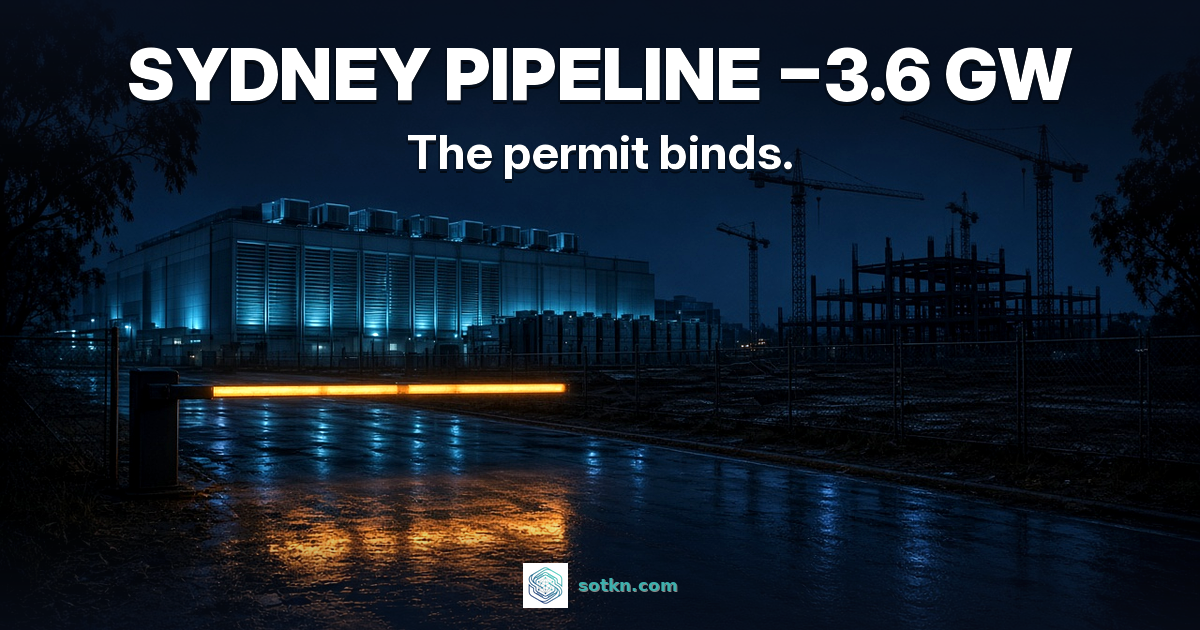
On 30 October, Australia’s data centre industry body published its twice-yearly count of what is really being built. In six months the national pipeline grew by 5.2 gigawatts, to 26.8. Capacity under construction doubled. But the part that is actually switched on rose by just 0.1 gigawatts. And the map moved. Sydney’s pipeline shrank by 3.6 gigawatts; Melbourne’s grew by 1.7 and is now the bigger of the two. The report puts much of that down to one thing: how fast each state hands out permits. That same week, Victoria’s councils asked for a moratorium, the state headed into an election pause, and Canberra asked for a new test before any big hall connects. The stuck step is the permit.
AUSTRALIA PULSE · AI DATA CENTERS · Data as at 30 Sep 2026 (report 30 Oct) · Next update: Victorian election 28 Nov and the next forecast report, around April 2027
Affects: AI Data Centers · NEXTDC · Equinix — Markets: Australia · Singapore · Malaysia
Education only, not advice to buy or sell any security. Capacity figures are IT load in gigawatts (GW) as published in the 30 October report, using data at 30 September, rounded to 0.1 GW. Our own sums are labelled.
The numbers that matter this week
Total pipeline
26.8 GW
21.6 GW in April · +5.2 GW in six months
GrowingSwitched on
1.6 GW
+0.1 GW since April · 163 operating sites
SlowUnder construction
0.4 GW
Doubled from 0.2 GW · split Sydney / Melbourne
BuildingSydney pipeline
−3.6 GW
11.4 → 7.8 GW · early stage 8.6 → 4.2 GW
ShrinkingMelbourne pipeline
+1.7 GW
9.0 → 10.7 GW · committed 1.0 → 2.2 GW
Fast permitsVictoria’s permit lane
Paused
Caretaker 3 Nov · election 28 Nov · new rules since 23 Sep
Stuck stepData Centres Australia and DC Byte, Forecast Report Issue 2 (30 Oct 2026; data at 30 Sep). Victorian dates from the state and ABC News. Status chips are Second Order’s read.
On this page: Why it matters · The ladder · Six months · Two cities · Victoria now · Canberra’s test · Elsewhere · Our math · Who gets paid · What is stuck? · Dates next · FAQ
Why does an industry head count matter?
Because most numbers about Australian data centres are wish lists. The market operator’s latest power outlook lists 225 data centre projects adding up to 67 gigawatts. For scale, the whole eastern power market has about 77 gigawatts of generation. Nobody expects all of that to be built. A data centre needs land, a grid connection, power contracts, a building permit and customers before it uses a single watt (what is an AI data center?).
The forecast from Data Centres Australia, the industry’s peak body, and DC Byte, a data centre research firm, tries to strip out the wish list. It removes duplicate and speculative projects and sorts the rest into four phases by how likely they are to be finished. Its total, 26.8 gigawatts, is about 40% of the market operator’s list (our arithmetic). And because it is the second edition, we can now see what moved between April and September.
What moved is the useful part. It shows where projects are getting stuck, and where they are getting through. The short answer: more projects are getting the paperwork done, far fewer are getting switched on, and the paperwork is sorting them by state. So the chain looks like this.
1 · Land and a grid offer
Who: Site bought or optioned; network says power can come
Paid: Landowners and network planners paid first
2 · The permit
Who: State or council approval to build; soon a firm-power test too
Paid: Decides which projects become “committed”
3 · The build
Who: Shell, then power and cooling fit-out
Paid: Builders and equipment makers paid now
4 · The switch-on
Who: Power energised; customers move in and start paying
Paid: Owners and lenders paid last
How does a project climb from plan to power?
The report uses four rungs. Early stage is any credible project that has not yet secured everything it needs, such as land, power or permits, and may or may not happen. Committed means DC Byte has high confidence it will be built: to the best of its knowledge it has land, power and permits secured, or it is being built by an operator with a strong record. Under construction means the data halls are being fitted out with their electrical and mechanical gear. Operational means fitted halls that are live and available, whether or not customers are using them yet.
Each rung has a different owner of the delay. Getting from early stage to committed is mostly about permission: the planning approval, the environmental sign-off and an agreement with the network. Getting from committed to switched on is about building and about the power physically arriving at the gate. That second part usually takes two to three years for a large hall (how long it takes to build an AI data center), while new transmission lines can take five to ten.
So the report gives two readings at once. Movement into committed tells you where permits are being granted. Movement into operational tells you where power is being switched on. Between April and September, the first moved a lot and the second barely moved at all.
What changed between April and September?
Nationally, every rung grew. Operating capacity rose from 1.5 to 1.6 gigawatts. Capacity under construction went from 0.2 to 0.4 gigawatts. Committed capacity rose from 3.1 to 5.2 gigawatts, the biggest jump in proportion. Early-stage capacity rose from 16.8 to 19.6 gigawatts. The total went from 21.6 to 26.8.
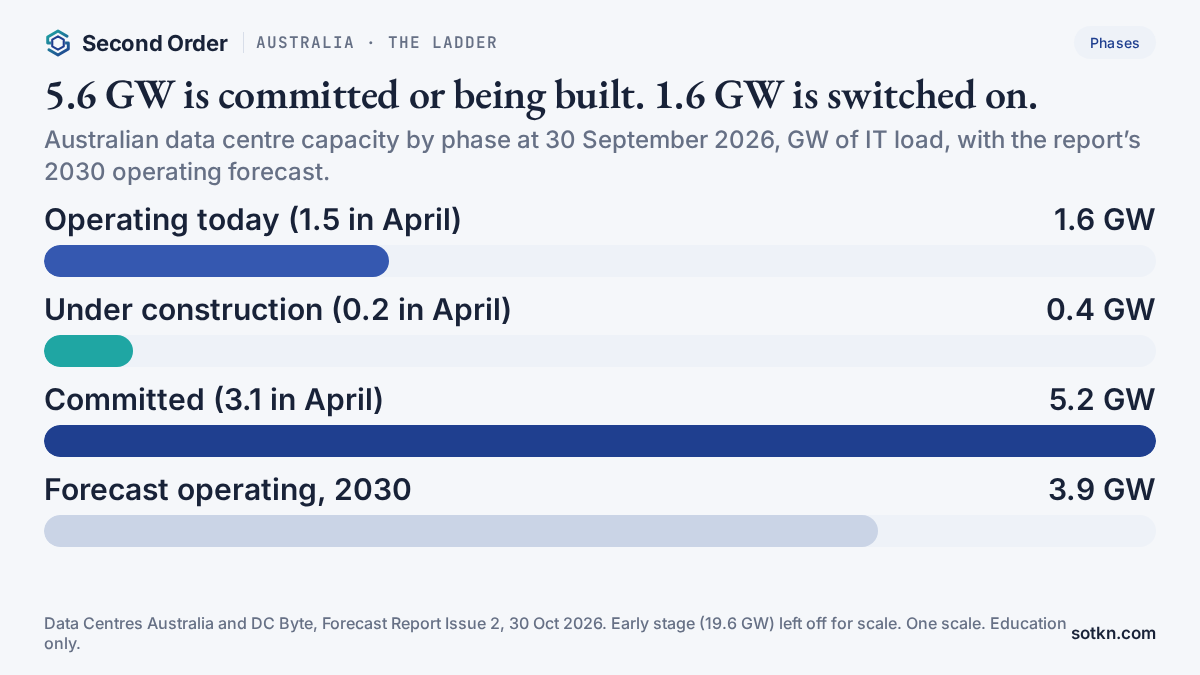
Look at the bottom two rungs together. There are now 5.6 gigawatts that are committed or being fitted out, against 1.6 gigawatts switched on (our arithmetic). The report’s own forecast expects operating capacity to reach about 1.8 gigawatts by the end of 2026, 2.3 by 2027, 2.7 by 2028, 3.4 by 2029 and 3.9 by 2030. That forecast is about 20% higher than April’s, which had 3.2 gigawatts for 2030.
Two things stand out. First, getting from 1.6 to 1.8 gigawatts by December means switching on about 0.2 gigawatts in one quarter, after 0.1 gigawatts in the previous six months (our arithmetic, on rounded figures). Second, even the 2030 forecast only adds about 2.3 gigawatts. That is roughly 40% of what is already committed or being built (our arithmetic). The researchers are not saying the rest will fail. They are saying it will take longer than the press releases suggest.
The scale of the halls is changing too. Only four operating Australian data centres have more than 100 megawatts live. In the pipeline, 52 of 97 projects plan more than that. The pipeline added seven projects in six months: two fewer in New South Wales, five more in Victoria and two in other states.
On our read, this is the gap behind the headlines of the past month. NEXTDC’s Melbourne halls were built and sold before the extra power arrived, as our earlier Pulses showed (the Melbourne power delay; the guidance cut). AirTrunk’s new Sydney loan is tied to a switch-on date in mid-2028 (the SYD3 loan). The forecast puts a number on how big that gap has become across the whole country.
Why did Sydney shrink and Melbourne grow?
This is the sharpest part of the report. Sydney’s total pipeline fell from 11.4 to 7.8 gigawatts. Almost all of the fall was in early-stage projects, which dropped from 8.6 to 4.2 gigawatts. Sydney’s committed capacity rose from 1.9 to 2.6 gigawatts, operating capacity from 0.8 to 0.9, and capacity under construction stayed at 0.1.
Melbourne went the other way. Its total rose from 9.0 to 10.7 gigawatts and is now larger than Sydney’s. Its committed capacity more than doubled, from 1.0 to 2.2 gigawatts, close to Sydney’s 2.6. Under construction went from 0.1 to 0.2 and operating from 0.4 to 0.5. Early stage grew only a little, from 7.5 to 7.8.
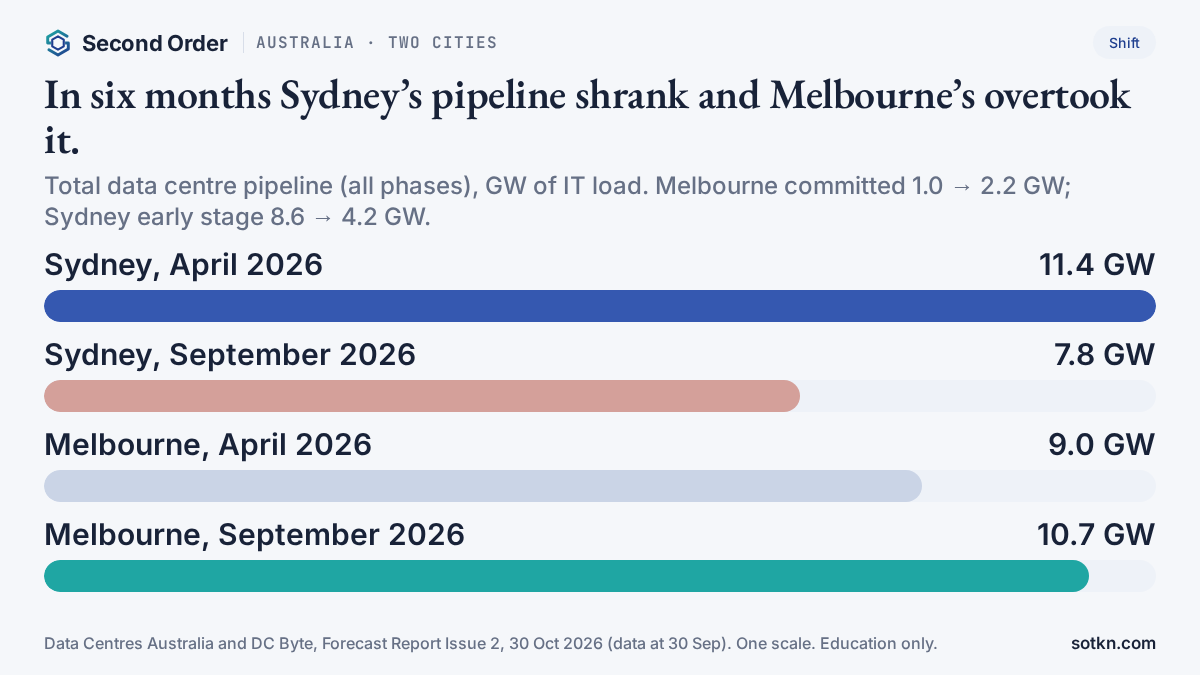
The report is direct about why. It says 1.2 gigawatts moved from early stage to committed in Melbourne, against 0.7 in Sydney, and that this “may indicate the impact of faster approval processes” through Victoria’s Development Facilitation Program, compared with New South Wales’ state significant development process. The Victorian program lets large projects seen as important for the economy apply straight to the planning minister instead of the local council. In Sydney, it links the fall to “announced energy constraints, less certain policy approval timelines and recent policy announcements”. Our 17 October Pulse showed Sydney’s grid had little new connection room left, and our 10 October Pulse covered the state’s new matching-power condition (Sydney sold out; the NSW power condition).
The arithmetic makes the point harder. Sydney’s early stage fell by 4.4 gigawatts, but its committed capacity rose by only 0.7. So at least 3.7 gigawatts of Sydney plans did not climb the ladder; they left the Sydney count, either dropped or moved elsewhere (our arithmetic). The report says some may have moved to Melbourne or regional sites.
And look at where the net growth went. Sydney and Melbourne together fell from 20.4 to 18.5 gigawatts while the national pipeline grew by 5.2 (our arithmetic from the report’s tables). On those rounded figures, all of the net growth in the past six months was outside the two big cities. The report’s longer view agrees: the share of the pipeline outside Sydney and Melbourne has risen from 19% to 31% in two years, including 1.3 gigawatts of new early-stage plans in regional New South Wales and 0.7 in regional Victoria.
None of this changes where the computers are today. Sydney still has 0.9 gigawatts running against Melbourne’s 0.5, and the report expects Sydney to stay ahead, at 2.0 gigawatts by 2030 against 1.4. The change is in what comes after 2030, and it is being decided now, at the permit.
What is changing in Victoria right now?
The report itself flags the catch in a footnote. Victoria’s approach has changed, it says, with new policies for data centres and “an apparent pause on approvals” before the November state election. The next report will show whether that matters.
Three things changed in quick succession. On 22 September the state published its Sustainable Data Centre Action Plan. It bans data centres on land zoned for housing and sets a 150-metre buffer from homes. It keeps them away from schools and childcare centres. It requires new halls to invest in new renewable generation and storage to match their power use, to pay their own connection and network upgrade costs, and to use recycled or non-drinking water for cooling. The expectations apply to permit applications lodged from 23 September, including those on the fast track. Halls already approved, and eight applications already before the minister, are exempt.
Then the election clock. The Victorian government enters caretaker mode on 3 November, ahead of the 28 November vote, and big new decisions usually wait. NEXTDC has already said it expects the fast-track decision on the later stages of its Melbourne campus, lodged early this year, to come in 2027. We covered that delay earlier and will not repeat it here; it is one example of a permit sitting in the queue.
Then the councils. At its October state council, the Municipal Association of Victoria, which speaks for all 79 councils in the state, passed a motion calling for a moratorium on approvals for all new or expanded data centres until a full planning and environmental framework is in place, ABC News reported on 30 October. Eight councils, including Melbourne, Geelong, Maribyrnong and Hume, brought data centre motions. The association also criticised the fast-track program for letting projects skip councils.
The parties are already answering. The government says data centres must bring their own power and cannot be built near homes. The opposition says it would put them in designated data centre precincts away from homes and green wedges. The Greens want a moratorium on new AI data centres. Whichever way the vote goes, the fast lane that pulled 1.2 gigawatts into Melbourne’s committed column now has more conditions on it than it did in April.
That is the second-order point for Victoria. The projects that got their permits, or got into the queue before 23 September, now sit behind a door that has narrowed. The ones that did not will be judged against a stricter list, by whichever government forms after 28 November.
What test does Canberra want before a hall connects?
On 20 October the national market rule-maker, the Australian Energy Market Commission, received two rule-change requests from energy minister Chris Bowen; it posted them on 28 October and has not yet started either review. The first would make qualifying data centres back their power use with firm supply in the same state: contracts with new generation and storage, or dependable flexibility such as their own batteries. “New” would probably mean a project that reached a final investment decision after a set date. The size threshold is left to the rule-maker (contracted power explained).
The enforcement is what caught the eye. The energy regulator would check a data centre’s contracts before it connects to the network and again at later reviews, for example if its load grows by more than 10%. Fines would be the main tool. If fines are not enough, a data centre that cannot show enough firm cover could be made to cut its demand until it can, Renew Economy reported. The request also floats making data centres reduce demand when the grid is short of reserve.
The second request runs the other way. It would make it easier for data centres to connect alongside solar farms and batteries, assess the combined site at one connection point, let staged projects connect a tranche at a time, and make networks consider flexible demand before saying no. It is meant for renewables; the request says it is not meant to help data centres paired only with fossil-fuel plants.
The timing is the problem for anyone in the early-stage column. Neither request has a start date. The rule-maker has previously estimated that connection reforms take two to three years to put in place once ministers agree, PV Tech reported, and the federal government wants to pass data centre laws early in 2027. Meanwhile, the Australian Financial Review reported on 30 October that the draft federal law is weighing limits on large AI halls in suburbs, and that operators are warning the mixed signals put investment at risk.
In his letter to the rule-maker, Bowen gave the reason in grid terms. The New South Wales network company Transgrid is in advanced talks to connect 8 gigawatts of data centre load in Western Sydney, on par with the state’s whole average daily demand, and a major Sydney transmission upgrade is now needed three years earlier than planned, at an extra A$1 billion or so. In Victoria, the market operator has received more than 18 gigawatts of large-load enquiries, mostly data centres in Melbourne. This is the same queue story we have mapped in other markets (Johor’s substation queue; Korea’s grid queue).
Where else is the pipeline going?
The report names Queensland, Tasmania, South Australia and Western Australia as places with new early-stage projects, and says the “open for business” message from the South Australian and Queensland governments in particular is drawing interest. The same week gave two examples of how projects are trying to get around the city queues.
In Western Australia, AirTrunk has held talks with gas pipeline owner APA about building a data centre at a proposed energy hub at Keralup, about 53 kilometres south-east of Perth, the Australian Financial Review reported on 29 October. APA has filed plans with the state environment regulator for a gas-fired power station and battery there, which would be the state’s biggest gas plant if built. Western Australia is outside the eastern power market, so the federal rule would not apply in the same way. In the national capital, CDC won conditional approval in late October for an 84-megawatt, three-storey hall at Beard, next to its existing 39-megawatt building (where AI data centers are located).
Both are bets on the same thing: that a site with its own power next door, or in a place that wants the business, gets through the permit and the grid faster than another application in Western Sydney or inner Melbourne.
Our math, in plain sums
- Switched on in six months: 1.6 GW − 1.5 GW = 0.1 GW. Total pipeline added: 26.8 GW − 21.6 GW = 5.2 GW (report figures).
- Committed plus under construction: 5.2 GW + 0.4 GW = 5.6 GW, about 3.5 times what is operating today (our arithmetic).
- 2030 forecast against that: 3.9 GW − 1.6 GW = 2.3 GW added by 2030, about 41% of the 5.6 GW (our arithmetic).
- Year-end target: 1.8 GW (end-2026 forecast) − 1.6 GW (30 Sep) = about 0.2 GW in one quarter, against 0.1 GW in the previous six months (our arithmetic, rounded).
- Sydney drop-outs: early stage −4.4 GW against committed +0.7 GW, so at least 3.7 GW left the Sydney count rather than moving up (our arithmetic).
- Two cities against the rest: Sydney + Melbourne 20.4 GW in April, 18.5 GW in September; national +5.2 GW, so the rest of Australia grew by about 7 GW on the rounded tables (our arithmetic).
- Melbourne committed: 2.2 GW ÷ 1.0 GW = 2.2 times in six months; Sydney 2.6 GW ÷ 1.9 GW = about 1.4 times (our arithmetic).
- Wish list against head count: 26.8 GW ÷ 67 GW (market operator’s 225 projects) = about 40% (our arithmetic).
What this tells you: the pipeline is growing faster than the grid can switch it on, and the permit is now the filter that decides which projects even join the queue for power. Where permits were quick, projects climbed. Where they were slow, projects left.
Who gets paid first?
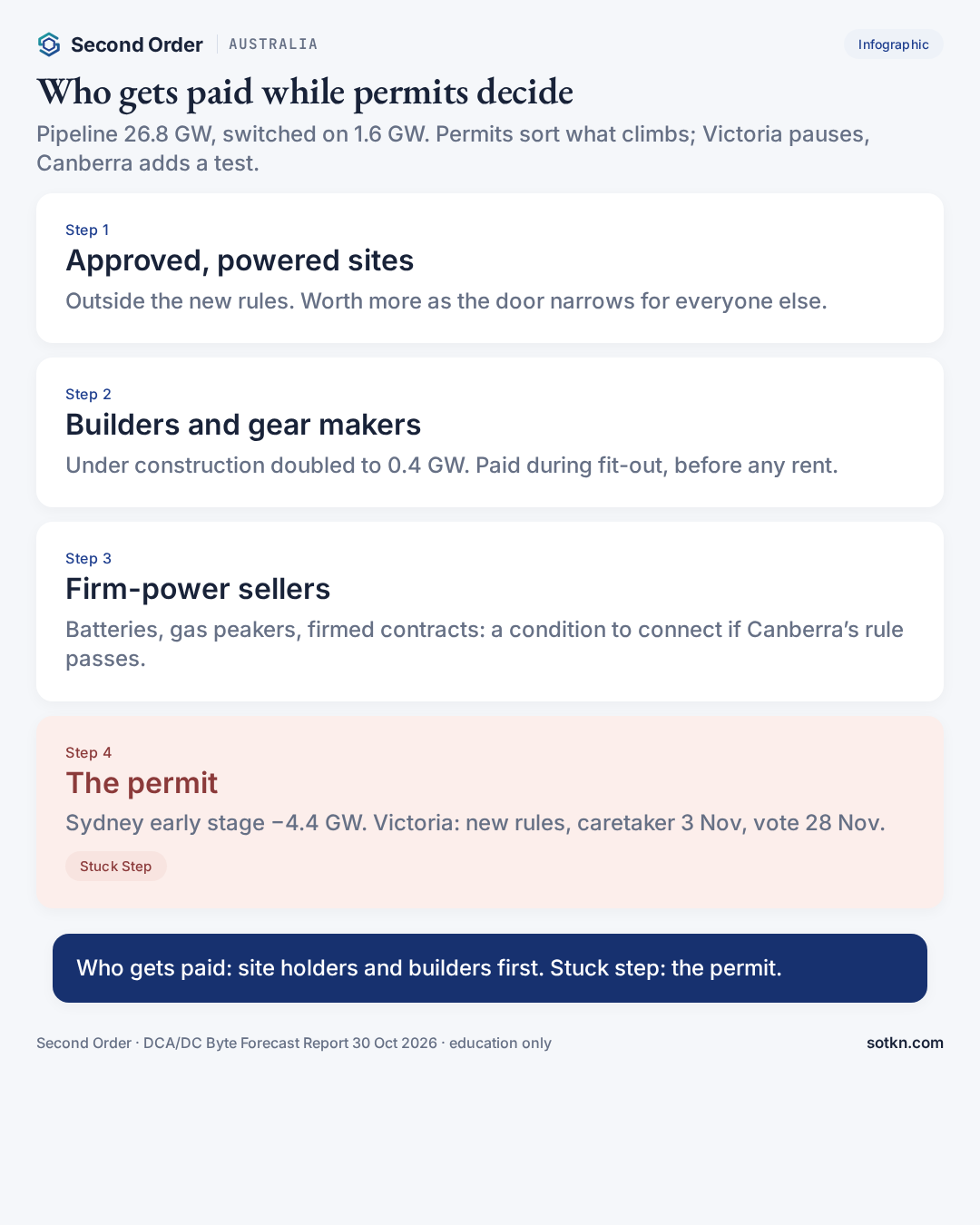
First, whoever already holds an approved site with power — by scarcity. Every new condition, from Victoria’s buffer to Canberra’s firm-power test, applies to new applications and new connections. Halls already approved, and the eight Victorian applications that were before the minister on 22 September, are outside the new state rules. When the door narrows, the projects already inside it are worth more. Our Goodman Analysis looked at what that kind of power bank is worth on a listed balance sheet (the Goodman Analysis).
Second, the builders — now. Capacity under construction doubled to 0.4 gigawatts, split evenly between Sydney and Melbourne. Contractors, electrical and mechanical trades, and makers of switchgear, transformers, generators and cooling are paid as halls are fitted out, months or years before a customer pays rent.
Third, the sellers of firm power — next. If the federal rule passes, every large new hall in the eastern market will need contracts with new generation, storage or flexible demand in its own state before it connects. That makes a battery, a gas peaking plant or a firmed wind and solar contract a condition of the permit to connect, not an option. It also explains why a gas pipeline owner is talking to a data centre builder in Western Australia (how much power an AI data center uses).
Fourth, the network companies — over time. Transgrid’s Sydney upgrade being pulled forward three years at about A$1 billion more is new regulated spending, which earns a return once approved. Who pays for it is the political fight behind every rule in this piece.
Waiting: the early-stage developers, especially in Sydney, where 4.4 gigawatts of plans fell out of that column in six months; Victorian applicants who lodged after 23 September or who need a decision before the election; the councils and residents who say they are not being asked; and shareholders in listed operators whose prices assume new halls come on time. Our NEXTDC Analysis looked at what its price assumes about contracts that are signed but not yet billing (the NEXTDC Analysis).
One-line rule: when permits get stricter, the holders of approved, powered sites and the builders already on site are paid first, the sellers of firm power are paid next, and anyone still waiting for a permit waits longer.
So what is the stuck step?
The permit: the bundle of state planning approval and, soon, federal proof of firm power that a project needs before it counts as committed and before it can connect. Not demand, which keeps growing. Not money, which keeps arriving, as AirTrunk’s A$4.25 billion loan showed last week. Not even construction, which doubled. Four things make it stick:
- Permits sort the pipeline. The report links Melbourne’s 1.2 GW climb into committed, and Sydney’s 4.4 GW early-stage fall, to how fast each state approves.
- The fast lane is narrowing. Victoria’s new rules apply from 23 September, caretaker starts 3 November and councils want a moratorium.
- A new test is coming. Canberra’s firming rule would be checked before connection, with a possible power cut-back for halls that fall short.
- Nobody knows the final terms. Neither federal request has a start date, and the federal law is due early 2027; developers cannot price a hall without them.
This is the move our stuck-step Analysis describes: when power gets scarce, the bind shifts to whoever controls the slowest permission. In Singapore it is the state’s power plan and land (Singapore’s power plan). In Australia, the slowest permission is now the permit itself, and it is being rewritten in two places at once.
Which dates test this read next?
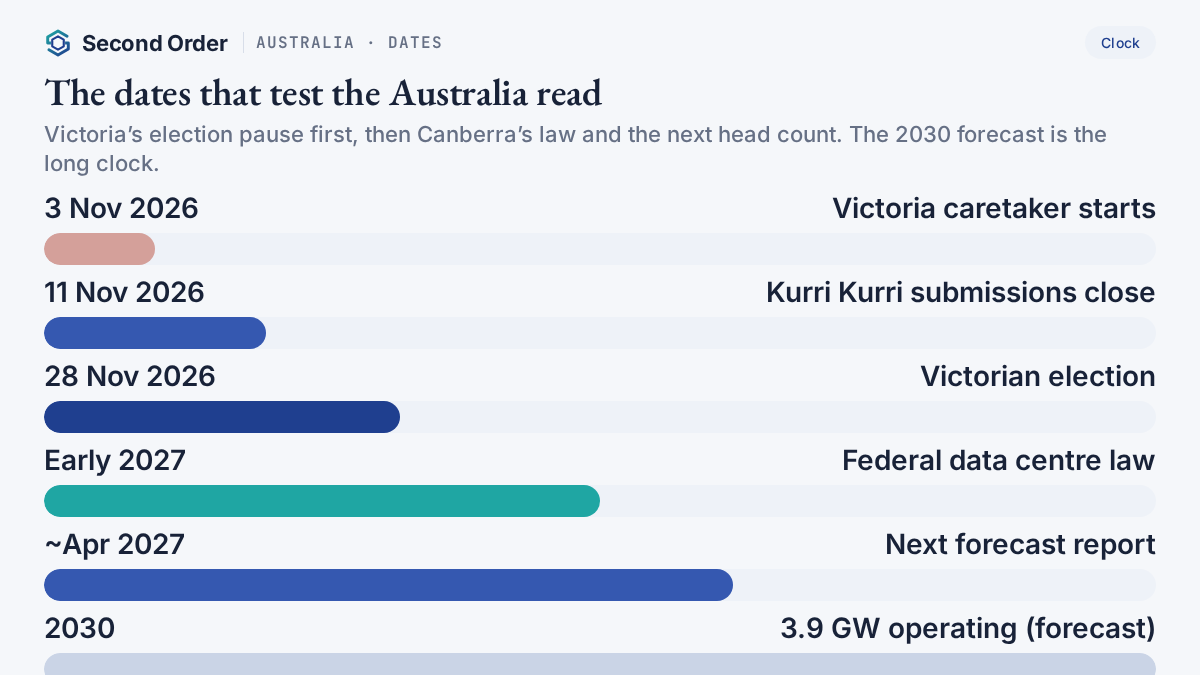
- 3 November 2026 — Victoria enters caretaker mode; watch whether any data centre decisions are still issued.
- 11 November 2026 — public submissions close on AirTrunk’s Kurri Kurri campus in the Hunter, a test of the New South Wales approval path (the Kurri Kurri Pulse).
- 28 November 2026 — Victorian state election; the winner decides how the fast-track program and the new rules are applied.
- Early 2027 — the federal government aims to pass its data centre law; the rule-maker’s consultation papers on both requests could come earlier.
- Around April 2027 — the next forecast report (it is twice-yearly) shows whether Melbourne’s committed column held up after the election.
- 2030 — the report’s forecast of about 3.9 GW operating, against 5.6 GW committed or under construction today.
What would change this view?
- Victoria keeps the fast lane open. If the new government keeps fast-track decisions flowing after 28 November with clear precinct rules, Melbourne’s committed column should keep climbing and the bind moves to power.
- Sydney’s grid opens up. If Transgrid firms up connection dates for the 8 GW in talks, Sydney’s early-stage column could refill quickly.
- The federal test is light. If the size threshold is high or existing contracts count, the firm-power test becomes paperwork rather than a gate.
- Switch-ons speed up. If operating capacity reaches the 1.8 GW year-end forecast, the gap between committed and live is closing faster than we think.
Practical takeaways
- Australia’s data centre pipeline rose 5.2 GW to 26.8 GW in six months, but only 0.1 GW was switched on
- Sydney’s pipeline fell 3.6 GW to 7.8 GW; Melbourne’s rose 1.7 GW to 10.7 GW, with committed capacity up 2.2 times
- The report links the swing to Victoria’s faster permits; that lane now has new rules, an election pause and a councils’ moratorium call
- Canberra wants large new halls to prove new firm power before they connect, with a possible cut-back if they fall short
- Approved site holders, builders and firm-power sellers are paid first; early-stage developers wait; stuck step: the permit
FAQ
What does the new forecast show?
Data Centres Australia and DC Byte say Australia had 1.6 GW of operating data centre capacity across 163 sites at 30 September, up only 0.1 GW since April. The total pipeline, from operating to early stage, rose 5.2 GW to 26.8 GW. Sydney’s pipeline fell 3.6 GW to 7.8 GW while Melbourne’s rose 1.7 GW to 10.7 GW, now bigger than Sydney’s. They expect about 3.9 GW to be operating by 2030.
Why did Melbourne gain and Sydney lose?
The report links it to approvals. Victoria’s fast-track Development Facilitation Program let large projects go straight to the planning minister, and 1.2 GW in Melbourne moved from early stage to committed, against 0.7 GW in Sydney. In Sydney, power limits, slower state approvals and new rules cut early-stage capacity from 8.6 GW to 4.2 GW.
What is the stuck step?
The permit. A project only counts as committed once it has land, power and permits. Melbourne’s faster permits moved projects up the ladder. But Victoria brought in stricter rules for applications from 23 September, enters caretaker mode on 3 November before its 28 November election, and its councils want a moratorium. A federal rule would also make large data centres prove new firmed power before they connect.
Is this investment advice?
No. Education only. It maps who gets paid and which step is stuck. It is not a recommendation to buy or sell any security, and we leave out price targets and ratings on purpose.
Keep reading on the map
- Australia Markets hub — country page
- AirTrunk’s SYD3 loan · Kurri Kurri and the NSW grid fee · NEXTDC’s billing date · NEXTDC’s Melbourne line · Sydney power sold out · The NSW power condition · Australia’s AI money
- Johor’s substation queue · Korea’s grid queue · Singapore’s power plan — other markets
- What does NEXTDC do? · What does Equinix do? · What does Digital Realty do?
- How much power does an AI data center use? · Contracted power explained · How long it takes to build one · What it costs to build · Data center financing explained · Hyperscale vs colocation
- NEXTDC: signed, not billing · Goodman: the power bank · Where does the stuck step move?
- AI Data Centers on the stack · All Markets doors — Taiwan, Korea, US, China, Singapore, Australia, Malaysia
How we check this. The pipeline tables, phase definitions, project counts and operating forecast come from the Australian Data Centre Forecast Report, Issue 2, published by Data Centres Australia with DC Byte on 30 October 2026, using data current at 30 September. Data Centres Australia is the industry’s own peak body, so we treat its read of policy as a view, not a finding. The Victorian rules come from the state’s own action plan page; the councils’ resolution, caretaker timing and party positions are as reported by ABC News. The federal rule-change requests are as summarised by Renew Economy and PV Tech from the documents posted by the market rule-maker. Company items are as reported by ARN, the Australian Financial Review and Real Estate Source. Every sum we worked out is labelled “our arithmetic”; the report rounds to 0.1 GW, so small differences can be rounding. Price targets and ratings are left out on purpose. The references we used are listed at the end. Our editorial standards →
Not investment advice. Do your own research.
References
- Data Centres Australia and DC Byte, Australian Data Centre Forecast Report, Issue 2, 30 Oct 2026. datacentres.org.au — the national, Sydney and Melbourne pipeline tables, phase definitions, project counts and the operational forecast.
- ABC News, Municipal Association of Victoria demands data centre moratorium, 30 Oct 2026. abc.net.au — the councils’ resolution, caretaker timing and party positions before the Victorian election.
- Victorian Government, Sustainable Data Centre Action Plan and Statement of Expectations, Sep 2026. planning.vic.gov.au — the new Victorian rules and the 23 September start date, including for fast-tracked applications.
- ABC News, new restrictions on data centre water use and proximity to schools under Victorian strategy, 22 Sep 2026. abc.net.au — the 150-metre buffer and the eight applications before the minister that are exempt.
- Renew Economy, data centres without sufficient firm power could be switched off under Bowen rule change proposal, 29 Oct 2026. reneweconomy.com.au — the firming request, the turn-down power, AEMO’s 67 GW project list and the minister’s letter on Western Sydney.
- PV Tech, Australia’s energy minister seeks AEMC rule change forcing data centres to contract new firmed energy, 30 Oct 2026. pv-tech.org — both rule-change requests, the 20 October receipt date and the implementation timeline.
- ARN, NextDC’s M3 grid expansion delayed due to community and stakeholder opposition, 21 Oct 2026. arnnet.com.au — the caretaker date, the election date and the delayed fast-track permit for M3’s later stages.
- Australian Financial Review, data centre confusion risks investment pipeline, operators warn, 30 Oct 2026. afr.com — the federal draft law and operators’ warnings.
- Australian Financial Review, AirTrunk considers first Western Australia data centre at new gas hub, 29 Oct 2026. afr.com — AirTrunk’s talks with APA about a site at the proposed Keralup energy hub.
- Real Estate Source, AirTrunk and CDC advance data centre plans, 27 Oct 2026. realestatesource.com.au — CDC’s conditional approval for Beard 2 in Canberra.