Data Center Financing Explained: Who Lends Before the Rent
AI data centers are paid for in a relay: equity and short construction loans build the halls, then cheaper bonds, securitisations or a REIT take over once the rent starts. The stuck step is the handoff in between.
EXPLAINED · Mechanism · Last reviewed: 22 Oct 2026 · Next review: after DayOne’s IPO pricing and Digital Realty’s Q3 2026 supplemental
AI data centers are financed in a relay. Developer equity and construction loans pay to build the halls. Once tenants are paying rent, that short, expensive debt is refinanced into cheaper bonds or asset-backed securities, or the finished building is sold to a REIT or infrastructure fund. The stuck step is the handoff between them.
In short. An AI data center is usually paid for in stages: equity and construction loans build the halls, then cheaper long-term debt or a buyer such as a REIT takes over once they are leased and billing. Construction debt is the dear part: Applied Digital pays 9.25% on its project notes. The prize comes at the end: Digital Realty’s buy-in valued leased Northern Virginia halls at about $27 million per megawatt, against about $14 million to $18 million to build one (our arithmetic). The stuck step is the gap between a signed tenant and a paying one: across all its markets, DayOne has 2,281 MW booked but 953 MW billing.
Why an investor cares: the way a data center is financed decides who carries the risk while it is being built, and who collects once it is full. Our page on how much an AI data center costs ended on one point: the money has to be spent before the rent starts. This page follows that money. It builds on what an AI data center is and covers the building, not the chips inside it. It is part of our AI Data Centers layer.
How are AI data centers financed?
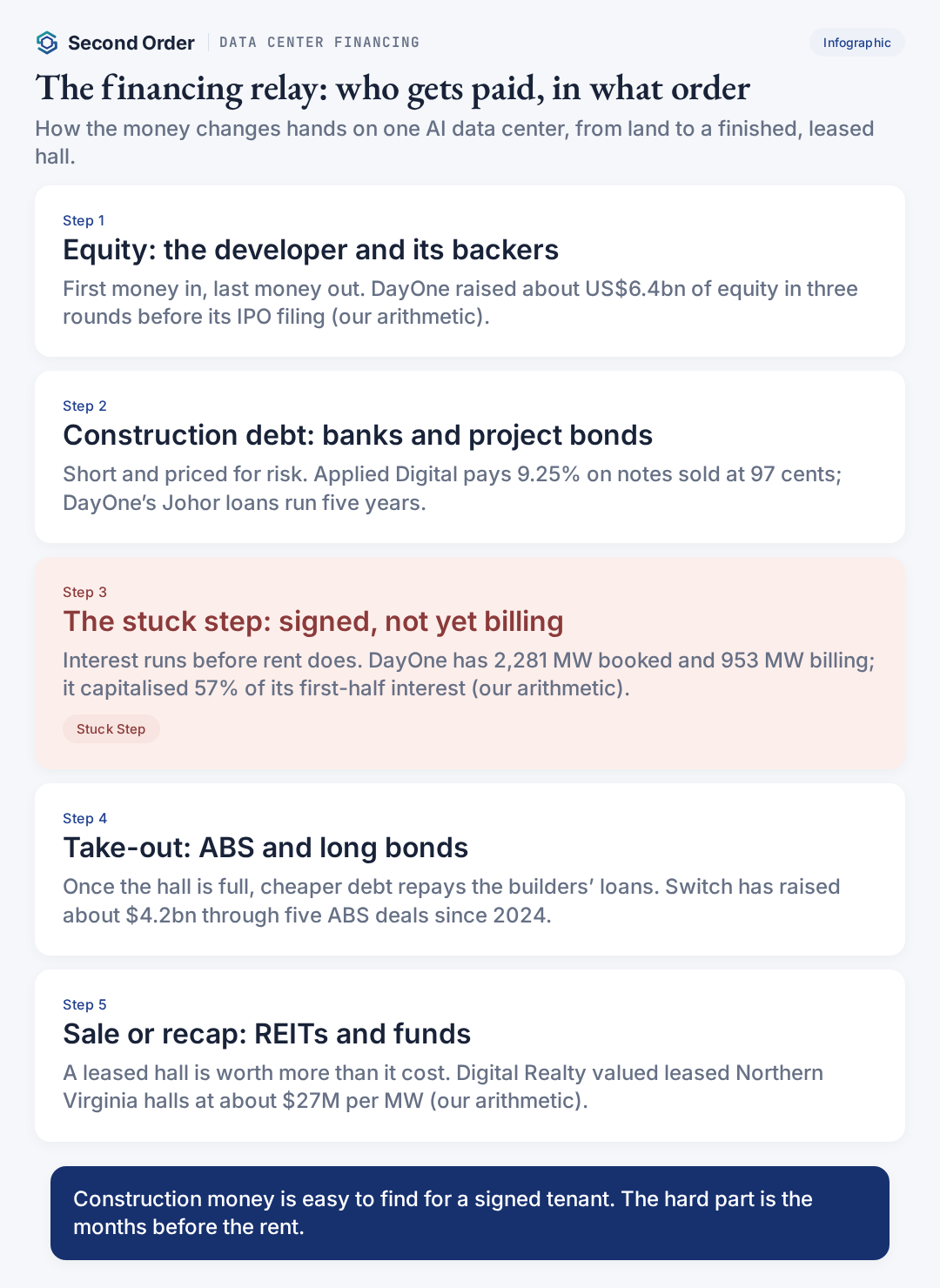
Think of a relay race in which each runner pays the one before. A developer finds land with a grid connection and puts in its own money, or its investors’ money. That equity is the first cheque and the riskiest, because nothing is earning yet. Next, lenders fund most of the construction. They charge more than they would on a finished building, because the hall might be late, over budget or short of tenants.
When the hall is finished, leased and billing, its risk drops. The owner can then swap the construction debt for cheaper, longer debt secured on the rent, or sell part or all of the building to an investor who wants steady income: a REIT, a pension fund or an infrastructure fund. The money from that take-out repays the construction lenders and returns cash to the developer, who starts again on the next site.
Hyperscalers add a twist. Instead of paying for a campus themselves, they can set up a joint venture in which outside investors own most of the building and the hyperscaler rents it. That is how Meta’s Hyperion campus in Louisiana is being paid for. Leases like this show up in the lease lines we track in hyperscaler capex lines to watch.
| Stage | Who puts the money in | How they get paid | Real example |
|---|---|---|---|
| 1. Equity | The developer, private equity, sovereign and pension funds, or the tenant itself | Last, from whatever is left after lenders; most upside if the halls fill | DayOne: US$1.9bn Series A and B, then US$1.3bn (2025) and US$3.2bn (2026) of Series C |
| 2. Construction debt | Bank syndicates, or bond buyers in a project note | Interest and fees while the hall is built; principal from rent or a refinancing | Applied Digital: $2.35bn of 9.25% notes due 2030 for 250 MW. DayOne: five-year Johor loans at SOFR + 2.20% |
| 3. Off-balance-sheet joint venture | Infrastructure funds and their bondholders, alongside the tenant | Rent from the tenant’s lease, plus a guarantee if it leaves | Hyperion: Blue Owl funds 80%, Meta 20%, about $27bn of development cost |
| 4. Take-out debt | ABS and long-term bond investors | A rated coupon paid from many tenants’ rent | Switch: $768m 2026-1 ABS to repay existing debt and for general corporate purposes; about $4.2bn across five deals since 2024 |
| 5. Sale or recapitalisation | REITs and core infrastructure funds | Rental yield on a finished, leased building | Digital Realty: 64% of three leased N. Virginia halls, 288 MW, about $7.8bn gross value. Keppel DC REIT: two leased Tokyo halls |
Order is typical, not fixed: some projects skip stages or run them together.
Who lends to build a data center?
Two kinds of lender do most of it: bank syndicates and bond buyers. DayOne, which Structure Research estimates holds 33% of the Singapore, Johor and Riau Islands market by bookings, according to DayOne’s F-1, shows the bank route. Its Form F-1, filed on 5 October 2026 for a US listing, says its Johor facilities were enlarged on 10 September 2026 to a US$4.1 billion offshore term loan and a MYR13 billion (about US$3.2 billion) Murabahah facility, an Islamic financing structure, each running for five years. The US dollar loan costs SOFR plus 2.20%, falling to 2.10% after the IPO. At 30 June 2026 DayOne had US$6.39 billion of working capital and project finance facilities, of which US$1.82 billion was unused. Our Malaysia Pulse covers what that money is waiting on.
Applied Digital shows the bond route. On 20 November 2025 a subsidiary sold $2.35 billion of senior secured notes at 9.25%, due December 2030, at 97 cents on the dollar. The money pays for part of two buildings, 100 MW and 150 MW, at its 400 MW Ellendale campus in North Dakota, repays an earlier bank loan from Sumitomo Mitsui Banking Corporation and funds debt service reserves. That is about $9.4 million of debt per megawatt (our arithmetic). Principal repayments start on 15 December 2027, after the buildings are due to be in service. See what Applied Digital does.
- What lenders lend against. The project itself: Applied Digital’s notes are senior secured obligations of the subsidiary building the halls, and Applied Digital gives a completion guarantee to put in more money if needed to get each hall to the start date of its lease. The signed lease is the real collateral, because rent is what repays the loan.
- Why it is dear. Construction risk. A 9.25% coupon on notes sold below face value is what bond buyers want for a hall that is not yet earning.
- Why it is short. Five-year bank loans and notes due within about five years are built to be refinanced once the building is full, not held for its life.
- What they watch. Covenants. DayOne’s filing lists interest cover, debt service cover, leverage and net worth tests, and says a missed test can make a loan repayable early.
What happens once the rent starts?
A leased, billing data center is a different asset. It has a known tenant, a known rent and years of contract left, so it can carry cheaper money. Two exits matter.
The first is take-out debt. Data center asset-backed securities, or ABS, are bonds secured on a pool of built, leased halls and repaid from their rent. Switch, a US operator, raised about $768 million in April 2026 through its Series 2026-1 ABS and said it would use the money to repay existing debt and for general corporate purposes. It was Switch’s fifth ABS deal since 2024, about $4.2 billion in all, from a pool of 11 data centers with more than 550 customers, about 84% of the trust’s revenue coming from investment-grade customers. The top slice was rated AAA. That rating is only possible because the halls are full.
The second is a sale. Digital Realty’s Q2 2026 supplemental shows it bought a 64% stake in three fully leased data centers in Northern Virginia with 288 MW of IT capacity, at a gross value of about $7.8 billion and an expected initial stabilised cap rate of over 6.5%. That is about $27.1 million per megawatt (our arithmetic). Digital Realty’s own 1,402 MW under construction is costing about $14.4 million per megawatt, and Cushman & Wakefield puts the 2026 all-in average for the most modern greenfield builds in the US and Canada at $17.6 million, both before chips. The same quarter, Digital Realty booked $188 million of net promote income, a performance fee it earned for developing and leasing three data centers in a development joint venture. See what Digital Realty does.
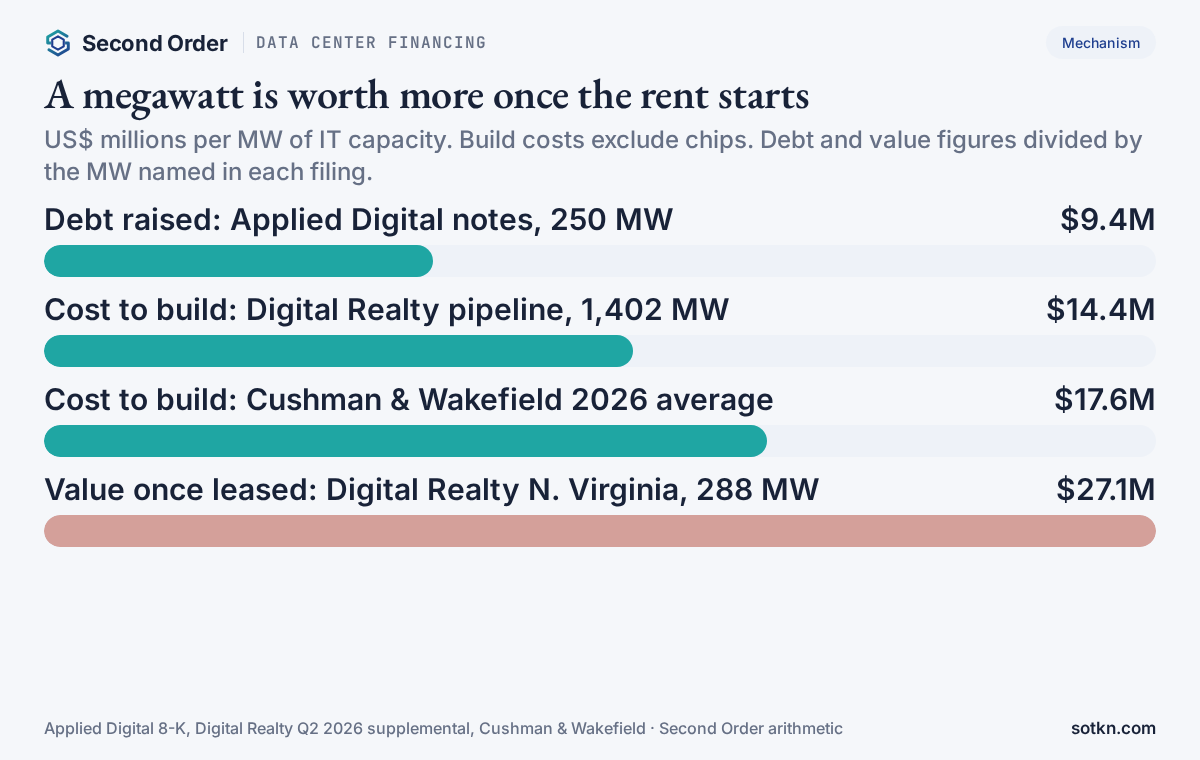
Read that chart with care. The $27.1 million is a gross value for three fully leased Northern Virginia buildings that are not all finished: Digital Realty expects them to be fully stabilised in the first halves of 2027 and 2028, and the $4.13 billion it paid for its partners’ 64% stake, including assumed debt, leaves out about $900 million of capex still to spend. The filing does not split the value into land, building and fit-out. The build costs are averages. But the shape is the point: a hall is worth far more once it is leased than it cost to build, and that gap is what pays the developer’s equity for taking the early risk.
Why do hyperscalers finance data centers off their balance sheet?
To keep the cash for chips and let investors who want long, steady income own the building. Meta’s release of 21 October 2025 says funds managed by Blue Owl Capital own 80% of the Hyperion joint venture and Meta keeps 20%, with both funding their share of about $27 billion of development costs for the buildings and the long-lived power, cooling and connectivity kit. Blue Owl’s funds put in about $7 billion of cash, and Meta received a one-time distribution of about $3 billion. Part of Blue Owl’s money comes from bonds sold privately to PIMCO and other investors.
The catch is the lease. Meta rents the campus on a four-year initial term with options to extend, and gives the joint venture a capped residual value guarantee for the first 16 years of operations if it leaves. The bondholders are lending against a tenant that has promised four years and a guarantee, not 16 years of rent. Our Wire on the Hyperion bond shows how bond buyers priced that gap in October, and our Analysis on SPV leasebacks follows the same idea into chips.
A tenant’s credit can also be borrowed: Google backstops part of Fluidstack’s lease obligations at TeraWulf’s Lake Mariner campus, which supports the project debt. See what TeraWulf does and what Fluidstack does.
Who gets paid, and when?
- 1. Builders and equipment makers. Paid month by month from equity and construction loans while the hall goes up. They carry the least financing risk.
- 2. Banks and project bond buyers. Paid arrangement fees up front and interest throughout. DayOne’s interest bill was US$145.4 million in the first half of 2026 alone.
- 3. The tenant. Pays rent per kilowatt once the power is on, as our data center lease explainer shows. Its credit rating sets how cheap the later debt can be.
- 4. ABS investors and REIT unitholders. Paid a coupon or a distribution from that rent, for years. They take the least construction risk because they arrive after the build.
- 5. The developer’s equity. Paid last, through a sale, a refinancing that returns cash, or a promote fee. It earns the gap between cost and leased value, if the halls fill on time.
What is the stuck step?
Not finding money. Banks and bond buyers have been willing to lend to halls with signed tenants. The stuck step is the handoff: the cheap take-out money only arrives once the hall is finished, powered and billing, and the construction debt keeps charging interest until then.
DayOne’s filing shows the gap. At 20 September 2026 it had 2,281 MW booked by customers but 953 MW billing, about 42% (our arithmetic), with 1,328 MW under construction that was 99.3% pre-committed. Tenants have signed; the rent is still to come. In the first half of 2026 DayOne’s total interest cost was US$145.4 million, of which US$83.1 million, about 57% (our arithmetic), was capitalised: added to the cost of halls still being built rather than charged against profit. That is cash paid to lenders for buildings that are not yet paying rent.
The same shape shows up elsewhere. Digital Realty still had $15.02 billion to spend on its 1,402 MW under construction at 30 June 2026, and 54% of that capacity was leased. NEXTDC had 740.1 MW contracted but 175.0 MW billing, about 24% (our arithmetic); our NEXTDC Analysis traces what that gap costs. Anything that delays the power, from a substation to a grid study, stretches the expensive part of the relay. Our page on how long a data center takes to build shows where those months go.
Our view: in data center financing, the headline loan size matters less than three dates and one ratio. When does the construction debt fall due, when does the tenant start paying, and when can the owner refinance? And how much of the capacity being built is already billing?
How does it work in Singapore, Malaysia and Australia?
Malaysia is the bank-funded build. DayOne’s two Johor facilities add up to about US$7.3 billion (our arithmetic), and Singapore-based Princeton Digital Group is borrowing for its own Johor campus, as our Wire on its loan reported. Malaysia’s rule that operators pay for power they book but do not use adds a cost to every empty hall the loans fund; see our unused-power charge note.
Singapore is where many of the buyers sit. Keppel DC REIT agreed on 1 September 2026 to buy interests in two freehold Tokyo data centers that are 100% occupied by four investment-grade clients, for JPY190.0 billion on a 100% basis. It pays about S$1,372.3 million for its 88.62% and says it will fund that with a mix of equity and yen debt. It raised about S$625.0 million from a private placement that was about 3.4 times covered, and S$615.8 million of it goes to the deal, about 45% of Keppel DC REIT’s share (our arithmetic). That is the end of the relay: a listed landlord paying for a finished, full building. See what Keppel DC REIT does and our Singapore Pulse on the deal.
Australia shows a developer using every layer of the capital stack. NEXTDC says it put A$9.75 billion of capital commitments in place from August 2025 to its FY26 results: A$5.8 billion of senior bank debt, A$750 million of subordinated notes, A$1.7 billion of hybrid securities and A$1.5 billion of equity. On 10 September 2026 it added A$1.1 billion of 1.75% convertible notes due 2031, which rank below its senior debt and can turn into shares at A$16.695. A low coupon in exchange for possible new shares is a way of paying for the build with future equity. See what NEXTDC does and our Australia Pulse on funding costs.
| Market | Who | How the money is raised | What to watch |
|---|---|---|---|
| Malaysia (Johor) | DayOne | Bank syndicate: US$4.1bn offshore term loan plus MYR13bn (about US$3.2bn) Murabahah facility, five years; US$6.4bn of equity since 2024, Series A to C (our arithmetic) | Group billing (953 MW at 20 Sep 2026) catching up with 2,281 MW booked across all markets; the US-listed IPO |
| Singapore | Keppel DC REIT | Buys finished, leased halls with new units and yen debt: about S$625m placement, 3.4 times covered, for two Tokyo data centers | Whether buyers keep paying up for leased halls; distribution per unit after each deal |
| Australia | NEXTDC | A$9.75bn of commitments since Aug 2025: A$5.8bn senior debt, A$0.75bn subordinated notes, A$1.7bn hybrids, A$1.5bn equity; then A$1.1bn of 1.75% convertible notes | 175.0 MW billing against 740.1 MW contracted |
How is data center financing different from GPU financing?
They fund different things on different clocks. Data center financing pays for land, the shell and the power and cooling plant, which last for decades and can be re-let to a new tenant. GPU financing pays for the chips, which age in a few years and are worth what the next customer will pay to rent them. Lenders treat the two very differently, and the same campus often carries both. Our GPU financing explainer and who finances GPU clusters cover the chip side. IREN’s Microsoft deal shows the chip side: a 20% customer prepayment plus GPU-backed debt. See what IREN does.
What would change this view?
- Billing catches up. If DayOne’s billing MW and NEXTDC’s billing MW close on their booked and contracted figures, the stuck step shrinks and the take-out stage gets easier.
- Leased values fall. If buyers stop paying well above build cost for leased halls, developers’ equity earns less and less of it gets raised.
- Take-out markets shut. If ABS and long bond buyers demand much higher rates, construction lenders get refinanced later or at a worse price. AirTrunk’s Singapore data center REIT float, reported to be on hold until early 2027, shows that door can close; see our Singapore Pulse on the delay.
- Hyperscalers bring it back on balance sheet. If big tenants fund more halls with their own cash, the joint venture and bond route matters less.
What to check in a data center financing announcement
- Tenor and repayment start. When the principal starts being repaid, and whether that is after the halls are due to be billing.
- What it is secured on. A project, a signed lease or the whole company.
- Booked versus billing. How much of the capacity being financed already pays rent.
- Capitalised interest. How much of the interest bill is being added to the cost of unfinished halls.
- The take-out. Who is expected to refinance or buy the building, and on what lease length.
FAQ
How are AI data centers financed?
In stages. The developer puts in equity and borrows short-term construction money from banks or project bond buyers to build the halls. Once tenants are paying rent, the owner refinances into cheaper long-term debt such as data center asset-backed securities, or sells all or part of the finished building to a REIT or an infrastructure fund. Each stage is paid by the next one, and the whole chain is repaid by the tenant’s rent.
What is data center project finance?
Lending to a single project rather than the whole company, repaid from that project’s rent. During the build it is short and dear: it is lent against a hall that is not yet earning, usually secured on the land, the buildings and the project’s bank accounts. DayOne’s Johor facilities run for five years at SOFR plus 2.20% on the US dollar loan. Applied Digital’s project notes pay 9.25% and were sold at 97 cents on the dollar, with principal repayments starting only in December 2027, after the halls are due to be finished.
What is data center ABS?
Asset-backed securities secured on data centers that are already built and leased. The rent from many customers pays the bondholders. Switch raised about $768 million in its 2026-1 deal to repay existing debt and for general corporate purposes, its fifth such deal since 2024, from a pool of 11 data centers where about 84% of revenue comes from investment-grade customers. ABS refinances a finished, filled hall; it does not pay for an empty one.
Why did Meta finance Hyperion through a joint venture?
So that outside investors fund most of the building. Funds managed by Blue Owl own 80% of the Hyperion joint venture and Meta 20%, and both fund their share of about $27 billion of development costs. Part of Blue Owl’s money comes from bonds sold to PIMCO and others. Meta rents the campus on a four-year initial lease with options to extend, and gives a capped residual value guarantee for the first 16 years of operations.
Who gets paid first in data center financing?
The builders, equipment makers and the banks’ fees and interest, because they are paid while the hall is going up. The bondholders and REIT investors who take over later are paid from rent. The developer’s equity is paid last but can earn the most: the gap between what a hall costs to build and what a buyer will pay once it is leased.
What is capitalised interest, and why does it matter?
Interest on money borrowed to build an asset that is not yet in use is added to the asset’s cost instead of being charged against profit straight away. It is still real cash going to lenders. DayOne capitalised US$83.1 million of its US$145.4 million interest cost in the first half of 2026, about 57% (our arithmetic). The longer a hall takes to start billing, the bigger that number grows.
How is data center financing done in Singapore, Malaysia and Australia?
Malaysia’s Johor build runs on large bank syndicates: DayOne’s facilities include a MYR13 billion Islamic Murabahah loan. Singapore is home to listed buyers of finished halls such as Keppel DC REIT, which raised about S$625 million from investors in September 2026 to help buy two fully leased Tokyo data centers. Australia’s NEXTDC funds its build with senior bank debt, subordinated notes, hybrids, equity and A$1.1 billion of 1.75% convertible notes.
Is this a list of stocks to buy or sell?
No. Second Order Explained pages explain how the money and the constraints move. They do not give buy or sell calls. Not investment advice. Do your own research.
Related: what is an AI data center; how much it costs to build one; hyperscale vs colocation; take-or-pay GPU contracts; what Equinix does; what Digital Core REIT does.
Stack doors
Layer: AI Data Centers. Also: Hyperscalers, Neoclouds, Semiconductors. Markets: US, Singapore, Malaysia, Australia.
Get the Wire — short daily notes when data center loans, bonds and leases move.
How we check this
Every figure on this page comes from a company filing or release we read in full: Meta’s Hyperion joint venture release, Applied Digital’s Form 8-K on its notes, DayOne’s Form F-1, Digital Realty’s Q2 2026 financial supplement, Switch’s ABS release, NEXTDC’s ASX releases, Keppel DC REIT’s SGX announcements and Cushman & Wakefield’s 2026 cost guide release. All are listed under References and were checked on 22 Oct 2026. Every number we derived by dividing or adding is labelled “our arithmetic”. Per-megawatt figures divide by the IT megawatts named in each filing; they are not like-for-like valuations. Market prices of bonds and shares are not used. The featured photo is “Data centers in Ashburn” by Theodore Christopher (CC0, Wikimedia Commons), graded by Second Order. This page explains how the money moves. It does not give buy or sell calls. Not investment advice. Do your own research.
Last reviewed: 22 Oct 2026 · Next review: after DayOne’s IPO pricing and Digital Realty’s Q3 2026 supplemental
Spot an error? Tell us and we will correct it and note the change here.
References
- Meta — Joint venture with funds managed by Blue Owl Capital to develop Hyperion (release, 21 Oct 2025) — 80/20 ownership, about $27bn development cost, about $7bn cash in, about $3bn distribution to Meta, four-year initial lease, 16-year residual value guarantee, bonds to PIMCO and others
- Applied Digital — Closing of $2.35bn senior secured notes (Form 8-K, 20 Nov 2025) — 9.250% notes due 2030 issued at 97%; fund 100 MW ELN-02 and 150 MW ELN-03 at the 400 MW Ellendale campus; repay the SMBC loan; debt service reserves; amortisation from 15 Dec 2027
- DayOne Data Centers — Form F-1 registration statement (SEC, 5 Oct 2026) — Johor facilities upsized on 10 Sep 2026 (US$4.1bn offshore term loan, MYR13bn Murabahah, five years, SOFR + 2.20%); US$6.4bn of facilities; US$4.9bn debt; equity rounds; capitalised interest; bookings, billings and pre-commitment
- Digital Realty — Q2 2026 Financial Supplement (8-K Exhibit 99.1, 23 Jul 2026) — 64% stake in three fully leased Northern Virginia data centers (288 MW, about $7.8bn gross value, cap rate over 6.5%); $188m net promote; 1,402 MW under construction, $20.18bn total, 54% leased
- Cushman & Wakefield — 2026 Data Center Development Cost Guide (release, 3 Sep 2026) — $17.6M per MW average all-in greenfield cost in the US and Canada, excluding chips
- Switch — $768m data center ABS issuance, Series 2026-1 (release, 14 Apr 2026) — proceeds repay existing debt and for general corporate purposes; about $4.2bn across five ABS deals since 2024; 11 data centers; about 84% of trust revenue from investment-grade customers
- NEXTDC — Pricing of A$1.1bn convertible notes (ASX release, 10 Sep 2026) — 1.75% subordinated convertible notes due 2031; net proceeds about A$1,006m; conversion price A$16.695; junior to senior debt
- NEXTDC — FY26 results (ASX release, 27 Aug 2026) — 740.1 MW contracted vs 175.0 MW billing; A$9.75bn of capital commitments since Aug 2025 by type; A$8.7bn pro forma liquidity
- Keppel DC REIT — Acquisition of Tokyo Data Centre 4 and 5 (SGX media release, 1 Sep 2026) — JPY190.0bn price on a 100% basis; S$1,372.3m for 88.62%; fully occupied by four investment-grade clients; funded by equity and yen debt; DPU +2.6% pro forma
- Keppel DC REIT — Results of the private placement (SGX announcement, 2 Sep 2026) — about S$625.0m raised, about 3.4 times covered; S$615.8m to part-fund the acquisition