GPU Financing Explained: Loans That Draw as the GPUs Go Live
GPU financing lends against GPU servers and the customer contract that pays for them. The loan is drawn as servers go live and repaid from the customer's cash, so the stuck step is the day the customer accepts the site.
EXPLAINED · Mechanism · Last reviewed: 16 Oct 2026 · Next review: after CoreWeave's third-quarter 2026 10-Q
GPU financing is borrowing to buy GPU servers, where the loan is secured by the servers themselves and by the customer contract that will pay for their use. The lender is repaid from that contract's cash, so the loan is only as good as the customer and the date the GPUs go live.
In short. A GPU-backed loan is lent to a separate company that owns the GPUs and one customer contract, not to the operator itself. It is drawn in pieces as servers are installed, up to about 90% of their cost in CoreWeave's largest facility, and repaid monthly from the customer's payments once the customer accepts the site. A strong customer makes the loan cheap: CoreWeave's March 2026 facility, backed by an investment-grade AI customer, was rated A3 and priced near 5.9%. The stuck step is acceptance. Until the GPUs are live and accepted, most of the loan sits undrawn and the hours earn nothing.
Why an investor cares: a neocloud pays for its chips years before the hours it sells pay back the cost, so most of the money comes from lenders, not from its own cash. The price and terms of that debt decide how much of each GPU-hour the operator keeps. This page builds on what a neocloud is and how take-or-pay GPU contracts work, and explains the loan that sits between them.
What is GPU financing?
Money borrowed to buy GPU servers and the network and storage gear around them, paid back from the cash those servers earn. Several kinds of money are involved, but the one that defines the market is the GPU-backed loan: a loan secured by the GPUs and by a signed customer contract.
It exists because the money and the chips arrive at different times. A neocloud pays for servers up front. Its customer pays by the hour or the month over several years. Someone has to fund that gap, and selling shares alone would be too expensive at this scale. CoreWeave’s listing prospectus, filed on 3 March 2025, said it had raised more than $14.5 billion of debt and equity across 12 financings, including $7.6 billion of committed GPU-backed debt led by Blackstone and Magnetar.
The table below shows the main sources of money side by side. Who supplies each one is mapped in who finances GPU clusters; this page explains how the main loan works.
| Source of money | How it works | Dated example |
|---|---|---|
| GPU-backed loan | Lent to a separate company holding the GPUs and a customer contract; drawn as servers go live; repaid from the contract's cash | CoreWeave DDTL 4.0, $8.5bn, rated A3 / A (low), 31 Mar 2026. Lambda, $1.008bn at 6.78% fixed, 1 Oct 2026 |
| Equipment financing | The server maker or a financier lets the operator pay for the metal over time | CoreWeave: $4.8bn outstanding at 30 Jun 2026, up from $3.8bn at 31 Dec 2025 |
| Customer prepayment | The customer pays part of the contract before the capacity is delivered | Nebius: 70% of second-quarter 2026 deals included prepayments covering 50–60% of the related capex |
| Unsecured bonds | Lent to the whole company and priced on the company's own credit | CoreWeave's unsecured bonds were reported yielding in the low teens, Oct 2026 |
| New shares | No repayment, but existing owners are diluted | Lambda reported to be raising up to $4bn at a $14.5bn pre-money valuation, Oct 2026 |
From CoreWeave, Lambda and Nebius filings and releases, plus press reports labelled as reported. Sources under References.
How does a GPU-backed loan work?
The operator sets up a separate company, often called a special-purpose vehicle, that owns the GPUs for one customer contract. The lender lends to that company, not to the parent. In CoreWeave’s March 2026 facility the borrower is CoreWeave Compute Acquisition Co. VIII, a wholly owned subsidiary, and the loan is non-recourse to the parent apart from a guarantee that covers installing the GPUs and related performance.
The lender takes security over three things: the equipment, the customer contract, and the data center leases where the equipment sits. That is the first-priority collateral listed in CoreWeave’s term sheet. Lambda’s 1 October 2026 loan is secured the same way, by the GPU servers it funds and the contracted cash flows from its customers.
So the lender is really underwriting the customer. If the customer pays, the loan is repaid from that cash. If it does not, the lender is left with GPUs that lose value every year, which is why the contract matters more than the chips. How fast they lose value is in GPU depreciation explained.
One accounting point. Because the parent owns the borrower, the loan still shows up in the group’s consolidated debt. CoreWeave’s own slide says DDTL 4.0 adds $8.5 billion to total debt while leaving debt at the parent level unchanged. Investors who read only the parent’s borrowings miss it; investors who add every facility at full size overstate it.
What is a delayed draw term loan?
A delayed draw term loan is a loan committed in full on day one but paid out in pieces, as the borrower needs it. In GPU financing each draw follows installation: the lender funds servers as they arrive and are switched on, not an empty hall.
Lambda describes its facility exactly that way. The delayed-draw structure, it said on 1 October 2026, aligns proceeds with cluster commissioning milestones, funding capital only as infrastructure enters service. Commissioning means the servers are installed, powered and tested.
That is why a facility headline overstates how much has been lent. CoreWeave’s $8.5 billion DDTL 4.0 closed on 31 March 2026. At 30 June 2026 its quarterly report showed $2.837 billion outstanding, about a third of the facility (our arithmetic). The rest waits on GPUs being installed and accepted.

How much can you borrow against GPUs?
Two rules apply, one before the customer accepts a site and one after. While GPUs are being installed, CoreWeave’s DDTL 4.0 can lend up to 90% of their cost, a loan-to-cost limit. Once the customer accepts a site, the limit switches to cash: the contract must earn at least 1.2 times what the loan needs each period in interest and repayment, a debt service coverage ratio. CoreWeave says that can lift the loan to about 102% of cost.
In dollars: on $100 million of installed GPUs, the lender advances up to $90 million during installation and the operator funds the other $10 million itself. After acceptance, if the contract’s cash covers the payments 1.2 times over, the loan can grow to about $102 million, so the operator gets its $10 million back and a little more (our arithmetic from CoreWeave’s ratios). For the whole facility, CoreWeave says the switch can add up to about $1 billion of borrowing, taking it from about $7.5 billion to $8.5 billion.
| Phase | What sets the loan size | CoreWeave DDTL 4.0 (March 2026) |
|---|---|---|
| Installation | The cost of the GPUs going in (loan-to-cost) | Up to 90% of cost |
| After the customer accepts a site | The contract's cash against what the loan needs each period (debt service coverage) | At least 1.2x cover, which CoreWeave says implies up to about 102% of cost |
| Repayment | Monthly payments from the contract's cash | Fully repaid by 31 Mar 2032, about six years |
CoreWeave DDTL 4.0 overview and summary term sheet, March 2026.
Why does the customer set the interest rate?
Because the customer’s cash is what repays the loan. When the customer is investment grade and its contract runs as long as the loan, rating agencies can rate the loan close to the customer rather than the operator.
CoreWeave’s DDTL 4.0, backed by a contract with what it calls an investment-grade AI enterprise, was rated A3 by Moody’s and A (low) by DBRS. It priced at SOFR plus 2.25% floating, or about 5.9% fixed. CoreWeave says that is 1.75 percentage points cheaper than its previous facility, DDTL 3.0, and about 7.5 points cheaper than its first, DDTL 1.0. Lambda’s loan, backed by two investment-grade customers, was rated A (low) by DBRS and Baa1 by Moody’s and fixed at 6.78%. Nebius’s first asset-backed facility, $775 million in July 2026, rested on one long-term investment-grade agreement and priced at SOFR plus 2.50%.
| Loan | Backed by | Rating | Price | Final maturity |
|---|---|---|---|---|
| CoreWeave DDTL 4.0, $8.5bn (31 Mar 2026) | GPUs, one investment-grade AI customer contract, the data center leases | A3 (Moody's) / A (low) (DBRS) | SOFR + 2.25% floating, about 5.9% fixed | 31 Mar 2032 |
| Lambda delayed-draw loan, $1.008bn (1 Oct 2026) | GPU servers and contracted cash flows from two investment-grade customers | A (low) (DBRS) / Baa1 (Moody's) | 6.78% fixed | 30 May 2033 |
| Nebius asset-backed facility, $775m (Jul 2026) | One long-term investment-grade customer agreement | Not stated | SOFR + 2.50% | Not stated |
Company releases and filings listed under References.
The same companies borrow far more expensively on their own name. The Financial Times reported on 14 October 2026 that CoreWeave’s unsecured bonds were still yielding in the low teens. At 12% against 5.9%, that is about $61 million more interest a year on every $1 billion borrowed (our arithmetic). The gap explains why operators push as much borrowing as they can into contract-backed loans, and why CoreWeave now wants insurers, who buy long investment-grade debt, to fund more of it. See CoreWeave courting insurers.
How is a GPU loan repaid?
From the customer’s payments, monthly, and in full by maturity. CoreWeave’s DDTL 4.0 starts monthly payments once each site meets its stabilisation tests and is fully repaid by 31 March 2032, about six years after closing. Lambda’s loan is fully amortising, meaning it is paid down to zero, by 30 May 2033.
The length is not an accident. CoreWeave depreciates its technology equipment over six years, so the loan is paid off over about the same life the company gives the GPUs. Our read: a loan that outlasted the useful life of its chips would leave the lender relying on old hardware, which is why lenders lean on the contract to cover the full term rather than on resale value.
Who gets paid, and where is the stuck step?
- Chip and server makers, first. They are paid on delivery, from the loan draw plus the operator’s own share. Their cash does not wait on the customer.
- The lender, from the first payment after acceptance. Interest and repayment come out of the contract’s cash before the operator keeps the rest.
- The operator, last. Its margin is what is left of each customer payment after the loan, and it carries the slice of cost the loan does not cover until the site is accepted. How the operator bills those hours is in GPU as a service explained.
- The stuck step: acceptance. A GPU that is delivered but not installed, powered and accepted cannot unlock the full loan or start repayment, and CoreWeave’s contracts start billing on a fixed date or when the capacity is delivered. A hall still waiting for power holds up all of it, which is why data center leases and GPU loans stall on the same date.
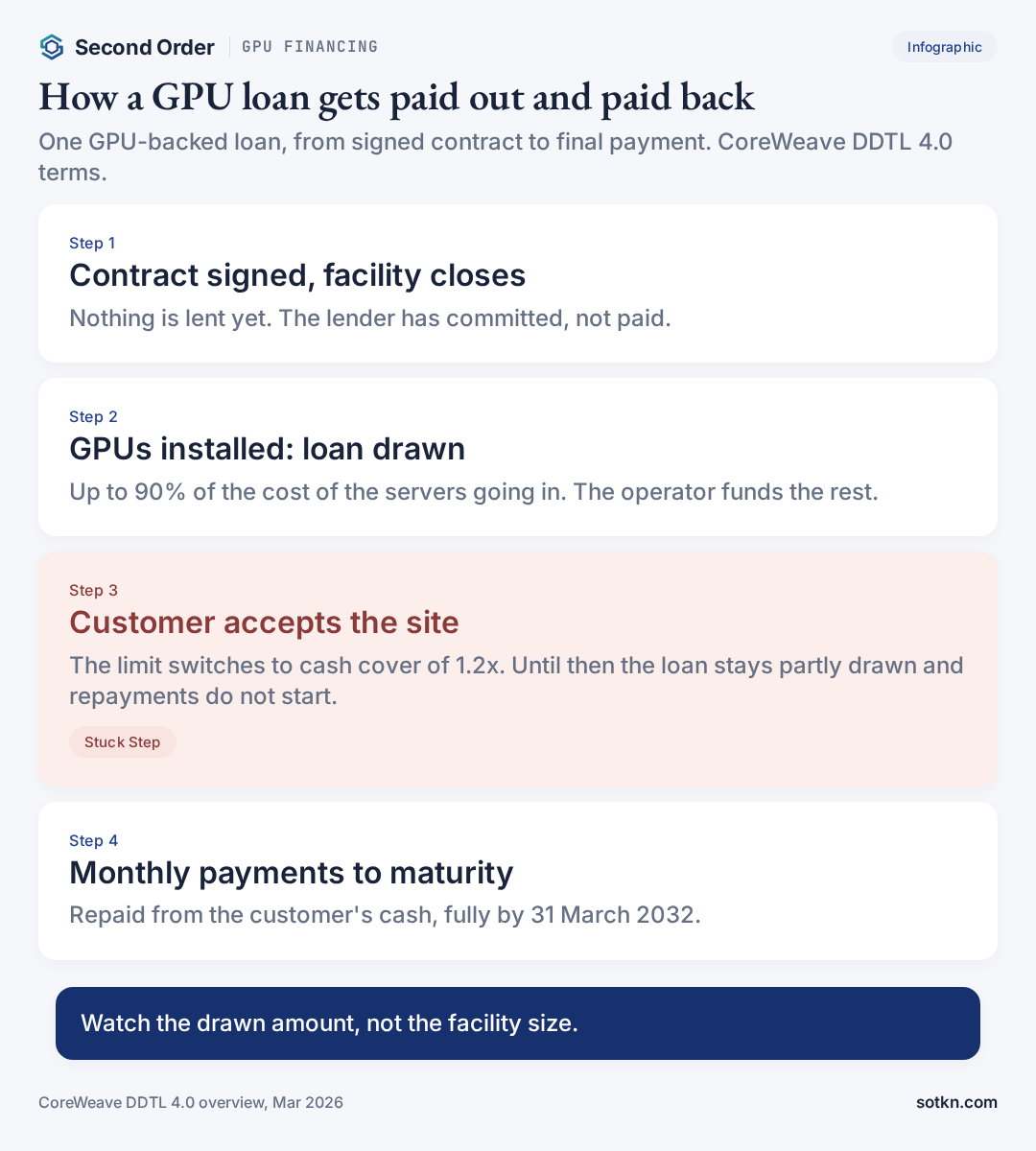
Our view: for a neocloud, the facility size measures what lenders will fund and the drawn amount measures what is live. Watch the second number. A large undrawn facility usually means GPUs that are ordered but not yet installed and accepted, and that is where the cash is stuck. The same gap between signed and live sits behind CoreWeave’s 4.2 GW signed against 1.5 GW live.
What would prove this wrong?
- Draws catch up fast. If CoreWeave’s next quarterly report shows DDTL 4.0 drawn well above a third, installation and acceptance are not the slow step.
- Weaker customers get the same terms. CoreWeave co-founder Brannin McBee told the Financial Times that contracts with AI labs below investment grade were not yet ready for insurer money. If such contracts start getting A-rated loans, the customer is no longer setting the price.
- Old GPUs hold their value. If used GPUs keep earning well beyond six years, lenders could lean more on the chips and less on the contract.
What to check next
CoreWeave’s third-quarter 2026 quarterly report will show how much of DDTL 4.0 is drawn. Lambda’s next draws, and any filing for its planned 2027 listing, will show how fast its contracts go live; the equity side is in Lambda’s reported $4 billion raise. The first GPU loan sold mainly to insurers on a contract below investment grade would mark the next step.
Common misconceptions
- People assume a GPU loan is lent against the chips. Actually it is lent against the customer contract; the chips are the backstop.
- People assume an $8.5 billion facility means $8.5 billion spent. Actually about a third of CoreWeave’s DDTL 4.0 was drawn at 30 June 2026.
- People assume the parent company is on the hook for every GPU loan. Actually the recent loans are lent to separate companies and are non-recourse to the parent, apart from installation guarantees, though they still count in consolidated debt.
- People assume cheap GPU debt means the operator is a strong credit. Actually the rating follows the customer; the same operator’s unsecured bonds were reported yielding in the low teens.
FAQ
What is GPU financing?
Borrowing to buy GPU servers, secured by the servers and by the customer contract that pays for them. The lender is repaid from the customer's payments, so the strength of the customer and the date the GPUs go live matter more than the chips.
How do GPU-backed loans work?
The operator puts the GPUs and one customer contract into a separate company, and the lender lends to that company. The loan is drawn as servers are installed, then repaid monthly from the customer's payments. CoreWeave's $8.5 billion DDTL 4.0 of March 2026 is non-recourse to the parent except for a guarantee on installing the GPUs.
What is a delayed draw term loan?
A loan committed in full on day one but paid out in pieces as the borrower needs it. In GPU financing each draw follows installation, so the lender funds servers as they go live, not an empty hall. CoreWeave had drawn $2.837 billion of its $8.5 billion facility by 30 June 2026.
How much can you borrow against GPUs?
Under CoreWeave's DDTL 4.0, up to 90% of the GPUs' cost while they are being installed. After the customer accepts a site, the limit switches to cash: the contract must cover loan payments 1.2 times, which CoreWeave says can lift the loan to about 102% of cost.
Why are some GPU loans investment grade?
Because the customer repays them. CoreWeave's DDTL 4.0, backed by a contract with an investment-grade AI customer, was rated A3 by Moody's and priced near 5.9% fixed. Lambda's October 2026 loan, backed by two investment-grade customers, was rated Baa1 and fixed at 6.78%.
How long do GPU loans last?
About six to seven years in the recent deals. CoreWeave's DDTL 4.0 is fully repaid by 31 March 2032 and Lambda's loan by 30 May 2033. CoreWeave depreciates its GPU equipment over six years, so the loan runs about as long as the company expects the chips to be useful.
Is this a list of stocks to buy or sell?
No. Second Order Explained pages explain how the money moves. They do not give buy or sell calls.
Related: who finances GPU clusters; what a GPU cluster is; remaining performance obligation; what CoreWeave does; what Lambda does; what Nebius does.
Stack doors
Layer: Neoclouds. Also: Hyperscalers, AI Data Centers, Semiconductors. Markets: US.
Get the Wire — short daily notes when GPU loans, offtake contracts and power dates move.
How we check this
Loan sizes, ratings, prices, ratios and maturities come from CoreWeave’s SEC filings and investor materials, Lambda’s release and Nebius’s SEC exhibit, listed under References. Each was re-checked on 16 Oct 2026. Bond yields and the Lambda equity raise come from press reports and are labelled as reported. Where we work something out ourselves, such as the share of a facility drawn or the interest gap between two rates, it is labelled “our arithmetic”. This page explains how the money moves. It does not give buy or sell calls.
Last reviewed: 16 Oct 2026 · Next review: after CoreWeave's third-quarter 2026 10-Q
Spot an error? Tell us and we will correct it and note the change here.
References
- CoreWeave — Closes $8.5 billion DDTL 4.0 facility, first investment-grade rated GPU-backed financing (31 Mar 2026) — facility size, ratings, pricing, maturity
- CoreWeave — DDTL 4.0 overview and summary term sheet (Mar 2026) — borrower, recourse, 90% loan-to-cost, 1.2x coverage, amortisation, collateral, cost versus DDTL 1.0 and 3.0
- CoreWeave — Form 10-Q for the quarter ended 30 Jun 2026 (SEC) — DDTL 4.0 outstanding; OEM financing outstanding
- CoreWeave — Form S-1 (SEC, filed 3 Mar 2025) — GPU infrastructure-backed lending history
- CoreWeave — Form 10-K for 2025 (SEC) — six-year useful life for technology equipment
- Lambda — Closes $1 billion senior secured fixed rate financing (1 Oct 2026) — delayed-draw structure, 6.78% fixed, ratings, maturity, collateral
- Nebius — Second quarter 2026 shareholder letter (SEC exhibit 99.2, 12 Aug 2026) — prepayments; $775 million asset-backed facility
- Startup Fortune — CoreWeave wants insurers to help bankroll its AI data center boom (Oct 2026, reporting a Financial Times interview of 14 Oct 2026) — insurer capital; unsecured bond yields
- TechCrunch — AI computing startup Lambda to raise $4B ahead of planned IPO (6 Oct 2026) — Lambda equity raise, as reported
- Wikimedia Commons — Pleiades supercomputer racks, photo by Oleg Alexandrov, CC BY-SA 4.0 — featured image base photo