What Is a GPU Cluster? Why Signed Racks Are Not a Computer
A GPU cluster is racks, fabric and power sold as one computer. NVIDIA SuperPOD builds it in eight-rack units. The stuck step is signed megawatts that are not yet live.
EXPLAINED · Mechanism · Last reviewed: 15 Oct 2026 · Next review: after CoreWeave’s Q3 2026 results (expected November 2026) print active gigawatts against the >1.85 GW year-end guide and 4.2 GW contracted
A GPU cluster is a set of GPU racks tied together by a scale-out fabric, shared storage and enough power and cooling that they can run one job as a single computer. One rack can be an NVLink domain. A cluster is the hall those racks talk across. If a rack, a switch or a watt is missing, the job does not start at “most of the cluster.” It waits.
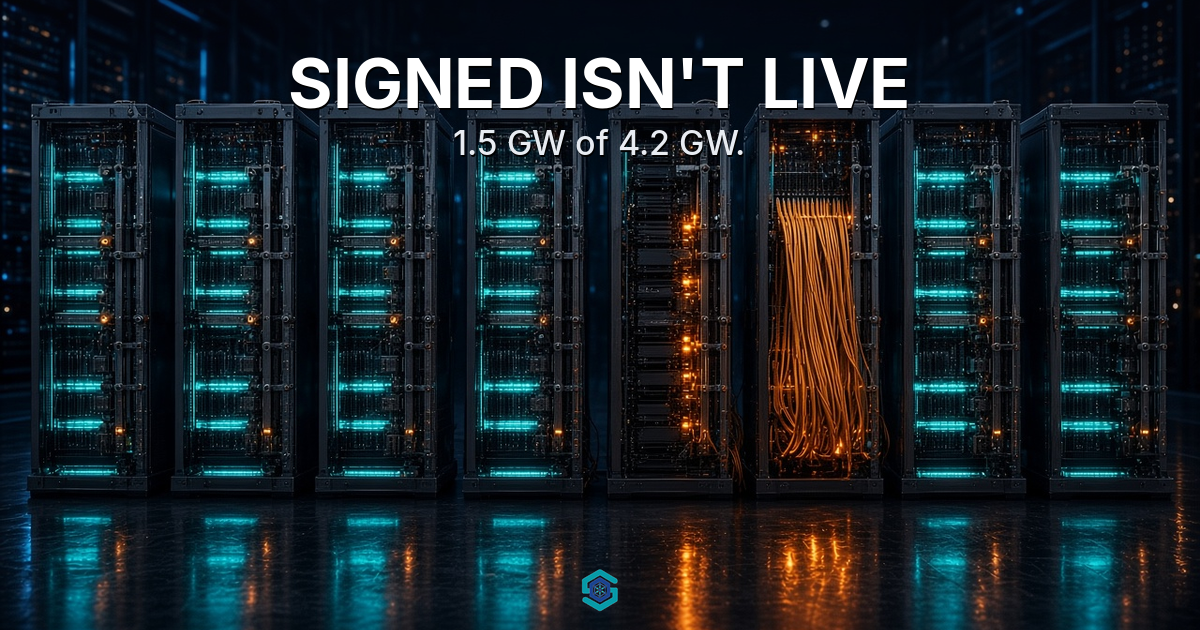
In short. NVIDIA’s DGX SuperPOD reference architecture builds that computer in scalable units of 8 GB200 NVL72 racks — 576 GPUs — at 1.2 MW TDP, and says a SuperPOD can reach 128 racks and 9,216 GPUs. Our check: 8 × 72 = 576; 128 × 72 = 9,216. CoreWeave’s 11 August 2026 call put 1.5 GW live and 4.2 GW contracted. Our check: 1.5 ÷ 4.2 = 35.7% live; 4.2 − 1.5 = 2.7 GW still dark. The stuck step is the last missing piece of a complete cluster.
Who gets paid when a neocloud sells a cluster — the chipmaker who ships the racks, the lender who funds them, or the operator who cannot bill until the fabric and the megawatts are both live.
What is a GPU cluster?
A GPU server is a node. A rack-scale NVL72 is a cabinet whose 72 GPUs share one NVLink domain. A GPU cluster is the next unit: those cabinets, the scale-out network that lets rack 1 talk to rack 8 as one machine, the storage fabric that feeds the job, and the power and liquid loop that keep every tray on.
NVIDIA’s name for a qualified version of that machine is DGX SuperPOD. The GB200 SuperPOD reference architecture (read 15 Oct 2026) sets the building block: a scalable unit is 8 DGX GB200 NVL72 racks (18 compute trays and 9 NVLink switch trays each). The compute fabric is NVIDIA Quantum QM9700 InfiniBand — rail-optimised, non-blocking, full fat-tree, eight NDR400 (400 Gbps) connections per system. Storage and in-band management sit on a separate Spectrum-4 Ethernet fabric so storage I/O does not fight the job. One scalable unit needs 1.2 MW of thermal design power. NVIDIA says building by unit cuts deployment from months to weeks, and that a SuperPOD can grow to 128 racks and 9,216 GPUs. Those are reference-design figures, not a live hall. The SuperPOD product page calls the result “a full-stack data center platform,” not a pile of cards.
A neocloud sells that computer by the hour or the contract, rather than as an owned SuperPOD. The SKU on the invoice is GPU as a service. The machine behind the invoice is the cluster. If you are buying the long reserved job, you are buying AI training. If you are buying the repeating request, you are buying inference. Both still need the cluster live.
| What you can point at | What it is | What has to be live |
|---|---|---|
| GPU / superchip | The die, with HBM and a CoWoS slot | The package |
| Rack (NVL72) | 72 GPUs on one NVLink domain | Every tray, NVLink switch, pump and watt in that cabinet |
| Cluster (SuperPOD-class) | Racks plus InfiniBand (or Ethernet) scale-out plus storage plus hall power | Every rack on the fabric, the spine, the storage, the MW |
| Cloud SKU | Billed hours or a dated capacity block | The cluster, then the scheduler, then the customer job |
NVIDIA’s GB200 NVL72 page is the neighbour: NVLink inside the rack is 130 TB/s; InfiniBand or Spectrum-X is how racks become a hall. A cluster missing the fabric is a row of expensive cabinets.
Why does it bind?
It binds because cash follows a live cluster, and a live cluster is several clocks stacked in one hall.
Power is the clock you can see on a neocloud filing. CoreWeave’s 11 August 2026 release said it expanded active power by nearly 500 MW to reach 1.5 GW, and grew contracted power to about 3.7 GW at 30 June 2026. On the call the same day, contracted power was 4.2 GW after another ~500 MW since quarter-end, with more than 1.5 GW of further potential from powered land, options and letters of intent excluded. Year-end active-power guidance rose to more than 1.85 GW. Our check: 1.5 ÷ 4.2 = 35.7% live; 1.85 ÷ 4.2 = 44.0% if contracted stays put and the guide is hit. The gap is the cluster that cannot yet bill.
Nebius prints the same bind with three labels. The Q2 2026 shareholder letter raised the year-end contracted power target to 5 GW. Connected power — power into built halls — was still guided at 800 MW to 1 GW by year-end 2026. Our check: 1.0 ÷ 5.0 = 20% if both tops are hit. On the earnings call, management walked the remaining steps in order: commission the data centre, build the network, build the clusters, deploy the platform, onboard the customer, then revenue. Connected MW is not a cluster. A cluster is not yet a billed hour.
The fabric is the second clock. NVIDIA’s SuperPOD compute fabric is a fat-tree of InfiniBand switches. A missing spine, a late leaf, or a rack that is powered but not cabled is not “slightly less bandwidth.” Traffic that has to cross racks has nowhere to go. CoreWeave said in the same Q2 print that it had completed the industry’s first bring-up and validation of NVIDIA Vera Rubin NVL72 — a rack-scale SKU sitting down inside a cluster. Bring-up is the fabric-and-software clock. It is not the same print as 4.2 GW contracted.
The third clock is money that has already left. CoreWeave’s Q2 2026 revenue was $2.575 billion. Revenue backlog at 30 June 2026 was about $104 billion, excluding more than $25 billion of net new commitments added in early Q3. Our check: 104 ÷ 2.575 = 40.4× that quarter’s revenue. CoreWeave’s footnote says backlog is remaining performance obligations plus other estimated amounts, “subject to the satisfaction of delivery and availability of service requirements.” Delivery is the cluster. See RPO and take-or-pay GPU contracts.
Who gets paid — and where is the stuck step?
Money leaves the customer — a lab, an enterprise, or a hyperscaler buying extra capacity — before a token is billed. It leaves in a set order.
| Step | Who | Why it matters |
|---|---|---|
| 1. Chip, NVLink and scale-out | NVIDIA | Paid when GPUs, NVLink trays and InfiniBand NICs and switches ship. Q2 FY2027 data-centre $89.0 billion; ACIE (neocloud, industrial, enterprise) $40 billion |
| 2. Memory and package | SK hynix, Samsung, Micron; TSMC CoWoS | A cluster of empty baseboards is not a cluster. Each GPU still needs HBM and a packaging slot |
| 3. Rack and CDU | Foxconn, Wistron, Quanta, Supermicro, Dell and the liquid-cooling chain | Paid to put superchips into a qualified NVL72. Eight of those racks are one SuperPOD scalable unit |
| 4. Hall, power and interconnect | Colocation landlords, utilities, on-site generation | 1.2 MW TDP per eight-rack unit. CoreWeave’s live column is 1.5 GW; contracted is 4.2 GW. The AI data center and speed-to-power clocks sit here |
| 5. Lenders | Delayed-draw and GPU-backed facilities | CoreWeave closed a $3.1 billion publicly syndicated delayed-draw term loan backed by HPC infrastructure in the same Q2 print. Capital is paid against a cluster that is supposed to turn on. See who finances GPU clusters |
| 6. The neocloud | CoreWeave, Nebius, Lambda, Crusoe, Fluidstack | Paid last, when the cluster is one computer and hours bill. CoreWeave Q2 revenue $2.575 billion against $104 billion of backlog that still needs delivery |
Stuck step: the last missing piece of a complete cluster. A dark rack, a missing InfiniBand spine, connected power with no cluster, or a signed megawatt that is not yet active all look the same from the neocloud’s chair: the machine is not a computer, so take-or-pay paper does not become GPU hours. Nebius’s sequence is the plain version: network, then clusters, then platform, then the customer, then revenue.
A useful test, not a ticker call: if CoreWeave’s November Q3 print lifts active GW toward >1.85 GW while contracted stays near 4.2 GW, the hall clock is closing. If active stalls and backlog still grows, the stuck step is still the cluster, not demand.
Not investment advice. Do your own research.
Common misconceptions
- People assume a GPU cluster is just many GPUs in a room. Actually NVIDIA’s SuperPOD is racks plus a non-blocking InfiniBand fabric, a separate storage fabric, and software that treats them as one system. Cabinets with no spine are inventory.
- People assume signed power is a live cluster. Actually CoreWeave’s split is 1.5 GW active against 4.2 GW contracted as of 11 August 2026. Our check: 35.7% live. Nebius splits further: contracted, connected, then cluster, then revenue.
- People assume you can start the training job at 80% of the cluster. Actually the reserved job needs the cluster the contract sold. A dark rack is the same bind as a 71-GPU NVL72. See GPU utilization.
- People assume NVIDIA is paid when the neocloud bills. Actually NVIDIA is paid when racks and switches ship. The neocloud is paid when hours bill. CoreWeave’s $104 billion backlog is the customer’s promise, not NVIDIA’s invoice.
- People assume connected MW is billed MW. Actually Nebius listed the remaining steps after connection: commission, network, clusters, platform, onboarding. Connected power is a hall clock.
FAQ
What is a GPU cluster?
A GPU cluster is a set of GPU racks tied together by a scale-out fabric, shared storage and enough power and cooling that they can run one job as a single computer. NVIDIA’s DGX SuperPOD is a qualified version of that machine, built in eight-rack scalable units.
How is a GPU cluster different from a GPU rack?
A rack-scale NVL72 is 72 GPUs sharing one NVLink domain inside one cabinet. A cluster is several of those cabinets talking across InfiniBand or Ethernet, plus storage and hall power. NVLink makes the rack a computer. The scale-out fabric makes the hall a computer.
Why isn’t signed power a live cluster?
Because contracted megawatts are a right to power, not a SuperPOD. CoreWeave’s 11 August 2026 call put 1.5 GW in the active column and 4.2 GW contracted. Our check: 1.5 ÷ 4.2 = 35.7% live. The rest is still waiting for a hall, a fabric or a bring-up.
Who gets paid for a GPU cluster?
NVIDIA is paid first, for GPUs, NVLink and InfiniBand. Memory and packaging cash in the same window. Rack builders and landlords are paid to stand the cabinets up. Lenders are paid to fund them. The neocloud is paid last, when the cluster is live and hours bill.
How big is an NVIDIA SuperPOD scalable unit?
Eight DGX GB200 NVL72 racks, 576 GPUs, 1.2 MW of thermal design power, with a Quantum InfiniBand fat-tree between the racks. NVIDIA’s reference architecture says a SuperPOD can grow to 128 racks and 9,216 GPUs.
What is the stuck step?
The last missing piece of a complete cluster: a dark rack, a missing InfiniBand spine, connected power with no cluster built, or signed megawatts that are not yet active. Until that piece lands, take-or-pay paper is not GPU hours.
Is this a list of stocks to buy or sell?
No. Second Order Explained pages explain how the money moves. They do not give buy or sell calls.
Related terms
- What is a neocloud? — the operator that bills the cluster.
- What is GPU as a service? — how a live cluster is sold by the hour or the block.
- What is rack-scale AI? — the cabinet inside the cluster.
- What is AI training? — the job that needs the whole cluster.
- What is a take-or-pay GPU contract? — paper that still needs delivery.
- Who finances GPU clusters? — the lenders in step 5.
Markets and stack doors
Layer: neoclouds. Sibling layers: hyperscalers · semiconductors. Markets: US CoreWeave / Vera Rubin · US Texas large-load rule · US PJM capacity · Taiwan · Korea. Company doors: What Does CoreWeave Do? · What Does Nebius Do? · What Does Lambda Do?.
Get the Wire. Analysis: where the stuck step moves.
How we check this
Figures come from company filings, company releases and NVIDIA reference architectures, each dated in the list below. Capacity and timing from press reports are labelled as reported, not guided. Where we work something out ourselves, the arithmetic is shown in full.
Last reviewed: 15 Oct 2026 · Next review: after CoreWeave’s Q3 2026 results (expected November 2026) print active gigawatts against the >1.85 GW year-end guide and 4.2 GW contracted
Spot an error? Tell us and we will correct it and note the change here.
Sources
- NVIDIA DGX SuperPOD GB200 key components — 8× NVL72 racks per scalable unit; QM9700 InfiniBand fat-tree; eight NDR400 links per system; Spectrum-4 storage/in-band (read 15 Oct 2026)
- NVIDIA DGX SuperPOD GB200 RA PDF — SU TDP 1.2 MW; 128 racks / 9,216 GPUs; 576-GPU fabric; months-to-weeks deployment (RA11338001, read 15 Oct 2026)
- NVIDIA DGX SuperPOD product page — full-stack platform, not a collection of hardware (read 15 Oct 2026)
- NVIDIA GB200 NVL72 — 72-GPU NVLink domain; 130 TB/s NVLink; InfiniBand / Spectrum-X scale-out (read 15 Oct 2026)
- NVIDIA Q2 FY2027 results — data-centre revenue $89.0bn; ACIE $40bn (26 Aug 2026)
- CoreWeave Q2 2026 results — revenue $2.575bn; backlog ~$104bn at 30 Jun 2026; active power 1.5 GW; contracted ~3.7 GW; Vera Rubin NVL72 bring-up; $3.1bn delayed-draw loan (11 Aug 2026)
- CoreWeave Q2 2026 call — contracted power 4.2 GW as of 11 Aug 2026; year-end active guide >1.85 GW (11 Aug 2026)
- CoreWeave Q2 2026 SEC press exhibit — active 1.5 GW; contracted ~3.7 GW; backlog subject to delivery (11 Aug 2026)
- Nebius Q2 2026 shareholder letter — contracted-power target 5 GW; first Vera Rubin NVL72 systems in validation (Q2 2026)
- Nebius Q2 2026 SEC exhibit — contracted vs connected vs active; 800 MW–1 GW connected guide; halls → clusters → revenue (Q2 2026)