6.8 GW Short: Who Gets Paid While America's Biggest Grid Waits for New Power
PJM, the biggest US grid, issued its first Capacity Advisory for 12-13 October 2026. Its last auction came up 6,831 MW short, and its new fast lane has approved 2.1 GW for mid-2029. Plants already running are paid first. The stuck step is new supply, and who pays for it.
America's biggest grid is short of power, and it is now saying so out loud. On 12 October 2026, PJM ran its first-ever Capacity Advisory. Its last auction came up 6,831 MW short. Its new fast lane has approved 2.1 GW, due in mid-2029. The plants already running get paid first. New supply is the step that sets the pace.
US PULSE · Data as at 12 Oct 2026 · Next update: PJM's backstop refiling, due 29 October; the 2029/30 auction in December
Affects: AI Data Centers · Hyperscalers · Neoclouds — Markets: US · Taiwan · Korea
Education only, not advice to buy or sell any security. Figures are as reported; many dates are targets, not contracts. Our own sums are labelled.
The numbers that matter (week of 5-12 October 2026)
Shortfall in the 2028/29 auction
6,831 MW
Below PJM's reliability requirement
PrimaryCapacity price
$325/MW-day
At the cap; about $555 without it
PrimaryFirst fast-lane projects
2,115 MW
Two Engie batteries, one LS Power gas uprate · mid-2029
PrimaryFirst Capacity Advisory
12-13 Oct
~104,000 MW peak vs ~70,000 MW of planned outages
PrimaryLarge-load registry
50 MW+
In force 12 Oct; curtailment plan rejected
PrimaryNew supply on the grid
Plants
Approved in weeks, built in years
Stuck stepFigures from PJM notices, FERC orders and company filings, July to October 2026. Status chips are Second Order’s read.
On this page: Why PJM? · What changed, 7-12 October 2026 · How big is the gap? · The fast lane · Who pays? · Our math · Who gets paid · What is stuck? · Dates next · What would change this · FAQ
Why does PJM matter for the AI build?
Because a large share of America's data centers plug into it. PJM Interconnection runs the high-voltage grid and the wholesale power market for more than 67 million people in 13 states and Washington, DC. Its area takes in Northern Virginia, the biggest data center market in the world, and fast-growing sites in Ohio, Pennsylvania and Illinois.
PJM's own forecast shows how fast things changed. In January it said its summer peak would grow about 3.6% a year for the next ten years. Its 2021 forecast had said 0.3% a year. The difference is mostly data centers. PJM expects the summer peak to reach about 183,000 MW in 2030, against about 160,500 MW in 2027.
Demand is not the question. The question is whether new plants can connect as fast as the halls, and who pays for them. We covered how much the US is spending on the halls in the US data-hall construction Pulse, and how Texas is pricing its grid queue in the Texas large-load Pulse.
1 · Data centers ask for power
Who: Hyperscalers, neoclouds, their developers
Paid: PJM's summer peak forecast rises about 3.6% a year
2 · Plants already running sell capacity
Who: Constellation, Vistra, Talen and others
Paid: Auction cleared at the $325/MW-day cap
3 · New plants try to connect
Who: Engie, LS Power and the fast lane
Paid: 2,115 MW approved for mid-2029
4 · Someone has to pay for new supply
Who: PJM, FERC, the states, the large loads
Paid: Backstop paused; rules being rewritten
What changed, 7-12 October 2026?
- 7 October, the Energy Department weighed in. The Department of Energy filed a rare statement with FERC, the federal power regulator. It said data centers and other large loads, not households, must fund the new power plants and grid they need.
- 8 October, the fast lane opened its first gate. PJM accepted the first three projects on its new Expedited Interconnection Track: two Engie battery projects of 860 MW and 800 MW, in Pennsylvania and Ohio, and a 455 MW uprate at LS Power's Hunterstown gas plant in Pennsylvania. All three are due online in mid-2029.
- 9 October, FERC said no to the curtailment plan. FERC accepted PJM's definition of a large load, 50 MW or more at one site, and a registry to track those loads from 12 October. It rejected the rest: a service under which new data centers that had not brought their own new power could be cut off early in an emergency.
- 9 October, PJM issued its first Capacity Advisory. It covers 12 and 13 October 2026: peaks of about 102,000 MW and 104,000 MW against about 70,000 MW of generation out for planned work.
The advisory is not an emergency; outages on this scale are normal in October, PJM said. But it also said something new. Capacity problems used to come with heat waves and cold snaps. It now sees them in mild weather, and expects more of them “as demand growth outpaces the addition of new power resources”. That sentence is the whole story in miniature.
How big is the gap?
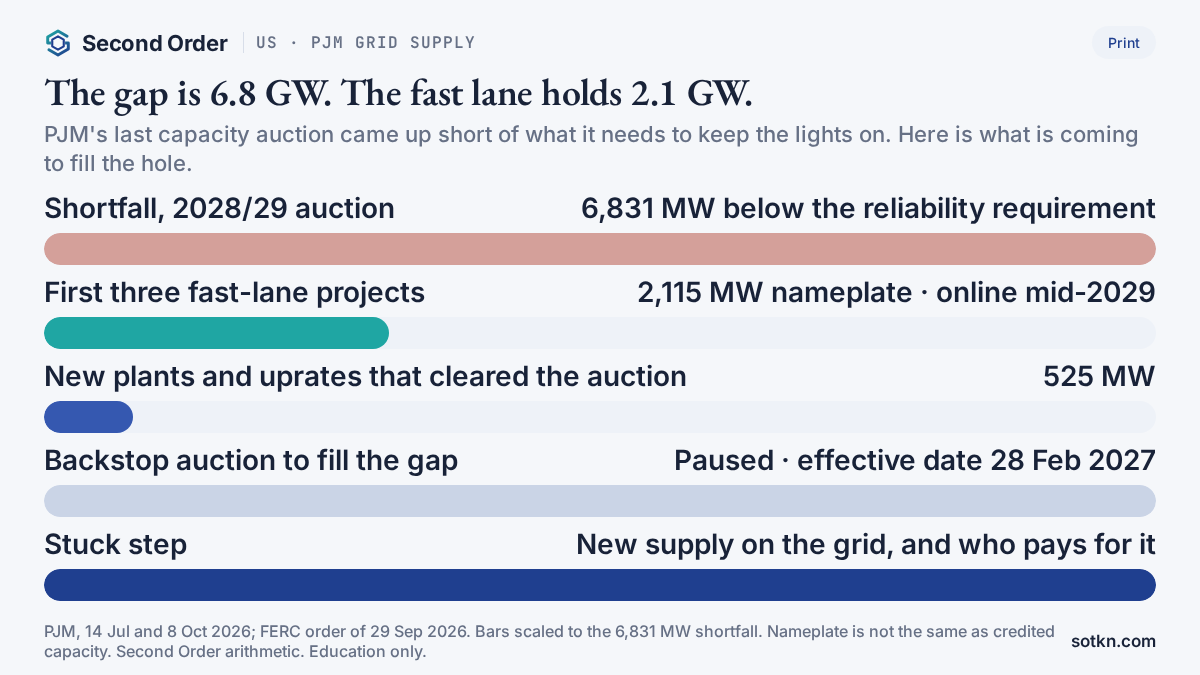
PJM pays power plants to promise they will be available in a future year. Its July auction covered June 2028 to May 2029.
- It bought 138,318 MW of accredited capacity, plus 10,864 MW from areas that supply themselves, 149,182 MW in all.
- That was 6,831 MW short of PJM's reliability requirement. The auction before it was about 6,500 MW short. Those were the first two auctions in PJM's history in which the whole region fell short.
- The price hit the cap set with the states and FERC: $325 per MW-day, a total of $16.4 billion.
- Only about 525 MW of new plants and uprates cleared, including 208 MW of uprates, Utility Dive reported. That was down from 774 MW in the auction before.
Being short does not mean the lights go out in 2028. It means PJM runs with thinner reserves and more risk. Its reserve margin for that year is 14.7%, below the 20% it aims for.
The plan to fill the gap was a one-off backstop auction for new plants, open from 30 September. On 29 September FERC accepted it in part but suspended it for five months, to 28 February 2027. FERC said the plan did not show that the costs would land on the customers causing them. Its chair, Laura Swett, called the last-minute filing a “mess” with “billion-dollar implications for consumers”.
PJM's 2028/29 auction
The fixes in play
What is the fast lane, and how much does it fix?
PJM's normal queue for new plants takes years. FERC approved a temporary fast lane in June. It is for big projects, at least 250 MW of credited capacity, that can start running within three years and have a promise from a state or local siting authority to review them by a set date. PJM will approve up to 10 a year in 2026 and 2027. The lane closes at the end of 2027.
All three first projects applied on the day the window opened, 31 July. Each asks to be in service by 31 July 2029, The Duck Curve reported. PJM expects each to sign its connection agreement within ten months of applying, so around the end of May 2027.
Look at what came first: batteries and an uprate. Neither needs a new gas turbine, and new turbines have long waiting lists. These are the projects that can meet a three-year deadline.
Two cautions. First, the 2,115 MW is nameplate, the full output rating. PJM credits each resource with less, based on how reliably it shows up at the tightest hours, and neither PJM nor the status sheet gave the batteries' duration. So the credited capacity will be lower than 2,115 MW. Second, ten slots a year is small. Seven of this year's ten were still open on 9 October, The Duck Curve counted.
The bigger backlog is elsewhere. PJM said on 30 September that 49 GW of generation has signed agreements, but many of those projects are stalled by state permits and supply chains. The fast lane does not fix that.
Who pays for the new power?
This is the fight under every headline from 7 to 12 October 2026. New plants cost money before they earn, and somebody has to promise to pay. PJM has tried three ways to make that the data centers.
- The backstop auction. PJM would buy new capacity and bill it out. FERC said the billing plan did not track who causes the cost, and suggested using updated load forecasts instead. It also questioned the collateral asked of utilities: one Virginia co-op, Northern Virginia Electric Cooperative, said it would have had to post about $2 billion.
- Bring your own power. New large loads that brought their own new supply would avoid being cut first in an emergency. FERC rejected this on 9 October along with the curtailment service it was tied to. Constellation had called its 890 MW nuclear uprate deal with Google a direct response to the proposal.
- The registry. Utilities must now report every load of 50 MW or more to PJM: location, peak, ramp schedule and backup generation. Data centers within a mile of each other count as one site, so nobody can stay under the line by building several small halls side by side. This part survived.
The Energy Department's filing points the same way. Under what it calls the Ratepayer Protection Pledge, large loads “not American households or other business ratepayers” must fund the generation they need. Utilities in PJM that signed the pledge include American Electric Power, Dominion Energy, Exelon, FirstEnergy and PPL. We looked at how one utility writes that into a tariff in the Duke data center tariff Wire, and at the bill it leaves behind in the utilities Analysis.
PJM now plans to refile the backstop by 29 October, rather than wait for FERC's hearing, and holds a special members' meeting on 22 October first. Until it lands, there is no agreed way to bill the cost of new plants for data centers to the data centers.
Our math: how big are the gaps?
- The fast lane against the shortfall: 2,115 MW of nameplate is about 31% of the 6,831 MW gap (our arithmetic). Credited capacity will be lower, so the real share is smaller.
- The fast lane against the backlog: 2,115 MW is about 4% of the 49 GW that already has signed agreements but is not being built quickly (our arithmetic).
- Demand growth: from about 160,500 MW in 2027 to about 183,000 MW in 2030 is about 22,500 MW in three years. The 6,831 MW shortfall is about 30% of that rise (our arithmetic).
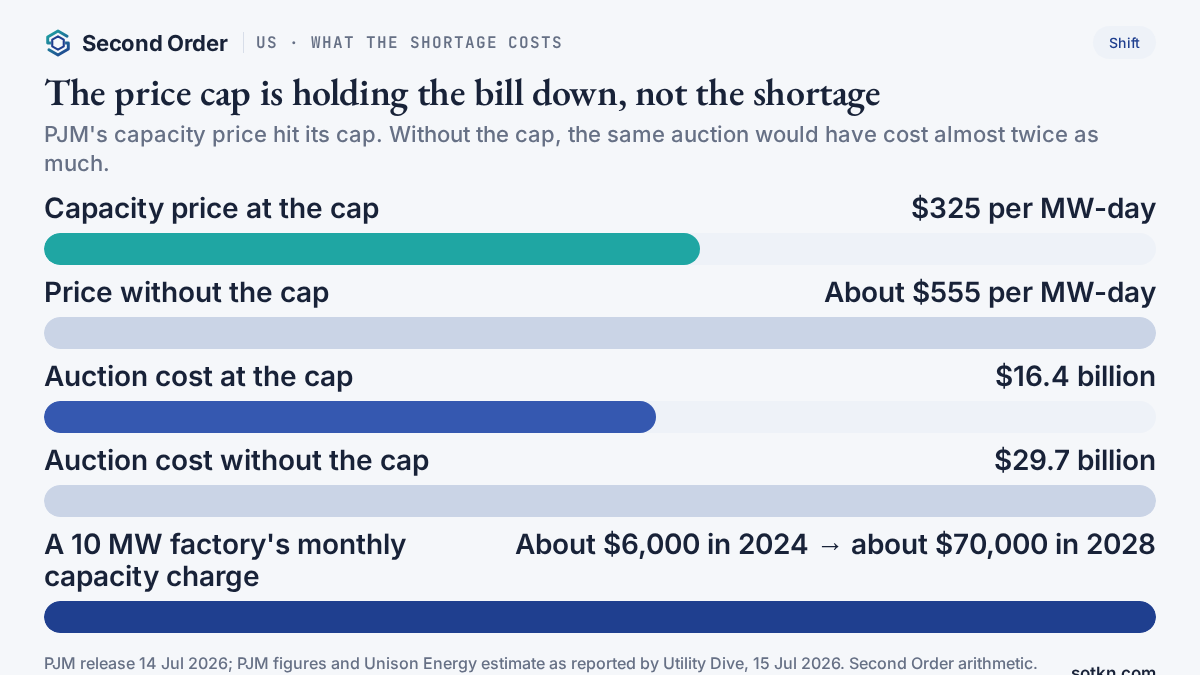
- The price cap: $325 per MW-day is about $119,000 per MW a year. At about $555 it would be about $203,000 (our arithmetic). The cap kept about $13.3 billion off the 2028/29 bill, $29.7 billion against $16.4 billion (our arithmetic).
- The 12 October 2026 advisory: about 70,000 MW of planned outages is about 38% of PJM's roughly 182,000 MW of generating capacity (our arithmetic). That is why a mild October day can be tight.
What this tells you: the money for data centers exists, and so does the demand. The cap is holding the bill down, not the shortage. New plants need a price and a payer that last long enough to build them, and that is what is not settled. For how to read money spent long before it earns, see cash capex, explained.
Who gets paid first?
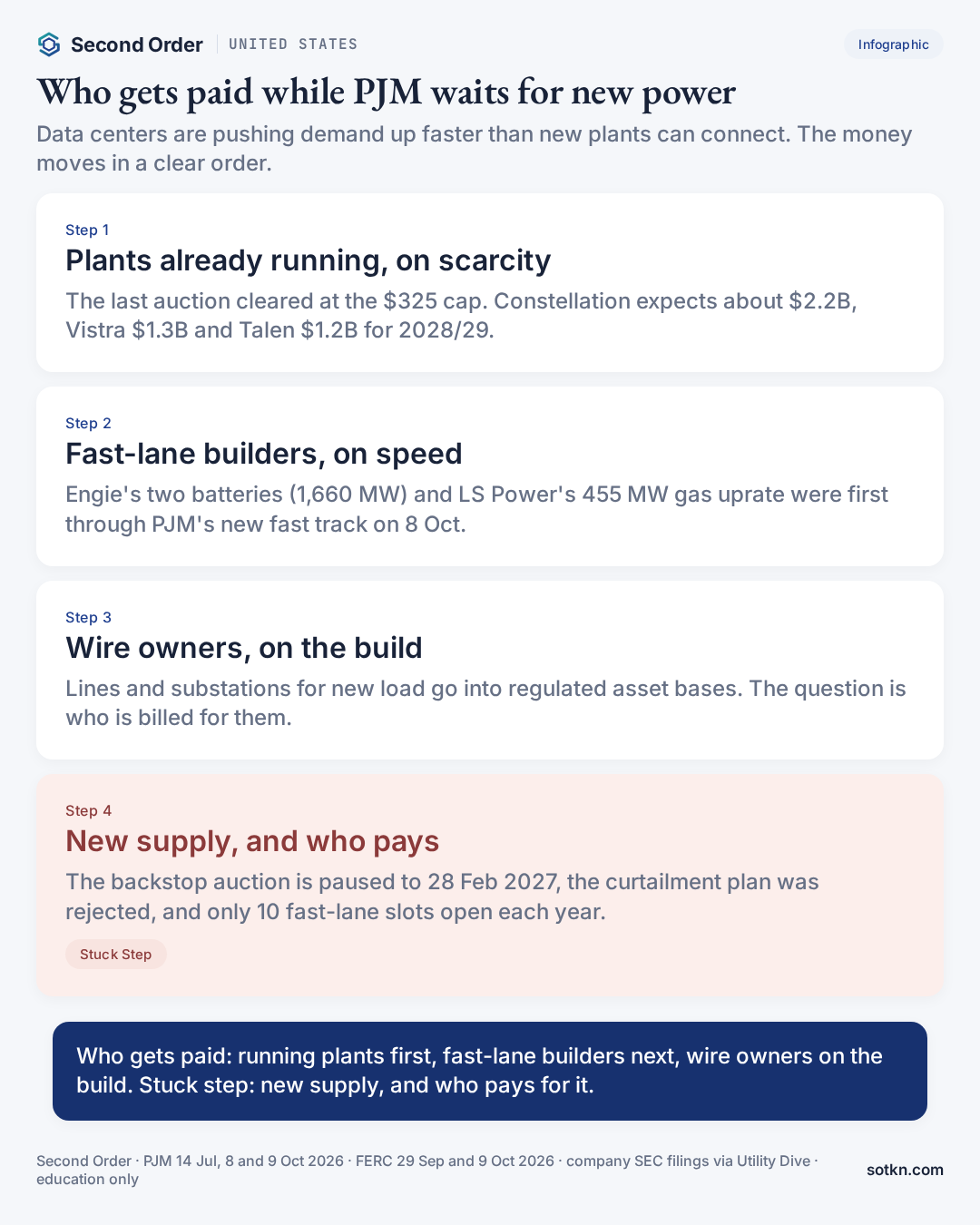
First, the plants already running — on scarcity. A short market pays the cap. Constellation cleared 18,875 MW in the July auction and expects about $2.2 billion of capacity revenue for 2028/29, Utility Dive reported from its SEC filing. Vistra expects about $1.3 billion and Talen about $1.2 billion. Those three alone are about 29% of the $16.4 billion auction (our arithmetic). Every year new supply is late is another year existing plants sell into a short market.
Second, the builders who can move fast — on speed. Engie and LS Power are first through the fast lane. Batteries dodge the turbine queue, and an uprate adds power at a plant that is already connected. The same logic shows up in Google's 890 MW nuclear uprate deal: the quickest new megawatt is often an old plant made bigger.
Third, the wire owners — on the build. Lines and substations for new load go into the regulated asset base utilities earn a return on. The billing rules decide whether that cost lands on the data center or on every customer. Big users already feel it. A 10 MW factory's monthly capacity charge is set to go from about $6,000 in 2024 to about $70,000 in 2028, Unison Energy estimated. For one hyperscaler's own answer, see Black Hills building gas power for Google.
Fourth, the data centers — which pay and wait. They pay the capacity price through their utilities now, and may be billed directly for new plants later. Those that bring their own power, from gas turbines to nuclear uprates, buy themselves time. See the BKV gas turbines Wire and TeraWulf's 1 GW Kentucky power deal for two recent examples. For why power is the longest clock in a data center build, see how long it takes to build an AI data center.
One-line rule: while PJM waits for new power, plants already running are paid first on scarcity, fast-lane builders next on speed, wire owners on the build, and data centers pay and wait. The stuck step is new supply, and who pays for it.
So what is the stuck step?
New supply on the grid, and who pays for it. Not demand, not the money for the halls, not the chips. Three things make it stick:
- Time: even the fast lane's first projects, approved in October 2026, are due in mid-2029. New gas turbines take longer still.
- Money: the price cap holds the capacity price at $325 per MW-day. Aurora Energy Research said new plants need “significantly more” than that to pay for themselves.
- Rules: the backstop is suspended, the curtailment plan was rejected, and nobody has yet agreed how to bill the cost of new plants to the loads that need them.
So-what: PJM is now short in mild weather, short in its auctions and short on rules. That does not stop data centers being built in its area. It changes who carries the risk. Projects that bring their own power, or that sit on sites with power already connected, move ahead. Projects that wait on new grid supply wait longer. The same pattern shows up in New South Wales and in Korea's chip fabs. For the general rule, see where does the stuck step move?.
Which dates test this read next?
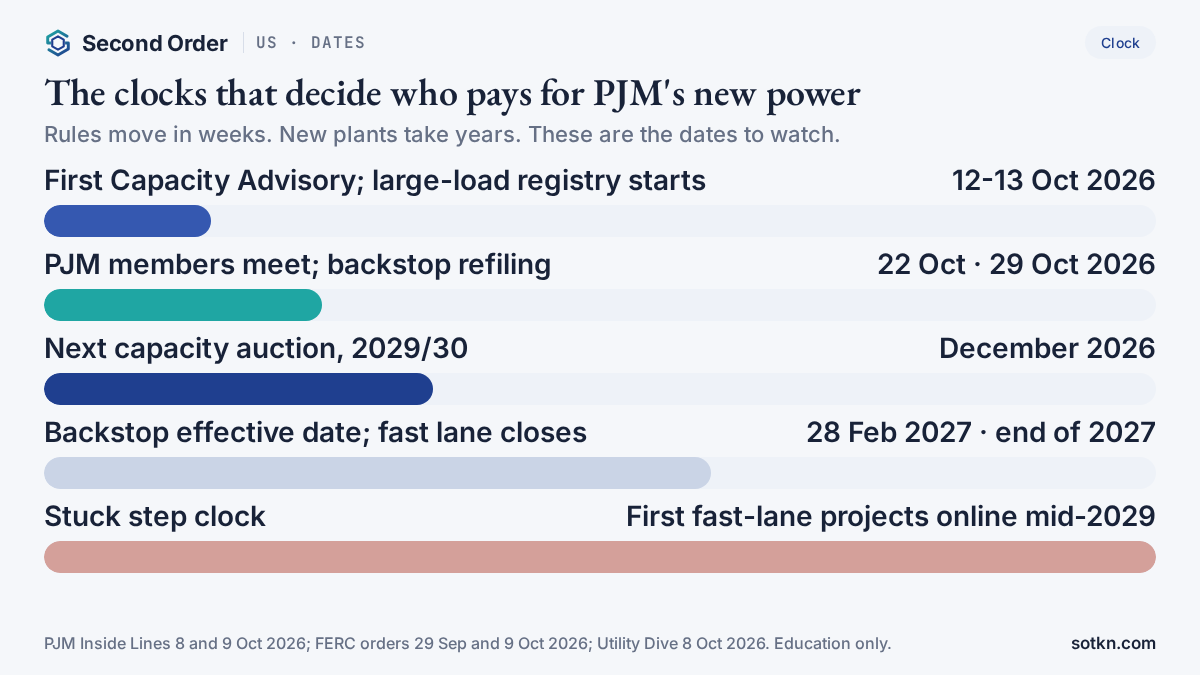
- 12-13 Oct 2026 — PJM's first Capacity Advisory; the large-load registry rules take effect on 12 October.
- 22 Oct 2026 — special PJM Members Committee meeting on the backstop refiling.
- 29 Oct 2026 — PJM's planned refiling of the backstop at FERC. The test: does the cost land on the large loads?
- Early November 2026 — PJM's 30-day compliance filing on the registry; PJM has also said it plans filings on new grid services for flexible large loads.
- December 2026 — the capacity auction for 2029/30. The test: does more new supply clear than July's 525 MW?
- 28 Feb 2027 — the date FERC set for the suspended backstop, unless a refiling moves it.
- End of May 2027 — about when the first fast-lane projects should sign connection agreements (our arithmetic from PJM's ten-month target).
- End of 2027 — the fast lane closes.
- Mid-2029 — the first fast-lane projects are due online.
The 29 October refiling matters most. It is the first real answer to who pays for new plants for data centers in America's biggest grid.
What would change this view?
- PJM's refiled backstop is approved quickly and draws large offers of new plants — the money problem eases and new supply moves faster.
- The December auction clears far more new capacity than July's 525 MW — the market starts to fix the gap itself.
- The registry shows fewer real large loads than forecast — the shortfall shrinks on the demand side.
- The states set clear rules for which customers are cut first in an emergency — the curtailment question returns in a form FERC can accept.
Practical takeaways
- PJM issued its first Capacity Advisory for 12-13 October as demand outpaces new supply
- Its 2028/29 auction cleared 6,831 MW short at the $325 per MW-day cap
- The fast lane approved 2,115 MW on 8 October, due mid-2029; seven of this year's ten slots were still open
- FERC kept a 50 MW large-load registry but rejected the plan to cut new data centers first; the backstop is paused to 28 February 2027
- Stuck step: new supply on the grid, and who pays for it
FAQ
What is PJM?
PJM Interconnection runs the high-voltage grid and the wholesale power market for more than 67 million people in 13 states and Washington, DC, from New Jersey to Illinois. It includes Northern Virginia, the biggest data center market in the world.
Why is PJM 6.8 GW short?
Its auction for June 2028 to May 2029 bought 6,831 MW less than its reliability requirement. Demand forecasts rose, largely because of data centers, while only 525 MW of new plants and uprates cleared.
Who pays for new power plants for data centers?
That is the open question. FERC and the Department of Energy want the costs to fall on the large loads that cause them. PJM plans to refile its backstop auction plan by 29 October.
Is this investment advice?
No. Education only. It maps who gets paid and which step is stuck. It is not a recommendation to buy or sell any security.
Keep reading on the map
- US Markets hub — country page
- Texas large-load rule Pulse — the other big US grid
- AI Data Centers stack — layer map
- What is an AI data center? · Hyperscalers, explained
- All Markets doors — Taiwan, Korea, US, China, Singapore, Australia, Malaysia
How we check this. Grid rules, project sizes and dates come from PJM's own notices and from FERC orders, as published or as reported by named energy outlets. Auction results come from PJM's release. Generator revenue figures are from the companies' SEC filings as reported. Analyst price targets and buy calls are left out on purpose. Anything we worked out ourselves is labelled “our arithmetic”. We do not invent margins, prices or dates. The references we used are listed at the end. Our editorial standards →
Not investment advice. Do your own research.
References
- PJM Inside Lines, PJM Capacity Advisory Issued for Oct. 12-13, 9 Oct 2026. insidelines.pjm.com — first use of the Capacity Advisory; forecast peaks and scheduled outages.
- PJM Inside Lines, PJM Accepts First Expedited Interconnection Track Projects, 8 Oct 2026. insidelines.pjm.com — the three fast-lane projects, sizes, zones and rules.
- The Duck Curve, PJM accepts two ENGIE batteries and a gas uprate on its fast track, 9 Oct 2026. theduckcurve.com — requested in-service dates, open slots, signed-but-unbuilt backlog.
- The Duck Curve, FERC rejects PJM's large-load curtailment plan, keeps the load registry, 10 Oct 2026. theduckcurve.com — FERC's 9 October order on the registry and curtailment service.
- Utility Dive, DOE presses PJM on ratepayer protections from large load costs, 8 Oct 2026. utilitydive.com — DOE position, PJM refiling plan and meeting dates.
- Utility Dive, FERC chair slams PJM 'mess' as country's largest grid operator delays power auction, 30 Sep 2026. utilitydive.com — backstop delay, offer cap, collateral concerns.
- American Public Power Association, FERC Accepts PJM Proposed Reliability Backstop Procurement, But Suspends It for Five Months, 2 Oct 2026. publicpower.org — 28 February 2027 effective date and 2032 deadline for new plants.
- PJM, Capacity Auction Procures 138,318 MW of Generation Resources, 14 Jul 2026. prnewswire.com — 2028/29 auction price, cost and shortfall.
- Utility Dive, PJM capacity prices hit price cap, reserve shortfall grows, 15 Jul 2026. utilitydive.com — uncapped price, generator revenue, new resources, industrial bill example.
- PJM Inside Lines, PJM's Updated 20-Year Forecast Continues To See Significant Long-Term Load Growth, 14 Jan 2026. insidelines.pjm.com — summer peak forecast and growth rates.