When Utilities Bill Data Centers Before Power, Where Does Cash Stick?
Big new data centers now pay at least 75% of their power bill, used or not, and post security before power flows. The floor is affordable. The security is the cost. Who gets paid first?
ANALYSIS · MEMBERS CONTINUE · 5 min free / 14 min full · Data as at 10 Oct 2026
Utilities used to build the wires and hope the data center showed up. This week Duke Energy and the four biggest cloud buyers agreed that a big new data center pays at least 75% of its power bill, used or not, for 15 years, and posts security first. Who gets paid when power is billed before it flows?
In short
- The question: if utilities bill data centers before the power flows, where does the cash stick?
- The answer: Scenario B. The utility is paid first: build money within 60 days, then a 15-year minimum bill. Banks writing letters of credit come second. Cloud giants cover security with a cheap parent guarantee. Smaller landlords and GPU clouds need real or borrowed money
- Why: on 6 October 2026, Duke filed a settlement signed by Amazon, Google, Meta and Microsoft: a 75% floor, 15-year terms, and security. In Duke's 500 MW example, security peaks near $587 million. Texas, since 8 October, asks $50,000 per MW
- The size of the floor: about $200,000 a megawatt a year on Duke's main rate (ours). That is roughly 12% of what a landlord like Applied Digital earns on a live megawatt (ours)
- Behind the wall: who gets paid, in order · three scenarios, arithmetic shown · what the security really costs per megawatt · six practical takeaways · Members' FAQ
- What would break it: rules tightened and copied everywhere (A), or cheap exits and common waivers (C)
- Nothing here is a recommendation. This maps what today's filings already assume, with the working shown
What's in this piece: the numbers that matter · why power became a contract with a deposit · what the map assumes in one line · members from here · who gets paid, in order · three scenarios, arithmetic shown · our read · what would change the view, with dates · practical takeaways · FAQ · references
The numbers that matter
| What | Figure | Date | What it tells us |
|---|---|---|---|
| Duke minimum bill | At least 75% of contract demand, for every demand charge | Duke settlement, filed 6 Oct 2026 | Half-empty halls still pay most of the bill |
| Duke contract term | At least 15 years for 100 MW or more | Duke settlement, 6 Oct 2026 | The bill outlasts most GPU generations |
| Duke build money | Customer funds its own substation within 60 days; letter of credit for shared lines | Duke settlement, 6 Oct 2026 | The utility is paid before it builds |
| Duke security, 500 MW example | Peaks at $587.4M in year 4 of service; $331M four years before power | Duke settlement, Exhibit 2 | Hundreds of millions sit at risk before any power flows |
| Duke minimum bills, same example | $100.26M a year at $22.28 per kW a month | Duke settlement, Exhibit 2 | About $0.2M per MW a year (ours) |
| Who signed | Amazon, Google, Meta and Microsoft among the parties; order expected by mid-November | Duke Energy, 7 Oct 2026 | The biggest buyers accepted it as a rule |
| Texas security | $50,000 per MW before an ERCOT study, loads of 75 MW or more | PUCT rule, in force 8 Oct 2026 | Texas asks far less up front |
| Oncor collateral | About $5.9B of customer collateral held | Oncor, 6 Aug 2026 | Deposits are already a big pile of money |
| Ohio | Minimum demand up to 85% of contract capacity, loads over 25 MW | PUCO order, 9 Jul 2025 | The 75% floor is not the strictest |
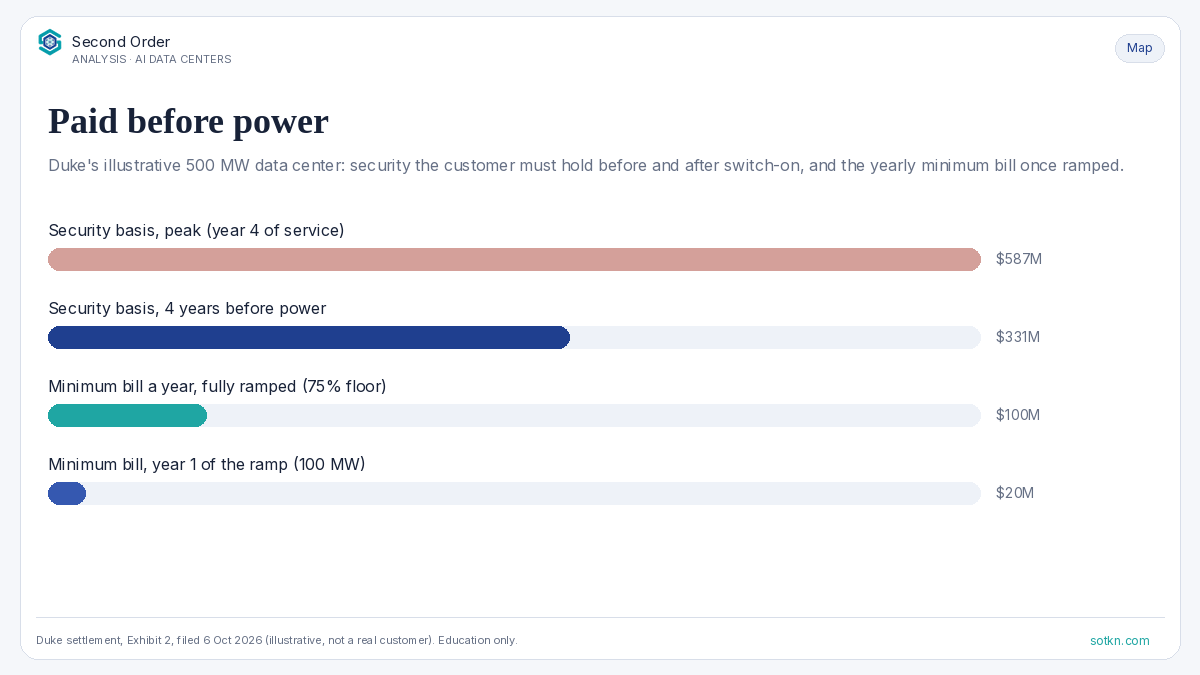
Chart 1 — Duke's 500 MW example: security held before power, the peak, and the yearly minimum bill. Based on Duke's settlement filing of 6 October 2026. Education only.
Why did power become a contract with a deposit?
An AI data center needs three things signed: power, money and a tenant. What is an AI data center? explains why power is usually the slowest. The AI Data Centers layer shows where landlords sit in the chain.
For a utility, a data center is a giant customer that might not show up. Substations and lines are built years ahead. If the customer walks away, everyone else's bill carries the cost. So the new rules put that risk on the data center.
Three rules now set the pattern:
- North Carolina (Duke Energy). The settlement filed on 6 October covers new loads of 50 MW at a high, steady load, or any load of 150 MW or more, signed from 1 June 2026. Before, Duke's threshold was 100 MW. The customer funds its own substation within 60 days, posts a letter of credit for shared lines, signs for 15 years or more, pays at least 75% of contract demand, and posts security equal to its exit bill: cash, a letter of credit, or a parent guarantee. Amazon, Google, Meta and Microsoft are among the parties. The state commission is expected to rule by mid-November
- Texas. Since 8 October, a load of 75 MW or more must post $50,000 per MW of security and a flat $100,000 study fee before ERCOT studies it. Walk away after capacity is set aside and 20% is kept. We covered it in our Texas Markets note
- Ohio (AEP Ohio). Since July 2025, data centers over 25 MW pay a minimum of up to 85% of contract capacity
The same week Duke filed, TeraWulf doubled the power it has signed with Kentucky Power to 1 GW. Its filing says it will raise new secured debt to back letters of credit to its utilities, with "no assurance" the money will be found (see our TeraWulf Wire).
So in one week the biggest buyers signed a 75% floor, Texas started taking deposits, and a mid-size builder said it must borrow for security. Today's Duke Wire has the filing. This piece asks the money question: when power is billed before it flows, who gets paid, and who waits?
What does the map already assume?
Three answers compete:
- The rules tighten and spread. Others copy Duke at 75–85%. Security becomes the gate
- The rules land as filed, and spread unevenly. Security is a real cost, not a wall
- The rules soften. Exits get cheap and waivers common. Utilities carry the risk again
A tip sheet would pick a utility. Analysis asks which answer today's filings already need.
Our read, in one line: the map already assumes Scenario B. Duke's terms pass close to as filed, so the utility is paid first and for 15 years, and banks writing letters of credit second. The floor is about 12% of what a landlord earns on a live megawatt, so it is affordable. The real cost is the security: about $1.2 million a megawatt in Duke's example, which a cloud giant covers with a guarantee and a smaller builder covers with borrowed money. The stuck step is the commission's order, then the switch-on date. The scenarios and the arithmetic are below.
The free preview ends here.
—— Still to read · ~9 of 14 minutes ——
MEMBERS CONTINUE HERE
- Who gets paid, in order, and who waits
- Three scenarios with the arithmetic
- What the security really costs per megawatt
- Six practical takeaways
- Members' FAQ