Mid-2027 Isn't Wafers: Who Gets Paid When Micron Files the US 10-K
Micron’s 9 October 10-K shows $133.2 billion of fiscal 2026 sales and $12.75 billion of customer deposits already in the door. Who gets paid is Micron, on bits that already shipped. The stuck step is Idaho DRAM wafer output, still dated mid-calendar 2027.
Micron’s 9 October 10-K shows $133.2 billion of fiscal 2026 sales and $12.75 billion of customer deposits already in the door. Who gets paid is Micron, on bits that already shipped. The stuck step is Idaho DRAM wafer output, still dated mid-calendar 2027.
US PULSE · Data as at 12 Oct 2026 · Next update: after Idaho wafer-output confirmation or FQ1 FY27 results
Affects: Semiconductors · Hyperscalers · Neoclouds — Markets: US Markets hub · Taiwan · Korea · China
Education only, not advice to buy or sell any security. Filed figures are labelled. Percentages labelled our arithmetic are Second Order’s sums from the 10-K.
The numbers that matter this month
Fiscal 2026 revenue
$133.188bn
+256% vs FY25 $37.378bn · year ended 3 Sep 2026
PrimaryGross margin / operating income
81% / $99.3bn
Operating income 75% of sales · net income $84.969bn
PrimaryCustomer deposits received
$12.75bn
Cash in during FY26 · nearly all to be repaid 2029–2031
Paid nowRemaining performance obligations
~$134bn
About one-fourth next 12 months · $33.5bn, our arithmetic
Our mathCHIPS Act grants (up to)
$6.4bn
$6.1bn Idaho/NY + $275m Manassas · a grant is not a wafer
PrimaryIdaho first DRAM wafers
Mid-2027
265 days from 9 Oct 2026 to 1 Jul 2027, our arithmetic · NY 2030
Stuck stepSources: Micron Form 10-K, filed 9 Oct 2026 (sec.gov); Q4/FY26 8-K, 30 Sep 2026 (sec.gov). Status chips are Second Order’s read.
On this page: Why the US? · What changed · Our math · Where money sticks · Is Idaho still stuck? · Dates next · How this differs · What would change this · FAQ
Why does the US matter now?
Because the United States is where the large AI buyers sit, and Micron is the US-listed memory maker that those buyers have been paying to lock supply. Korea still makes most of the world’s HBM, explained. Taiwan still finishes most leading-edge logic. This door is the American cheque: deposits already in, bits already shipped, and a leading-edge DRAM fab in Idaho that has not printed a wafer yet.
The 10-K is the dated print. Earnings landed on 30 Sep. What the annual report adds is the audited remaining-performance-obligation book, the deposit totals, the Idaho/New York clocks, and an 8 Oct board vote that raises the buyback authorisation to $35.16 billion from 9 Dec, inside CHIPS limits. That is a US filing about US plants. It is not evidence that Idaho is live.
1 · Micron, already
Who: Micron on shipped DRAM and NAND
Paid: $133.188bn of FY26 sales; holds $12.75bn of deposits
2 · Toolmakers and builders
Who: Equipment and construction vendors on Idaho and New York
Paid: As capex leaves. Q1 FY27 net capex guided at about $11.5bn
3 · Idaho DRAM wafers
Who: New US leading-edge output
Paid: Not until first wafers, projected mid-calendar 2027. New York: 2030
If you only remember one thing: Micron already got paid on fiscal 2026 bits. The new US clean room is still a 2027 date. A deposit is a place in line, not a wafer off Boise.
What changed
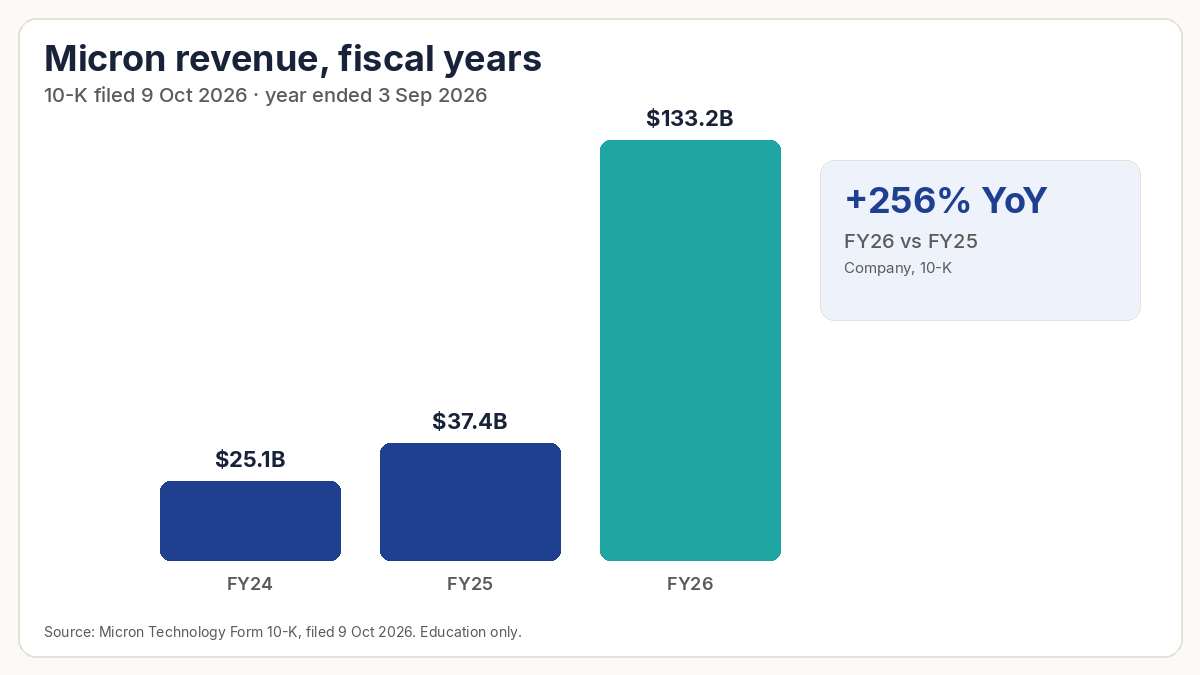
The primary print is dated 9 October 2026: Micron’s Form 10-K for the 53-week year ended 3 September 2026. The 30 September 8-K and Exhibit 99.1 are the earnings flash this filing audits. We lead on the 10-K because that is the last few days’ company filing.
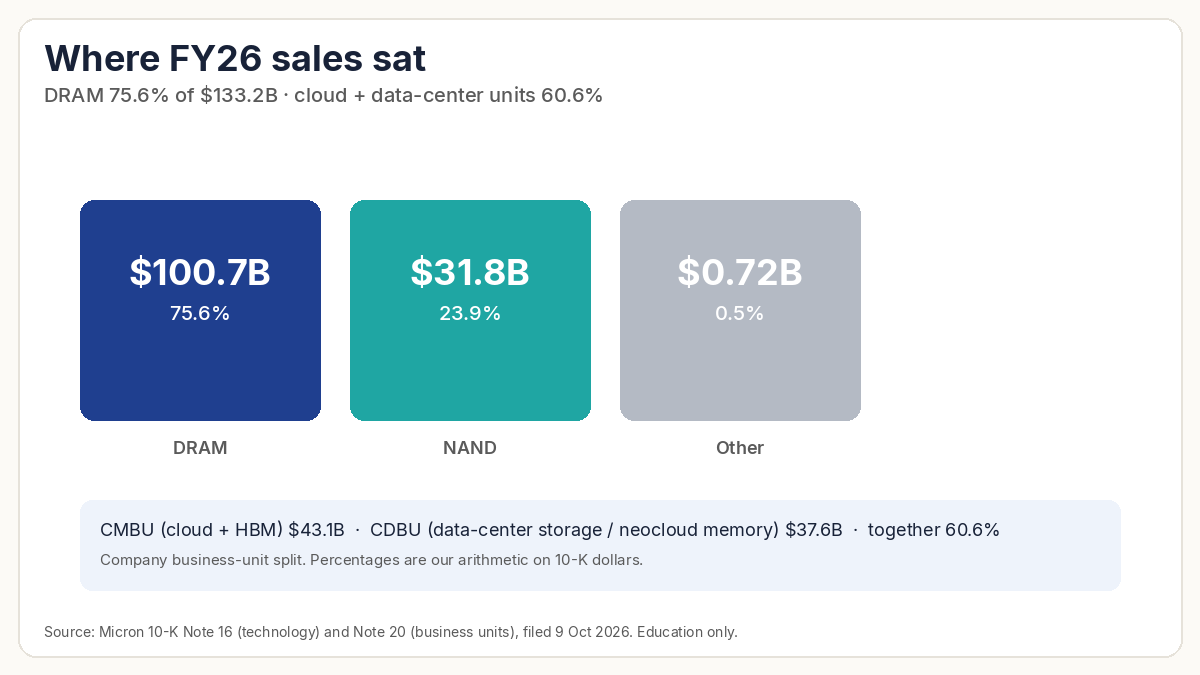
What the year actually did. Revenue was $133.188 billion, against $37.378 billion in fiscal 2025. Gross margin was 81%, against 40%. Operating income was $99.340 billion. Net income was $84.969 billion. DRAM sales were $100.679 billion; NAND $31.785 billion. DRAM average selling prices rose about 180% and bits in the mid-20% range; NAND prices about 200% with bits also in the mid-20% range. The company says AI-driven demand is outpacing its ability, and the industry’s, to add supply.
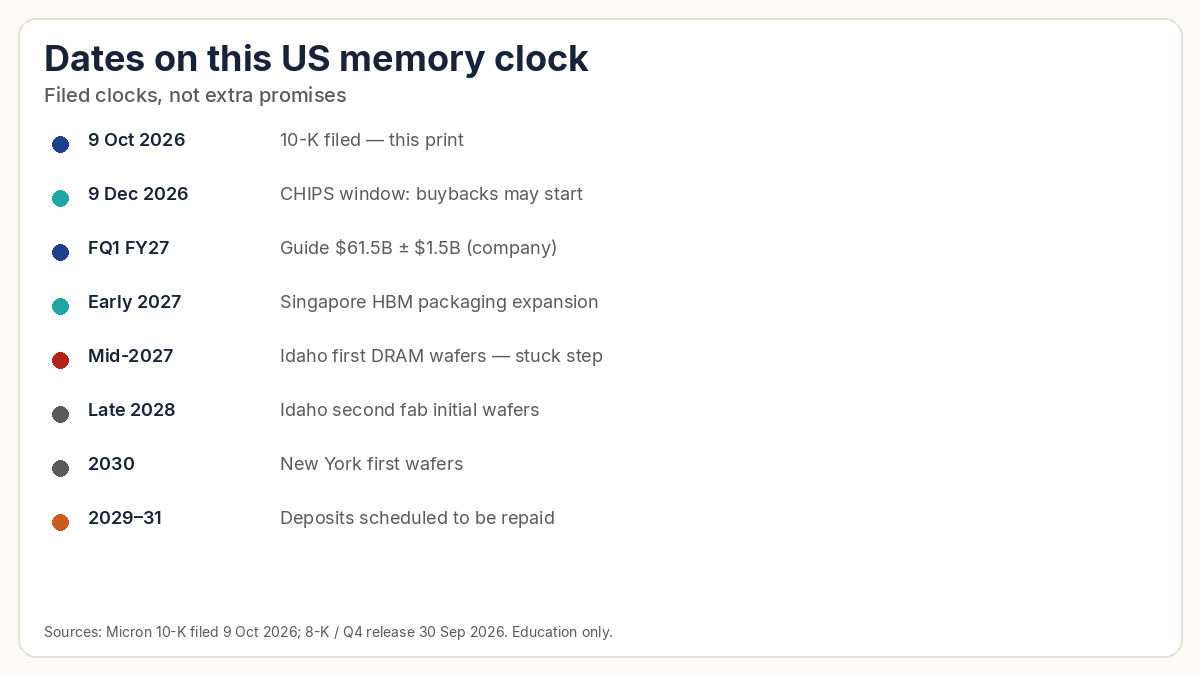
What the strategic agreements add. In the third and fourth quarters of 2026 Micron entered take-or-pay agreements with binding volumes over multi-year terms. Pricing is fixed or banded. The 10-K says even floor pricing on the banded deals is expected to yield gross margins meaningfully above any past-cycle peak quarter. In connection with those agreements it received $12.75 billion of cash deposits in 2026. Nearly all of those deposits are scheduled to be repaid between 2029 and 2031. If a customer meets the minimum purchases, the cash goes back. If not, Micron may keep some or all of it and recognise it as revenue. Customers also maintain $7 billion of letters of credit that Micron can draw only on default or breach.
What the US build clock still says. Boise’s first DRAM wafers are projected in mid-calendar 2027. A second Idaho fab began construction in 2026, with initial wafers by late calendar 2028. Clay, New York, poured concrete in July 2026; first wafers calendar 2030. CHIPS Act funding is up to $6.4 billion. Micron also “announced plans to bring advanced HBM packaging capabilities to the United States,” with no date here. Singapore’s HBM packaging expansion is dated early calendar 2027 — before Idaho wafers.
Do not turn $133 billion into next year’s Idaho output. Those bits came from rooms that already run.
Our math — labelled our arithmetic
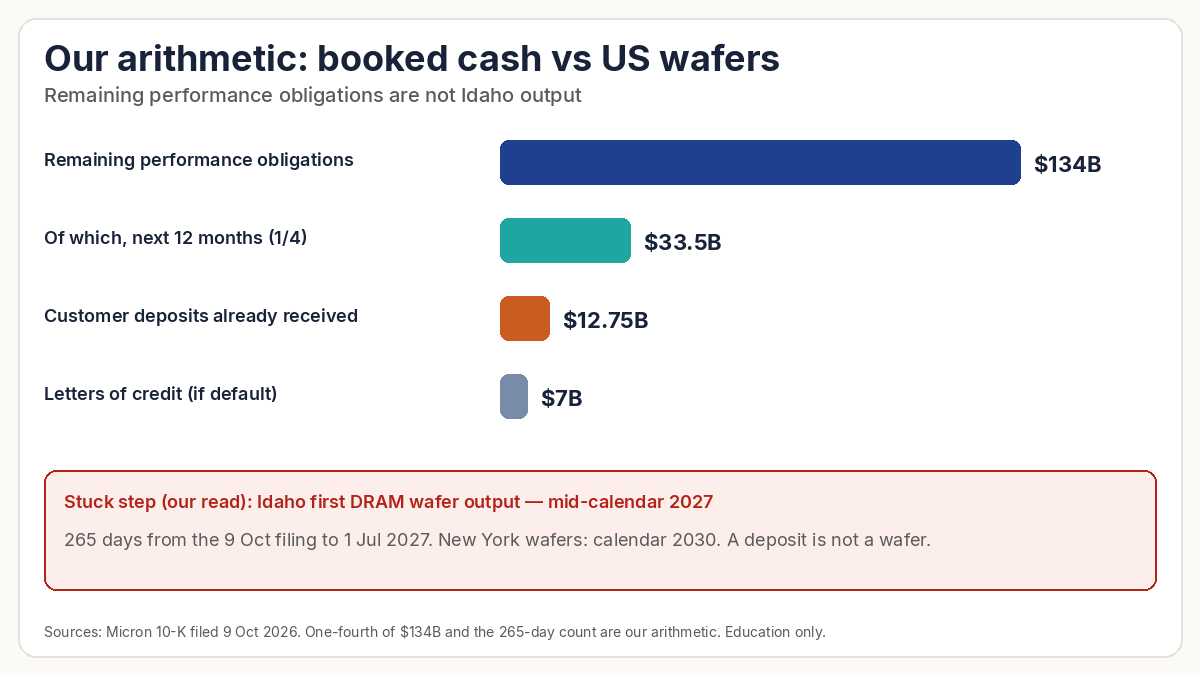
Our arithmetic — print vs stuck step
Inputs: Micron 10-K Note 16 (technology mix, remaining performance obligations, deposits, letters of credit), Note 20 (business units), Item 7 (results and Idaho/NY clocks), Item 5 (8 Oct buyback). The percentages, the $33.5 billion, the $19.75 billion, the 1.45× and the 265-day count are Second Order’s arithmetic.
What this tells you. Three-quarters of the year’s sales were DRAM. Cloud and data-center units together were about 61%. The remaining-performance-obligation book is about $134 billion, but the company says it is not expected to be indicative of future revenue, and it excludes contracts of a year or less and deals without a price floor. On our arithmetic only about $33.5 billion of that book sits in the next twelve months. Fourth-quarter sales were already $54.229 billion, 45% more than the whole of fiscal 2025. Most near-term cash is still the short book plus the run-rate. The $12.75 billion of deposits is 9.5% of the $134 billion book, due back in 2029–31 if customers take the bits.
What it does not tell you. How many Idaho wafers a month will ship in 2027, the settled HBM ASP, or whether the $61.5 billion plus or minus $1.5 billion first-quarter guide will hold. We do not annualise that guide.
One more sum, because the 8 Oct board vote sits in this filing. The leftover 2018 buyback authorisation was $2.16 billion. The basis for the increase is Q4 adjusted free cash flow of $33.199 billion, less $174 million of dividends, or $33.025 billion. $2.16 plus $33.025 is $35.185 billion, which rounds to the $35.16 billion headline (our arithmetic). Repurchases under the new total start from 9 Dec 2026, inside the CHIPS funding agreements. A larger authorisation is not a completed buyback, and it is not an Idaho wafer.
Where does the money stick?
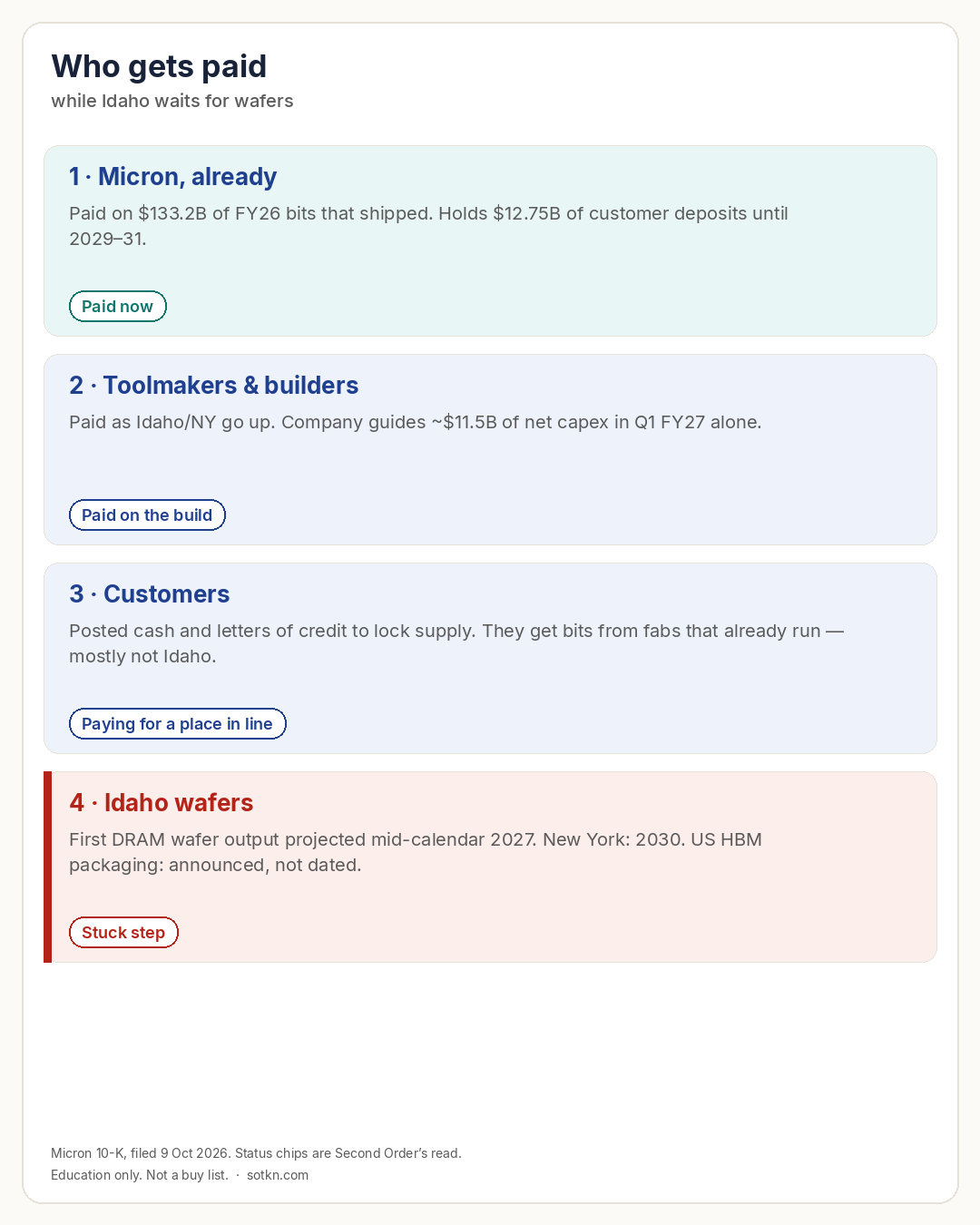
Follow the bit, then follow the cheque.
Micron is paid first on this print. Fiscal 2026 bits already left existing fabs — Taiwan, Singapore, Japan, and US rooms that already run, including Manassas on legacy DDR4. Gross margin of 81 cents on the dollar is the evidence that the scarce step kept the cash. The $12.75 billion of deposits is a second cheque: customers paid to hold supply, due back in 2029–31 if they meet the minima. Letters of credit add $7 billion that only moves on default. See cash capex, explained for why cash that arrives early still has a clock on it.
Toolmakers and builders are paid next, as Idaho and New York go up. Net capital expenditures were $27.37 billion in fiscal 2026. The company estimates about $11.5 billion of net capex in the first quarter of fiscal 2027 and about $25 billion in the first six months. That cash leaves whether or not a Boise wafer yields. CHIPS grants of up to $6.4 billion offset some of the US spend; a grant that is still “up to” is not a wafer.
Customers paid to wait. They posted deposits and letters of credit so they are not last in line for HBM and server DRAM. They do not get extra Idaho wafers this year. Korea’s door still sets most AI-class HBM supply — Korea / HBM allocation Pulse — and Taiwan still joins stacks to logic. The US cheque is for a place in that line, plus bits Micron can already make.
Idaho is paid last. First DRAM wafers are still a mid-calendar 2027 projection. Until those wafers exist, the US leading-edge room is a construction site with a CHIPS file. That is the same pattern as Korea Samsung Vietnam test-fab Pulse on the Korea door: a dated plan is not a tested chip. Here a dated 10-K is not a Boise wafer.
Is Idaho still stuck?
On our read, yes. Demand is not the limit on this door. Price is not the limit. The limit is new US wafer output.
Think about the three steps the filing itself lays out.
- Bits from rooms that already run. Done, at record dollars. FY26 sales, 81% gross margin, $73.45 billion of cash and marketable investments. This is not the stuck step.
- Deposits and take-or-pay books. Done as cash in. $12.75 billion received; remaining performance obligations about $134 billion; $13 billion of that sitting as contract liabilities. This locks supply. It does not print Idaho wafers.
- New US leading-edge wafers. Not done. Idaho first output mid-calendar 2027. Idaho 2 late 2028. New York 2030. US HBM packaging announced, not dated. Singapore HBM packaging is the nearer packaging clock, and it is not Idaho.
Two cautions. HBM4 36GB 12-high was already in volume in 2026; HBM4E is expected to ramp in calendar 2027 in rooms that already exist — that is not the Idaho greenfield clock. And built is not working: first wafer output is only the start. Watch first Idaho wafers, then yields — not the CHIPS headline. If Idaho qualifies on time, the stuck step moves to whether Idaho 2, Japan and New York land before the shortage eases. Neighbour clocks: Where does the stuck step move?. Power for US halls: Texas large-load Pulse.
What dates matter
Dates to watch
Micron 10-K filed 9 Oct 2026; 8-K and Exhibit 99.1 dated 30 Sep 2026. We do not invent a monthly Idaho output date Micron has not filed.
TSMC’s Q3 results on 15 Oct are a Taiwan cash clock. ERCOT’s Texas reports due 10 Dec are a US power clock. Neither is evidence that Idaho is live. GlobalFoundries–TSMC $2B interposer Wire is a New York packaging-adjacent clock (volume 1H 2028), not this DRAM fab.
How is this different from …
- Micron clean-room Analysis (5 Oct): what Micron’s price assumes about clean rooms. This Pulse is the country door on the 9 Oct 10-K. We do not do price calls.
- Texas large-load Pulse (8 Oct): who gets paid while Texas holds the switch. This is who gets paid while Idaho waits for wafers.
- Korea SK hynix grid Pulse (11 Oct): SK hynix building faster than Korea’s grid. Same pattern — a plant plan is not power, a 10-K is not a wafer — different country.
- Korea Samsung Vietnam test-fab Pulse (6 Oct): a Vietnam test line dated Q4 2027. This is a US DRAM fab dated mid-2027.
- Taiwan September-exports Pulse (11 Oct): Taiwan’s record September goods. Neighbour export clock, not Idaho.
- TSMC August-revenue Pulse: TSMC monthly sales and CoWoS. Packaging remains Taiwan’s finish line; this door is US memory capacity.
- China Alibaba 20 GW Pulse: Alibaba waiting on chips for a 20 GW plan. Different buyer, same idea that a plan is not live MW.
What would change this view?
The “Micron is paid now, Idaho wafers still wait until mid-2027” read weakens if:
- Micron or the state confirms Idaho first DRAM wafers ahead of mid-calendar 2027, with a lot a customer will accept
- The company dates US HBM packaging with meaningful output, not just an announcement
- Remaining performance obligations start converting much faster than one-fourth in twelve months, which would mean the long book is nearer cash
- Deposits start being repaid early, which would mean customers already took the bits the cash was securing
- Idaho slips past mid-2027 without a new dated filing — the clock would be worse, not better
- Buyers cut memory per server so hard that existing rooms cover demand and the Idaho clock stops binding
It stays intact while Idaho is still a 2027 date, New York is still 2030, and the $12.75 billion of deposits is still cash that waits on bits from rooms that are not yet Boise.
Practical takeaways
- Micron’s 9 Oct 10-K is the US print: $133.188 billion of FY26 sales, up 256%, 81% gross margin
- Who gets paid now: Micron, on shipped bits and as holder of $12.75 billion of deposits
- Who gets paid on the build: toolmakers; Q1 FY27 net capex guided at about $11.5 billion
- Stuck step: Idaho first DRAM wafers, mid-calendar 2027 — 265 days from this filing to 1 Jul 2027, our arithmetic
- Remaining POs ~$134 billion; about $33.5 billion in the next twelve months, our arithmetic; the company says that book is not a forecast
- CHIPS grants of up to $6.4 billion are not wafers. US HBM packaging is announced, not dated
- Watch FQ1 against the $61.5 billion guide, then Idaho wafers — not the CHIPS headline
FAQ
What did Micron file on 9 October 2026?
Its annual report on Form 10-K for the fiscal year ended 3 September 2026. The filing puts revenue at $133.188 billion, net income at $84.969 billion, and customer deposits received under strategic agreements at $12.75 billion.
Who gets paid?
Micron, already, on bits that shipped in fiscal 2026 and on the $12.75 billion of deposits it holds. Toolmakers and builders get paid as Idaho and New York go up. Customers posted cash and letters of credit to lock supply. This is a map of who gets paid — not a buy list.
What is the stuck step?
Idaho’s first DRAM wafer output, projected for mid-calendar 2027. New York’s first wafers are dated calendar 2030. A deposit is not a wafer, and a CHIPS grant is not output. US HBM packaging is announced, not dated.
How much of the $134 billion remaining performance obligations converts next year?
On our arithmetic, about one-fourth: $33.5 billion. The company says remaining performance obligations are not expected to be indicative of future revenue, and it excludes short contracts from that book.
Does this mean US memory fabs are running?
Existing Micron fabs in the United States include Manassas, Virginia, on legacy DDR4. The leading-edge Idaho DRAM fab is still construction, with first wafer output mid-calendar 2027. That is the new-capacity clock on this door.
Is this investment advice?
No. Education only. It maps who gets paid and which step is stuck. It is not a recommendation to buy or sell any security.
Keep reading on the map
- US Markets hub — country page
- Texas large-load Pulse — the power switch
- Micron clean-room Analysis — the clean-room clock (members)
- HBM, explained — why stacks bind
- Korea / HBM allocation Pulse — who gets paid while memory stays booked
- Where does the stuck step move? — where the stuck step moves
How we check this
Headline figures come from Micron Technology’s Form 10-K for the fiscal year ended 3 September 2026, filed 9 October 2026, and from the 30 September 2026 Form 8-K and Exhibit 99.1 earnings release. Idaho, New York, Singapore, CHIPS, deposit, letter-of-credit and remaining-performance-obligation figures are the company’s. Where we work something out ourselves — the 75.6/23.9 mix, the 60.6% cloud-plus-data-center share, the $33.5 billion one-fourth, the $19.75 billion of customer security, the 1.45× Q4-versus-FY25 check, the 265-day count, and the $2.16bn + $33.025bn buyback basis — the arithmetic is shown and labelled our arithmetic. A 10-K is not treated as Idaho output. Remaining performance obligations are labelled with the company’s own caution that they are not expected to be indicative of future revenue.
Last reviewed: 12 Oct 2026 · Next review: after FQ1 FY27 results or a dated Idaho wafer-output print
Spot an error? Tell us and we will correct it and note the change here.
Not investment advice. Do your own research.
Sources
- Micron Technology — Form 10-K for the year ended 3 Sep 2026 (filed 9 Oct 2026): sec.gov
- Micron Technology — Form 8-K, Q4 and FY26 results (30 Sep 2026): sec.gov
- Micron Technology — Exhibit 99.1 press release (30 Sep 2026): Exhibit 99.1